PARAGRAPH BASICS
Steps forWriters
Paragraph Basics
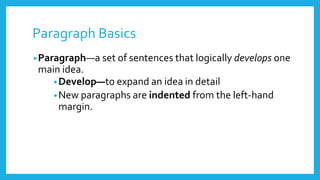
•Paragraph—a set of sentences that logically develops one
main idea.
•Develop—to expand an idea in detail
•New paragraphs are indented from the left-hand
margin.
Unity
•Readers expect a paragraph to be focused, based on a clear
and appropriate purpose.
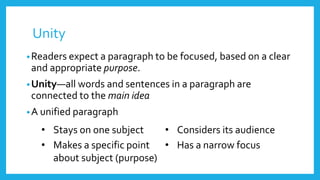
•Unity—all words and sentences in a paragraph are
connected to the main idea
•A unified paragraph
• Stays on one subject • Considers its audience
• Makes a specific point
about subject (purpose)
• Has a narrow focus
Topic Sentence
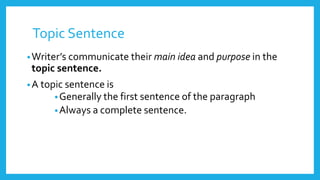
•Writer’s communicate their main idea and purpose in the
topic sentence.
•A topic sentence is
•Generally the first sentence of the paragraph
•Always a complete sentence.
Parts of aTopic Sentence
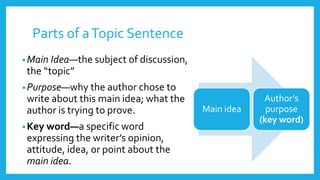
•Main Idea—the subject of discussion,
the “topic”
•Purpose—why the author chose to
write about this main idea; what the
author is trying to prove.
•Key word—a specific word
expressing the writer’s opinion,
attitude, idea, or point about the
main idea.
Main idea
Author’s
purpose
(key word)
Support
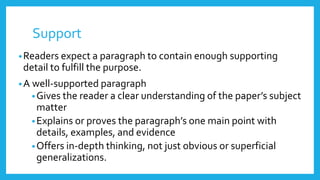
•Readers expect a paragraph to contain enough supporting
detail to fulfill the purpose.
•A well-supported paragraph
•Gives the reader a clear understanding of the paper’s subject
matter
•Explains or proves the paragraph’s one main point with
details, examples, and evidence
•Offers in-depth thinking, not just obvious or superficial
generalizations.
Practice
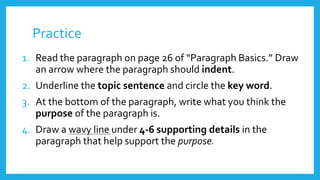
1. Read the paragraph on page 26 of “Paragraph Basics.” Draw
an arrow where the paragraph should indent.
2. Underline the topic sentence and circle the key word.
3. At the bottom of the paragraph, write what you think the
purpose of the paragraph is.
4. Draw a wavy line under 4-6 supporting details in the
paragraph that help support the purpose.
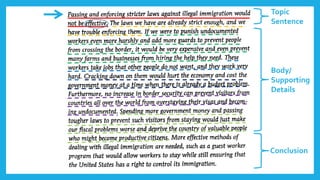
Conclusion
Topic
Sentence
Body/
Supporting
Details
Group Challenge
•Divide into groups of 3-4.
•Using the example paragraph as a template, write a strong
paragraph that answers the following question:
Is the registration process atTVCC easy or difficult? Why?
•Underline your topic sentence!
•Turn in one paper per group.

Paragraph Basics

  • 1.
  • 2.
    Paragraph Basics •Paragraph—a setof sentences that logically develops one main idea. •Develop—to expand an idea in detail •New paragraphs are indented from the left-hand margin.
  • 3.
    Unity •Readers expect aparagraph to be focused, based on a clear and appropriate purpose. •Unity—all words and sentences in a paragraph are connected to the main idea •A unified paragraph • Stays on one subject • Considers its audience • Makes a specific point about subject (purpose) • Has a narrow focus
  • 4.
    Topic Sentence •Writer’s communicatetheir main idea and purpose in the topic sentence. •A topic sentence is •Generally the first sentence of the paragraph •Always a complete sentence.
  • 5.
    Parts of aTopicSentence •Main Idea—the subject of discussion, the “topic” •Purpose—why the author chose to write about this main idea; what the author is trying to prove. •Key word—a specific word expressing the writer’s opinion, attitude, idea, or point about the main idea. Main idea Author’s purpose (key word)
  • 6.
    Support •Readers expect aparagraph to contain enough supporting detail to fulfill the purpose. •A well-supported paragraph •Gives the reader a clear understanding of the paper’s subject matter •Explains or proves the paragraph’s one main point with details, examples, and evidence •Offers in-depth thinking, not just obvious or superficial generalizations.
  • 7.
    Practice 1. Read theparagraph on page 26 of “Paragraph Basics.” Draw an arrow where the paragraph should indent. 2. Underline the topic sentence and circle the key word. 3. At the bottom of the paragraph, write what you think the purpose of the paragraph is. 4. Draw a wavy line under 4-6 supporting details in the paragraph that help support the purpose.
  • 8.
  • 9.
    Group Challenge •Divide intogroups of 3-4. •Using the example paragraph as a template, write a strong paragraph that answers the following question: Is the registration process atTVCC easy or difficult? Why? •Underline your topic sentence! •Turn in one paper per group.