Grammar for Writing
CLAUSES
Sam An Teng
July 2013
Copyright © All rights reserved.
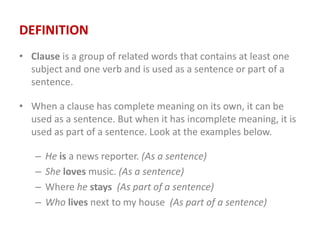
DEFINITION
• Clause is a group of related words that contains at least one
subject and one verb and is used as a sentence or part of a
sentence.
• When a clause has complete meaning on its own, it can be
used as a sentence. But when it has incomplete meaning, it is
used as part of a sentence. Look at the examples below.
– He is a news reporter. (As a sentence)
– She loves music. (As a sentence)
– Where he stays (As part of a sentence)
– Who lives next to my house (As part of a sentence)
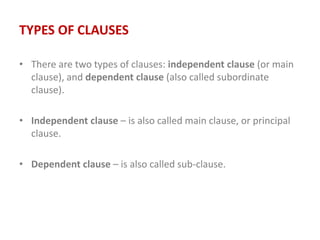
TYPES OF CLAUSES
• There are two types of clauses: independent clause (or main
clause), and dependent clause (also called subordinate
clause).
• Independent clause – is also called main clause, or principal
clause.
• Dependent clause – is also called sub-clause.
Independent Clauses
• An independent clause has a subject and a verb, and can
stand alone as a sentence. For examples,
– They work in marketing department.
– What products are they going to launch this year?
– The company didn't perform well last year.
– What shall we do?
Dependent Clauses
• A dependent clause has a subject and a predicate, but it
cannot stand alone as a sentence.
• There are three types of subordinate clauses:
o Noun clauses
o Adjective clauses
o Adverb clauses
Dependent Clauses: Noun clauses
• A noun clause is a subordinate clause used as a noun. For
examples,
– What you have proposed is acceptable. (Noun clause)
– Tell me what your marketing strategies are. (Noun clause)
Dependent Clauses: Adjective clauses
• An adjective clause is a subordinate clause that modifies a
noun or a pronoun. For examples,
– The man who is standing over there is a product
development manager. (Adjective clause)
– His team has come up with products that have more
features for customers. (Adjective clause)
Dependent Clauses: Adverb clauses
• An adverb clause is a subordinate clause that modifies a verb,
an adjective, or an adverb. It tells when, where, how, why, to
what extent, or under what conditions. For examples,
– If the products are fit for the customers, we will maintain
sales increase of 10%. (Adverb clause)
– There will be some promotion when the new product are
available. (Adverb clause)
Related Topics :
• What is Clause?
• Noun Clause
• Adjective Clause
• Adverb Clause
• Reduced Noun Clause
• Reduced Adjective Clause
• Reduced Adverb Clause
MY BOOKS ON KINDLE STORE
Grammar & Composition:
Parts of Speech in English
English Grammar: The Verb Tenses
Phrases and Clauses in English
Short stories:
He Deserves! Sympathy and Love
FREE LESSONS ONLINE
• If you wish to read free lessons, please click the links
below:
–http://grammarkit.blogspot.com
–http://thewindlike.blogspot.com

Clauses

  • 1.
    Grammar for Writing CLAUSES SamAn Teng July 2013 Copyright © All rights reserved.
  • 2.
    DEFINITION • Clause isa group of related words that contains at least one subject and one verb and is used as a sentence or part of a sentence. • When a clause has complete meaning on its own, it can be used as a sentence. But when it has incomplete meaning, it is used as part of a sentence. Look at the examples below. – He is a news reporter. (As a sentence) – She loves music. (As a sentence) – Where he stays (As part of a sentence) – Who lives next to my house (As part of a sentence)
  • 3.
    TYPES OF CLAUSES •There are two types of clauses: independent clause (or main clause), and dependent clause (also called subordinate clause). • Independent clause – is also called main clause, or principal clause. • Dependent clause – is also called sub-clause.
  • 4.
    Independent Clauses • Anindependent clause has a subject and a verb, and can stand alone as a sentence. For examples, – They work in marketing department. – What products are they going to launch this year? – The company didn't perform well last year. – What shall we do?
  • 5.
    Dependent Clauses • Adependent clause has a subject and a predicate, but it cannot stand alone as a sentence. • There are three types of subordinate clauses: o Noun clauses o Adjective clauses o Adverb clauses
  • 6.
    Dependent Clauses: Nounclauses • A noun clause is a subordinate clause used as a noun. For examples, – What you have proposed is acceptable. (Noun clause) – Tell me what your marketing strategies are. (Noun clause)
  • 7.
    Dependent Clauses: Adjectiveclauses • An adjective clause is a subordinate clause that modifies a noun or a pronoun. For examples, – The man who is standing over there is a product development manager. (Adjective clause) – His team has come up with products that have more features for customers. (Adjective clause)
  • 8.
    Dependent Clauses: Adverbclauses • An adverb clause is a subordinate clause that modifies a verb, an adjective, or an adverb. It tells when, where, how, why, to what extent, or under what conditions. For examples, – If the products are fit for the customers, we will maintain sales increase of 10%. (Adverb clause) – There will be some promotion when the new product are available. (Adverb clause)
  • 9.
    Related Topics : •What is Clause? • Noun Clause • Adjective Clause • Adverb Clause • Reduced Noun Clause • Reduced Adjective Clause • Reduced Adverb Clause
  • 10.
    MY BOOKS ONKINDLE STORE Grammar & Composition: Parts of Speech in English English Grammar: The Verb Tenses Phrases and Clauses in English Short stories: He Deserves! Sympathy and Love
  • 11.
    FREE LESSONS ONLINE •If you wish to read free lessons, please click the links below: –http://grammarkit.blogspot.com –http://thewindlike.blogspot.com