
Active Voice, Passive Voice
Lecture No. 11, 12
Zafar Ullah, lecturer in English zafarullah76@gmail.com
Foundation of Active Voice Passive voice
• Personal Pronoun table
• 12 tenses
• Direct object, indirect object
• Transitive verb, intransitive verb
• Forms of verbs
2
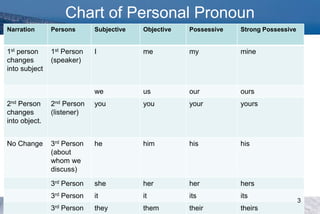
Chart of Personal Pronoun
Narration Persons Subjective Objective Possessive Strong Possessive
1st person
changes
into subject
1st Person
(speaker)
I me my mine
we us our ours
2nd Person
changes
into object.
2nd Person
(listener)
you you your yours
No Change 3rd Person
(about
whom we
discuss)
he him his his
3rd Person she her her hers
3rd Person it it its its
3rd Person they them their theirs
3
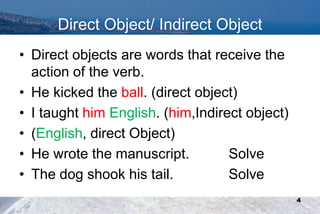
Direct Object/ Indirect Object
• Direct objects are words that receive the
action of the verb.
• He kicked the ball. (direct object)
• I taught him English. (him,Indirect object)
• (English, direct Object)
• He wrote the manuscript. Solve
• The dog shook his tail. Solve
4
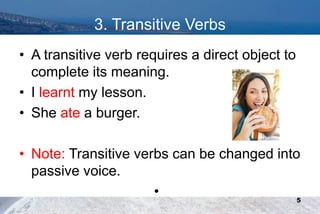
3. Transitive Verbs
• A transitive verb requires a direct object to
complete its meaning.
• I learnt my lesson.
• She ate a burger.
• Note: Transitive verbs can be changed into
passive voice.
• 5
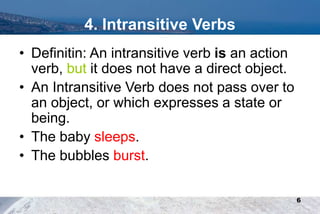
4. Intransitive Verbs
• Definitin: An intransitive verb is an action
verb, but it does not have a direct object.
• An Intransitive Verb does not pass over to
an object, or which expresses a state or
being.
• The baby sleeps.
• The bubbles burst.
6
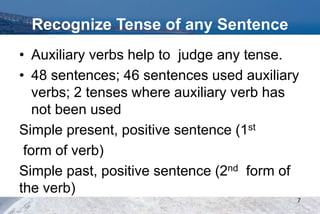
Recognize Tense of any Sentence
• Auxiliary verbs help to judge any tense.
• 48 sentences; 46 sentences used auxiliary
verbs; 2 tenses where auxiliary verb has
not been used
Simple present, positive sentence (1st
form of verb)
Simple past, positive sentence (2nd form of
the verb)
7
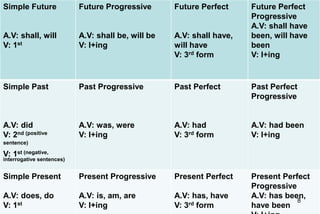
Forms of Tenses
Simple Future
A.V: shall, will
V: 1st
Future Progressive
A.V: shall be, will be
V: I+ing
Future Perfect
A.V: shall have,
will have
V: 3rd form
Future Perfect
Progressive
A.V: shall have
been, will have
been
V: I+ing
Simple Past
A.V: did
V: 2nd (positive
sentence)
V: 1st (negative,
interrogative sentences)
Past Progressive
A.V: was, were
V: I+ing
Past Perfect
A.V: had
V: 3rd form
Past Perfect
Progressive
A.V: had been
V: I+ing
Simple Present
A.V: does, do
V: 1st
Present Progressive
A.V: is, am, are
V: I+ing
Present Perfect
A.V: has, have
V: 3rd form
Present Perfect
Progressive
A.V: has been,
have been
8
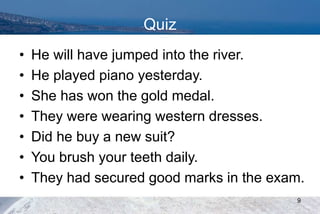
Quiz
• He will have jumped into the river.
• He played piano yesterday.
• She has won the gold medal.
• They were wearing western dresses.
• Did he buy a new suit?
• You brush your teeth daily.
• They had secured good marks in the exam.
9
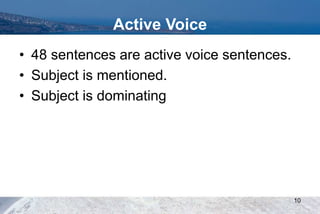
Active Voice
• 48 sentences are active voice sentences.
• Subject is mentioned.
• Subject is dominating
10
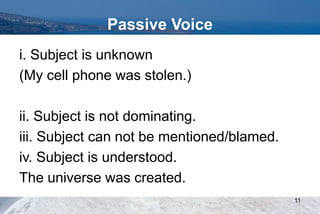
Passive Voice
i. Subject is unknown
(My cell phone was stolen.)
ii. Subject is not dominating.
iii. Subject can not be mentioned/blamed.
iv. Subject is understood.
The universe was created.
11
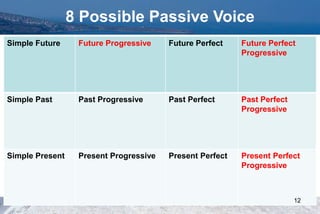
8 Possible Passive Voice
Simple Future Future Progressive Future Perfect Future Perfect
Progressive
Simple Past Past Progressive Past Perfect Past Perfect
Progressive
Simple Present Present Progressive Present Perfect Present Perfect
Progressive
12
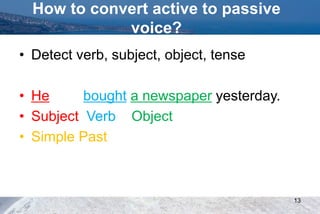
How to convert active to passive
voice?
• Detect verb, subject, object, tense
• He bought a newspaper yesterday.
• Subject Verb Object
• Simple Past
13
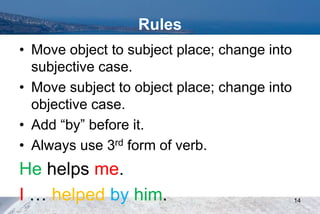
Rules
• Move object to subject place; change into
subjective case.
• Move subject to object place; change into
objective case.
• Add “by” before it.
• Always use 3rd form of verb.
He helps me.
I … helped by him. 14
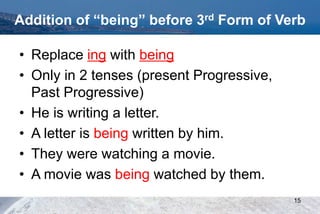
Addition of “being” before 3rd Form of Verb
• Replace ing with being
• Only in 2 tenses (present Progressive,
Past Progressive)
• He is writing a letter.
• A letter is being written by him.
• They were watching a movie.
• A movie was being watched by them.
15
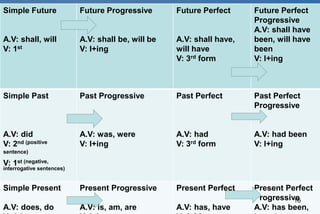
Forms of Tenses
Simple Future
A.V: shall, will
V: 1st
Future Progressive
A.V: shall be, will be
V: I+ing
Future Perfect
A.V: shall have,
will have
V: 3rd form
Future Perfect
Progressive
A.V: shall have
been, will have
been
V: I+ing
Simple Past
A.V: did
V: 2nd (positive
sentence)
V: 1st (negative,
interrogative sentences)
Past Progressive
A.V: was, were
V: I+ing
Past Perfect
A.V: had
V: 3rd form
Past Perfect
Progressive
A.V: had been
V: I+ing
Simple Present
A.V: does, do
Present Progressive
A.V: is, am, are
Present Perfect
A.V: has, have
Present Perfect
Progressive
A.V: has been,
16
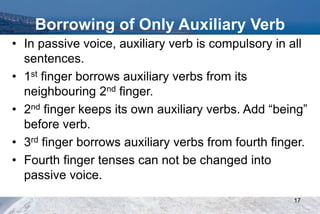
Borrowing of Only Auxiliary Verb
• In passive voice, auxiliary verb is compulsory in all
sentences.
• 1st finger borrows auxiliary verbs from its
neighbouring 2nd finger.
• 2nd finger keeps its own auxiliary verbs. Add “being”
before verb.
• 3rd finger borrows auxiliary verbs from fourth finger.
• Fourth finger tenses can not be changed into
passive voice.
17
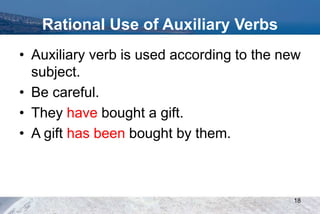
Rational Use of Auxiliary Verbs
• Auxiliary verb is used according to the new
subject.
• Be careful.
• They have bought a gift.
• A gift has been bought by them.
18
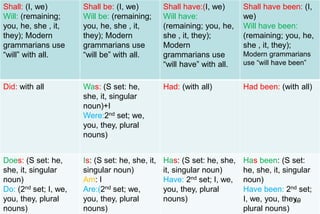
Shall: (I, we)
Will: (remaining;
you, he, she , it,
they); Modern
grammarians use
“will” with all.
Shall be: (I, we)
Will be: (remaining;
you, he, she , it,
they); Modern
grammarians use
“will be” with all.
Shall have:(I, we)
Will have:
(remaining; you, he,
she , it, they);
Modern
grammarians use
“will have” with all.
Shall have been: (I,
we)
Will have been:
(remaining; you, he,
she , it, they);
Modern grammarians
use “will have been”
Did: with all Was: (S set: he,
she, it, singular
noun)+I
Were:2nd set; we,
you, they, plural
nouns)
Had: (with all) Had been: (with all)
Does: (S set: he,
she, it, singular
noun)
Do: (2nd set; I, we,
you, they, plural
nouns)
Is: (S set: he, she, it,
singular noun)
Am: I
Are:(2nd set; we,
you, they, plural
nouns)
Has: (S set: he, she,
it, singular noun)
Have: 2nd set; I, we,
you, they, plural
nouns)
Has been: (S set:
he, she, it, singular
noun)
Have been: 2nd set;
I, we, you, they,
plural nouns)
19
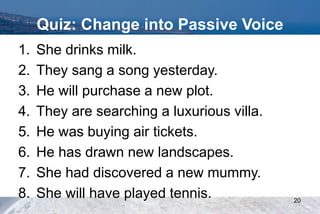
Quiz: Change into Passive Voice
1. She drinks milk.
2. They sang a song yesterday.
3. He will purchase a new plot.
4. They are searching a luxurious villa.
5. He was buying air tickets.
6. He has drawn new landscapes.
7. She had discovered a new mummy.
8. She will have played tennis. 20
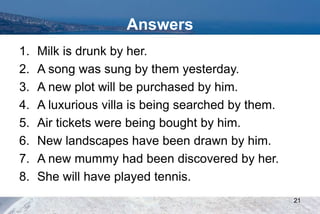
Answers
1. Milk is drunk by her.
2. A song was sung by them yesterday.
3. A new plot will be purchased by him.
4. A luxurious villa is being searched by them.
5. Air tickets were being bought by him.
6. New landscapes have been drawn by him.
7. A new mummy had been discovered by her.
8. She will have played tennis.
21
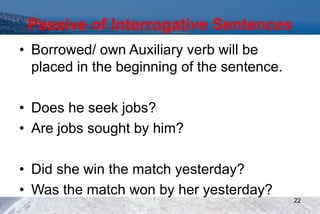
Passive of Interrogative Sentences
• Borrowed/ own Auxiliary verb will be
placed in the beginning of the sentence.
• Does he seek jobs?
• Are jobs sought by him?
• Did she win the match yesterday?
• Was the match won by her yesterday?
22
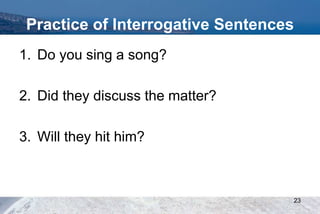
Practice of Interrogative Sentences
1. Do you sing a song?
2. Did they discuss the matter?
3. Will they hit him?
23
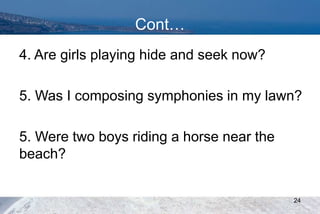
Cont…
4. Are girls playing hide and seek now?
5. Was I composing symphonies in my lawn?
5. Were two boys riding a horse near the
beach?
24
Cont…
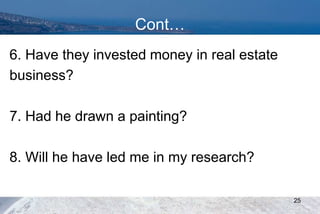
6. Have they invested money in real estate
business?
7. Had he drawn a painting?
8. Will he have led me in my research?
25
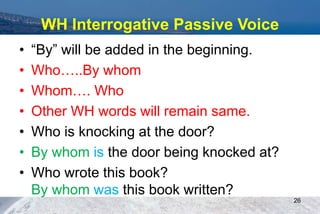
WH Interrogative Passive Voice
• “By” will be added in the beginning.
• Who…..By whom
• Whom…. Who
• Other WH words will remain same.
• Who is knocking at the door?
• By whom is the door being knocked at?
• Who wrote this book?
By whom was this book written?
26
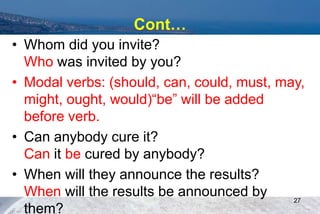
Cont…
• Whom did you invite?
Who was invited by you?
• Modal verbs: (should, can, could, must, may,
might, ought, would)“be” will be added
before verb.
• Can anybody cure it?
Can it be cured by anybody?
• When will they announce the results?
When will the results be announced by
them?
27
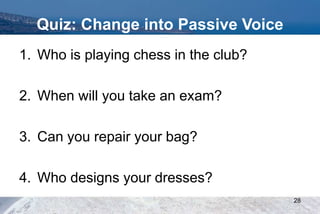
Quiz: Change into Passive Voice
1. Who is playing chess in the club?
2. When will you take an exam?
3. Can you repair your bag?
4. Who designs your dresses?
28
Imperative Sentences/ Moods
• Usually they start from verb.
• Open the door.
• Please guide me.
• Kindly assist us.
• Do not smoke a cigarette.
• Never waste your time.
29
Use of “let be” in Imperative Passives
• “Let” is used in the beginning.
• Use “be” before verb.
• Open the door.
• Verb object
• Let the door be opened.
• You are ordered to open the door.
30
Cont…
• Please guide me.
• Let I be guided.
• You are requested to guide me.
• Kindly assist us.
• Let we be assisted.
• You are requested to assist us.
31
Cont…
• Do not smoke a cigarette.
• Let not a cigarette be smoked.
• You are forbidden to smoke a cigarette.
• Never waste your time.
• Let not your time be wasted.
• You are forbidden to waste your time.
32
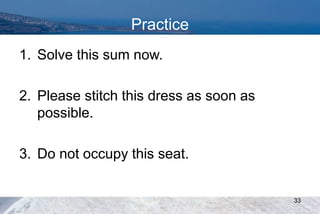
Practice
1. Solve this sum now.
2. Please stitch this dress as soon as
possible.
3. Do not occupy this seat.
33
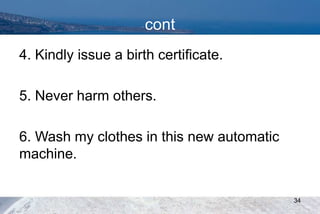
cont
4. Kindly issue a birth certificate.
5. Never harm others.
6. Wash my clothes in this new automatic
machine.
34
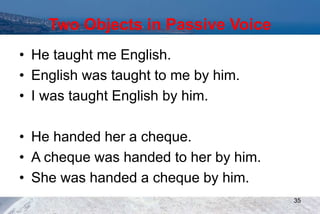
Two Objects in Passive Voice
• He taught me English.
• English was taught to me by him.
• I was taught English by him.
• He handed her a cheque.
• A cheque was handed to her by him.
• She was handed a cheque by him.
35
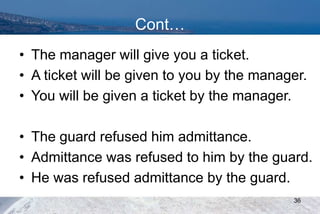
Cont…
• The manager will give you a ticket.
• A ticket will be given to you by the manager.
• You will be given a ticket by the manager.
• The guard refused him admittance.
• Admittance was refused to him by the guard.
• He was refused admittance by the guard.
36
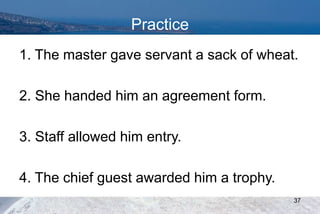
Practice
1. The master gave servant a sack of wheat.
2. She handed him an agreement form.
3. Staff allowed him entry.
4. The chief guest awarded him a trophy.
37
Thanks
38
Question Answers
39

11, 12. active voice, passive voice

  • 1.
    Active Voice, PassiveVoice Lecture No. 11, 12 Zafar Ullah, lecturer in English zafarullah76@gmail.com
  • 2.
    Foundation of ActiveVoice Passive voice • Personal Pronoun table • 12 tenses • Direct object, indirect object • Transitive verb, intransitive verb • Forms of verbs 2
  • 3.
    Chart of PersonalPronoun Narration Persons Subjective Objective Possessive Strong Possessive 1st person changes into subject 1st Person (speaker) I me my mine we us our ours 2nd Person changes into object. 2nd Person (listener) you you your yours No Change 3rd Person (about whom we discuss) he him his his 3rd Person she her her hers 3rd Person it it its its 3rd Person they them their theirs 3
  • 4.
    Direct Object/ IndirectObject • Direct objects are words that receive the action of the verb. • He kicked the ball. (direct object) • I taught him English. (him,Indirect object) • (English, direct Object) • He wrote the manuscript. Solve • The dog shook his tail. Solve 4
  • 5.
    3. Transitive Verbs •A transitive verb requires a direct object to complete its meaning. • I learnt my lesson. • She ate a burger. • Note: Transitive verbs can be changed into passive voice. • 5
  • 6.
    4. Intransitive Verbs •Definitin: An intransitive verb is an action verb, but it does not have a direct object. • An Intransitive Verb does not pass over to an object, or which expresses a state or being. • The baby sleeps. • The bubbles burst. 6
  • 7.
    Recognize Tense ofany Sentence • Auxiliary verbs help to judge any tense. • 48 sentences; 46 sentences used auxiliary verbs; 2 tenses where auxiliary verb has not been used Simple present, positive sentence (1st form of verb) Simple past, positive sentence (2nd form of the verb) 7
  • 8.
    Forms of Tenses SimpleFuture A.V: shall, will V: 1st Future Progressive A.V: shall be, will be V: I+ing Future Perfect A.V: shall have, will have V: 3rd form Future Perfect Progressive A.V: shall have been, will have been V: I+ing Simple Past A.V: did V: 2nd (positive sentence) V: 1st (negative, interrogative sentences) Past Progressive A.V: was, were V: I+ing Past Perfect A.V: had V: 3rd form Past Perfect Progressive A.V: had been V: I+ing Simple Present A.V: does, do V: 1st Present Progressive A.V: is, am, are V: I+ing Present Perfect A.V: has, have V: 3rd form Present Perfect Progressive A.V: has been, have been 8
  • 9.
    Quiz • He willhave jumped into the river. • He played piano yesterday. • She has won the gold medal. • They were wearing western dresses. • Did he buy a new suit? • You brush your teeth daily. • They had secured good marks in the exam. 9
  • 10.
    Active Voice • 48sentences are active voice sentences. • Subject is mentioned. • Subject is dominating 10
  • 11.
    Passive Voice i. Subjectis unknown (My cell phone was stolen.) ii. Subject is not dominating. iii. Subject can not be mentioned/blamed. iv. Subject is understood. The universe was created. 11
  • 12.
    8 Possible PassiveVoice Simple Future Future Progressive Future Perfect Future Perfect Progressive Simple Past Past Progressive Past Perfect Past Perfect Progressive Simple Present Present Progressive Present Perfect Present Perfect Progressive 12
  • 13.
    How to convertactive to passive voice? • Detect verb, subject, object, tense • He bought a newspaper yesterday. • Subject Verb Object • Simple Past 13
  • 14.
    Rules • Move objectto subject place; change into subjective case. • Move subject to object place; change into objective case. • Add “by” before it. • Always use 3rd form of verb. He helps me. I … helped by him. 14
  • 15.
    Addition of “being”before 3rd Form of Verb • Replace ing with being • Only in 2 tenses (present Progressive, Past Progressive) • He is writing a letter. • A letter is being written by him. • They were watching a movie. • A movie was being watched by them. 15
  • 16.
    Forms of Tenses SimpleFuture A.V: shall, will V: 1st Future Progressive A.V: shall be, will be V: I+ing Future Perfect A.V: shall have, will have V: 3rd form Future Perfect Progressive A.V: shall have been, will have been V: I+ing Simple Past A.V: did V: 2nd (positive sentence) V: 1st (negative, interrogative sentences) Past Progressive A.V: was, were V: I+ing Past Perfect A.V: had V: 3rd form Past Perfect Progressive A.V: had been V: I+ing Simple Present A.V: does, do Present Progressive A.V: is, am, are Present Perfect A.V: has, have Present Perfect Progressive A.V: has been, 16
  • 17.
    Borrowing of OnlyAuxiliary Verb • In passive voice, auxiliary verb is compulsory in all sentences. • 1st finger borrows auxiliary verbs from its neighbouring 2nd finger. • 2nd finger keeps its own auxiliary verbs. Add “being” before verb. • 3rd finger borrows auxiliary verbs from fourth finger. • Fourth finger tenses can not be changed into passive voice. 17
  • 18.
    Rational Use ofAuxiliary Verbs • Auxiliary verb is used according to the new subject. • Be careful. • They have bought a gift. • A gift has been bought by them. 18
  • 19.
    Shall: (I, we) Will:(remaining; you, he, she , it, they); Modern grammarians use “will” with all. Shall be: (I, we) Will be: (remaining; you, he, she , it, they); Modern grammarians use “will be” with all. Shall have:(I, we) Will have: (remaining; you, he, she , it, they); Modern grammarians use “will have” with all. Shall have been: (I, we) Will have been: (remaining; you, he, she , it, they); Modern grammarians use “will have been” Did: with all Was: (S set: he, she, it, singular noun)+I Were:2nd set; we, you, they, plural nouns) Had: (with all) Had been: (with all) Does: (S set: he, she, it, singular noun) Do: (2nd set; I, we, you, they, plural nouns) Is: (S set: he, she, it, singular noun) Am: I Are:(2nd set; we, you, they, plural nouns) Has: (S set: he, she, it, singular noun) Have: 2nd set; I, we, you, they, plural nouns) Has been: (S set: he, she, it, singular noun) Have been: 2nd set; I, we, you, they, plural nouns) 19
  • 20.
    Quiz: Change intoPassive Voice 1. She drinks milk. 2. They sang a song yesterday. 3. He will purchase a new plot. 4. They are searching a luxurious villa. 5. He was buying air tickets. 6. He has drawn new landscapes. 7. She had discovered a new mummy. 8. She will have played tennis. 20
  • 21.
    Answers 1. Milk isdrunk by her. 2. A song was sung by them yesterday. 3. A new plot will be purchased by him. 4. A luxurious villa is being searched by them. 5. Air tickets were being bought by him. 6. New landscapes have been drawn by him. 7. A new mummy had been discovered by her. 8. She will have played tennis. 21
  • 22.
    Passive of InterrogativeSentences • Borrowed/ own Auxiliary verb will be placed in the beginning of the sentence. • Does he seek jobs? • Are jobs sought by him? • Did she win the match yesterday? • Was the match won by her yesterday? 22
  • 23.
    Practice of InterrogativeSentences 1. Do you sing a song? 2. Did they discuss the matter? 3. Will they hit him? 23
  • 24.
    Cont… 4. Are girlsplaying hide and seek now? 5. Was I composing symphonies in my lawn? 5. Were two boys riding a horse near the beach? 24
  • 25.
    Cont… 6. Have theyinvested money in real estate business? 7. Had he drawn a painting? 8. Will he have led me in my research? 25
  • 26.
    WH Interrogative PassiveVoice • “By” will be added in the beginning. • Who…..By whom • Whom…. Who • Other WH words will remain same. • Who is knocking at the door? • By whom is the door being knocked at? • Who wrote this book? By whom was this book written? 26
  • 27.
    Cont… • Whom didyou invite? Who was invited by you? • Modal verbs: (should, can, could, must, may, might, ought, would)“be” will be added before verb. • Can anybody cure it? Can it be cured by anybody? • When will they announce the results? When will the results be announced by them? 27
  • 28.
    Quiz: Change intoPassive Voice 1. Who is playing chess in the club? 2. When will you take an exam? 3. Can you repair your bag? 4. Who designs your dresses? 28
  • 29.
    Imperative Sentences/ Moods •Usually they start from verb. • Open the door. • Please guide me. • Kindly assist us. • Do not smoke a cigarette. • Never waste your time. 29
  • 30.
    Use of “letbe” in Imperative Passives • “Let” is used in the beginning. • Use “be” before verb. • Open the door. • Verb object • Let the door be opened. • You are ordered to open the door. 30
  • 31.
    Cont… • Please guideme. • Let I be guided. • You are requested to guide me. • Kindly assist us. • Let we be assisted. • You are requested to assist us. 31
  • 32.
    Cont… • Do notsmoke a cigarette. • Let not a cigarette be smoked. • You are forbidden to smoke a cigarette. • Never waste your time. • Let not your time be wasted. • You are forbidden to waste your time. 32
  • 33.
    Practice 1. Solve thissum now. 2. Please stitch this dress as soon as possible. 3. Do not occupy this seat. 33
  • 34.
    cont 4. Kindly issuea birth certificate. 5. Never harm others. 6. Wash my clothes in this new automatic machine. 34
  • 35.
    Two Objects inPassive Voice • He taught me English. • English was taught to me by him. • I was taught English by him. • He handed her a cheque. • A cheque was handed to her by him. • She was handed a cheque by him. 35
  • 36.
    Cont… • The managerwill give you a ticket. • A ticket will be given to you by the manager. • You will be given a ticket by the manager. • The guard refused him admittance. • Admittance was refused to him by the guard. • He was refused admittance by the guard. 36
  • 37.
    Practice 1. The mastergave servant a sack of wheat. 2. She handed him an agreement form. 3. Staff allowed him entry. 4. The chief guest awarded him a trophy. 37
  • 38.
  • 39.