Reported Speech
There are two ways of relating what a person has said: direct and indirect. In direct
speech we repeat the original speaker’s exact words.
He said,” I have missed my bus”
These thoughts, believes or remarks are written between the inverted commas, and a comma or
colon is placed immediately before the remark.
In indirect speech we give the exact meaning of a remark, or a speech, without necessarily
using the speaker’s exact words. We make somebody’s words or thoughts part of our own
sentence.
He said that he had missed his bus.
When we turn direct speech into indirect, some changes are usually necessary. These are most
easily studied by considering: statements, questions and commands separately.
A. STATEMENTS
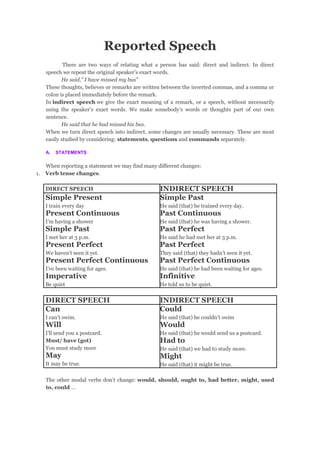
When reporting a statement we may find many different changes:
1. Verb tense changes.
DIRECT SPEECH INDIRECT SPEECH
Simple Present
I train every day
Present Continuous
I’m having a shower
Simple Past
I met her at 3 p.m.
Present Perfect
We haven’t seen it yet.
Present Perfect Continuous
I’ve been waiting for ages.
Imperative
Be quiet
Simple Past
He said (that) he trained every day.
Past Continuous
He said (that) he was having a shower.
Past Perfect
He said he had met her at 3 p.m.
Past Perfect
They said (that) they hadn’t seen it yet.
Past Perfect Continuous
He said (that) he had been waiting for ages.
Infinitive
He told us to be quiet.
DIRECT SPEECH INDIRECT SPEECH
Can
I can’t swim.
Will
I’ll send you a postcard.
Must/ have (got)
You must study more
May
It may be true.
Could
He said (that) he couldn’t swim
Would
He said (that) he would send us a postcard.
Had to
He said (that) we had to study more.
Might
He said (that) it might be true.
The other modal verbs don’t change: would, should, ought to, had better, might, used
to, could …
2. Pronouns and possessive adjectives normally change from first or second person to third
person, except when the speaker is reporting his own words.
DIRECT
SPEECH
INDIRECT SPEECH
Personal pronouns subject
I He, she
we They
Personal pronouns object
me Him, her
us them
Possessive adjectives
my His, her
our their
Possessive pronouns
mine His, hers
ours theirs
3. Demonstratives also change, based on the rule that words denoting “nearness” become the
corresponding words denoting “remoteness”.
DIRECT SPEECH INDIRECT SPEECH
this That
These those
4. Adverbs and adverbial phrases of time and the adverb here
DIRECT SPEECH INDIRECT SPEECH
Now Then
Today That day
Yesterday The day before
Tomorrow The next day, the following day
Next week, year … The following week, year …
Last week, year… The week / year before or
the previous week, year
Adverb of place
here there
The introductory verb is usually “said” (he said to me…), “tell” ( he told me…).See some
examples:
He said, “I saw the boy here in this room today”
R.S.: He said (that) he had seen the boy there in that room that day.
He said, “I’ll go to the office tomorrow”
R.S.: He said (that) he would come to the office the next day. (in this case the speaker is in the
office)
B. QUESTIONS
When we turn direct questions into indirect speech, the following changes are necessary:
1. The changes in tense, pronouns, possessives and adverbial phrases of time and place,
noted in indirect statements, apply also to indirect questions.
2. The interrogative construction of the direct question is replaced by the statement
construction in the indirect questions. So, the interrogative form of the verb changes to
the affirmative (or negative). The question mark (?) is therefore omitted in indirect
questions.
3. The introductory verb in the main clause is “say”, it must be changed to a verb of
inquiry, e.g. “ask, inquire, wonder, and want to know…”
There are two types of interrogative sentences:
a) Wh questions: These are questions beginning with an interrogative word (when, where, why,
how, who….). These interrogative words are the connective in the indirect questions:
e.g. He said, “how will you do it?”
He asked how she would do it.
b) Yes/ no questions: The connective words to join the indirect questions to the main clause
are: “if” or “whether”. There is not much difference in meaning between whether and if . Usage
generally favours if. Whether usually expresses a doubt and an alternative possibility or choice
between two alternatives, and so is often followed by the correlative “or”
e.g. He said, “Did she go yesterday?”
He asked if she had gone the day before.
C. COMMANDS.
When a direct command is turned into an indirect one, the following changes will be noticed:
1. The introductory verb, “say” is changed to a verb of command or request,
such as “tell, order, command, ask, request…”
2. Commands could be:
a) Affirmative: introductory verb + person addressed + to + infinitive.
E.g. He said “Open the door, Mary”
He told Mary to open the door.
b) Negative: introductory verb + person addressed + not + to + infinitive.
E.g. He said “Don’t go away, Mary”
He told Mary not to go away.
3. Finally, pronouns and possessive adjectives, and adverbs of place and time
change as in statements and questions.
D. OTHER STRUCTURES.
Suggest. We can reprt suggestions or recommendations in three different ways:
a) subject + suggest + (not) + verb + -ing.
E.g. “Let’s go to the cinema”
She suggested going to the cinema.
b) subject + suggest + that + subject + should + infinitive without to.
E.g. “Why don’t you read this book?”
She suggested that I should read that book.
c) Subject + suggest + subjunctive.
E.g. “How about reusing this plastic bag?”
She suggested that I reuse that plastic bag.
E. REPORTING VERBS.
When we report the speaker’s exact words, we don’t just apply the rules mechanically, we
interpret what we hear or read, so we use different reporting verbs followed by the following
structures:
1. Subject + reporting verb + (not) + to + infinitive.
Verbs like: agree, offer, promise, refuse, threaten, demand etc…
E.g. “I won’t go with you!”
She refused to go with me.
2. Subject + reporting verb + object + (not) + to + infinitive.
Verbs like: advise, ask, encourage, invite, order, persuade, recommend, remind, tell, warn etc…
E.g. “You should go to the doctor”
She advised me to go to the doctor.
3. Subject + reporting verb + (not) + verb –ing.
Verbs like: apologize for, accuse sb of, complain to, deny, recommend, suggest, insist on, boast
about …
E.g. “I didn’t steal your purse”
He denied stealing /having stolen my purse.
4. Subject + reporting verb + (that) + subject + verb.
Verbs like: add, admit, agree, announce, claim, complain, declare, deny, explain, insist, mention,
predict, promise, reply, reveal, say, state, suggest…
E.g. “You are always talking”.
She complained that we were always talking.
5. subject + reporting verb + object + (that) + subject + verb.
Verbs like: persuade, remind, tell, warn.
E.g. “I’m going out tonight”
She reminded me that she was going out that night.
6. subject + reporting verb + if/ whether/wh-word + subject + verb.
Verbs like: ask, enquire, question, wonder, want to know…
E.g. She asked herself, “Will I win a prize tonight?”
She wondered whether she would win a prize that night.
©Mercedes Sánchez 2012

Reported speech

  • 1.
    Reported Speech There aretwo ways of relating what a person has said: direct and indirect. In direct speech we repeat the original speaker’s exact words. He said,” I have missed my bus” These thoughts, believes or remarks are written between the inverted commas, and a comma or colon is placed immediately before the remark. In indirect speech we give the exact meaning of a remark, or a speech, without necessarily using the speaker’s exact words. We make somebody’s words or thoughts part of our own sentence. He said that he had missed his bus. When we turn direct speech into indirect, some changes are usually necessary. These are most easily studied by considering: statements, questions and commands separately. A. STATEMENTS When reporting a statement we may find many different changes: 1. Verb tense changes. DIRECT SPEECH INDIRECT SPEECH Simple Present I train every day Present Continuous I’m having a shower Simple Past I met her at 3 p.m. Present Perfect We haven’t seen it yet. Present Perfect Continuous I’ve been waiting for ages. Imperative Be quiet Simple Past He said (that) he trained every day. Past Continuous He said (that) he was having a shower. Past Perfect He said he had met her at 3 p.m. Past Perfect They said (that) they hadn’t seen it yet. Past Perfect Continuous He said (that) he had been waiting for ages. Infinitive He told us to be quiet. DIRECT SPEECH INDIRECT SPEECH Can I can’t swim. Will I’ll send you a postcard. Must/ have (got) You must study more May It may be true. Could He said (that) he couldn’t swim Would He said (that) he would send us a postcard. Had to He said (that) we had to study more. Might He said (that) it might be true. The other modal verbs don’t change: would, should, ought to, had better, might, used to, could …
  • 2.
    2. Pronouns andpossessive adjectives normally change from first or second person to third person, except when the speaker is reporting his own words. DIRECT SPEECH INDIRECT SPEECH Personal pronouns subject I He, she we They Personal pronouns object me Him, her us them Possessive adjectives my His, her our their Possessive pronouns mine His, hers ours theirs 3. Demonstratives also change, based on the rule that words denoting “nearness” become the corresponding words denoting “remoteness”. DIRECT SPEECH INDIRECT SPEECH this That These those 4. Adverbs and adverbial phrases of time and the adverb here DIRECT SPEECH INDIRECT SPEECH Now Then Today That day Yesterday The day before Tomorrow The next day, the following day Next week, year … The following week, year … Last week, year… The week / year before or the previous week, year Adverb of place here there The introductory verb is usually “said” (he said to me…), “tell” ( he told me…).See some examples: He said, “I saw the boy here in this room today” R.S.: He said (that) he had seen the boy there in that room that day. He said, “I’ll go to the office tomorrow” R.S.: He said (that) he would come to the office the next day. (in this case the speaker is in the office)
  • 3.
    B. QUESTIONS When weturn direct questions into indirect speech, the following changes are necessary: 1. The changes in tense, pronouns, possessives and adverbial phrases of time and place, noted in indirect statements, apply also to indirect questions. 2. The interrogative construction of the direct question is replaced by the statement construction in the indirect questions. So, the interrogative form of the verb changes to the affirmative (or negative). The question mark (?) is therefore omitted in indirect questions. 3. The introductory verb in the main clause is “say”, it must be changed to a verb of inquiry, e.g. “ask, inquire, wonder, and want to know…” There are two types of interrogative sentences: a) Wh questions: These are questions beginning with an interrogative word (when, where, why, how, who….). These interrogative words are the connective in the indirect questions: e.g. He said, “how will you do it?” He asked how she would do it. b) Yes/ no questions: The connective words to join the indirect questions to the main clause are: “if” or “whether”. There is not much difference in meaning between whether and if . Usage generally favours if. Whether usually expresses a doubt and an alternative possibility or choice between two alternatives, and so is often followed by the correlative “or” e.g. He said, “Did she go yesterday?” He asked if she had gone the day before. C. COMMANDS. When a direct command is turned into an indirect one, the following changes will be noticed: 1. The introductory verb, “say” is changed to a verb of command or request, such as “tell, order, command, ask, request…” 2. Commands could be: a) Affirmative: introductory verb + person addressed + to + infinitive. E.g. He said “Open the door, Mary” He told Mary to open the door. b) Negative: introductory verb + person addressed + not + to + infinitive. E.g. He said “Don’t go away, Mary” He told Mary not to go away. 3. Finally, pronouns and possessive adjectives, and adverbs of place and time change as in statements and questions.
  • 4.
    D. OTHER STRUCTURES. Suggest.We can reprt suggestions or recommendations in three different ways: a) subject + suggest + (not) + verb + -ing. E.g. “Let’s go to the cinema” She suggested going to the cinema. b) subject + suggest + that + subject + should + infinitive without to. E.g. “Why don’t you read this book?” She suggested that I should read that book. c) Subject + suggest + subjunctive. E.g. “How about reusing this plastic bag?” She suggested that I reuse that plastic bag. E. REPORTING VERBS. When we report the speaker’s exact words, we don’t just apply the rules mechanically, we interpret what we hear or read, so we use different reporting verbs followed by the following structures: 1. Subject + reporting verb + (not) + to + infinitive. Verbs like: agree, offer, promise, refuse, threaten, demand etc… E.g. “I won’t go with you!” She refused to go with me. 2. Subject + reporting verb + object + (not) + to + infinitive. Verbs like: advise, ask, encourage, invite, order, persuade, recommend, remind, tell, warn etc… E.g. “You should go to the doctor” She advised me to go to the doctor. 3. Subject + reporting verb + (not) + verb –ing. Verbs like: apologize for, accuse sb of, complain to, deny, recommend, suggest, insist on, boast about … E.g. “I didn’t steal your purse” He denied stealing /having stolen my purse. 4. Subject + reporting verb + (that) + subject + verb. Verbs like: add, admit, agree, announce, claim, complain, declare, deny, explain, insist, mention, predict, promise, reply, reveal, say, state, suggest… E.g. “You are always talking”. She complained that we were always talking. 5. subject + reporting verb + object + (that) + subject + verb. Verbs like: persuade, remind, tell, warn. E.g. “I’m going out tonight” She reminded me that she was going out that night. 6. subject + reporting verb + if/ whether/wh-word + subject + verb. Verbs like: ask, enquire, question, wonder, want to know… E.g. She asked herself, “Will I win a prize tonight?” She wondered whether she would win a prize that night. ©Mercedes Sánchez 2012