Ibrahim Muneer
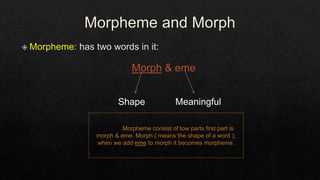
Morph & eme
Shape Meaningful
Morpheme consist of tow parts first part is
morph & eme. Morph ( means the shape of a word ),
when we add eme to morph it becomes morpheme.
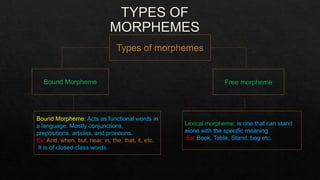
Types of morphemes
Free morpheme
Lexical morpheme: is one that can stand
alone with the specific meaning
Ex: Book, Table, Stand, bag etc.
Bound Morpheme
Bound Morpheme: Acts as functional words in
a language. Mostly conjunctions,
prepositions, articles, and pronouns.
Ex: And, when, but, near, in, the, that, it, etc.
It is of closed-class words.
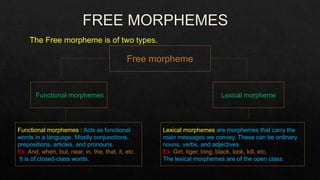
Free morpheme
Lexical morpheme
Lexical morphemes are morphemes that carry the
main messages we convey. These can be ordinary
nouns, verbs, and adjectives.
Ex: Girl, tiger, long, black, look, kill, etc.
The lexical morphemes are of the open class.
Functional morphemes
Functional morphemes : Acts as functional
words in a language. Mostly conjunctions,
prepositions, articles, and pronouns.
Ex: And, when, but, near, in, the, that, it, etc.
It is of closed-class words.
The Free morpheme is of two types.
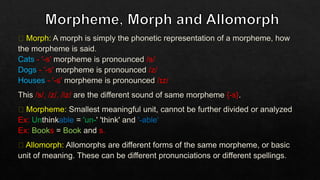
Morpheme, Morph and Allomorph
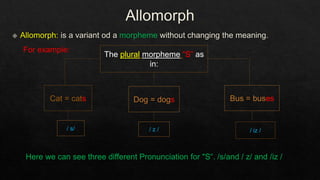
The plural morpheme “S” as
in:
Cat = cats Dog = dogs Bus = buses
/ s/ / z / / iz /
Here we can see three different Pronunciation for "S“. /s/and / z/ and /iz /
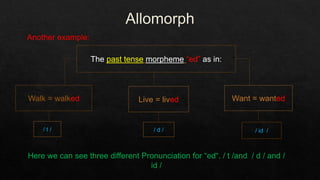
The past tense morpheme “ed” as in:
Walk = walked Live = lived Want = wanted
/ t / / d / / id /
Here we can see three different Pronunciation for “ed“. / t /and / d / and /
id /
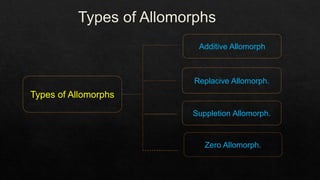
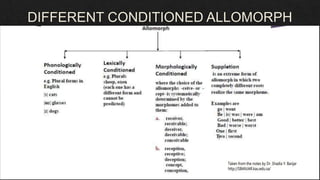
Zero Allomorph.
Suppletion Allomorph.
Replacive Allomorph.
Additive Allomorph
Types of Allomorphs
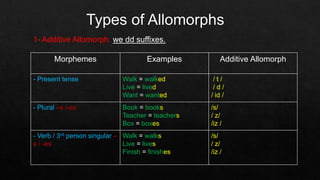
Morphemes Examples Additive Allomorph
- Present tense Walk = walked
Live = lived
Want = wanted
/ t /
/ d /
/ id /
- Plural –s /-es Book = books
Teacher = teachers
Box = boxes
/s/
/ z/
/iz /
- Verb / 3rd person singular –
s / -es
Walk = walks
Live = lives
Finish = finishes
/s/
/ z/
/iz /
1- Additive Allomorph: we dd suffixes.
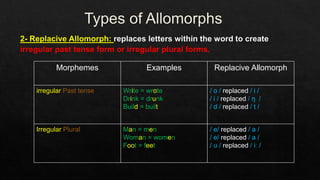
Morphemes Examples Replacive Allomorph
irregular Past tense Write = wrote
Drink = drunk
Build = built
/ o / replaced / i /
/ i / replaced / ŋ /
/ d / replaced / t /
Irregular Plural Man = men
Woman = women
Foot = feet
/ e/ replaced / a /
/ e/ replaced / a /
/ ʊ / replaced / iː /
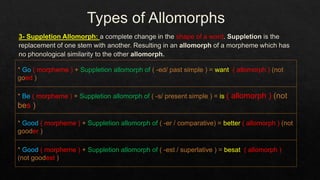
* Go ( morpheme ) + Suppletion allomorph of ( -ed/ past simple ) = want ( allomorph ) (not
goed )
* Be ( morpheme ) + Suppletion allomorph of ( -s/ present simple ) = is ( allomorph ) (not
bes )
* Good ( morpheme ) + Suppletion allomorph of ( -er / comparative) = better ( allomorph ) (not
gooder )
* Good ( morpheme ) + Suppletion allomorph of ( -est / superlative ) = besat ( allomorph )
(not goodest )
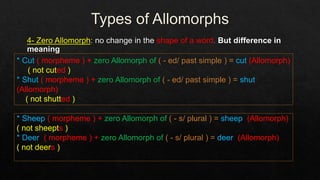
* Cut ( morpheme ) + zero Allomorph of ( - ed/ past simple ) = cut (Allomorph)
( not cuted )
* Shut ( morpheme ) + zero Allomorph of ( - ed/ past simple ) = shut
(Allomorph)
( not shutted )
* Sheep ( morpheme ) + zero Allomorph of ( - s/ plural ) = sheep (Allomorph)
( not sheepts )
* Deer ( morpheme ) + zero Allomorph of ( - s/ plural ) = deer (Allomorph)
( not deers )
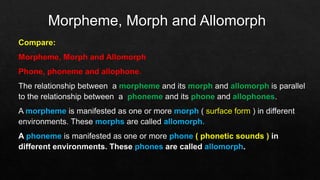
Morpheme, morph and allomorph

Morpheme, morph and allomorph

  • 1.
  • 3.
    Morph & eme ShapeMeaningful Morpheme consist of tow parts first part is morph & eme. Morph ( means the shape of a word ), when we add eme to morph it becomes morpheme.
  • 4.
    Types of morphemes Freemorpheme Lexical morpheme: is one that can stand alone with the specific meaning Ex: Book, Table, Stand, bag etc. Bound Morpheme Bound Morpheme: Acts as functional words in a language. Mostly conjunctions, prepositions, articles, and pronouns. Ex: And, when, but, near, in, the, that, it, etc. It is of closed-class words.
  • 5.
    Free morpheme Lexical morpheme Lexicalmorphemes are morphemes that carry the main messages we convey. These can be ordinary nouns, verbs, and adjectives. Ex: Girl, tiger, long, black, look, kill, etc. The lexical morphemes are of the open class. Functional morphemes Functional morphemes : Acts as functional words in a language. Mostly conjunctions, prepositions, articles, and pronouns. Ex: And, when, but, near, in, the, that, it, etc. It is of closed-class words. The Free morpheme is of two types.
  • 9.
  • 10.
    The plural morpheme“S” as in: Cat = cats Dog = dogs Bus = buses / s/ / z / / iz / Here we can see three different Pronunciation for "S“. /s/and / z/ and /iz /
  • 11.
    The past tensemorpheme “ed” as in: Walk = walked Live = lived Want = wanted / t / / d / / id / Here we can see three different Pronunciation for “ed“. / t /and / d / and / id /
  • 12.
    Zero Allomorph. Suppletion Allomorph. ReplaciveAllomorph. Additive Allomorph Types of Allomorphs
  • 13.
    Morphemes Examples AdditiveAllomorph - Present tense Walk = walked Live = lived Want = wanted / t / / d / / id / - Plural –s /-es Book = books Teacher = teachers Box = boxes /s/ / z/ /iz / - Verb / 3rd person singular – s / -es Walk = walks Live = lives Finish = finishes /s/ / z/ /iz / 1- Additive Allomorph: we dd suffixes.
  • 14.
    Morphemes Examples ReplaciveAllomorph irregular Past tense Write = wrote Drink = drunk Build = built / o / replaced / i / / i / replaced / ŋ / / d / replaced / t / Irregular Plural Man = men Woman = women Foot = feet / e/ replaced / a / / e/ replaced / a / / ʊ / replaced / iː /
  • 15.
    * Go (morpheme ) + Suppletion allomorph of ( -ed/ past simple ) = want ( allomorph ) (not goed ) * Be ( morpheme ) + Suppletion allomorph of ( -s/ present simple ) = is ( allomorph ) (not bes ) * Good ( morpheme ) + Suppletion allomorph of ( -er / comparative) = better ( allomorph ) (not gooder ) * Good ( morpheme ) + Suppletion allomorph of ( -est / superlative ) = besat ( allomorph ) (not goodest )
  • 16.
    * Cut (morpheme ) + zero Allomorph of ( - ed/ past simple ) = cut (Allomorph) ( not cuted ) * Shut ( morpheme ) + zero Allomorph of ( - ed/ past simple ) = shut (Allomorph) ( not shutted ) * Sheep ( morpheme ) + zero Allomorph of ( - s/ plural ) = sheep (Allomorph) ( not sheepts ) * Deer ( morpheme ) + zero Allomorph of ( - s/ plural ) = deer (Allomorph) ( not deers )