Stimulus-Response Theory
            (B. F. Skinner)


                              1
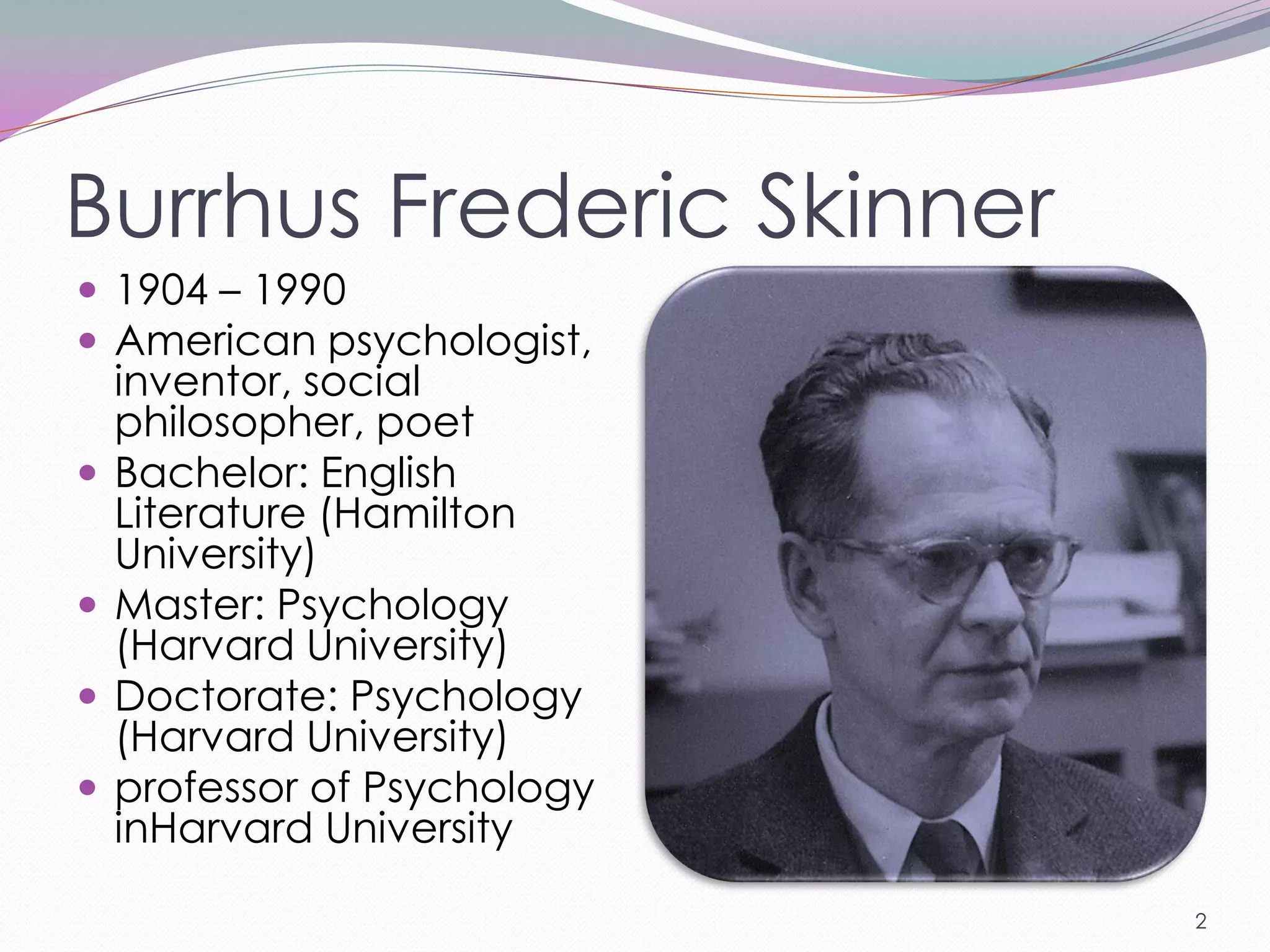
Burrhus Frederic Skinner
 1904 – 1990
 American psychologist,
    inventor, social
    philosopher, poet
   Bachelor: English
    Literature (Hamilton
    University)
   Master: Psychology
    (Harvard University)
   Doctorate: Psychology
    (Harvard University)
   professor of Psychology
    inHarvard University

                              2
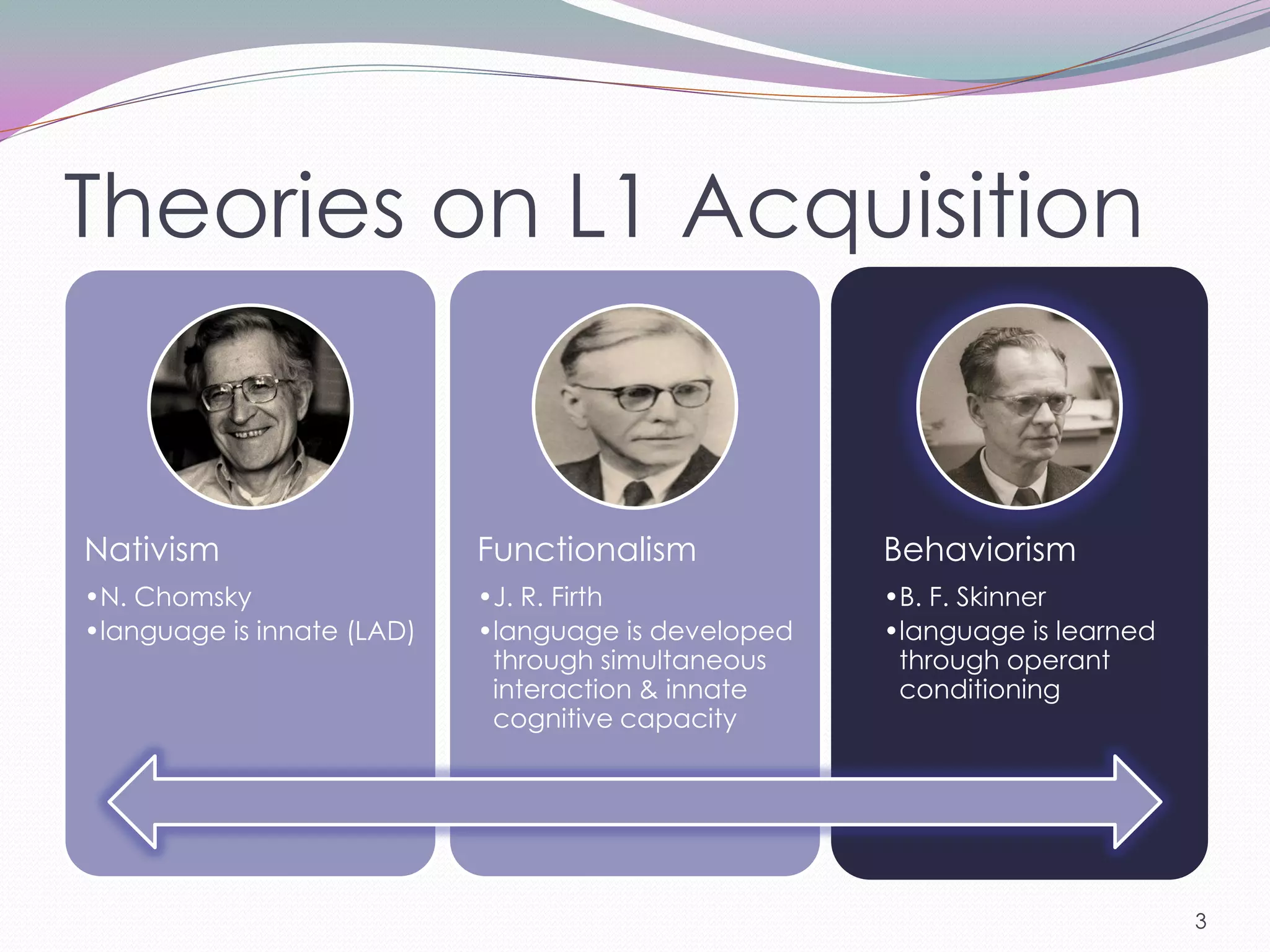
Theories on L1 Acquisition


Nativism                    Functionalism            Behaviorism
•N. Chomsky                 •J. R. Firth             •B. F. Skinner
•language is innate (LAD)   •language is developed   •language is learned
                             through simultaneous     through operant
                             interaction & innate     conditioning
                             cognitive capacity


                                                                            3
Behaviorial Theory
 behaviors, such as acting, thinking, and feeling,
  can be scientifically observed and measured
 Language, as a behavior, is a set of habits
  acquired by operant conditioning and
  reinforcement
 developed by B. F. Skinner, among others


                                                      4
Language
 a subset of other learned behaviors
 a set of associations between meaning and
  word, word and phoneme, and statement and
  response
 is learned or conditioned through association
  between a stimulus and the following response
 a verbal behavior modified by the environment


                                                  5
Language
 the ―how‖ of language is more important than
  the ―what‖ of language form
 a child learns language ―when relatively
  unpatterned vocalizations, selectively
  reinforced, gradually assume forms which
  produce appropriate consequences‖


                                                 6
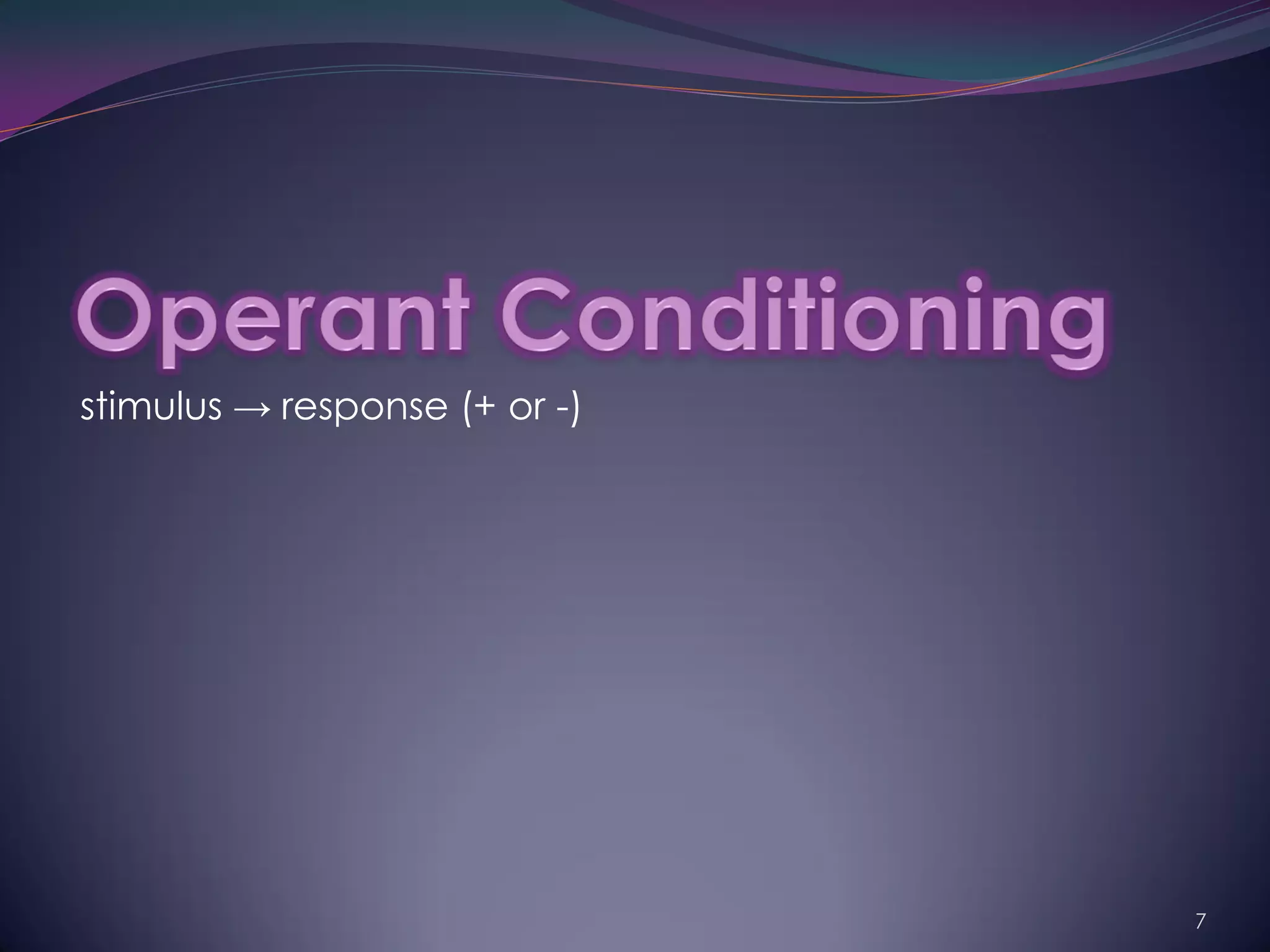
stimulus → response (+ or -)


                               7
Operant Conditioning
 the strength of the stimulus-response bond
  determines the probability of occurrence of a
  certain response
 all behavior is learned or operant


                                                  8
Operant Conditioning
 complex linguistic behaviors represent chains or
  combinations of various stimulus-response
  sequences
 behavior is modified or changed by the events
  that follow or are contingent upon that
  behavior


                                                     9
Operant Conditioning
 if a particular response is reinforced, it then
  becomes habitual
 thus, children produce linguistic responses that
  are reinforced, and loses those that are left out


                                                      10
Reinforcer
 any event that increases the probability of
 occurrence of a preceding behavior


                                                11
Positive Reinforcers
 benefits the person receiving it
 examples:
    praising
    repetition
    frequent exposure
    material reward


                                     12
Negative Reinforcers
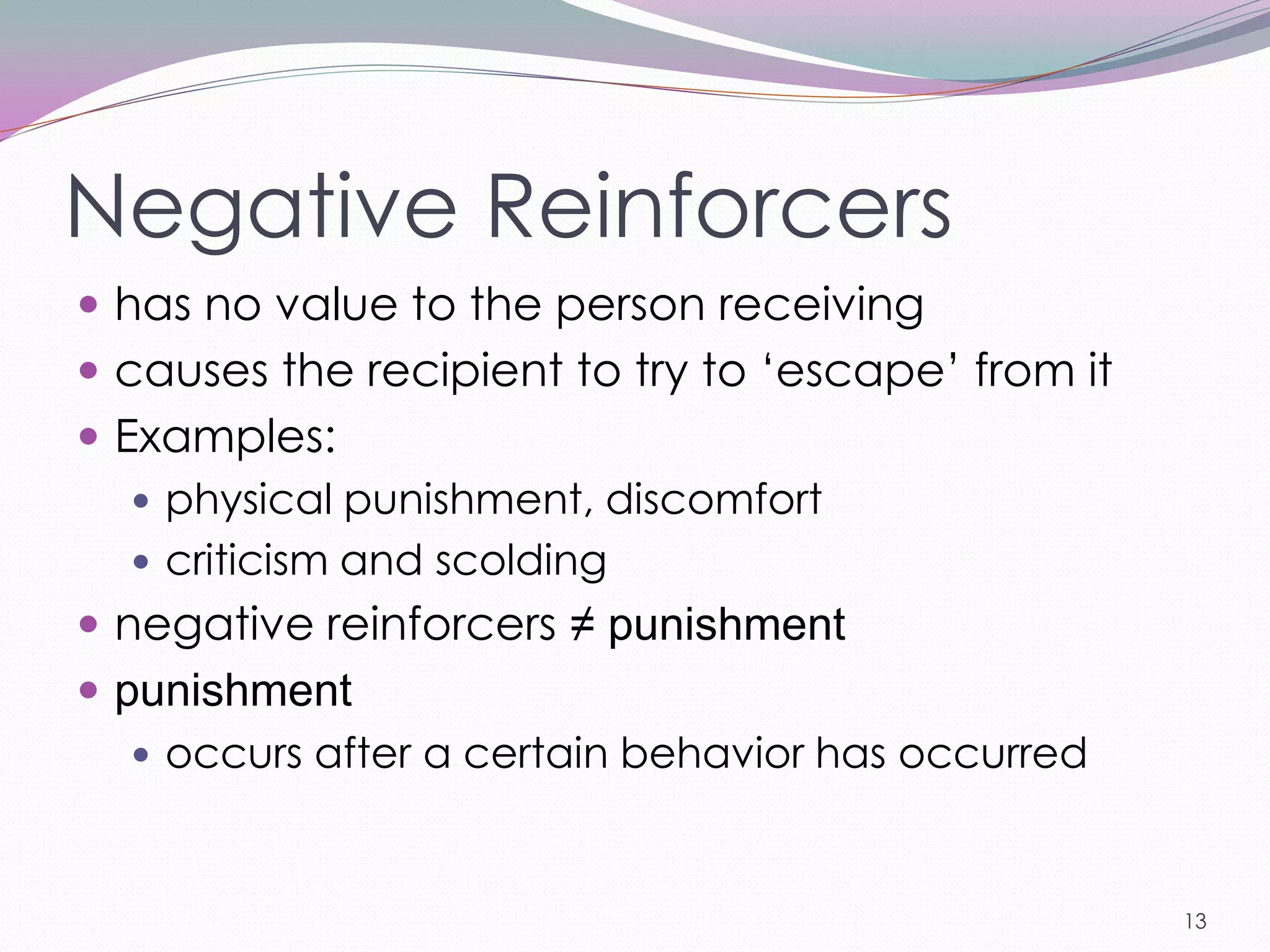
 has no value to the person receiving
 causes the recipient to try to ‗escape‘ from it
 Examples:
    physical punishment, discomfort
    criticism and scolding
 negative reinforcers ≠ punishment
 punishment
    occurs after a certain behavior has occurred


                                                    13
Operant Conditioning
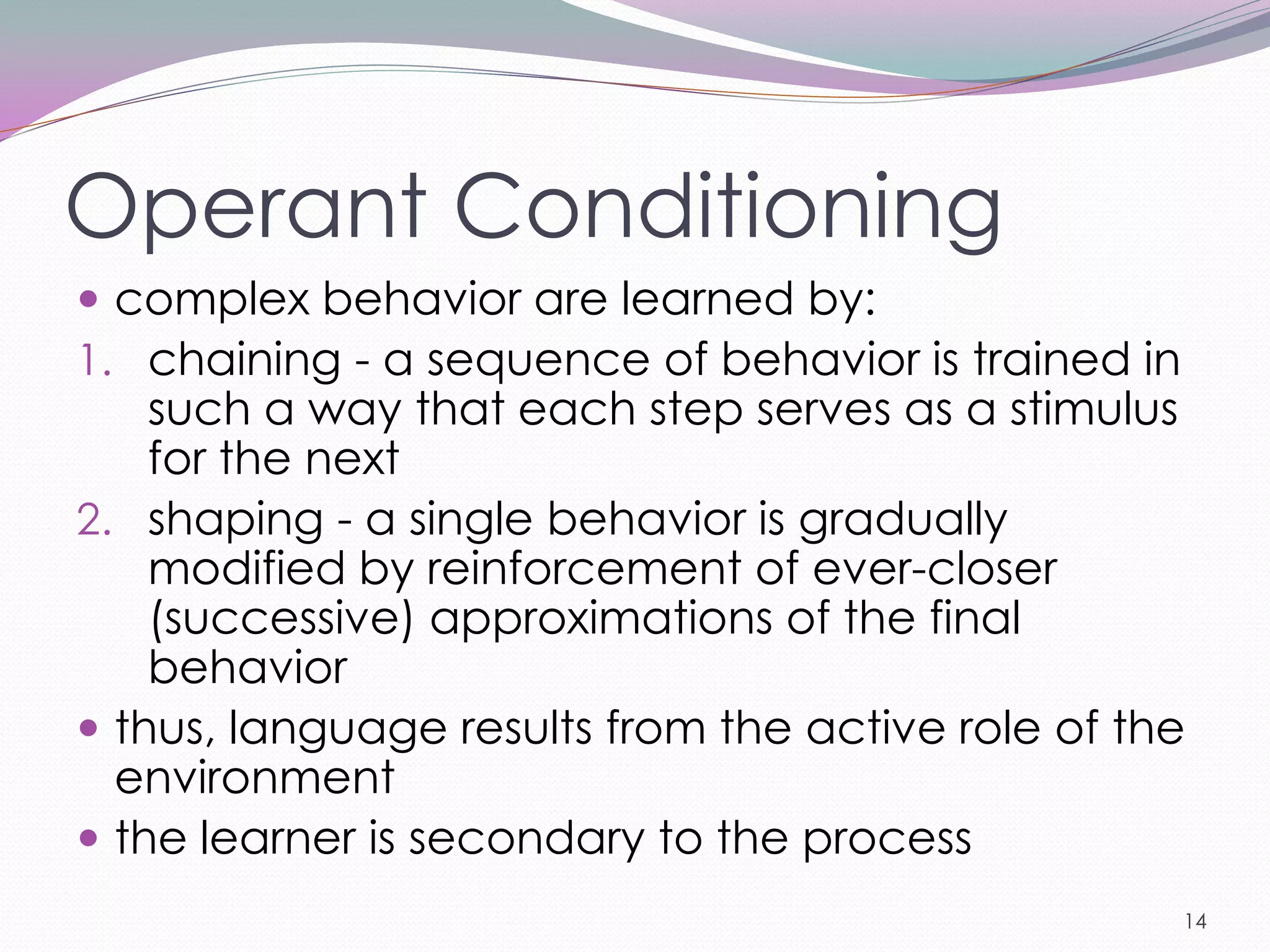
 complex behavior are learned by:
1. chaining - a sequence of behavior is trained in
    such a way that each step serves as a stimulus
    for the next
2. shaping - a single behavior is gradually
    modified by reinforcement of ever-closer
    (successive) approximations of the final
    behavior
 thus, language results from the active role of the
  environment
 the learner is secondary to the process
                                                     14
Operant Conditioning
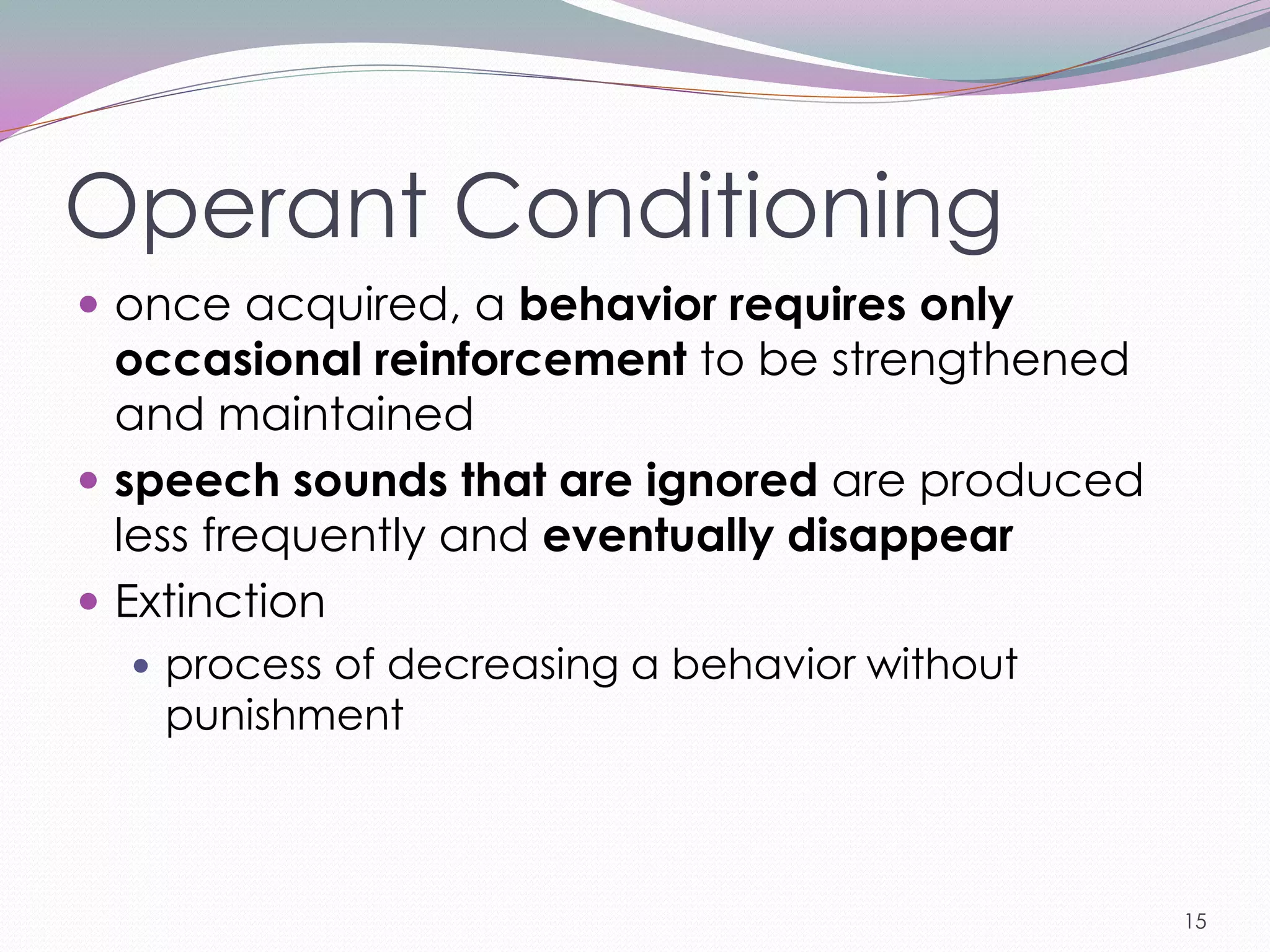
 once acquired, a behavior requires only
  occasional reinforcement to be strengthened
  and maintained
 speech sounds that are ignored are produced
  less frequently and eventually disappear
 Extinction
   process of decreasing a behavior without
   punishment


                                                15
an example of Operant Conditioning


                                     16
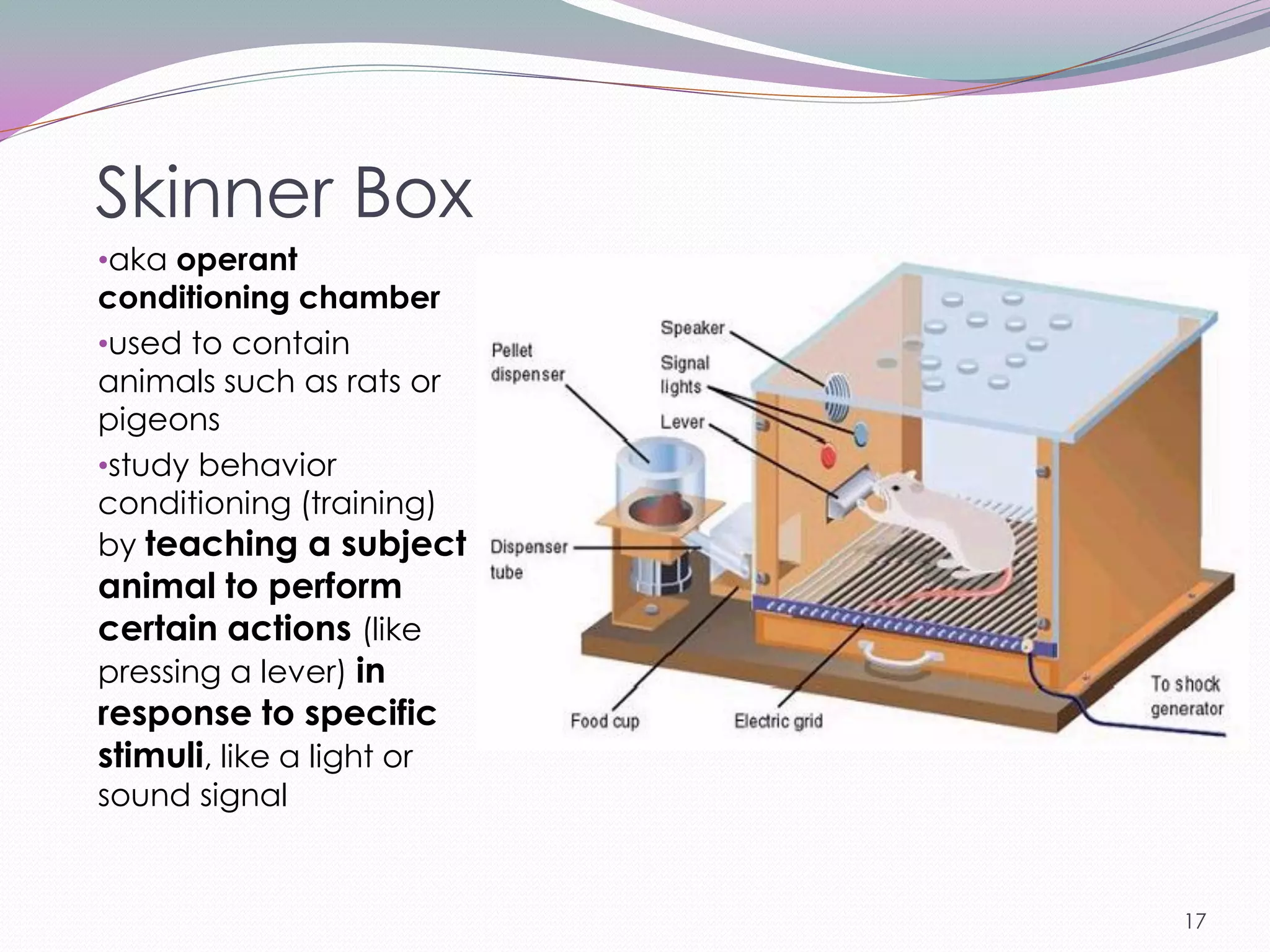
Skinner Box
•aka operant
conditioning chamber
•used to contain
animals such as rats or
pigeons
•study behavior
conditioning (training)
by teaching a subject
animal to perform
certain actions (like
pressing a lever) in
response to specific
stimuli, like a light or
sound signal


                           17
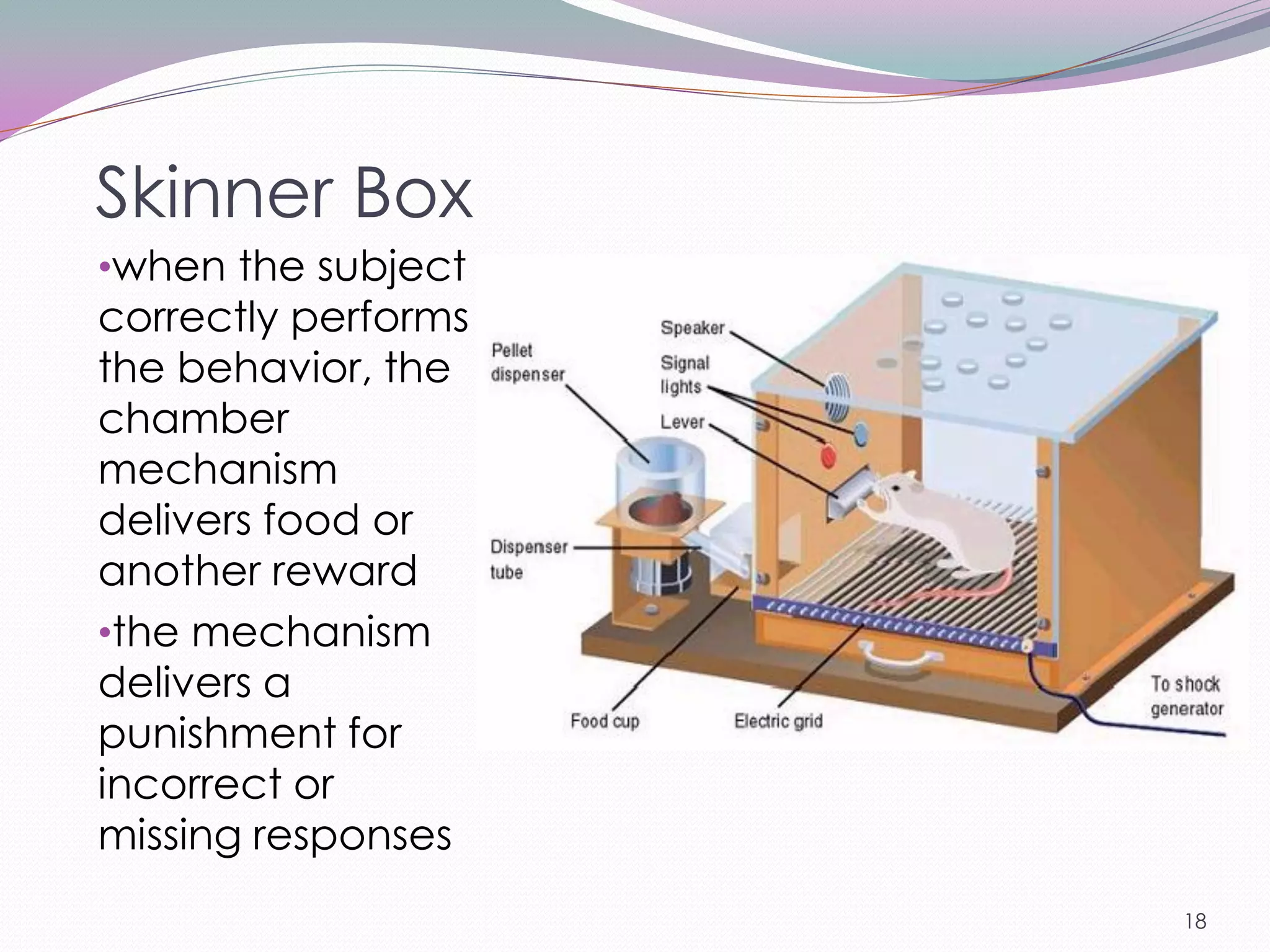
Skinner Box
•when the subject
correctly performs
the behavior, the
chamber
mechanism
delivers food or
another reward
•the mechanism
delivers a
punishment for
incorrect or
missing responses
                     18
Rat Experiment
1. the rat that was placed in the box did not
   know what the lever was for at first
2. the rat pressed the lever, food eventually
   came out
3. the rat (when it gets hungry) continue to press
   the lever, and gets satisfied with the food


                                                     19
Rat Experiment
 this is operant behavior because this is an action
  that results with a consequence
 the food acts as a reinforcer because it causes
  the operant behavior to increase


                                                    20
Rat Experiment
 operant behavior may come to the points of its
  extinction
1. the rat continues to press the lever and yet
   food does not come out
2. the rat will eventually cease on pressing the
   lever, thus stopping an operant behavior


                                                   21
Instead of punishing behavior, it is better to
  simply take off the reinforcers that cause that
  certain behavior. By doing so, the doer of the
  behavior will not see the value of his actions,
  because the reinforcers have been taken away
  from him. The behavior will gradually start to
  fade away.


                                                    22
predictions and assumptions


                              23
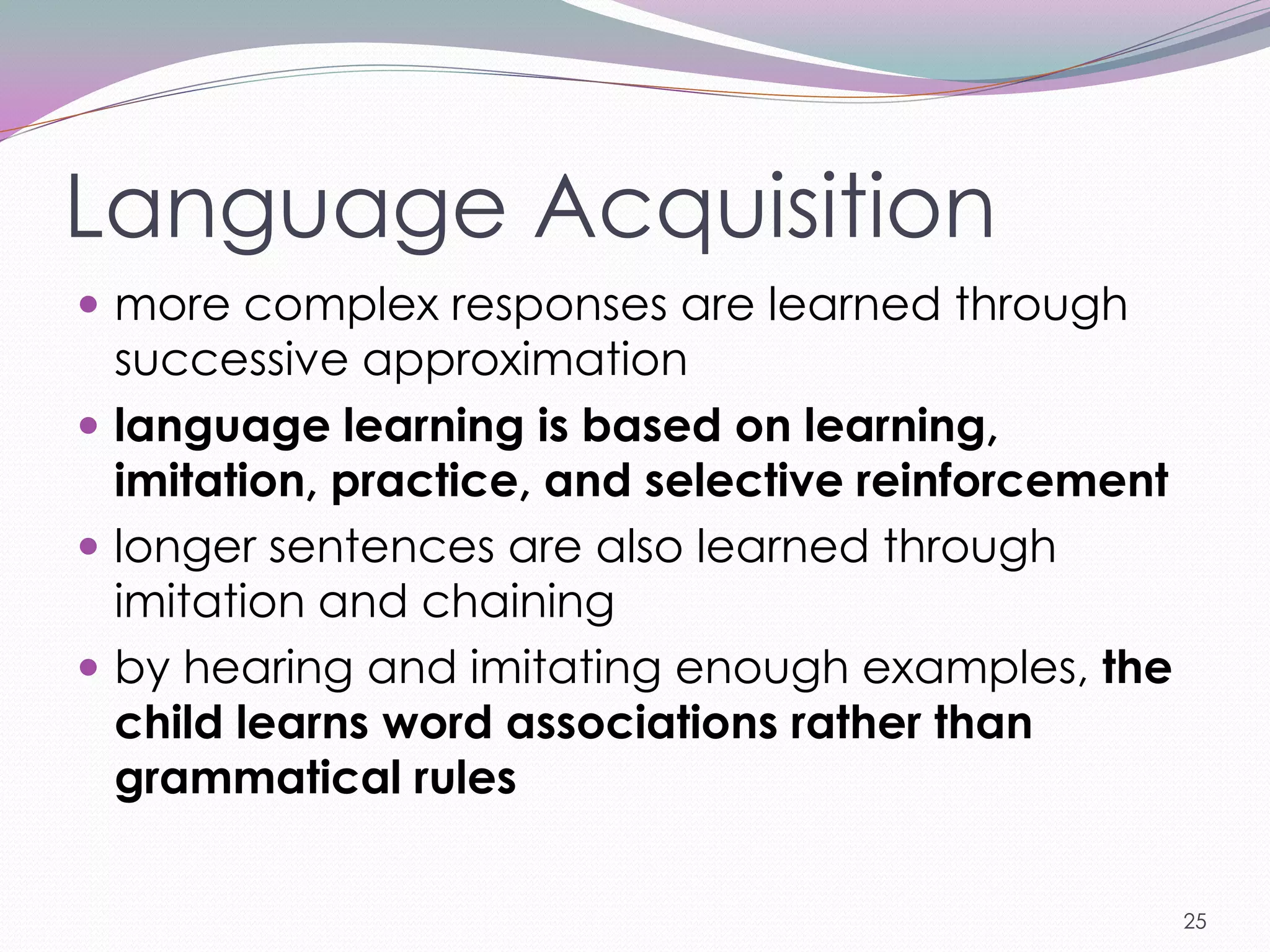
Language Acquisition
 word learning is more complex
 mother has become discriminative stimulus (SD),
  a stimulus in the presence of which ―mama‖ will
  be reinforced
 a bond is built between the referent ―mother‖
  and the word mama
 meaning is attached to the speech sound


                                                    24
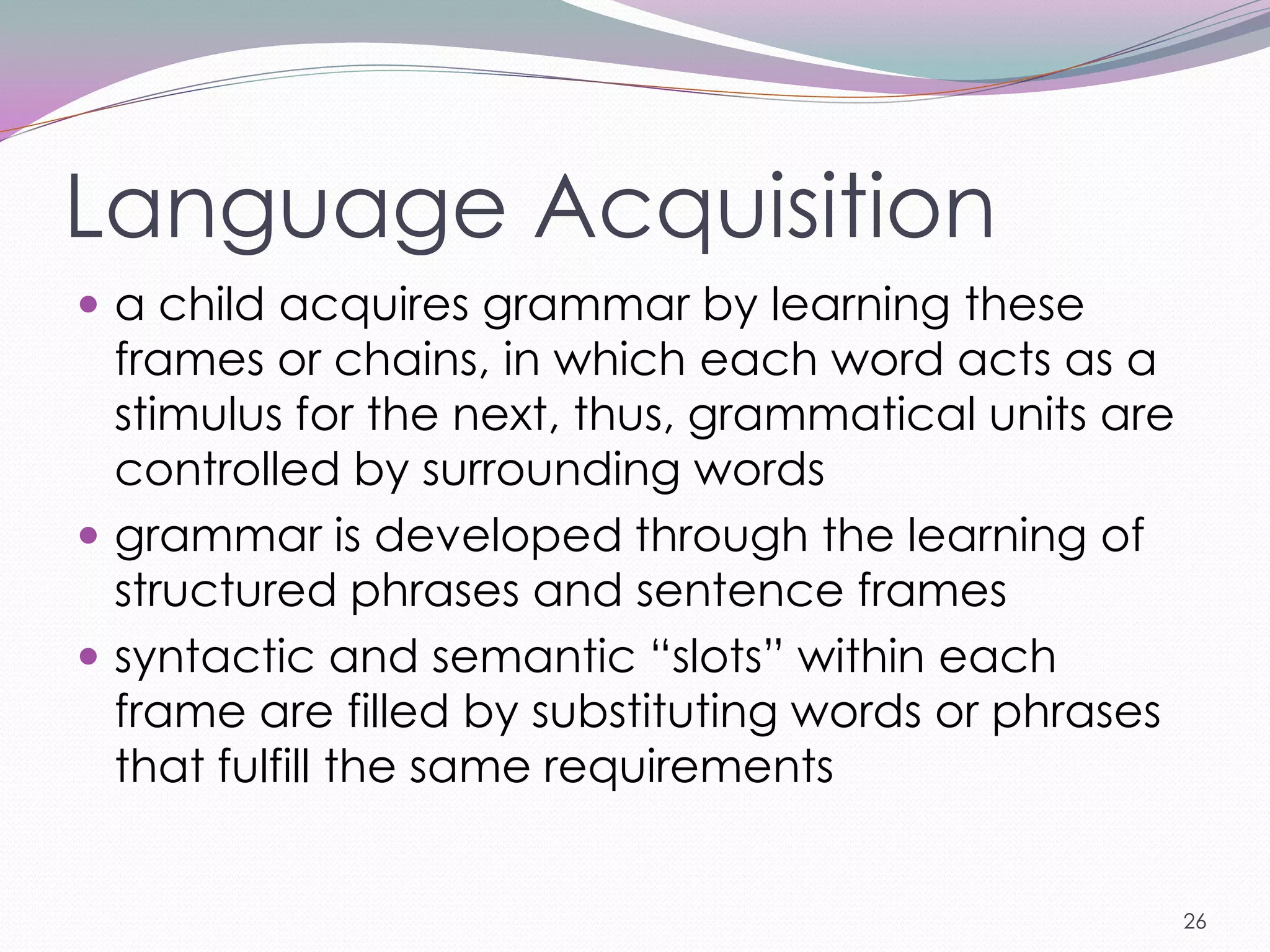
Language Acquisition
 more complex responses are learned through
  successive approximation
 language learning is based on learning,
  imitation, practice, and selective reinforcement
 longer sentences are also learned through
  imitation and chaining
 by hearing and imitating enough examples, the
  child learns word associations rather than
  grammatical rules

                                                     25
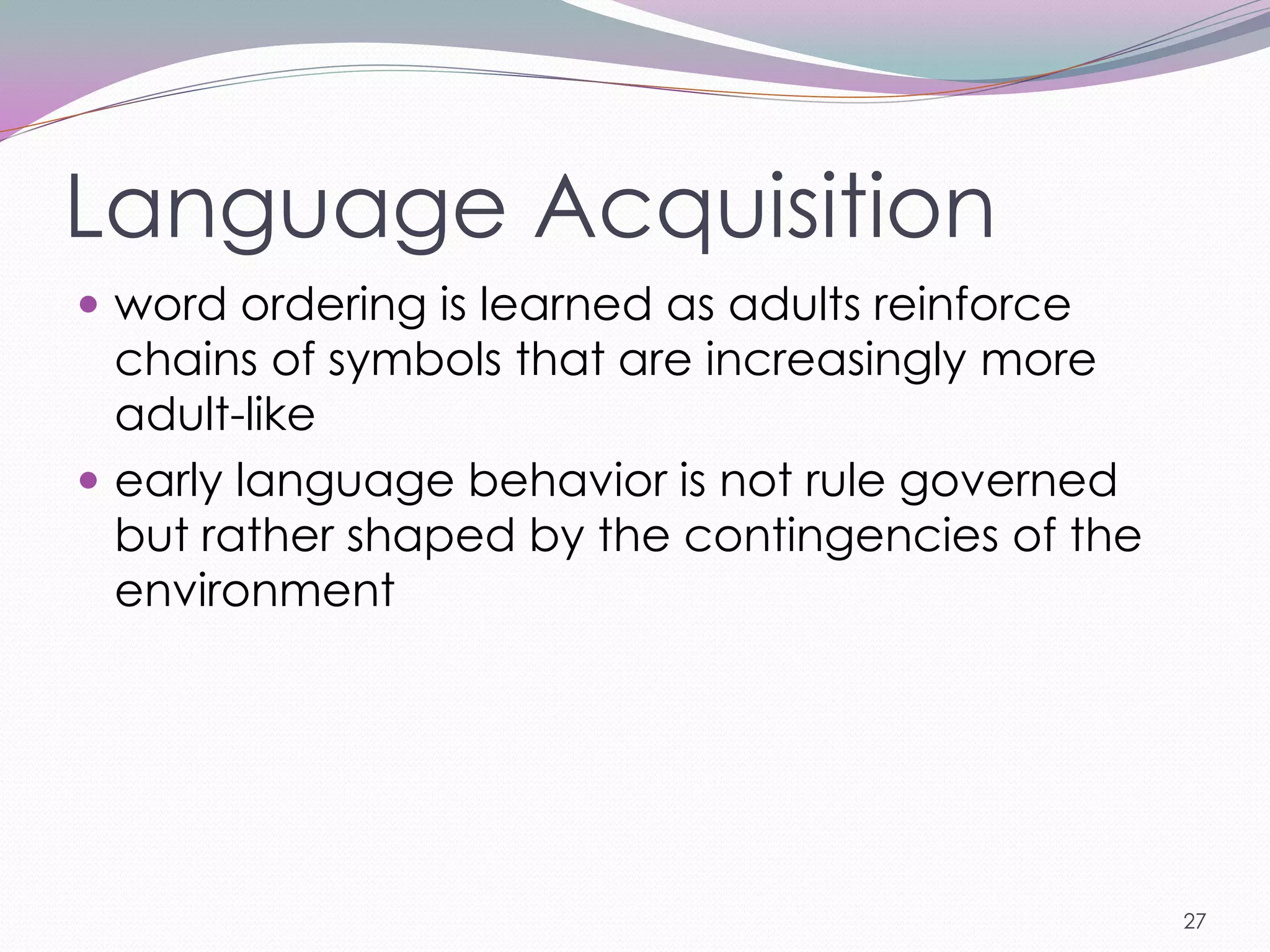
Language Acquisition
 a child acquires grammar by learning these
  frames or chains, in which each word acts as a
  stimulus for the next, thus, grammatical units are
  controlled by surrounding words
 grammar is developed through the learning of
  structured phrases and sentence frames
 syntactic and semantic ―slots‖ within each
  frame are filled by substituting words or phrases
  that fulfill the same requirements


                                                       26
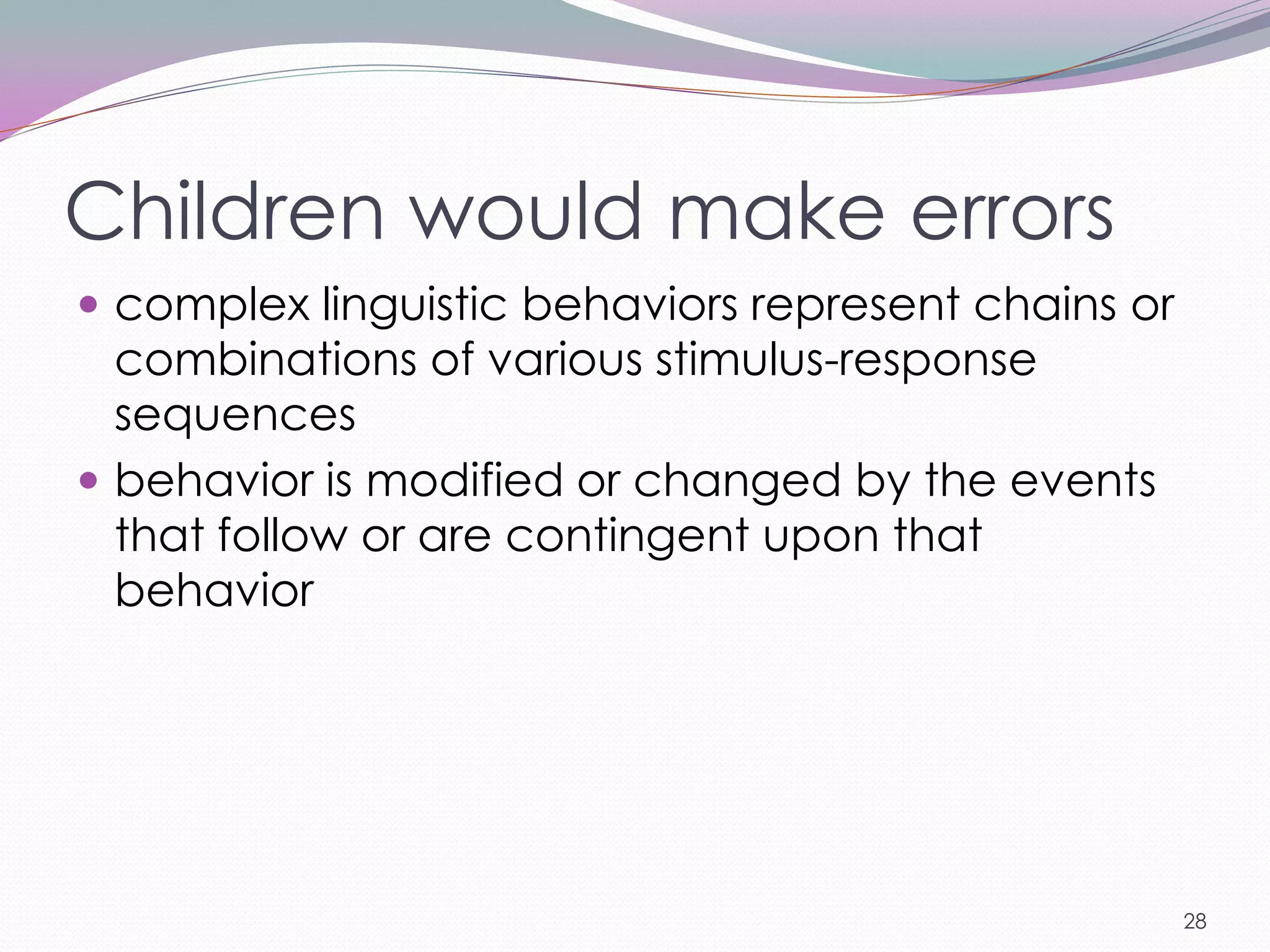
Language Acquisition
 word ordering is learned as adults reinforce
  chains of symbols that are increasingly more
  adult-like
 early language behavior is not rule governed
  but rather shaped by the contingencies of the
  environment


                                                  27
Children would make errors
 complex linguistic behaviors represent chains or
  combinations of various stimulus-response
  sequences
 behavior is modified or changed by the events
  that follow or are contingent upon that
  behavior


                                                     28
Errors would differ from
child to child


                           29
The level of linguistic
attainment would differ
from child to child
 this depends on the frequency and degree of
 reinforcements


                                                30
(mostly by Chomsky, of course.)


                                  31
Limitations and Loopholes
 children will utter words that even adults do not
  say
 children would not know the duality property of
  language
 children would not know syntax


                                                      32
Limitations and Loopholes
 retention of negative language (e.g., cuss
  expressions)
 no reinforcement on abstract ideas
 highly dependent on adult control


                                               33
Summary(yey~)
 language is a behavior
 as a behavior, it requires reinforcers and stimuli
  from the environment
 reinforcers may be positive or negative, primary
  or secondary
 languages can be unlearned by putting away
  the stimuli/reinforcers


                                                       34
Owens, Robert. Language Development: An Introduction.
        New York: Merill, 1992.
Skinner, Buhhrus Frederic. About Behaviorism. New York:
        Random House, 1974.
—. Verbal Behavior. New York: Random House, 1957.


                                                          35
Prepared by:
Mejia, Coltz
Mendoza, Olive
Moulic, Ezra
Mutya, Daryll
Muyano, Jo

Presentation prepared for BLL 102 (Theories of Language and Language
Acquisition) under Prof. Rosario Florendo


                                                                       36

Behaviorism (Linguistics)

  • 1.
    Stimulus-Response Theory (B. F. Skinner) 1
  • 2.
    Burrhus Frederic Skinner 1904 – 1990  American psychologist, inventor, social philosopher, poet  Bachelor: English Literature (Hamilton University)  Master: Psychology (Harvard University)  Doctorate: Psychology (Harvard University)  professor of Psychology inHarvard University 2
  • 3.
    Theories on L1Acquisition Nativism Functionalism Behaviorism •N. Chomsky •J. R. Firth •B. F. Skinner •language is innate (LAD) •language is developed •language is learned through simultaneous through operant interaction & innate conditioning cognitive capacity 3
  • 4.
    Behaviorial Theory  behaviors,such as acting, thinking, and feeling, can be scientifically observed and measured  Language, as a behavior, is a set of habits acquired by operant conditioning and reinforcement  developed by B. F. Skinner, among others 4
  • 5.
    Language  a subsetof other learned behaviors  a set of associations between meaning and word, word and phoneme, and statement and response  is learned or conditioned through association between a stimulus and the following response  a verbal behavior modified by the environment 5
  • 6.
    Language  the ―how‖of language is more important than the ―what‖ of language form  a child learns language ―when relatively unpatterned vocalizations, selectively reinforced, gradually assume forms which produce appropriate consequences‖ 6
  • 7.
  • 8.
    Operant Conditioning  thestrength of the stimulus-response bond determines the probability of occurrence of a certain response  all behavior is learned or operant 8
  • 9.
    Operant Conditioning  complexlinguistic behaviors represent chains or combinations of various stimulus-response sequences  behavior is modified or changed by the events that follow or are contingent upon that behavior 9
  • 10.
    Operant Conditioning  ifa particular response is reinforced, it then becomes habitual  thus, children produce linguistic responses that are reinforced, and loses those that are left out 10
  • 11.
    Reinforcer  any eventthat increases the probability of occurrence of a preceding behavior 11
  • 12.
    Positive Reinforcers  benefitsthe person receiving it  examples:  praising  repetition  frequent exposure  material reward 12
  • 13.
    Negative Reinforcers  hasno value to the person receiving  causes the recipient to try to ‗escape‘ from it  Examples:  physical punishment, discomfort  criticism and scolding  negative reinforcers ≠ punishment  punishment  occurs after a certain behavior has occurred 13
  • 14.
    Operant Conditioning  complexbehavior are learned by: 1. chaining - a sequence of behavior is trained in such a way that each step serves as a stimulus for the next 2. shaping - a single behavior is gradually modified by reinforcement of ever-closer (successive) approximations of the final behavior  thus, language results from the active role of the environment  the learner is secondary to the process 14
  • 15.
    Operant Conditioning  onceacquired, a behavior requires only occasional reinforcement to be strengthened and maintained  speech sounds that are ignored are produced less frequently and eventually disappear  Extinction  process of decreasing a behavior without punishment 15
  • 16.
    an example ofOperant Conditioning 16
  • 17.
    Skinner Box •aka operant conditioningchamber •used to contain animals such as rats or pigeons •study behavior conditioning (training) by teaching a subject animal to perform certain actions (like pressing a lever) in response to specific stimuli, like a light or sound signal 17
  • 18.
    Skinner Box •when thesubject correctly performs the behavior, the chamber mechanism delivers food or another reward •the mechanism delivers a punishment for incorrect or missing responses 18
  • 19.
    Rat Experiment 1. therat that was placed in the box did not know what the lever was for at first 2. the rat pressed the lever, food eventually came out 3. the rat (when it gets hungry) continue to press the lever, and gets satisfied with the food 19
  • 20.
    Rat Experiment  thisis operant behavior because this is an action that results with a consequence  the food acts as a reinforcer because it causes the operant behavior to increase 20
  • 21.
    Rat Experiment  operantbehavior may come to the points of its extinction 1. the rat continues to press the lever and yet food does not come out 2. the rat will eventually cease on pressing the lever, thus stopping an operant behavior 21
  • 22.
    Instead of punishingbehavior, it is better to simply take off the reinforcers that cause that certain behavior. By doing so, the doer of the behavior will not see the value of his actions, because the reinforcers have been taken away from him. The behavior will gradually start to fade away. 22
  • 23.
  • 24.
    Language Acquisition  wordlearning is more complex  mother has become discriminative stimulus (SD), a stimulus in the presence of which ―mama‖ will be reinforced  a bond is built between the referent ―mother‖ and the word mama  meaning is attached to the speech sound 24
  • 25.
    Language Acquisition  morecomplex responses are learned through successive approximation  language learning is based on learning, imitation, practice, and selective reinforcement  longer sentences are also learned through imitation and chaining  by hearing and imitating enough examples, the child learns word associations rather than grammatical rules 25
  • 26.
    Language Acquisition  achild acquires grammar by learning these frames or chains, in which each word acts as a stimulus for the next, thus, grammatical units are controlled by surrounding words  grammar is developed through the learning of structured phrases and sentence frames  syntactic and semantic ―slots‖ within each frame are filled by substituting words or phrases that fulfill the same requirements 26
  • 27.
    Language Acquisition  wordordering is learned as adults reinforce chains of symbols that are increasingly more adult-like  early language behavior is not rule governed but rather shaped by the contingencies of the environment 27
  • 28.
    Children would makeerrors  complex linguistic behaviors represent chains or combinations of various stimulus-response sequences  behavior is modified or changed by the events that follow or are contingent upon that behavior 28
  • 29.
    Errors would differfrom child to child 29
  • 30.
    The level oflinguistic attainment would differ from child to child  this depends on the frequency and degree of reinforcements 30
  • 31.
    (mostly by Chomsky,of course.) 31
  • 32.
    Limitations and Loopholes children will utter words that even adults do not say  children would not know the duality property of language  children would not know syntax 32
  • 33.
    Limitations and Loopholes retention of negative language (e.g., cuss expressions)  no reinforcement on abstract ideas  highly dependent on adult control 33
  • 34.
    Summary(yey~)  language isa behavior  as a behavior, it requires reinforcers and stimuli from the environment  reinforcers may be positive or negative, primary or secondary  languages can be unlearned by putting away the stimuli/reinforcers 34
  • 35.
    Owens, Robert. LanguageDevelopment: An Introduction. New York: Merill, 1992. Skinner, Buhhrus Frederic. About Behaviorism. New York: Random House, 1974. —. Verbal Behavior. New York: Random House, 1957. 35
  • 36.
    Prepared by: Mejia, Coltz Mendoza,Olive Moulic, Ezra Mutya, Daryll Muyano, Jo Presentation prepared for BLL 102 (Theories of Language and Language Acquisition) under Prof. Rosario Florendo 36