Presented by
Hani Shakir GS39584
Hemin Hasan GS40423
Rashad Yaqoob GS38704
Fibi Balami GsS41868
Bilal H. Yaseen GS39550
Presented to
Dr. Che An Abdul Ghani
Faculty of Modern Languages and Communication
University Putra Malaysia
November 2014
Definitions of Communicative Competence
Hani Shakir
The idea was originally derived from Chomsky’s
distinction between Competence and
Performance.
 Competence: shared knowledge of ideal
speaker-listener set in a completely homogenous
speech community.
 Performance: process of applying underlying
knowledge to actual language.
Hymes: Chomsky’s view is too narrow to describe
language behavior as a whole.
Communicative Competence: is the aspect of our
competence that enables us to convey and interpret
messages and to negotiate meanings interpersonally
within specific contexts. (Hymes 1972)
 Sociocultural factors or differential competence in a heterogeneous
speech community.
 Social life affects outward performance and inner competence itself.
 Social factors interfere with or restrict grammar use because the rules
of use are dominant over the rules of grammar
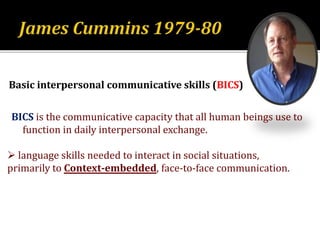
Basic interpersonal communicative skills (BICS)
BICS is the communicative capacity that all human beings use to
function in daily interpersonal exchange.
 language skills needed to interact in social situations,
primarily to Context-embedded, face-to-face communication.
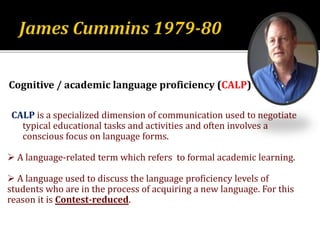
Cognitive / academic language proficiency (CALP)
CALP is a specialized dimension of communication used to negotiate
typical educational tasks and activities and often involves a
conscious focus on language forms.
 A language-related term which refers to formal academic learning.
 A language used to discuss the language proficiency levels of
students who are in the process of acquiring a new language. For this
reason it is Contest-reduced.
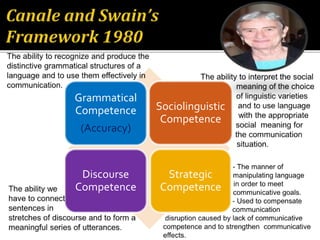
Grammatical
Competence
(Accuracy)
Sociolinguistic
Competence
Discourse
Competence
Strategic
Competence
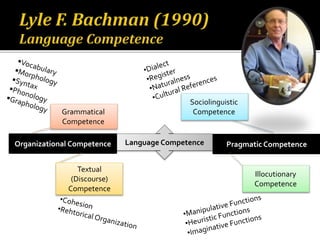
Language CompetenceOrganizational Competence Pragmatic Competence
Grammatical
Competence
Textual
(Discourse)
Competence
Illocutionary
Competence
Sociolinguistic
Competence
Language Function
Hemin Hasan
Functions are essentially the purposes that
we accomplish with language, e.g
.
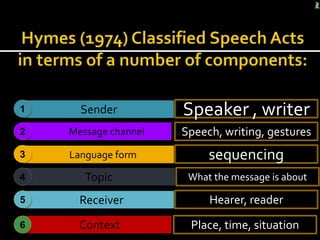
Sender1
Language form3
Topic4
Receiver5
Context6
Message channel2
Speaker , writer
Speech, writing, gestures
sequencing
What the message is about
Hearer, reader
Place, time, situation
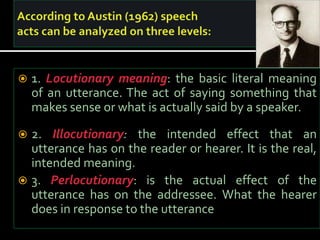
 1. Locutionary meaning: the basic literal meaning
of an utterance. The act of saying something that
makes sense or what is actually said by a speaker.
 2. Illocutionary: the intended effect that an
utterance has on the reader or hearer. It is the real,
intended meaning.
 3. Perlocutionary: is the actual effect of the
utterance has on the addressee. What the hearer
does in response to the utterance
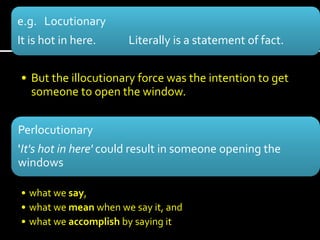
e.g. Locutionary
It is hot in here. Literally is a statement of fact.
• But the illocutionary force was the intention to get
someone to open the window.
Perlocutionary
'It's hot in here' could result in someone opening the
windows
• what we say,
• what we mean when we say it, and
• what we accomplish by saying it
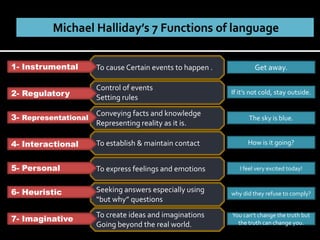
To cause Certain events to happen .1- Instrumental
Control of events
Setting rules
Conveying facts and knowledge
Representing reality as it is.
To establish & maintain contact
To express feelings and emotions
Seeking answers especially using
“but why” questions
To create ideas and imaginations
Going beyond the real world.
2- Regulatory
3- Representational
4- Interactional
5- Personal
6- Heuristic
7- Imaginative
Get away.
If it’s not cold, stay outside.
The sky is blue.
How is it going?
I feel very excited today!
why did they refuse to comply?
You can’t change the truth but
the truth can change you.
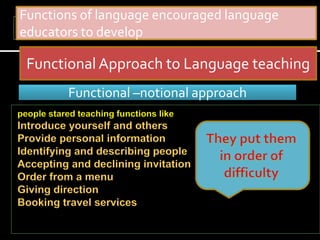
people stared teaching functions like
Introduce yourself and others
Provide personal information
Identifying and describing people
Accepting and declining invitation
Order from a menu
Giving direction
Booking travel services
Functions of language encouraged language
educators to develop
Functional Approach to Language teaching
Functional –notional approach
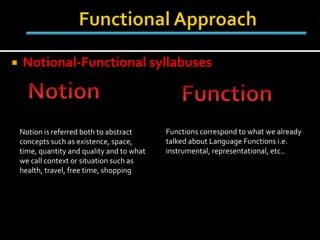
 Notional-Functional syllabuses
Notion is referred both to abstract
concepts such as existence, space,
time, quantity and quality and to what
we call context or situation such as
health, travel, free time, shopping
Functions correspond to what we already
talked about Language Functions i.e.
instrumental, representational, etc..
Pragmatics
Rashad Yaqoob
 The study of the relations between linguistic forms
and its users
 The INFERENCES made by listeners
 UNSAID “invisible meaning”
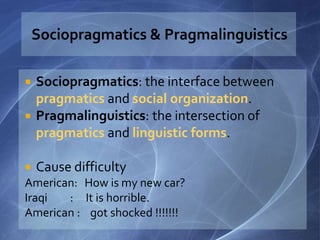
 Sociopragmatics: the interface between
pragmatics and social organization.
 Pragmalinguistics: the intersection of
pragmatics and linguistic forms.
 Cause difficulty
American: How is my new car?
Iraqi : It is horrible.
American : got shocked !!!!!!!
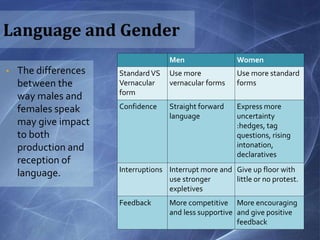
• The differences
between the
way males and
females speak
may give impact
to both
production and
reception of
language.
Men Women
StandardVS
Vernacular
form
Use more
vernacular forms
Use more standard
forms
Confidence Straight forward
language
Express more
uncertainty
:hedges, tag
questions, rising
intonation,
declaratives
Interruptions Interrupt more and
use stronger
expletives
Give up floor with
little or no protest.
Feedback More competitive
and less supportive
More encouraging
and give positive
feedback
Communicative Competence
Interactive Competence
Fibi Balami
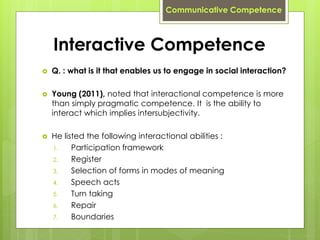
Interactive Competence
 Q. : what is it that enables us to engage in social interaction?
 Young (2011), noted that interactional competence is more
than simply pragmatic competence. It is the ability to
interact which implies intersubjectivity.
 He listed the following interactional abilities :
1. Participation framework
2. Register
3. Selection of forms in modes of meaning
4. Speech acts
5. Turn taking
6. Repair
7. Boundaries
Communicative Competence
Discourse Analysis
 Technically discourse refers to any string of words that
extends beyond the sentence.
 Discourse analysis involves the analysis of the
interrelation between form and function.
 The focus of analysis is on the context that shapes
the form and gives it meaning and function.
 Context includes, persons, places, time, topic, etc.
 Meaning is represented by the interaction of
sentences, the prior and the following.
 Without the pragmatic context, the communicative
purpose will be ambiguous
Communicative Competence
Conversation Analysis
 What are the rules that govern our conversation?
It involves an analysis to the discourse paying more
attention to the social and interaction.
This process is governed by the following rules:
1. Attention getting
2. Topic nomination
3. Topic development
4. Turn-taking
5. Topic clarification
6. Repair
7. Shifting, avoiding and interrupting
8. Topic termination
Communicative Competence
Style
 In analysing a discourse, the accepted
conventions for selecting words, phrases,
discourse, and nonverbal language is called style
Style can be classified into five speech styles:
1. Oratorical
2. Deliberative
3. Consultative
4. Casual
5. Intimate/personal
Communicative Competence
Nonverbal Communication
Bilal H. Yaseen
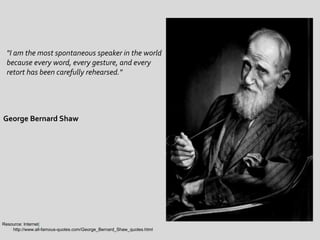
"I am the most spontaneous speaker in the world
because every word, every gesture, and every
retort has been carefully rehearsed."
Resource: Internet/
http://www.all-famous-quotes.com/George_Bernard_Shaw_quotes.html
George Bernard Shaw
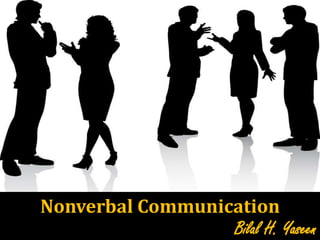
What is nonverbal communication?
Nonverbal Communication = Communication without words
o Nonverbal communication is a process of communication through sending
and receiving wordless messages.
o Communication or interpretation of information by any means other than
language.
o Edward Hall (1959) called it as ‘silent language’.
- Key importance: ‘it is not what you say, but how you say it’.
- To convey message with body language, gestures, eye contact, physical
distance, etc.
Before moving forward, let’s keep in your mind
that verbal communication and nonverbal
communication are interconnected and they
operate together in communication.
Verbal and non verbal are all types of
communication. But the difference between
them is that we use our voice in verbal
communication and we use body signs in
non-verbal communication.
Importance of Nonverbal Communication
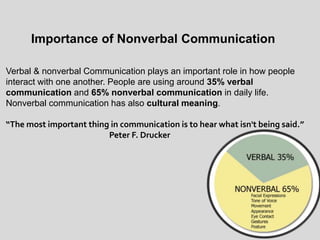
Verbal & nonverbal Communication plays an important role in how people
interact with one another. People are using around 35% verbal
communication and 65% nonverbal communication in daily life.
Nonverbal communication has also cultural meaning.
“The most important thing in communication is to hear what isn't being said.”
Peter F. Drucker
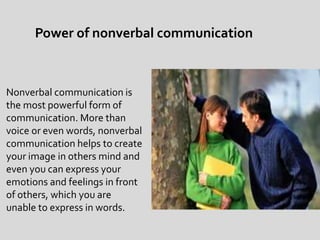
Nonverbal communication is
the most powerful form of
communication. More than
voice or even words, nonverbal
communication helps to create
your image in others mind and
even you can express your
emotions and feelings in front
of others, which you are
unable to express in words.
Power of nonverbal communication
Types of Nonverbal Communication
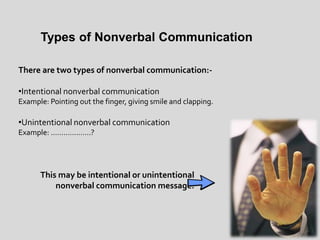
There are two types of nonverbal communication:-
•Intentional nonverbal communication
Example: Pointing out the finger, giving smile and clapping.
•Unintentional nonverbal communication
Example: ……………….?
This may be intentional or unintentional
nonverbal communication message.
Forms of nonverbal communication
• KINESICS
• Eye Contact
• PROXEMICS/ Personal Space
• ARTIFACTS
• KINESTHETIC
• OLFACTORY DIMENSION
• Facial Expressions
• Posture
• Gestures
Kinesics is the non-verbal behaviour related to
movement, either of any part of the body, or the
body as a whole.
In short all communicative body movements are
generally classified as kinesics.
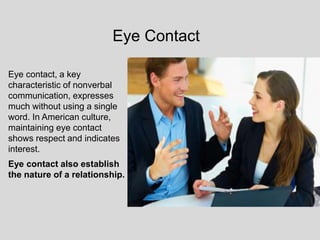
Eye contact, a key
characteristic of nonverbal
communication, expresses
much without using a single
word. In American culture,
maintaining eye contact
shows respect and indicates
interest.
Eye contact also establish
the nature of a relationship.
Eye Contact
Have you ever felt
uncomfortable during a
conversation because the
other person was standing
too close and invading your
space?
People often refer to their
need for "personal space,"
which is also an important
type of nonverbal
communication.
When someone violates an
appropriate distance,
people may feel
uncomfortable or defensive.
Their actions may well be
open to misinterpretation.
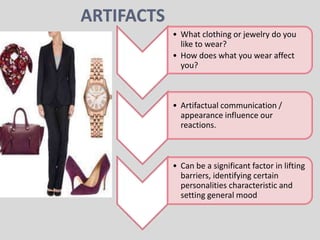
• What clothing or jewelry do you
like to wear?
• How does what you wear affect
you?
• Artifactual communication /
appearance influence our
reactions.
• Can be a significant factor in lifting
barriers, identifying certain
personalities characteristic and
setting general mood
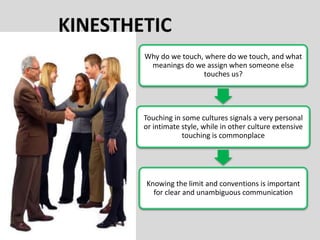
Why do we touch, where do we touch, and what
meanings do we assign when someone else
touches us?
Touching in some cultures signals a very personal
or intimate style, while in other culture extensive
touching is commonplace
Knowing the limit and conventions is important
for clear and unambiguous communication
The olfactory
system concerns the sense of
smell.
Our sense of smell can deliver
many different messages.
Subtle but powerful ways to
influence how one reacts to
other people
The smell of human
perspiration is quite
acceptable and attractive.
Exp: Lotions,Creams,
Powders, etc..
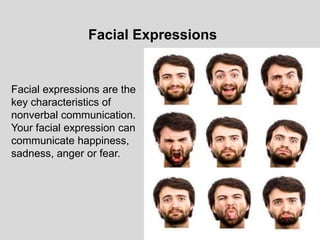
Facial expressions are the
key characteristics of
nonverbal communication.
Your facial expression can
communicate happiness,
sadness, anger or fear.
Facial Expressions
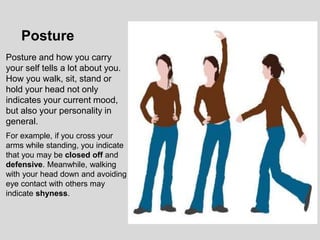
Posture and how you carry
your self tells a lot about you.
How you walk, sit, stand or
hold your head not only
indicates your current mood,
but also your personality in
general.
For example, if you cross your
arms while standing, you indicate
that you may be closed off and
defensive. Meanwhile, walking
with your head down and avoiding
eye contact with others may
indicate shyness.
Posture
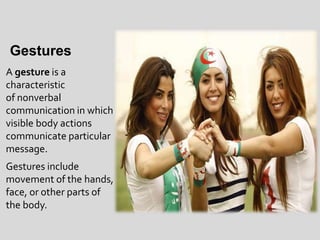
A gesture is a
characteristic
of nonverbal
communication in which
visible body actions
communicate particular
message.
Gestures include
movement of the hands,
face, or other parts of
the body.
Gestures
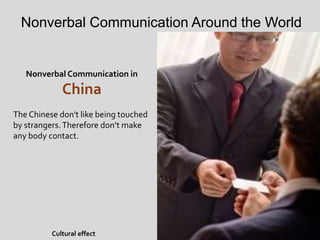
Nonverbal Communication Around the World
Nonverbal Communication in
China
The Chinese don't like being touched
by strangers.Therefore don’t make
any body contact.
Cultural effect
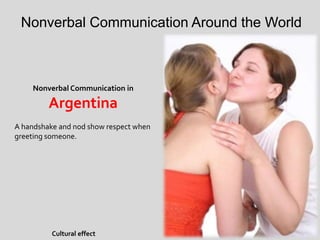
Nonverbal Communication Around the World
Nonverbal Communication in
Argentina
A handshake and nod show respect when
greeting someone.
Cultural effect
Nonverbal Communication Around the World
Nonverbal Communication in
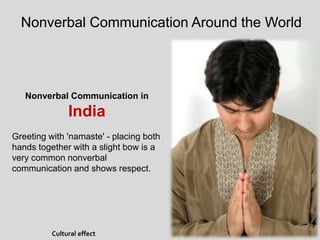
India
Greeting with 'namaste' - placing both
hands together with a slight bow is a
very common nonverbal
communication and shows respect.
Cultural effect
Nonverbal Communication Around the World
Nonverbal Communication in
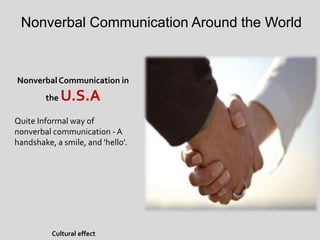
the U.S.A
Quite Informal way of
nonverbal communication - A
handshake, a smile, and 'hello'.
Cultural effect
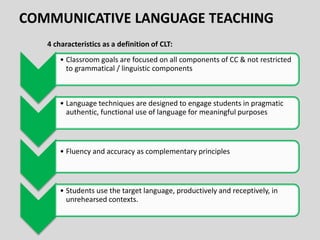
• Classroom goals are focused on all components of CC & not restricted
to grammatical / linguistic components
• Language techniques are designed to engage students in pragmatic
authentic, functional use of language for meaningful purposes
• Fluency and accuracy as complementary principles
• Students use the target language, productively and receptively, in
unrehearsed contexts.
4 characteristics as a definition of CLT:
Communicative Competence -Final PPT.

Communicative Competence -Final PPT.

  • 1.
    Presented by Hani ShakirGS39584 Hemin Hasan GS40423 Rashad Yaqoob GS38704 Fibi Balami GsS41868 Bilal H. Yaseen GS39550 Presented to Dr. Che An Abdul Ghani Faculty of Modern Languages and Communication University Putra Malaysia November 2014
  • 2.
    Definitions of CommunicativeCompetence Hani Shakir
  • 3.
    The idea wasoriginally derived from Chomsky’s distinction between Competence and Performance.  Competence: shared knowledge of ideal speaker-listener set in a completely homogenous speech community.  Performance: process of applying underlying knowledge to actual language.
  • 4.
    Hymes: Chomsky’s viewis too narrow to describe language behavior as a whole. Communicative Competence: is the aspect of our competence that enables us to convey and interpret messages and to negotiate meanings interpersonally within specific contexts. (Hymes 1972)  Sociocultural factors or differential competence in a heterogeneous speech community.  Social life affects outward performance and inner competence itself.  Social factors interfere with or restrict grammar use because the rules of use are dominant over the rules of grammar
  • 5.
    Basic interpersonal communicativeskills (BICS) BICS is the communicative capacity that all human beings use to function in daily interpersonal exchange.  language skills needed to interact in social situations, primarily to Context-embedded, face-to-face communication.
  • 6.
    Cognitive / academiclanguage proficiency (CALP) CALP is a specialized dimension of communication used to negotiate typical educational tasks and activities and often involves a conscious focus on language forms.  A language-related term which refers to formal academic learning.  A language used to discuss the language proficiency levels of students who are in the process of acquiring a new language. For this reason it is Contest-reduced.
  • 7.
  • 8.
    Language CompetenceOrganizational CompetencePragmatic Competence Grammatical Competence Textual (Discourse) Competence Illocutionary Competence Sociolinguistic Competence
  • 9.
  • 10.
    Functions are essentiallythe purposes that we accomplish with language, e.g
  • 11.
  • 12.
    Sender1 Language form3 Topic4 Receiver5 Context6 Message channel2 Speaker, writer Speech, writing, gestures sequencing What the message is about Hearer, reader Place, time, situation
  • 13.
     1. Locutionarymeaning: the basic literal meaning of an utterance. The act of saying something that makes sense or what is actually said by a speaker.  2. Illocutionary: the intended effect that an utterance has on the reader or hearer. It is the real, intended meaning.  3. Perlocutionary: is the actual effect of the utterance has on the addressee. What the hearer does in response to the utterance
  • 14.
    e.g. Locutionary It ishot in here. Literally is a statement of fact. • But the illocutionary force was the intention to get someone to open the window. Perlocutionary 'It's hot in here' could result in someone opening the windows • what we say, • what we mean when we say it, and • what we accomplish by saying it
  • 15.
    To cause Certainevents to happen .1- Instrumental Control of events Setting rules Conveying facts and knowledge Representing reality as it is. To establish & maintain contact To express feelings and emotions Seeking answers especially using “but why” questions To create ideas and imaginations Going beyond the real world. 2- Regulatory 3- Representational 4- Interactional 5- Personal 6- Heuristic 7- Imaginative Get away. If it’s not cold, stay outside. The sky is blue. How is it going? I feel very excited today! why did they refuse to comply? You can’t change the truth but the truth can change you.
  • 16.
    people stared teachingfunctions like Introduce yourself and others Provide personal information Identifying and describing people Accepting and declining invitation Order from a menu Giving direction Booking travel services Functions of language encouraged language educators to develop Functional Approach to Language teaching Functional –notional approach
  • 17.
     Notional-Functional syllabuses Notionis referred both to abstract concepts such as existence, space, time, quantity and quality and to what we call context or situation such as health, travel, free time, shopping Functions correspond to what we already talked about Language Functions i.e. instrumental, representational, etc..
  • 18.
  • 19.
     The studyof the relations between linguistic forms and its users  The INFERENCES made by listeners  UNSAID “invisible meaning”
  • 21.
     Sociopragmatics: theinterface between pragmatics and social organization.  Pragmalinguistics: the intersection of pragmatics and linguistic forms.  Cause difficulty American: How is my new car? Iraqi : It is horrible. American : got shocked !!!!!!!
  • 22.
    • The differences betweenthe way males and females speak may give impact to both production and reception of language. Men Women StandardVS Vernacular form Use more vernacular forms Use more standard forms Confidence Straight forward language Express more uncertainty :hedges, tag questions, rising intonation, declaratives Interruptions Interrupt more and use stronger expletives Give up floor with little or no protest. Feedback More competitive and less supportive More encouraging and give positive feedback
  • 23.
  • 24.
    Interactive Competence  Q.: what is it that enables us to engage in social interaction?  Young (2011), noted that interactional competence is more than simply pragmatic competence. It is the ability to interact which implies intersubjectivity.  He listed the following interactional abilities : 1. Participation framework 2. Register 3. Selection of forms in modes of meaning 4. Speech acts 5. Turn taking 6. Repair 7. Boundaries Communicative Competence
  • 25.
    Discourse Analysis  Technicallydiscourse refers to any string of words that extends beyond the sentence.  Discourse analysis involves the analysis of the interrelation between form and function.  The focus of analysis is on the context that shapes the form and gives it meaning and function.  Context includes, persons, places, time, topic, etc.  Meaning is represented by the interaction of sentences, the prior and the following.  Without the pragmatic context, the communicative purpose will be ambiguous Communicative Competence
  • 26.
    Conversation Analysis  Whatare the rules that govern our conversation? It involves an analysis to the discourse paying more attention to the social and interaction. This process is governed by the following rules: 1. Attention getting 2. Topic nomination 3. Topic development 4. Turn-taking 5. Topic clarification 6. Repair 7. Shifting, avoiding and interrupting 8. Topic termination Communicative Competence
  • 27.
    Style  In analysinga discourse, the accepted conventions for selecting words, phrases, discourse, and nonverbal language is called style Style can be classified into five speech styles: 1. Oratorical 2. Deliberative 3. Consultative 4. Casual 5. Intimate/personal Communicative Competence
  • 28.
  • 29.
    "I am themost spontaneous speaker in the world because every word, every gesture, and every retort has been carefully rehearsed." Resource: Internet/ http://www.all-famous-quotes.com/George_Bernard_Shaw_quotes.html George Bernard Shaw
  • 30.
    What is nonverbalcommunication? Nonverbal Communication = Communication without words o Nonverbal communication is a process of communication through sending and receiving wordless messages. o Communication or interpretation of information by any means other than language. o Edward Hall (1959) called it as ‘silent language’. - Key importance: ‘it is not what you say, but how you say it’. - To convey message with body language, gestures, eye contact, physical distance, etc.
  • 31.
    Before moving forward,let’s keep in your mind that verbal communication and nonverbal communication are interconnected and they operate together in communication.
  • 32.
    Verbal and nonverbal are all types of communication. But the difference between them is that we use our voice in verbal communication and we use body signs in non-verbal communication.
  • 33.
    Importance of NonverbalCommunication Verbal & nonverbal Communication plays an important role in how people interact with one another. People are using around 35% verbal communication and 65% nonverbal communication in daily life. Nonverbal communication has also cultural meaning. “The most important thing in communication is to hear what isn't being said.” Peter F. Drucker
  • 34.
    Nonverbal communication is themost powerful form of communication. More than voice or even words, nonverbal communication helps to create your image in others mind and even you can express your emotions and feelings in front of others, which you are unable to express in words. Power of nonverbal communication
  • 35.
    Types of NonverbalCommunication There are two types of nonverbal communication:- •Intentional nonverbal communication Example: Pointing out the finger, giving smile and clapping. •Unintentional nonverbal communication Example: ……………….? This may be intentional or unintentional nonverbal communication message.
  • 36.
    Forms of nonverbalcommunication • KINESICS • Eye Contact • PROXEMICS/ Personal Space • ARTIFACTS • KINESTHETIC • OLFACTORY DIMENSION • Facial Expressions • Posture • Gestures
  • 37.
    Kinesics is thenon-verbal behaviour related to movement, either of any part of the body, or the body as a whole. In short all communicative body movements are generally classified as kinesics.
  • 38.
    Eye contact, akey characteristic of nonverbal communication, expresses much without using a single word. In American culture, maintaining eye contact shows respect and indicates interest. Eye contact also establish the nature of a relationship. Eye Contact
  • 39.
    Have you everfelt uncomfortable during a conversation because the other person was standing too close and invading your space? People often refer to their need for "personal space," which is also an important type of nonverbal communication. When someone violates an appropriate distance, people may feel uncomfortable or defensive. Their actions may well be open to misinterpretation.
  • 40.
    • What clothingor jewelry do you like to wear? • How does what you wear affect you? • Artifactual communication / appearance influence our reactions. • Can be a significant factor in lifting barriers, identifying certain personalities characteristic and setting general mood
  • 41.
    Why do wetouch, where do we touch, and what meanings do we assign when someone else touches us? Touching in some cultures signals a very personal or intimate style, while in other culture extensive touching is commonplace Knowing the limit and conventions is important for clear and unambiguous communication
  • 42.
    The olfactory system concernsthe sense of smell. Our sense of smell can deliver many different messages. Subtle but powerful ways to influence how one reacts to other people The smell of human perspiration is quite acceptable and attractive. Exp: Lotions,Creams, Powders, etc..
  • 43.
    Facial expressions arethe key characteristics of nonverbal communication. Your facial expression can communicate happiness, sadness, anger or fear. Facial Expressions
  • 44.
    Posture and howyou carry your self tells a lot about you. How you walk, sit, stand or hold your head not only indicates your current mood, but also your personality in general. For example, if you cross your arms while standing, you indicate that you may be closed off and defensive. Meanwhile, walking with your head down and avoiding eye contact with others may indicate shyness. Posture
  • 45.
    A gesture isa characteristic of nonverbal communication in which visible body actions communicate particular message. Gestures include movement of the hands, face, or other parts of the body. Gestures
  • 46.
    Nonverbal Communication Aroundthe World Nonverbal Communication in China The Chinese don't like being touched by strangers.Therefore don’t make any body contact. Cultural effect
  • 47.
    Nonverbal Communication Aroundthe World Nonverbal Communication in Argentina A handshake and nod show respect when greeting someone. Cultural effect
  • 48.
    Nonverbal Communication Aroundthe World Nonverbal Communication in India Greeting with 'namaste' - placing both hands together with a slight bow is a very common nonverbal communication and shows respect. Cultural effect
  • 49.
    Nonverbal Communication Aroundthe World Nonverbal Communication in the U.S.A Quite Informal way of nonverbal communication - A handshake, a smile, and 'hello'. Cultural effect
  • 50.
    • Classroom goalsare focused on all components of CC & not restricted to grammatical / linguistic components • Language techniques are designed to engage students in pragmatic authentic, functional use of language for meaningful purposes • Fluency and accuracy as complementary principles • Students use the target language, productively and receptively, in unrehearsed contexts. 4 characteristics as a definition of CLT: