DEEP STRUCTURE AND
SURFACE STRUCTURE
Executed by: Turganbekova A.,
Uglamova Sh., 315 group
Structure can be defined as a set of relations
on a linear sequence of units, such that criteria
can be defined for when the structure has been
completed.
One of the most important concepts
proposed by Chomsky is the concept
of surface and deep structure.
The surface structure is actually produced structure.
It refers to the sentence as it is pronounced or written.
The deep structure is the abstract structure that allows
the native speaker of a language to know what the
sentence means. It may then be said that the deep structure
expresses the semantic contents of a sentence, whereas the
surface structure of a sentence determines its phonetic
form.
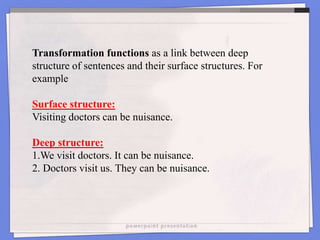
Transformation functions as a link between deep
structure of sentences and their surface structures. For
example
Surface structure:
Visiting doctors can be nuisance.
Deep structure:
1.We visit doctors. It can be nuisance.
2. Doctors visit us. They can be nuisance.
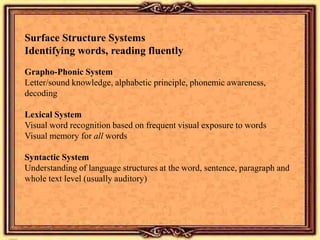
Surface Structure Systems
Identifying words, reading fluently
Grapho-Phonic System
Letter/sound knowledge, alphabetic principle, phonemic awareness,
decoding
Lexical System
Visual word recognition based on frequent visual exposure to words
Visual memory for all words
Syntactic System
Understanding of language structures at the word, sentence, paragraph and
whole text level (usually auditory)
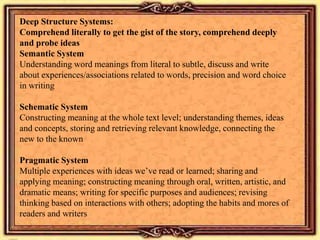
Deep Structure Systems:
Comprehend literally to get the gist of the story, comprehend deeply
and probe ideas
Semantic System
Understanding word meanings from literal to subtle, discuss and write
about experiences/associations related to words, precision and word choice
in writing
Schematic System
Constructing meaning at the whole text level; understanding themes, ideas
and concepts, storing and retrieving relevant knowledge, connecting the
new to the known
Pragmatic System
Multiple experiences with ideas we’ve read or learned; sharing and
applying meaning; constructing meaning through oral, written, artistic, and
dramatic means; writing for specific purposes and audiences; revising
thinking based on interactions with others; adopting the habits and mores of
readers and writers
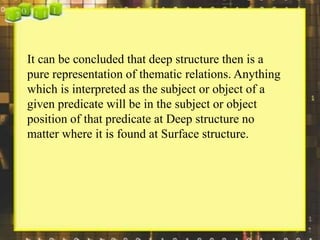
It can be concluded that deep structure then is a
pure representation of thematic relations. Anything
which is interpreted as the subject or object of a
given predicate will be in the subject or object
position of that predicate at Deep structure no
matter where it is found at Surface structure.
Literature:
•http://awinlanguage.blogspot.com/2012/04/dee
p-structure-vs-surface-structure.html
•http://noamchomsky2011.blogspot.com/2011/1
1/deep-and-surface-structure-in-
chomskys.html

Deep and surface_structures

  • 1.
    DEEP STRUCTURE AND SURFACESTRUCTURE Executed by: Turganbekova A., Uglamova Sh., 315 group
  • 2.
    Structure can bedefined as a set of relations on a linear sequence of units, such that criteria can be defined for when the structure has been completed.
  • 3.
    One of themost important concepts proposed by Chomsky is the concept of surface and deep structure.
  • 4.
    The surface structureis actually produced structure. It refers to the sentence as it is pronounced or written. The deep structure is the abstract structure that allows the native speaker of a language to know what the sentence means. It may then be said that the deep structure expresses the semantic contents of a sentence, whereas the surface structure of a sentence determines its phonetic form.
  • 5.
    Transformation functions asa link between deep structure of sentences and their surface structures. For example Surface structure: Visiting doctors can be nuisance. Deep structure: 1.We visit doctors. It can be nuisance. 2. Doctors visit us. They can be nuisance.
  • 6.
    Surface Structure Systems Identifyingwords, reading fluently Grapho-Phonic System Letter/sound knowledge, alphabetic principle, phonemic awareness, decoding Lexical System Visual word recognition based on frequent visual exposure to words Visual memory for all words Syntactic System Understanding of language structures at the word, sentence, paragraph and whole text level (usually auditory)
  • 7.
    Deep Structure Systems: Comprehendliterally to get the gist of the story, comprehend deeply and probe ideas Semantic System Understanding word meanings from literal to subtle, discuss and write about experiences/associations related to words, precision and word choice in writing Schematic System Constructing meaning at the whole text level; understanding themes, ideas and concepts, storing and retrieving relevant knowledge, connecting the new to the known Pragmatic System Multiple experiences with ideas we’ve read or learned; sharing and applying meaning; constructing meaning through oral, written, artistic, and dramatic means; writing for specific purposes and audiences; revising thinking based on interactions with others; adopting the habits and mores of readers and writers
  • 8.
    It can beconcluded that deep structure then is a pure representation of thematic relations. Anything which is interpreted as the subject or object of a given predicate will be in the subject or object position of that predicate at Deep structure no matter where it is found at Surface structure.
  • 9.