SENSORS AND THEIR APPLICATIONS
PRESENTED BY: PRESENTED TO:
KAMAL JEET K SHRINAVASRAO
B.TECH (ECE) DEPT. OF ECE
CONTENTS
 Introduction about Sensors
 Different types of Sensors in Smartphones
 IR based proximity Sensor
 Application of Proximity sensor
Introduction about sensors
 A sensor is a device that detects and responds to some type
of input from the physical environment.
 The specific input could be light, heat, motion, moisture,
pressure or any other environmental phenomena.
 The output is generally a signal that is converted to human
readable display at the sensor location or transmitted
electronically over a network for reading or further processing.
Sensors in Smartphones
Accelerometer
 The accelerometer is a built-in electronic component that measures tilt
and motion.
 It measures linear acceleration of movement.
 Capable of detecting rotation and motion gestures such as swinging &
shaking.
 The most common use for it is to activate auto screen rotation on
smartphones when the user changes their orientation.
 Another modern application for the accelerometer is to control the mobile
device music with gestures & also enriching the gaming controls.
 Gyroscope
 The gyroscope, or gyro for short is and advance version of
accelerometer most commonly
used in smartphones.
 It is sensor that can provide orientation information as well,
but with precision, android’s photo sphere camera feature can
tell how much a phone has been rotated and in which
orientation.
 Gyroscope measures the angular rotational velocity &
measures rate of change of different things.
 When we combine the 3-axis accelerometer with 3-axis gyro,
we get an output that is both clean and responsive.
IR based proximity sensor
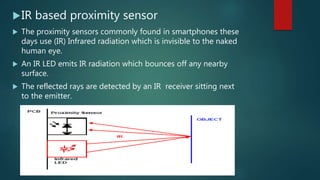
 The proximity sensors commonly found in smartphones these
days use (IR) Infrared radiation which is invisible to the naked
human eye.
 An IR LED emits IR radiation which bounces off any nearby
surface.
 The reflected rays are detected by an IR receiver sitting next
to the emitter.
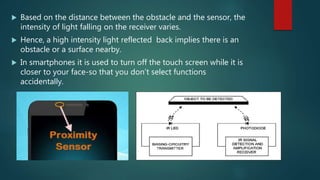
 Based on the distance between the obstacle and the sensor, the
intensity of light falling on the receiver varies.
 Hence, a high intensity light reflected back implies there is an
obstacle or a surface nearby.
 In smartphones it is used to turn off the touch screen while it is
closer to your face-so that you don’t select functions
accidentally.
Applications
 Detecting Dynamic Motion
 Position Measurement
 Touchscreen & Touchpads
 Most commonly found in smartphones
 Parking sensors, system mounted on car bumpers that sense
distance to nearby cars for parking
References:
 en.Wikipedia.org/wiki/Proximity-sensors
 www.g9toengineering.com
 www.quora.com
 technical guruji.in

Sensors & applications , commenly used sensors

  • 1.
    SENSORS AND THEIRAPPLICATIONS PRESENTED BY: PRESENTED TO: KAMAL JEET K SHRINAVASRAO B.TECH (ECE) DEPT. OF ECE
  • 2.
    CONTENTS  Introduction aboutSensors  Different types of Sensors in Smartphones  IR based proximity Sensor  Application of Proximity sensor
  • 3.
    Introduction about sensors A sensor is a device that detects and responds to some type of input from the physical environment.  The specific input could be light, heat, motion, moisture, pressure or any other environmental phenomena.  The output is generally a signal that is converted to human readable display at the sensor location or transmitted electronically over a network for reading or further processing.
  • 4.
    Sensors in Smartphones Accelerometer The accelerometer is a built-in electronic component that measures tilt and motion.  It measures linear acceleration of movement.  Capable of detecting rotation and motion gestures such as swinging & shaking.  The most common use for it is to activate auto screen rotation on smartphones when the user changes their orientation.  Another modern application for the accelerometer is to control the mobile device music with gestures & also enriching the gaming controls.
  • 5.
     Gyroscope  Thegyroscope, or gyro for short is and advance version of accelerometer most commonly used in smartphones.  It is sensor that can provide orientation information as well, but with precision, android’s photo sphere camera feature can tell how much a phone has been rotated and in which orientation.  Gyroscope measures the angular rotational velocity & measures rate of change of different things.  When we combine the 3-axis accelerometer with 3-axis gyro, we get an output that is both clean and responsive.
  • 6.
    IR based proximitysensor  The proximity sensors commonly found in smartphones these days use (IR) Infrared radiation which is invisible to the naked human eye.  An IR LED emits IR radiation which bounces off any nearby surface.  The reflected rays are detected by an IR receiver sitting next to the emitter.
  • 7.
     Based onthe distance between the obstacle and the sensor, the intensity of light falling on the receiver varies.  Hence, a high intensity light reflected back implies there is an obstacle or a surface nearby.  In smartphones it is used to turn off the touch screen while it is closer to your face-so that you don’t select functions accidentally.
  • 8.
    Applications  Detecting DynamicMotion  Position Measurement  Touchscreen & Touchpads  Most commonly found in smartphones  Parking sensors, system mounted on car bumpers that sense distance to nearby cars for parking
  • 9.