SENSORS AND ITS TYPES
By: Nutronics India1
WHAT ARE SENSORS?
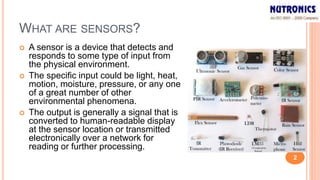
 A sensor is a device that detects and
responds to some type of input from
the physical environment.
 The specific input could be light, heat,
motion, moisture, pressure, or any one
of a great number of other
environmental phenomena.
 The output is generally a signal that is
converted to human-readable display
at the sensor location or transmitted
electronically over a network for
reading or further processing.
2
CRITERIA TO CHOOSE A SENSOR
 There are certain features which have to be considered when
we choose a sensor. They are as given below:
 Accuracy
 Environmental condition – usually has limits for temperature/
humidity
 Range – Measurement limit of sensor
 Calibration – Essential for most of the measuring devices as the
readings changes with time
 Resolution – Smallest increment detected by the sensor
 Cost
 Repeatability – The reading that varies is repeatedly measured
under the same environment 3
TYPES OF SENSORS
 Temperature – Thermistors, thermocouples, RTD’s, IC and many more.
 Pressure – Fibre optic, vacuum, elastic liquid based manometers, LVDT, electronic.
 Flow – Electromagnetic, differential pressure, positional displacement, thermal mass, etc.
 Level Sensors – Differential pressure, ultrasonic radio frequency, radar, thermal
displacement, etc.
 Proximity and displacement – LVDT, photoelectric, capacitive, magnetic, ultrasonic.
 Biosensors – Resonant mirror, electrochemical, surface Plasmon resonance, Light
addressable potentio-metric.
 Image – Charge coupled devices, CMOS
 Gas and chemical – Semiconductor, Infrared, Conductance, Electrochemical.
 Acceleration – Gyroscopes, Accelerometers.
 Others – Moisture, humidity sensor, Speed sensor, mass, Tilt sensor, force, viscosity.
4
SENSORS SOLD BY NUTRONICS INDIA
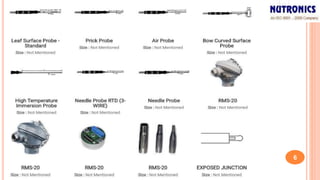
 Temperature Sensors
 This device collects information about temperature from a
source and converts into a form that is understandable by
other device or person.
 The best illustration of a temperature sensor is mercury in
glass thermometer. The mercury in the glass expands and
contracts depending on the alterations in temperature.
 The outside temperature is the source element for the
temperature measurement. The position of the mercury is
observed by the viewer to measure the temperature.
5
6
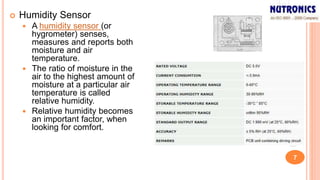
 Humidity Sensor
 A humidity sensor (or
hygrometer) senses,
measures and reports both
moisture and air
temperature.
 The ratio of moisture in the
air to the highest amount of
moisture at a particular air
temperature is called
relative humidity.
 Relative humidity becomes
an important factor, when
looking for comfort.
7
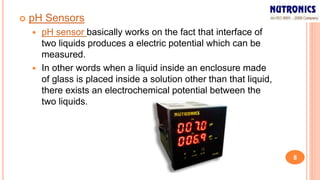
 pH Sensors
 pH sensor basically works on the fact that interface of
two liquids produces a electric potential which can be
measured.
 In other words when a liquid inside an enclosure made
of glass is placed inside a solution other than that liquid,
there exists an electrochemical potential between the
two liquids.
8
9

Sensors and its types

  • 1.
    SENSORS AND ITSTYPES By: Nutronics India1
  • 2.
    WHAT ARE SENSORS? A sensor is a device that detects and responds to some type of input from the physical environment.  The specific input could be light, heat, motion, moisture, pressure, or any one of a great number of other environmental phenomena.  The output is generally a signal that is converted to human-readable display at the sensor location or transmitted electronically over a network for reading or further processing. 2
  • 3.
    CRITERIA TO CHOOSEA SENSOR  There are certain features which have to be considered when we choose a sensor. They are as given below:  Accuracy  Environmental condition – usually has limits for temperature/ humidity  Range – Measurement limit of sensor  Calibration – Essential for most of the measuring devices as the readings changes with time  Resolution – Smallest increment detected by the sensor  Cost  Repeatability – The reading that varies is repeatedly measured under the same environment 3
  • 4.
    TYPES OF SENSORS Temperature – Thermistors, thermocouples, RTD’s, IC and many more.  Pressure – Fibre optic, vacuum, elastic liquid based manometers, LVDT, electronic.  Flow – Electromagnetic, differential pressure, positional displacement, thermal mass, etc.  Level Sensors – Differential pressure, ultrasonic radio frequency, radar, thermal displacement, etc.  Proximity and displacement – LVDT, photoelectric, capacitive, magnetic, ultrasonic.  Biosensors – Resonant mirror, electrochemical, surface Plasmon resonance, Light addressable potentio-metric.  Image – Charge coupled devices, CMOS  Gas and chemical – Semiconductor, Infrared, Conductance, Electrochemical.  Acceleration – Gyroscopes, Accelerometers.  Others – Moisture, humidity sensor, Speed sensor, mass, Tilt sensor, force, viscosity. 4
  • 5.
    SENSORS SOLD BYNUTRONICS INDIA  Temperature Sensors  This device collects information about temperature from a source and converts into a form that is understandable by other device or person.  The best illustration of a temperature sensor is mercury in glass thermometer. The mercury in the glass expands and contracts depending on the alterations in temperature.  The outside temperature is the source element for the temperature measurement. The position of the mercury is observed by the viewer to measure the temperature. 5
  • 6.
  • 7.
     Humidity Sensor A humidity sensor (or hygrometer) senses, measures and reports both moisture and air temperature.  The ratio of moisture in the air to the highest amount of moisture at a particular air temperature is called relative humidity.  Relative humidity becomes an important factor, when looking for comfort. 7
  • 8.
     pH Sensors pH sensor basically works on the fact that interface of two liquids produces a electric potential which can be measured.  In other words when a liquid inside an enclosure made of glass is placed inside a solution other than that liquid, there exists an electrochemical potential between the two liquids. 8
  • 9.