Unit 2: Sensors &Actuators 6 hrs
Hall Effect, hot wire, thermistor, piezoelectric, pizoresistive
based sensors. Introduction, basic sensor arrangement, types of
sensors, oxygen concentration sensor, lambda sensor, crankshaft
angular position sensor, cam position sensor, Mass air flow
(MAF) rate, Manifold absolute pressure (MAP), Throttle plate
angular position, engine oil pressure sensor, vehicle speed sensor,
stepper motors, relays, detonation sensor, emission sensors.
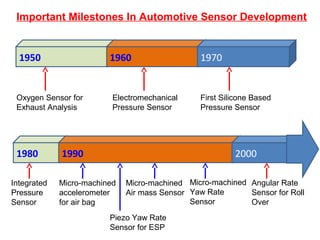
1950 1960 1970
Oxygen Sensor for
Exhaust Analysis
Electromechanical
Pressure Sensor
First Silicone Based
Pressure Sensor
1980 1990 2000
Integrated
Pressure
Sensor
Micro-machined
accelerometer
for air bag
Angular Rate
Sensor for Roll
Over
Micro-machined
Yaw Rate
Sensor
Micro-machined
Air mass Sensor
Piezo Yaw Rate
Sensor for ESP
Important Milestones In Automotive Sensor Development
Micromachining
Microfabrication of mechanical structures using
several microelectronics or micromechanics
processing techniques.
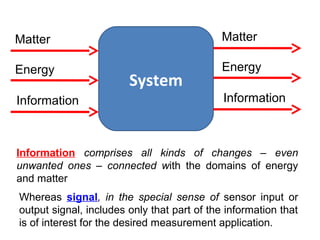
System
Energy
Matter
Information
Energy
Matter
Information
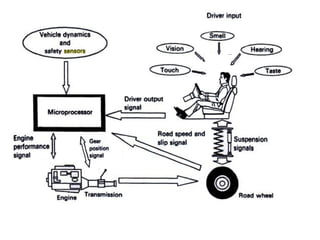
Information comprises all kinds of changes – even
unwanted ones – connected with the domains of energy
and matter
Whereas signal, in the special sense of sensor input or
output signal, includes only that part of the information that
is of interest for the desired measurement application.
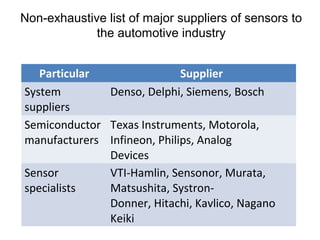
Non-exhaustive list of major suppliers of sensors to
the automotive industry
Particular Supplier
System
suppliers
Denso, Delphi, Siemens, Bosch
Semiconductor
manufacturers
Texas Instruments, Motorola,
Infineon, Philips, Analog
Devices
Sensor
specialists
VTI-Hamlin, Sensonor, Murata,
Matsushita, Systron-
Donner, Hitachi, Kavlico, Nagano
Keiki
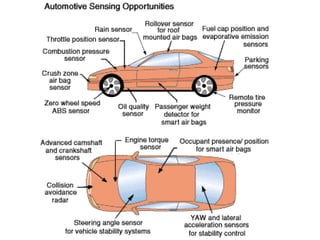
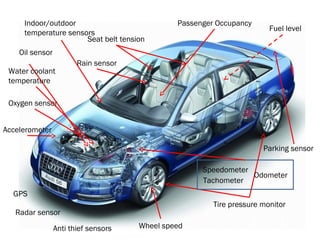
Oil sensor
Oxygen sensor
Fuel level
Accelerometer
Seat belt tension
Passenger Occupancy
Wheel speed
Tire pressure monitor
Anti thief sensors
Radar sensor
Rain sensor
Parking sensor
Indoor/outdoor
temperature sensors
GPS
Water coolant
temperature
Tachometer
Speedometer
Odometer
Sensors convert a physical or chemical (usually non-
electrical) quantity into an electrical quantity (non-electrical
intermediate stages may be employed).
Actuators (final-control elements) form the junction between
the electronic signal processor (data processing) and the
actual process (mechanical motion). They convert the low-
power signals conveying the positioning information into
operating signals of an energy level adequate for process
control. Signal converters are combined with amplifier
elements to exploit the physical transformation principles
governing the interrelationships between various forms of
energy (electrical –mechanical – fluid – thermal).
Sensors and actuators are the unsung heroes of the
automobile world. These devices perform most of the
maintenance functions for cars including communicating the
system's status to the car's on-board computer, monitoring
speed, and calculating engine timing. These devices have
several types that perform unique functions, with some
dependent on crystal vibration while others work with
magnetism to correctly calibrate automobile instrumentation.
Automotive sensors are commonly used to measure:
• Pressure
• position and level
• Flow
• Temperature
• gas composition
• vibration (knock)
• Acceleration
• Speed
• rotation (position).
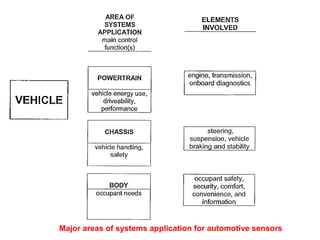
Major areas of systems application for automotive sensors
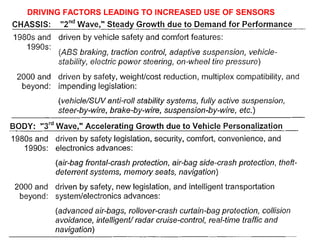
DRIVING FACTORS LEADING TO INCREASED USE OF SENSORS
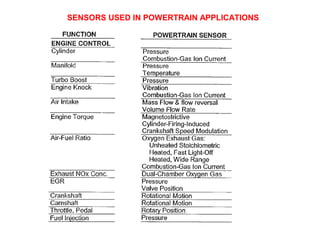
Powertrain systems, control functions and applications
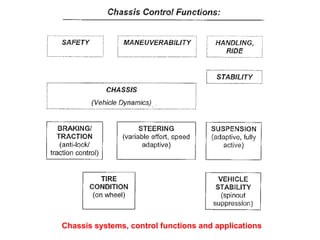
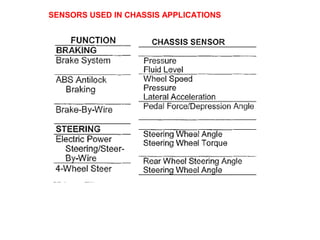
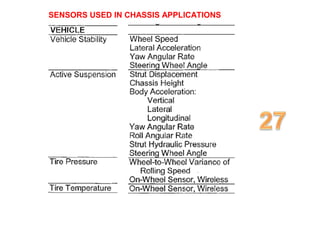
Chassis systems, control functions and applications
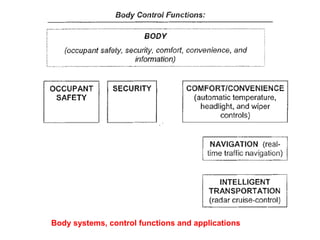
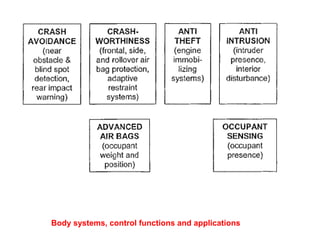
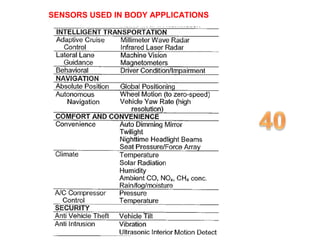
Body systems, control functions and applications
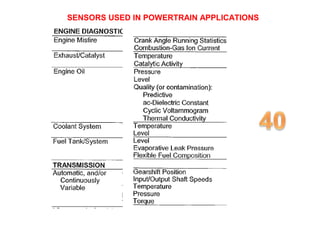
SENSORS USED IN POWERTRAIN APPLICATIONS
SENSORS USED IN CHASSIS APPLICATIONS
SENSORS USED IN BODY APPLICATIONS
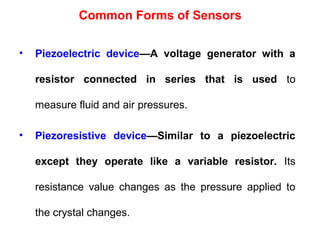
• Piezoelectric device—A voltage generator with a
resistor connected in series that is used to
measure fluid and air pressures.
• Piezoresistive device—Similar to a piezoelectric
except they operate like a variable resistor. Its
resistance value changes as the pressure applied to
the crystal changes.
Common Forms of Sensors
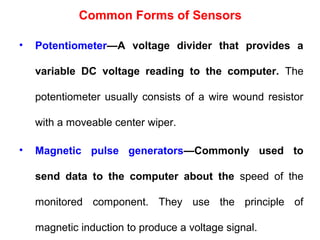
• Potentiometer—A voltage divider that provides a
variable DC voltage reading to the computer. The
potentiometer usually consists of a wire wound resistor
with a moveable center wiper.
• Magnetic pulse generators—Commonly used to
send data to the computer about the speed of the
monitored component. They use the principle of
magnetic induction to produce a voltage signal.
Common Forms of Sensors
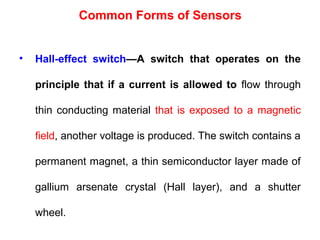
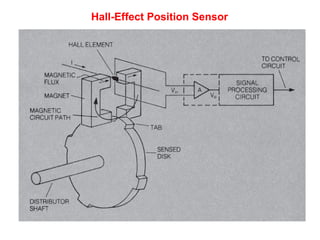
• Hall-effect switch—A switch that operates on the
principle that if a current is allowed to flow through
thin conducting material that is exposed to a magnetic
field, another voltage is produced. The switch contains a
permanent magnet, a thin semiconductor layer made of
gallium arsenate crystal (Hall layer), and a shutter
wheel.
Common Forms of Sensors
Hall effect devices
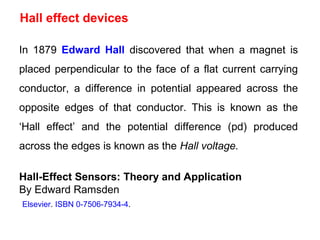
In 1879 Edward Hall discovered that when a magnet is
placed perpendicular to the face of a flat current carrying
conductor, a difference in potential appeared across the
opposite edges of that conductor. This is known as the
‘Hall effect’ and the potential difference (pd) produced
across the edges is known as the Hall voltage.
Hall-Effect Sensors: Theory and Application
By Edward Ramsden
Elsevier. ISBN 0-7506-7934-4.
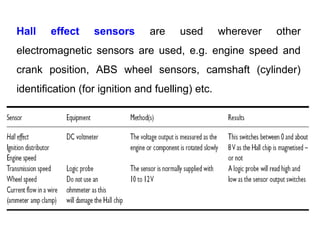
Hall effect sensors are used wherever other
electromagnetic sensors are used, e.g. engine speed and
crank position, ABS wheel sensors, camshaft (cylinder)
identification (for ignition and fuelling) etc.
Hall Sensors
Used for the purpose of detecting or registering the position
of moving components.
Hall effect:
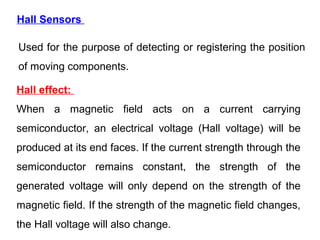
When a magnetic field acts on a current carrying
semiconductor, an electrical voltage (Hall voltage) will be
produced at its end faces. If the current strength through the
semiconductor remains constant, the strength of the
generated voltage will only depend on the strength of the
magnetic field. If the strength of the magnetic field changes,
the Hall voltage will also change.
Hall-Effect Position Sensor
Advantages of Hall sensors:
•Involve contactless operation (they do not wear out
through contact and are therefore maintenance free)
•Unaffected by temperature fluctuations
•Unaffected by vibration.
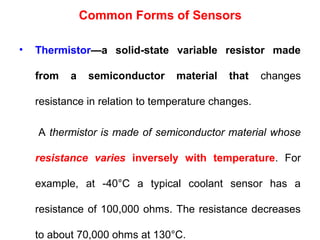
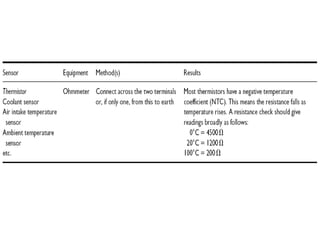
• Thermistor—a solid-state variable resistor made
from a semiconductor material that changes
resistance in relation to temperature changes.
A thermistor is made of semiconductor material whose
resistance varies inversely with temperature. For
example, at -40°C a typical coolant sensor has a
resistance of 100,000 ohms. The resistance decreases
to about 70,000 ohms at 130°C.
Common Forms of Sensors
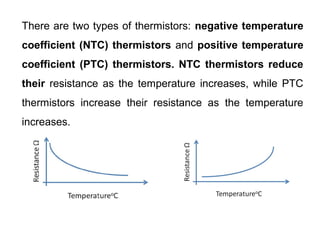
There are two types of thermistors: negative temperature
coefficient (NTC) thermistors and positive temperature
coefficient (PTC) thermistors. NTC thermistors reduce
their resistance as the temperature increases, while PTC
thermistors increase their resistance as the temperature
increases.
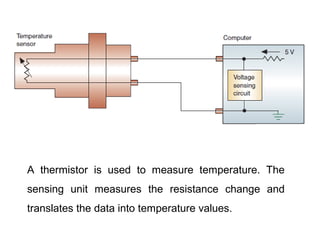
A thermistor is used to measure temperature. The
sensing unit measures the resistance change and
translates the data into temperature values.
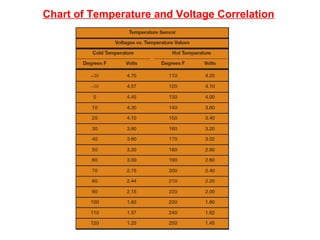
Chart of Temperature and Voltage Correlation
Dual ramp temperature sensor circuit
The same voltage value can
represent different temperatures
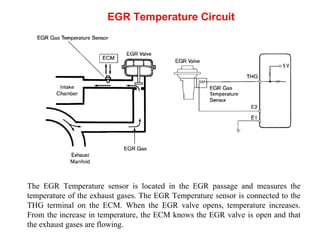
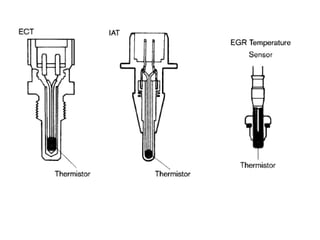
The EGR Temperature sensor is located in the EGR passage and measures the
temperature of the exhaust gases. The EGR Temperature sensor is connected to the
THG terminal on the ECM. When the EGR valve opens, temperature increases.
From the increase in temperature, the ECM knows the EGR valve is open and that
the exhaust gases are flowing.
EGR Temperature Circuit
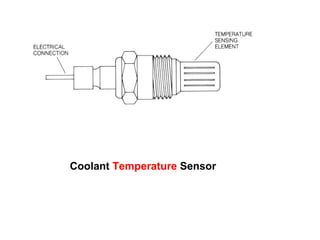
Coolant Temperature Sensor
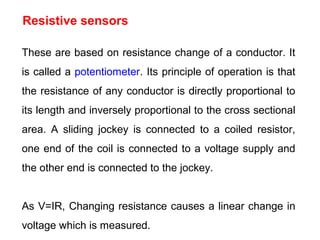
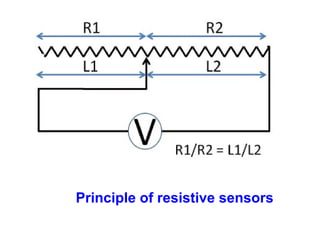
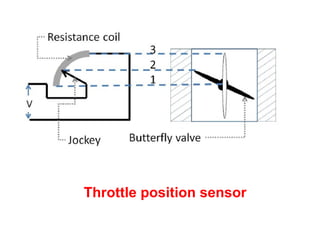
These are based on resistance change of a conductor. It
is called a potentiometer. Its principle of operation is that
the resistance of any conductor is directly proportional to
its length and inversely proportional to the cross sectional
area. A sliding jockey is connected to a coiled resistor,
one end of the coil is connected to a voltage supply and
the other end is connected to the jockey.
As V=IR, Changing resistance causes a linear change in
voltage which is measured.
Resistive sensors
Principle of resistive sensors
Optical sensors are based on photodiodes. A photodiode is a type of
photodetector capable of converting light into either current or voltage,
depending upon the mode of operation.
Photodiodes are similar to regular semiconductor diodes except that
they may be either exposed (to detect vacuum UV or X-rays) or
packaged with a window or optical fiber connection to allow light to
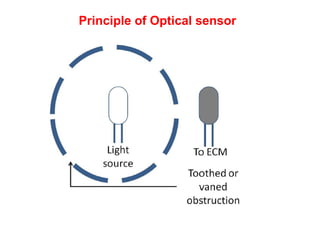
reach the sensitive part of the device. In this sense, there is a toothed
member, which alternatively exposes and opposes the light beam
from hitting the photo diode. This causes a pulse to be generated, the
frequency of which is the same as the frequency of obstruction.
Optical sensors
Principle of Optical sensor
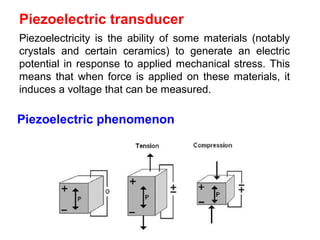
Piezoelectric phenomenon
Piezoelectricity is the ability of some materials (notably
crystals and certain ceramics) to generate an electric
potential in response to applied mechanical stress. This
means that when force is applied on these materials, it
induces a voltage that can be measured.
Piezoelectric transducer
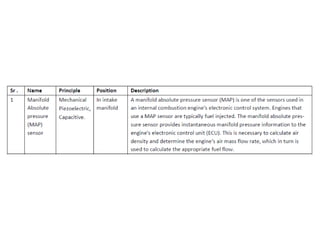
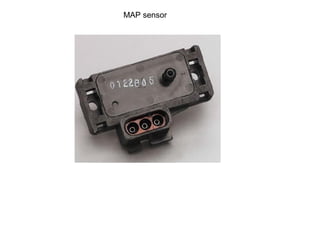
MAP sensor
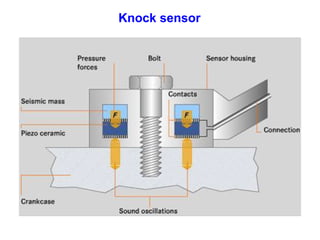
Knock sensor
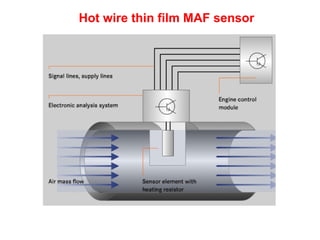
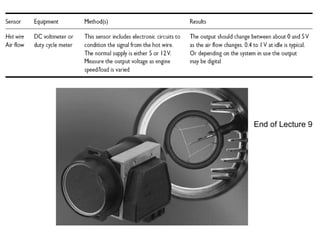
Hot wire thin film MAF sensor
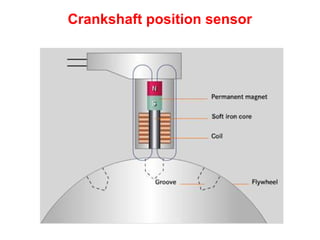
Crankshaft position sensor
Throttle position sensor
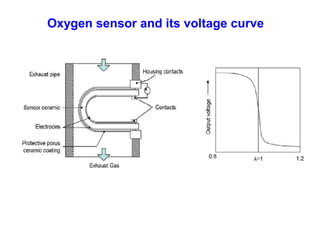
Oxygen sensor and its voltage curve
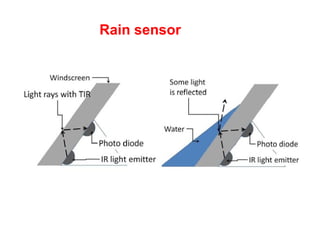
Rain sensor
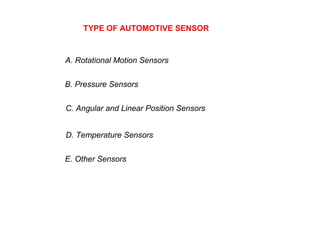
A. Rotational Motion Sensors
B. Pressure Sensors
C. Angular and Linear Position Sensors
D. Temperature Sensors
E. Other Sensors
TYPE OF AUTOMOTIVE SENSOR
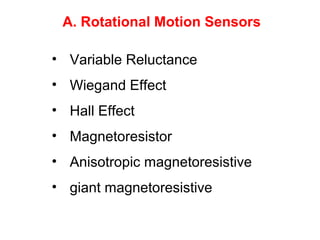
• Variable Reluctance
• Wiegand Effect
• Hall Effect
• Magnetoresistor
• Anisotropic magnetoresistive
• giant magnetoresistive
A. Rotational Motion Sensors
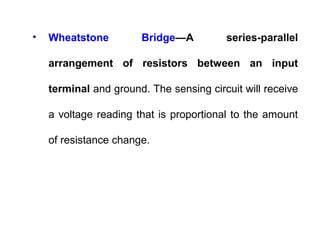
• Wheatstone Bridge—A series-parallel
arrangement of resistors between an input
terminal and ground. The sensing circuit will receive
a voltage reading that is proportional to the amount
of resistance change.
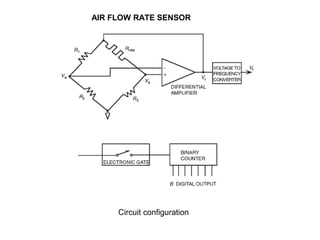
AIR FLOW RATE SENSOR
Circuit configuration
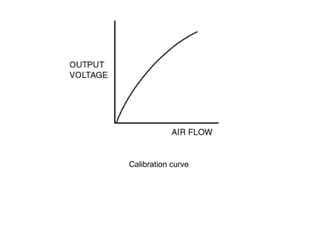
Calibration curve
The advantage of this sensor is that it measures air ass flow.
The basic principle is that as air passes over a hot wire it
tries to cool the wire down. If a circuit is created such as to
increase the current through the wire then this current will be
proportional to the airflow. A resistor is also incorporated to
compensate for temperature variations. The ‘hot wire’ is
made of platinum and is only a few millimetres long and
about 70m thick. Because of its small size the time constant
of the sensor is very short, in fact in the order of a few
milliseconds. This is a great advantage as any pulsations of
the airflow will be detected and reacted to in a control unit
accordingly. The output of the circuit involved with the hot
wire sensor is a voltage across a precision resistor.
Hot wire airflow sensor
End of Lecture 9
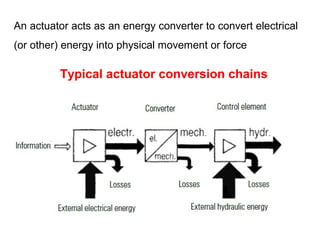
Typical actuator conversion chains
An actuator acts as an energy converter to convert electrical
(or other) energy into physical movement or force
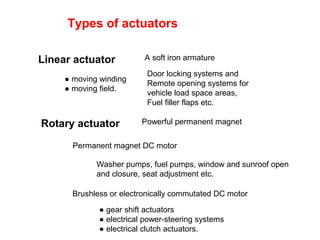
Types of actuators
Linear actuator
Rotary actuator
A soft iron armature
Powerful permanent magnet
● moving winding
● moving field.
Permanent magnet DC motor
Washer pumps, fuel pumps, window and sunroof open
and closure, seat adjustment etc.
Brushless or electronically commutated DC motor
● gear shift actuators
● electrical power-steering systems
● electrical clutch actuators.
Door locking systems and
Remote opening systems for
vehicle load space areas,
Fuel filler flaps etc.
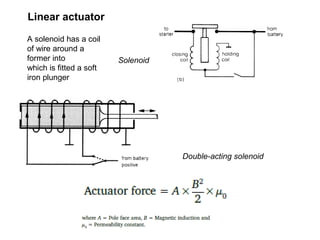
Linear actuator
Double-acting solenoid
Solenoid
A solenoid has a coil
of wire around a
former into
which is fitted a soft
iron plunger
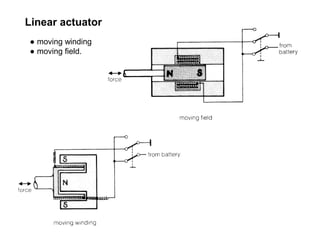
Linear actuator
● moving winding
● moving field.
Typical door lock servo actuator
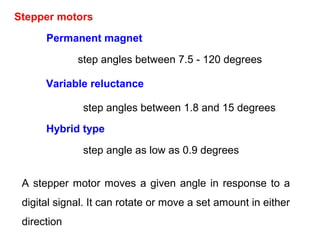
Stepper motors
Permanent magnet
Variable reluctance
Hybrid type
step angles between 1.8 and 15 degrees
step angles between 7.5 - 120 degrees
step angle as low as 0.9 degrees
A stepper motor moves a given angle in response to a
digital signal. It can rotate or move a set amount in either
direction
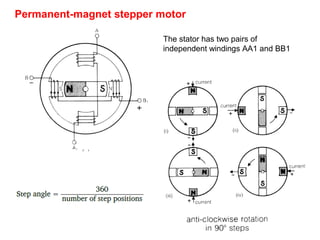
The stator has two pairs of
independent windings AA1 and BB1
Permanent-magnet stepper motor
The main advantage for these motors is that
the permanent magnet holds the rotor in
position even when the windings are de-
energised. This is known as detent torque
and not all stepper motors have this feature.
The disadvantage is they have relatively high
inertia.
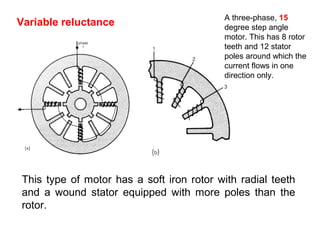
Variable reluctance
This type of motor has a soft iron rotor with radial teeth
and a wound stator equipped with more poles than the
rotor.
A three-phase, 15
degree step angle
motor. This has 8 rotor
teeth and 12 stator
poles around which the
current flows in one
direction only.
The number of step positions (N) is calculated via:
where S = Slots in stator and R = Slots in rotor.
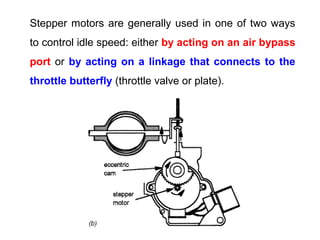
Stepper motors are generally used in one of two ways
to control idle speed: either by acting on an air bypass
port or by acting on a linkage that connects to the
throttle butterfly (throttle valve or plate).
Solenoids, and piezoelectric force generators
Solenoid is the most commonly used device because it is
relatively simple and inexpensive.
Applications of solenoids in automotive electronics include
fuel injectors and EGR valves.
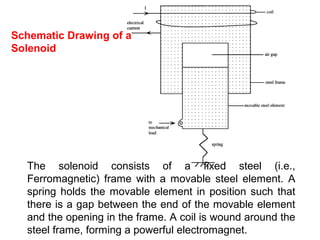
Schematic Drawing of a
Solenoid
The solenoid consists of a fixed steel (i.e.,
Ferromagnetic) frame with a movable steel element. A
spring holds the movable element in position such that
there is a gap between the end of the movable element
and the opening in the frame. A coil is wound around the
steel frame, forming a powerful electromagnet.
Schematic Drawing of Fuel Injector
Injector is open when the applied voltage is on
Injector is close when the applied voltage is off
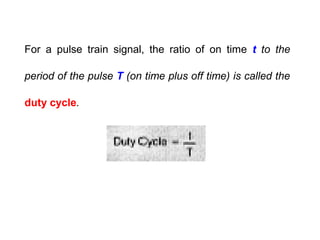
For a pulse train signal, the ratio of on time t to the
period of the pulse T (on time plus off time) is called the
duty cycle.
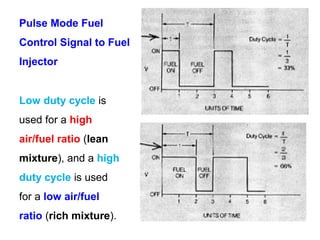
Pulse Mode Fuel
Control Signal to Fuel
Injector
Low duty cycle is
used for a high
air/fuel ratio (lean
mixture), and a high
duty cycle is used
for a low air/fuel
ratio (rich mixture).
Solenoid type idle
speed control
valves
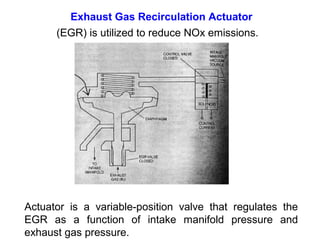
Exhaust Gas Recirculation Actuator
(EGR) is utilized to reduce NOx emissions.
Actuator is a variable-position valve that regulates the
EGR as a function of intake manifold pressure and
exhaust gas pressure.
Whenever the solenoid is energized (i.e., by current
supplied by the control system flowing through the
coil), the EGR valve is opened by the applied vacuum.
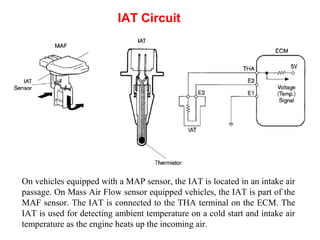
IAT Circuit
On vehicles equipped with a MAP sensor, the IAT is located in an intake air
passage. On Mass Air Flow sensor equipped vehicles, the IAT is part of the
MAF sensor. The IAT is connected to the THA terminal on the ECM. The
IAT is used for detecting ambient temperature on a cold start and intake air
temperature as the engine heats up the incoming air.
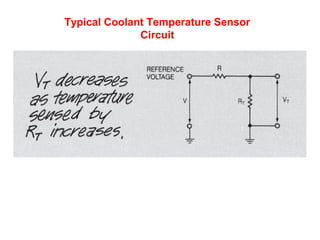
Typical Coolant Temperature Sensor
Circuit

Unit ii sensors and actuators

  • 1.
    Unit 2: Sensors&Actuators 6 hrs Hall Effect, hot wire, thermistor, piezoelectric, pizoresistive based sensors. Introduction, basic sensor arrangement, types of sensors, oxygen concentration sensor, lambda sensor, crankshaft angular position sensor, cam position sensor, Mass air flow (MAF) rate, Manifold absolute pressure (MAP), Throttle plate angular position, engine oil pressure sensor, vehicle speed sensor, stepper motors, relays, detonation sensor, emission sensors.
  • 3.
    1950 1960 1970 OxygenSensor for Exhaust Analysis Electromechanical Pressure Sensor First Silicone Based Pressure Sensor 1980 1990 2000 Integrated Pressure Sensor Micro-machined accelerometer for air bag Angular Rate Sensor for Roll Over Micro-machined Yaw Rate Sensor Micro-machined Air mass Sensor Piezo Yaw Rate Sensor for ESP Important Milestones In Automotive Sensor Development
  • 4.
    Micromachining Microfabrication of mechanicalstructures using several microelectronics or micromechanics processing techniques.
  • 5.
    System Energy Matter Information Energy Matter Information Information comprises allkinds of changes – even unwanted ones – connected with the domains of energy and matter Whereas signal, in the special sense of sensor input or output signal, includes only that part of the information that is of interest for the desired measurement application.
  • 6.
    Non-exhaustive list ofmajor suppliers of sensors to the automotive industry Particular Supplier System suppliers Denso, Delphi, Siemens, Bosch Semiconductor manufacturers Texas Instruments, Motorola, Infineon, Philips, Analog Devices Sensor specialists VTI-Hamlin, Sensonor, Murata, Matsushita, Systron- Donner, Hitachi, Kavlico, Nagano Keiki
  • 8.
    Oil sensor Oxygen sensor Fuellevel Accelerometer Seat belt tension Passenger Occupancy Wheel speed Tire pressure monitor Anti thief sensors Radar sensor Rain sensor Parking sensor Indoor/outdoor temperature sensors GPS Water coolant temperature Tachometer Speedometer Odometer
  • 10.
    Sensors convert aphysical or chemical (usually non- electrical) quantity into an electrical quantity (non-electrical intermediate stages may be employed).
  • 11.
    Actuators (final-control elements)form the junction between the electronic signal processor (data processing) and the actual process (mechanical motion). They convert the low- power signals conveying the positioning information into operating signals of an energy level adequate for process control. Signal converters are combined with amplifier elements to exploit the physical transformation principles governing the interrelationships between various forms of energy (electrical –mechanical – fluid – thermal).
  • 12.
    Sensors and actuatorsare the unsung heroes of the automobile world. These devices perform most of the maintenance functions for cars including communicating the system's status to the car's on-board computer, monitoring speed, and calculating engine timing. These devices have several types that perform unique functions, with some dependent on crystal vibration while others work with magnetism to correctly calibrate automobile instrumentation.
  • 13.
    Automotive sensors arecommonly used to measure: • Pressure • position and level • Flow • Temperature • gas composition • vibration (knock) • Acceleration • Speed • rotation (position).
  • 14.
    Major areas ofsystems application for automotive sensors
  • 15.
    DRIVING FACTORS LEADINGTO INCREASED USE OF SENSORS
  • 16.
    DRIVING FACTORS LEADINGTO INCREASED USE OF SENSORS
  • 17.
    Powertrain systems, controlfunctions and applications
  • 18.
    Chassis systems, controlfunctions and applications
  • 19.
    Body systems, controlfunctions and applications
  • 20.
    Body systems, controlfunctions and applications
  • 21.
    SENSORS USED INPOWERTRAIN APPLICATIONS
  • 22.
    SENSORS USED INPOWERTRAIN APPLICATIONS
  • 23.
    SENSORS USED INCHASSIS APPLICATIONS
  • 24.
    SENSORS USED INCHASSIS APPLICATIONS
  • 25.
    SENSORS USED INBODY APPLICATIONS
  • 26.
    SENSORS USED INBODY APPLICATIONS
  • 27.
    • Piezoelectric device—Avoltage generator with a resistor connected in series that is used to measure fluid and air pressures. • Piezoresistive device—Similar to a piezoelectric except they operate like a variable resistor. Its resistance value changes as the pressure applied to the crystal changes. Common Forms of Sensors
  • 28.
    • Potentiometer—A voltagedivider that provides a variable DC voltage reading to the computer. The potentiometer usually consists of a wire wound resistor with a moveable center wiper. • Magnetic pulse generators—Commonly used to send data to the computer about the speed of the monitored component. They use the principle of magnetic induction to produce a voltage signal. Common Forms of Sensors
  • 29.
    • Hall-effect switch—Aswitch that operates on the principle that if a current is allowed to flow through thin conducting material that is exposed to a magnetic field, another voltage is produced. The switch contains a permanent magnet, a thin semiconductor layer made of gallium arsenate crystal (Hall layer), and a shutter wheel. Common Forms of Sensors
  • 30.
    Hall effect devices In1879 Edward Hall discovered that when a magnet is placed perpendicular to the face of a flat current carrying conductor, a difference in potential appeared across the opposite edges of that conductor. This is known as the ‘Hall effect’ and the potential difference (pd) produced across the edges is known as the Hall voltage. Hall-Effect Sensors: Theory and Application By Edward Ramsden Elsevier. ISBN 0-7506-7934-4.
  • 32.
    Hall effect sensorsare used wherever other electromagnetic sensors are used, e.g. engine speed and crank position, ABS wheel sensors, camshaft (cylinder) identification (for ignition and fuelling) etc.
  • 33.
    Hall Sensors Used forthe purpose of detecting or registering the position of moving components. Hall effect: When a magnetic field acts on a current carrying semiconductor, an electrical voltage (Hall voltage) will be produced at its end faces. If the current strength through the semiconductor remains constant, the strength of the generated voltage will only depend on the strength of the magnetic field. If the strength of the magnetic field changes, the Hall voltage will also change.
  • 34.
  • 35.
    Advantages of Hallsensors: •Involve contactless operation (they do not wear out through contact and are therefore maintenance free) •Unaffected by temperature fluctuations •Unaffected by vibration.
  • 36.
    • Thermistor—a solid-statevariable resistor made from a semiconductor material that changes resistance in relation to temperature changes. A thermistor is made of semiconductor material whose resistance varies inversely with temperature. For example, at -40°C a typical coolant sensor has a resistance of 100,000 ohms. The resistance decreases to about 70,000 ohms at 130°C. Common Forms of Sensors
  • 37.
    There are twotypes of thermistors: negative temperature coefficient (NTC) thermistors and positive temperature coefficient (PTC) thermistors. NTC thermistors reduce their resistance as the temperature increases, while PTC thermistors increase their resistance as the temperature increases.
  • 38.
    A thermistor isused to measure temperature. The sensing unit measures the resistance change and translates the data into temperature values.
  • 39.
    Chart of Temperatureand Voltage Correlation
  • 40.
    Dual ramp temperaturesensor circuit The same voltage value can represent different temperatures
  • 42.
    The EGR Temperaturesensor is located in the EGR passage and measures the temperature of the exhaust gases. The EGR Temperature sensor is connected to the THG terminal on the ECM. When the EGR valve opens, temperature increases. From the increase in temperature, the ECM knows the EGR valve is open and that the exhaust gases are flowing. EGR Temperature Circuit
  • 43.
  • 44.
    These are basedon resistance change of a conductor. It is called a potentiometer. Its principle of operation is that the resistance of any conductor is directly proportional to its length and inversely proportional to the cross sectional area. A sliding jockey is connected to a coiled resistor, one end of the coil is connected to a voltage supply and the other end is connected to the jockey. As V=IR, Changing resistance causes a linear change in voltage which is measured. Resistive sensors
  • 45.
  • 46.
    Optical sensors arebased on photodiodes. A photodiode is a type of photodetector capable of converting light into either current or voltage, depending upon the mode of operation. Photodiodes are similar to regular semiconductor diodes except that they may be either exposed (to detect vacuum UV or X-rays) or packaged with a window or optical fiber connection to allow light to reach the sensitive part of the device. In this sense, there is a toothed member, which alternatively exposes and opposes the light beam from hitting the photo diode. This causes a pulse to be generated, the frequency of which is the same as the frequency of obstruction. Optical sensors
  • 47.
  • 48.
    Piezoelectric phenomenon Piezoelectricity isthe ability of some materials (notably crystals and certain ceramics) to generate an electric potential in response to applied mechanical stress. This means that when force is applied on these materials, it induces a voltage that can be measured. Piezoelectric transducer
  • 50.
  • 51.
  • 52.
    Hot wire thinfilm MAF sensor
  • 53.
  • 54.
  • 55.
    Oxygen sensor andits voltage curve
  • 56.
  • 57.
    A. Rotational MotionSensors B. Pressure Sensors C. Angular and Linear Position Sensors D. Temperature Sensors E. Other Sensors TYPE OF AUTOMOTIVE SENSOR
  • 58.
    • Variable Reluctance •Wiegand Effect • Hall Effect • Magnetoresistor • Anisotropic magnetoresistive • giant magnetoresistive A. Rotational Motion Sensors
  • 59.
    • Wheatstone Bridge—Aseries-parallel arrangement of resistors between an input terminal and ground. The sensing circuit will receive a voltage reading that is proportional to the amount of resistance change.
  • 60.
    AIR FLOW RATESENSOR Circuit configuration
  • 61.
  • 63.
    The advantage ofthis sensor is that it measures air ass flow. The basic principle is that as air passes over a hot wire it tries to cool the wire down. If a circuit is created such as to increase the current through the wire then this current will be proportional to the airflow. A resistor is also incorporated to compensate for temperature variations. The ‘hot wire’ is made of platinum and is only a few millimetres long and about 70m thick. Because of its small size the time constant of the sensor is very short, in fact in the order of a few milliseconds. This is a great advantage as any pulsations of the airflow will be detected and reacted to in a control unit accordingly. The output of the circuit involved with the hot wire sensor is a voltage across a precision resistor. Hot wire airflow sensor
  • 64.
  • 65.
    Typical actuator conversionchains An actuator acts as an energy converter to convert electrical (or other) energy into physical movement or force
  • 66.
    Types of actuators Linearactuator Rotary actuator A soft iron armature Powerful permanent magnet ● moving winding ● moving field. Permanent magnet DC motor Washer pumps, fuel pumps, window and sunroof open and closure, seat adjustment etc. Brushless or electronically commutated DC motor ● gear shift actuators ● electrical power-steering systems ● electrical clutch actuators. Door locking systems and Remote opening systems for vehicle load space areas, Fuel filler flaps etc.
  • 67.
    Linear actuator Double-acting solenoid Solenoid Asolenoid has a coil of wire around a former into which is fitted a soft iron plunger
  • 68.
    Linear actuator ● movingwinding ● moving field.
  • 69.
    Typical door lockservo actuator
  • 70.
    Stepper motors Permanent magnet Variablereluctance Hybrid type step angles between 1.8 and 15 degrees step angles between 7.5 - 120 degrees step angle as low as 0.9 degrees A stepper motor moves a given angle in response to a digital signal. It can rotate or move a set amount in either direction
  • 71.
    The stator hastwo pairs of independent windings AA1 and BB1 Permanent-magnet stepper motor
  • 72.
    The main advantagefor these motors is that the permanent magnet holds the rotor in position even when the windings are de- energised. This is known as detent torque and not all stepper motors have this feature. The disadvantage is they have relatively high inertia.
  • 73.
    Variable reluctance This typeof motor has a soft iron rotor with radial teeth and a wound stator equipped with more poles than the rotor. A three-phase, 15 degree step angle motor. This has 8 rotor teeth and 12 stator poles around which the current flows in one direction only.
  • 74.
    The number ofstep positions (N) is calculated via: where S = Slots in stator and R = Slots in rotor.
  • 75.
    Stepper motors aregenerally used in one of two ways to control idle speed: either by acting on an air bypass port or by acting on a linkage that connects to the throttle butterfly (throttle valve or plate).
  • 76.
    Solenoids, and piezoelectricforce generators Solenoid is the most commonly used device because it is relatively simple and inexpensive. Applications of solenoids in automotive electronics include fuel injectors and EGR valves.
  • 77.
    Schematic Drawing ofa Solenoid The solenoid consists of a fixed steel (i.e., Ferromagnetic) frame with a movable steel element. A spring holds the movable element in position such that there is a gap between the end of the movable element and the opening in the frame. A coil is wound around the steel frame, forming a powerful electromagnet.
  • 78.
    Schematic Drawing ofFuel Injector Injector is open when the applied voltage is on Injector is close when the applied voltage is off
  • 79.
    For a pulsetrain signal, the ratio of on time t to the period of the pulse T (on time plus off time) is called the duty cycle.
  • 80.
    Pulse Mode Fuel ControlSignal to Fuel Injector Low duty cycle is used for a high air/fuel ratio (lean mixture), and a high duty cycle is used for a low air/fuel ratio (rich mixture).
  • 81.
  • 82.
    Exhaust Gas RecirculationActuator (EGR) is utilized to reduce NOx emissions. Actuator is a variable-position valve that regulates the EGR as a function of intake manifold pressure and exhaust gas pressure.
  • 83.
    Whenever the solenoidis energized (i.e., by current supplied by the control system flowing through the coil), the EGR valve is opened by the applied vacuum.
  • 84.
    IAT Circuit On vehiclesequipped with a MAP sensor, the IAT is located in an intake air passage. On Mass Air Flow sensor equipped vehicles, the IAT is part of the MAF sensor. The IAT is connected to the THA terminal on the ECM. The IAT is used for detecting ambient temperature on a cold start and intake air temperature as the engine heats up the incoming air.
  • 86.