Sensitization and Protective
colloidal action
1
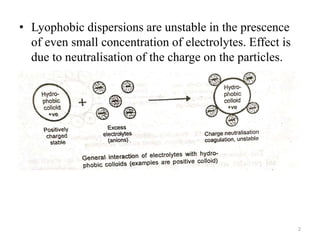
• Lyophobic dispersions are unstable in the prescence
of even small concentration of electrolytes. Effect is
due to neutralisation of the charge on the particles.
2
Sensitization
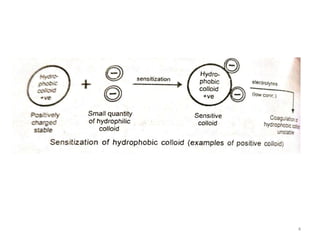
• If a very small amount of hydrophillic colloid is
added to a hydrophobic sol, it is sometimes observed
that the latter has become more sensitive to
precipitation on the subsequent adddition of
electrolytes.
• The sensitization may be partly due to adsorption of
the oppositely charged hydrophillic sols on
hydrophobic particles.
3
4
Protective colloidal action
• When a large amount of hydrophilic colloids carrying
opposite charges is added to hydrophobic colloids,
these get adsorbed on the hydrophobic particles and
form a protective layer around it.
• This adsorption layer prevents the precipitating ions
reaching the sol particles and hence preventing the
coagulation.
• An entire colloids are thermodynamically stable and
behaves like hydrophillic colloid.
5
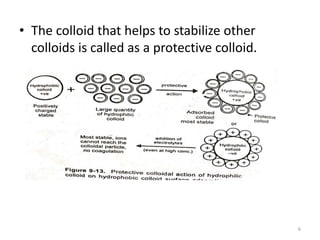
• The colloid that helps to stabilize other
colloids is called as a protective colloid.
6
• The phenomenon of protection is defined, as a
process by which the sol particles are prevented from
coagulation induced by an electrolyte due to the
previous addition of a some lyophillic sol.
• Eg.: hydrophobic sols for injection such as colloidal
gold (198 Au) injection, must be sterically stabilized,
in this case by gelatin.
• The protective property of colloids is expressed in
terms of gold number.
7
Gold number
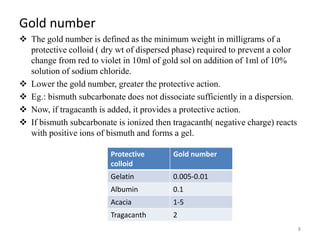
 The gold number is defined as the minimum weight in milligrams of a
protective colloid ( dry wt of dispersed phase) required to prevent a color
change from red to violet in 10ml of gold sol on addition of 1ml of 10%
solution of sodium chloride.
 Lower the gold number, greater the protective action.
 Eg.: bismuth subcarbonate does not dissociate sufficiently in a dispersion.
 Now, if tragacanth is added, it provides a protective action.
 If bismuth subcarbonate is ionized then tragacanth( negative charge) reacts
with positive ions of bismuth and forms a gel.
Protective
colloid
Gold number
Gelatin 0.005-0.01
Albumin 0.1
Acacia 1-5
Tragacanth 2
8
References
• C.V.S. Subrahmanyam, Textbook of physical
pharmaceutics, second edition, published by
vallabh prakashan , page no.341-343
9
Thank you
10

Sensitization and protective colloidal action

  • 1.
  • 2.
    • Lyophobic dispersionsare unstable in the prescence of even small concentration of electrolytes. Effect is due to neutralisation of the charge on the particles. 2
  • 3.
    Sensitization • If avery small amount of hydrophillic colloid is added to a hydrophobic sol, it is sometimes observed that the latter has become more sensitive to precipitation on the subsequent adddition of electrolytes. • The sensitization may be partly due to adsorption of the oppositely charged hydrophillic sols on hydrophobic particles. 3
  • 4.
  • 5.
    Protective colloidal action •When a large amount of hydrophilic colloids carrying opposite charges is added to hydrophobic colloids, these get adsorbed on the hydrophobic particles and form a protective layer around it. • This adsorption layer prevents the precipitating ions reaching the sol particles and hence preventing the coagulation. • An entire colloids are thermodynamically stable and behaves like hydrophillic colloid. 5
  • 6.
    • The colloidthat helps to stabilize other colloids is called as a protective colloid. 6
  • 7.
    • The phenomenonof protection is defined, as a process by which the sol particles are prevented from coagulation induced by an electrolyte due to the previous addition of a some lyophillic sol. • Eg.: hydrophobic sols for injection such as colloidal gold (198 Au) injection, must be sterically stabilized, in this case by gelatin. • The protective property of colloids is expressed in terms of gold number. 7
  • 8.
    Gold number  Thegold number is defined as the minimum weight in milligrams of a protective colloid ( dry wt of dispersed phase) required to prevent a color change from red to violet in 10ml of gold sol on addition of 1ml of 10% solution of sodium chloride.  Lower the gold number, greater the protective action.  Eg.: bismuth subcarbonate does not dissociate sufficiently in a dispersion.  Now, if tragacanth is added, it provides a protective action.  If bismuth subcarbonate is ionized then tragacanth( negative charge) reacts with positive ions of bismuth and forms a gel. Protective colloid Gold number Gelatin 0.005-0.01 Albumin 0.1 Acacia 1-5 Tragacanth 2 8
  • 9.
    References • C.V.S. Subrahmanyam,Textbook of physical pharmaceutics, second edition, published by vallabh prakashan , page no.341-343 9
  • 10.