




Stability of Colloids
Dr. A. SUMATHI
Professor & Head
Department of Pharmaceutics
Stability of Colloids
 The presence & magnitude or absence of a charge on a colloidal
particle is an important factor in the stability of colloidal system
 Lyophilic sols
 These are stabilized by the presence of charge on the colloidal
particles & surrounding of each particle with a solvent sheath
that prevents mutual adherence
2
Dr. A. SUMATHI COLLOIDS
Stability of Colloids
 Lyophobic sols
 These are thermodynamically unstable
 The like charges produce a repulsion that prevents
coagulation of the particles
 Addition of a small amount of electrolyte that stabilizes by
imparting a charge on the particles
3
Dr. A. SUMATHI COLLOIDS
Stability of Colloids
DLVO Theory
 Derjaguin Landau Vervey Overbeek Theory
 The forces on colloidal particles in a dispersion are due to
electrostatic repulsion & London type Vander Waals forces of
attraction
4
Dr. A. SUMATHI COLLOIDS
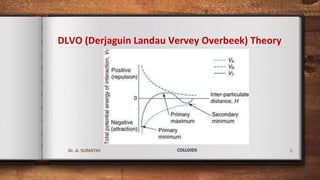
DLVO (Derjaguin Landau Vervey Overbeek) Theory
 These forces result in potential energies of Repulsion (VR) &
Attraction (VA) between the particles
 There is a attraction near the origin & a high potential barrier of
repulsion at moderate distances
 A shallow secondary attraction is sometimes observed at longer
distances of separation
5
Dr. A. SUMATHI COLLOIDS
DLVO (Derjaguin Landau Vervey Overbeek) Theory
6
Dr. A. SUMATHI COLLOIDS
Stability of Colloids
 Addition of electrolyte can bring about coagulation of colloidal
particles
 The mixing of oppositively charged colloids will result in mutual
agglomeration
 If salt is sufficiently added to Lyophilic colloids, agglomeration &
sedimentation of the particles will result. This phenomenon is
called Salting out
7
Dr. A. SUMATHI COLLOIDS
Sensitisation & Protective Colloidal Action
 The addition of small amount of Hydrophilic or Hydrophobic
colloid to a Hydrophobic colloid of opposite charge will sensitize or
coagulate the particles
 This is due to reduction of zeta potential below the critical value
8
Dr. A. SUMATHI COLLOIDS
Sensitisation & Protective Colloidal Action
 The addition of large amount of Hydrophilic substances stabilizes
the system
 Hydrophiles being adsorbed on the Hydrophobic particles
 This phenomenon is known as Protection and the added
Hydrophilic sols are called as Protective Colloids
9
Dr. A. SUMATHI COLLOIDS
GOLD NUMBER
 It is the minimum weight in milligrams of the protective colloid
required to prevent a colour change from red to violet in 10 ml of a
Gold sol on the addition of 1 ml of a 10 % solution of Sodium
chloride
10
Dr. A. SUMATHI COLLOIDS
Thank You
 Dr. A. SUMATHI

B.Pharmacy - Physical Pharmaceutics - Colloids - Part 1

  • 1.
    Stability of Colloids Dr.A. SUMATHI Professor & Head Department of Pharmaceutics
  • 2.
    Stability of Colloids The presence & magnitude or absence of a charge on a colloidal particle is an important factor in the stability of colloidal system  Lyophilic sols  These are stabilized by the presence of charge on the colloidal particles & surrounding of each particle with a solvent sheath that prevents mutual adherence 2 Dr. A. SUMATHI COLLOIDS
  • 3.
    Stability of Colloids Lyophobic sols  These are thermodynamically unstable  The like charges produce a repulsion that prevents coagulation of the particles  Addition of a small amount of electrolyte that stabilizes by imparting a charge on the particles 3 Dr. A. SUMATHI COLLOIDS
  • 4.
    Stability of Colloids DLVOTheory  Derjaguin Landau Vervey Overbeek Theory  The forces on colloidal particles in a dispersion are due to electrostatic repulsion & London type Vander Waals forces of attraction 4 Dr. A. SUMATHI COLLOIDS
  • 5.
    DLVO (Derjaguin LandauVervey Overbeek) Theory  These forces result in potential energies of Repulsion (VR) & Attraction (VA) between the particles  There is a attraction near the origin & a high potential barrier of repulsion at moderate distances  A shallow secondary attraction is sometimes observed at longer distances of separation 5 Dr. A. SUMATHI COLLOIDS
  • 6.
    DLVO (Derjaguin LandauVervey Overbeek) Theory 6 Dr. A. SUMATHI COLLOIDS
  • 7.
    Stability of Colloids Addition of electrolyte can bring about coagulation of colloidal particles  The mixing of oppositively charged colloids will result in mutual agglomeration  If salt is sufficiently added to Lyophilic colloids, agglomeration & sedimentation of the particles will result. This phenomenon is called Salting out 7 Dr. A. SUMATHI COLLOIDS
  • 8.
    Sensitisation & ProtectiveColloidal Action  The addition of small amount of Hydrophilic or Hydrophobic colloid to a Hydrophobic colloid of opposite charge will sensitize or coagulate the particles  This is due to reduction of zeta potential below the critical value 8 Dr. A. SUMATHI COLLOIDS
  • 9.
    Sensitisation & ProtectiveColloidal Action  The addition of large amount of Hydrophilic substances stabilizes the system  Hydrophiles being adsorbed on the Hydrophobic particles  This phenomenon is known as Protection and the added Hydrophilic sols are called as Protective Colloids 9 Dr. A. SUMATHI COLLOIDS
  • 10.
    GOLD NUMBER  Itis the minimum weight in milligrams of the protective colloid required to prevent a colour change from red to violet in 10 ml of a Gold sol on the addition of 1 ml of a 10 % solution of Sodium chloride 10 Dr. A. SUMATHI COLLOIDS
  • 11.