Social and Preventive
Pharmacy
WHAT IS HEALTH?
2
CONCEPTS OF HEALTH AND DISEASE
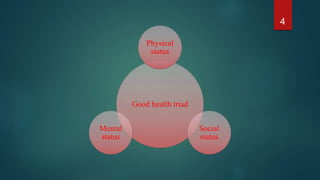
1. In 1947, WHO defines health as a state of complete physical, mental and social well- being
not merely the absence of disease or infirmity.
2. Positive health – it implies the notion of perfect health in body and mind. It cannot become a
reality, it always remain a dream because everything in our life is subject to change.
3. Wellness- is a multidimensional state of being describing the existence of positive health in
an individual as exemplified by quality of life and a sense of well-being.
3
4
Good health triad
Physical
status
Social
status
Mental
status
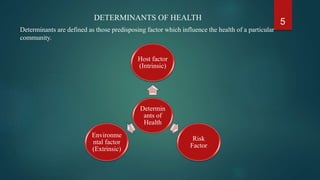
DETERMINANTS OF HEALTH
Determinants are defined as those predisposing factor which influence the health of a particular
community.
5
Determin
ants of
Health
Host factor
(Intrinsic)
Risk
Factor
Environme
ntal factor
(Extrinsic)
DIMENSIONS OF GOOD HEALTH
 Physical
 Emotional
 Spiritual
 Intellectual
 Environmental
 Social
6
CONCEPT OF HEALTH
 Biomedical concept
Traditionally health has been considered as an absence of the diseases and if someone was free
from diseases then that person was considered healthy. This concept is known as Biomedical
concept and it is based on the “germ theory of the disease”.
 Ecological concept
Ecologists viewed health as a dynamic equilibrium between man and his environment and the
disease as a maladjustment of the human organism to environment.
 Psychological concept
Advances in social sciences showed that health is not only a biomedical phenomenon but one
which is influenced by social, psychological, cultural, economic and political factors of the people
concerned.
 Holistic concept
Holistic concept recognizes the strength of social, economic, political and environmental
influences on the health. It has been variously described as multidimensional process as its involve
the wellbeing of the person as a whole.
7
Preventive Medicine
 Preventive medicine specialists works with large population groups as well as with individual
patients to promote health and to understand the risk of disease, injury, disability and death.
 The main principle of preventive medicine is Prevention First.
 It is a science of study on the connection between the external environment and human health.
 The main goal of preventive medicine is the abscence of disease by preventing the occurence of a
disease or by halting a disease.
 Preventive medicine can be practiced by governmental agencies, primary care physicians and the
individual himself.
8
9
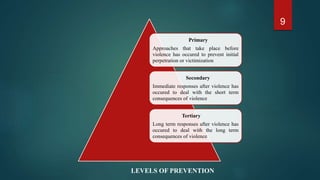
Primary
Approaches that take place before
violence has occured to prevent initial
perpetration or victimization
Secondary
Immediate responses after violence has
occured to deal with the short term
consequences of violence
Tertiary
Long term responses after violence has
occured to deal with the long term
consequences of violence
LEVELS OF PREVENTION
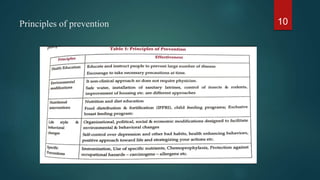
Principles of prevention 10
CHOLERA: PREVENTION AND CONTROL
11
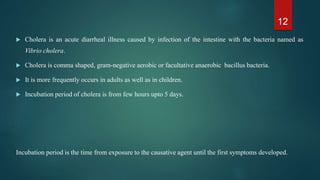
 Cholera is an acute diarrheal illness caused by infection of the intestine with the bacteria named as
Vibrio cholera.
 Cholera is comma shaped, gram-negative aerobic or facultative anaerobic bacillus bacteria.
 It is more frequently occurs in adults as well as in children.
 Incubation period of cholera is from few hours upto 5 days.
Incubation period is the time from exposure to the causative agent until the first symptoms developed.
12
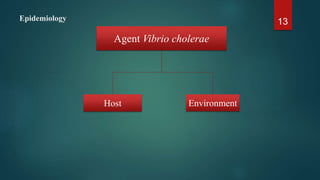
Epidemiology 13
Agent Vibrio cholerae
Host Environment
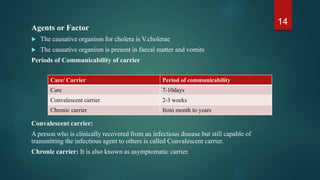
Agents or Factor
 The causative organism for cholera is V.cholerae
 The causative organism is present in faecal matter and vomits
Periods of Communicability of carrier
Convalescent carrier:
A person who is clinically recovered from an infectious disease but still capable of
transmitting the infectious agent to others is called Convalescent carrier.
Chronic carrier: It is also known as asymptomatic carrier.
14
Care/ Carrier Period of communicability
Care 7-10days
Convalescent carrier 2-3 weeks
Chronic carrier from month to years
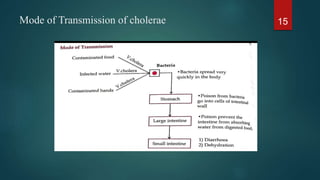
Mode of Transmission of cholerae 15
16
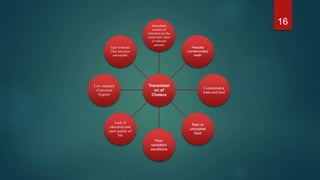
Transmissi
on of
Cholera
Immediate
sources of
infection are the
stools and vomit
of infected
patients
Feacally
Contaminated
water
Contaminated
water and food
Raw or
uncooked
food
Poor
sanitation
conditions
Lack of
education and
poor quality of
life
Low standard
of personal
hygeine
Type O blood-
They are twice
susceptible
17
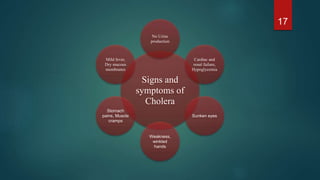
Signs and
symptoms of
Cholera
No Urine
production
Cardiac and
renal failure,
Hypoglycemia
Sunken eyes
Weakness,
winkled
hands
Stomach
pains, Muscle
cramps
Mild fever,
Dry mucous
membranes
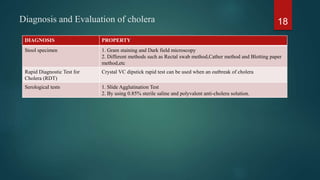
Diagnosis and Evaluation of cholera 18
DIAGNOSIS PROPERTY
Stool specimen 1. Gram staining and Dark field microscopy
2. Different methods such as Rectal swab method,Cather method and Blotting paper
method,etc
Rapid Diagnostic Test for
Cholera (RDT)
Crystal VC dipstick rapid test can be used when an outbreak of cholera
Serological tests 1. Slide Agglutination Test
2. By using 0.85% sterile saline and polyvalent anti-cholera solution.
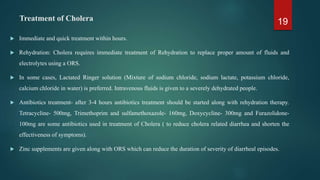
Treatment of Cholera
 Immediate and quick treatment within hours.
 Rehydration: Cholera requires immediate treatment of Rehydration to replace proper amount of fluids and
electrolytes using a ORS.
 In some cases, Lactated Ringer solution (Mixture of sodium chloride, sodium lactate, potassium chloride,
calcium chloride in water) is preferred. Intravenous fluids is given to a severely dehydrated people.
 Antibiotics treatment- after 3-4 hours antibiotics treatment should be started along with rehydration therapy.
Tetracycline- 500mg, Trimethoprim and sulfamethoxazole- 160mg, Doxycycline- 300mg and Furazolidone-
100mg are some antibiotics used in treatment of Cholera ( to reduce cholera related diarrhea and shorten the
effectiveness of symptoms).
 Zinc supplements are given along with ORS which can reduce the duration of severity of diarrheal episodes.
19
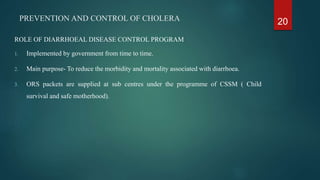
PREVENTION AND CONTROL OF CHOLERA
ROLE OF DIARRHOEAL DISEASE CONTROL PROGRAM
1. Implemented by government from time to time.
2. Main purpose- To reduce the morbidity and mortality associated with diarrhoea.
3. ORS packets are supplied at sub centres under the programme of CSSM ( Child
survival and safe motherhood).
20
21
THANK YOU
22

Social and preventive pharmacy

  • 1.
  • 2.
  • 3.
    CONCEPTS OF HEALTHAND DISEASE 1. In 1947, WHO defines health as a state of complete physical, mental and social well- being not merely the absence of disease or infirmity. 2. Positive health – it implies the notion of perfect health in body and mind. It cannot become a reality, it always remain a dream because everything in our life is subject to change. 3. Wellness- is a multidimensional state of being describing the existence of positive health in an individual as exemplified by quality of life and a sense of well-being. 3
  • 4.
  • 5.
    DETERMINANTS OF HEALTH Determinantsare defined as those predisposing factor which influence the health of a particular community. 5 Determin ants of Health Host factor (Intrinsic) Risk Factor Environme ntal factor (Extrinsic)
  • 6.
    DIMENSIONS OF GOODHEALTH  Physical  Emotional  Spiritual  Intellectual  Environmental  Social 6
  • 7.
    CONCEPT OF HEALTH Biomedical concept Traditionally health has been considered as an absence of the diseases and if someone was free from diseases then that person was considered healthy. This concept is known as Biomedical concept and it is based on the “germ theory of the disease”.  Ecological concept Ecologists viewed health as a dynamic equilibrium between man and his environment and the disease as a maladjustment of the human organism to environment.  Psychological concept Advances in social sciences showed that health is not only a biomedical phenomenon but one which is influenced by social, psychological, cultural, economic and political factors of the people concerned.  Holistic concept Holistic concept recognizes the strength of social, economic, political and environmental influences on the health. It has been variously described as multidimensional process as its involve the wellbeing of the person as a whole. 7
  • 8.
    Preventive Medicine  Preventivemedicine specialists works with large population groups as well as with individual patients to promote health and to understand the risk of disease, injury, disability and death.  The main principle of preventive medicine is Prevention First.  It is a science of study on the connection between the external environment and human health.  The main goal of preventive medicine is the abscence of disease by preventing the occurence of a disease or by halting a disease.  Preventive medicine can be practiced by governmental agencies, primary care physicians and the individual himself. 8
  • 9.
    9 Primary Approaches that takeplace before violence has occured to prevent initial perpetration or victimization Secondary Immediate responses after violence has occured to deal with the short term consequences of violence Tertiary Long term responses after violence has occured to deal with the long term consequences of violence LEVELS OF PREVENTION
  • 10.
  • 11.
  • 12.
     Cholera isan acute diarrheal illness caused by infection of the intestine with the bacteria named as Vibrio cholera.  Cholera is comma shaped, gram-negative aerobic or facultative anaerobic bacillus bacteria.  It is more frequently occurs in adults as well as in children.  Incubation period of cholera is from few hours upto 5 days. Incubation period is the time from exposure to the causative agent until the first symptoms developed. 12
  • 13.
    Epidemiology 13 Agent Vibriocholerae Host Environment
  • 14.
    Agents or Factor The causative organism for cholera is V.cholerae  The causative organism is present in faecal matter and vomits Periods of Communicability of carrier Convalescent carrier: A person who is clinically recovered from an infectious disease but still capable of transmitting the infectious agent to others is called Convalescent carrier. Chronic carrier: It is also known as asymptomatic carrier. 14 Care/ Carrier Period of communicability Care 7-10days Convalescent carrier 2-3 weeks Chronic carrier from month to years
  • 15.
    Mode of Transmissionof cholerae 15
  • 16.
    16 Transmissi on of Cholera Immediate sources of infectionare the stools and vomit of infected patients Feacally Contaminated water Contaminated water and food Raw or uncooked food Poor sanitation conditions Lack of education and poor quality of life Low standard of personal hygeine Type O blood- They are twice susceptible
  • 17.
    17 Signs and symptoms of Cholera NoUrine production Cardiac and renal failure, Hypoglycemia Sunken eyes Weakness, winkled hands Stomach pains, Muscle cramps Mild fever, Dry mucous membranes
  • 18.
    Diagnosis and Evaluationof cholera 18 DIAGNOSIS PROPERTY Stool specimen 1. Gram staining and Dark field microscopy 2. Different methods such as Rectal swab method,Cather method and Blotting paper method,etc Rapid Diagnostic Test for Cholera (RDT) Crystal VC dipstick rapid test can be used when an outbreak of cholera Serological tests 1. Slide Agglutination Test 2. By using 0.85% sterile saline and polyvalent anti-cholera solution.
  • 19.
    Treatment of Cholera Immediate and quick treatment within hours.  Rehydration: Cholera requires immediate treatment of Rehydration to replace proper amount of fluids and electrolytes using a ORS.  In some cases, Lactated Ringer solution (Mixture of sodium chloride, sodium lactate, potassium chloride, calcium chloride in water) is preferred. Intravenous fluids is given to a severely dehydrated people.  Antibiotics treatment- after 3-4 hours antibiotics treatment should be started along with rehydration therapy. Tetracycline- 500mg, Trimethoprim and sulfamethoxazole- 160mg, Doxycycline- 300mg and Furazolidone- 100mg are some antibiotics used in treatment of Cholera ( to reduce cholera related diarrhea and shorten the effectiveness of symptoms).  Zinc supplements are given along with ORS which can reduce the duration of severity of diarrheal episodes. 19
  • 20.
    PREVENTION AND CONTROLOF CHOLERA ROLE OF DIARRHOEAL DISEASE CONTROL PROGRAM 1. Implemented by government from time to time. 2. Main purpose- To reduce the morbidity and mortality associated with diarrhoea. 3. ORS packets are supplied at sub centres under the programme of CSSM ( Child survival and safe motherhood). 20
  • 21.
  • 22.