
Pharmacology- II
Bioassay of Insulin
 Prepared by: Sathe Komal Pramod
 College: HSBPVT’s GOI College of
Pharmacy Kashti
 Roll No: 117
• Insulin was discovered in 1921 by Sir Frederick G Banting, Charles H Best & JJR
Macleod.
• Insulin is a peptide hormone produced by beta cells of the pancreatic islets
(Islets of Langerhans).
• It is considered to be the main anabolic hormone of the body.
• The human insulin is composed of 51 amino acids. It is a dimer of an A-chain &
B-chain, which are linked together by disulfide bonds. A chain contains 21
amino acids & the B chain Contains 30 AA.
• Insulin is practically insoluble in water & in ethanol (95 %) & in ether. It
dissolves in dilute mineral acids &, with decomposition, in dilute solutions of
alkali hydroxides.
Introduction
 BIOASSAY
 To compare test substance with the international standard preparation.
 To find out how test substance is required to produce the same biological effect
as produced by standard.
 Principle
 The potency of a test sample is estimated by comparing the hypoglycemic
effect of the sample with that of the standard preparation of insulin.
 BIOASSAY OF INSULIN (According to I.P.)
Standard preparation & unit: It is pure, dry & crystalline insulin. One
unit contains 0.04082 mg. This unit is specified by Ministry of Health,
Government of India & is equivalent to international unit.
Preparation of standard solution:
• Accurately weigh 20 units of insulin & dissolve it in normal saline.
• Acidify it with HCl to pH 2.5.
• Add 0.5 % phenol as preservative.
• Add 1.4 % to 1.8 % glycerin.
• Final volume should contain 20 units/mL
• Store the solution in a cool place & use it within 6 months.
Preparation of test sample solution:
The solution of the test sample is prepared in the same way as the standard
solution.
1. Rabbit method
Selection of rabbits: Rabbits should be healthy, weighing about 1800-3000 gms.
They should then be maintained on uniform diet but are fasted for 18 hrs. before
assay.
Water is withdrawn during the experiment.
Standard & Sample Dilutions: These are freshly prepared by diluting with
normal NaCl solution so as to contain 1 unit/ml & 2 units/ml.
Doses: The dose which can produce suitable fall in blood sugar level is calculated
for the standard.
Experimental procedure:
• Animals are divided into 4 groups of 3 rabbits each.
• The rabbits are then put into an animal holder.
• They should be handled with care to avoid excitement.
First part of the test
A sample of blood is taken from the marginal ear vein of each rabbit. Presence of
reducing sugar is estimated per 100 ml of blood by a suitable chemical method.
This concentration is called ‘Initial Blood Sugar Level.’
The 4 groups of rabbits are then given subcutaneous injections of insulin as follows:
12 Rabbits
3 Rabbits
Standard dilutions
I
3 Rabbits
Standard dilutions
II
3 Rabbits
Test sample
dilution I
3 Rabbits
Test sample
dilution II
From each rabbit, a sample of blood is withdrawn up to 5 hrs. at the interval of 1 hr.
each. Blood sugar is determined again. This is known as ‘Final Blood Sugar Level.’
Second part of the test (Cross over test):
For second part the same animals are used. The experiment can be carried
out after 1 week.
Again the rabbits are fasted & initial blood sugar is determined. The grouping
is reversed, that is to say, those animals which received the standard are
given the test & those which received the test are now given the standard.
Those animals which received the less dose of the standard are given the
higher dose of the test sample & vice versa. This test is known as ‘Twin Cross
Over Test’
2. Mouse Method
Mice show characteristic convulsions after subcutaneous injection of insulin at
elevated temperatures. The percentage convulsions produced by the test & standard
preparations are compared.
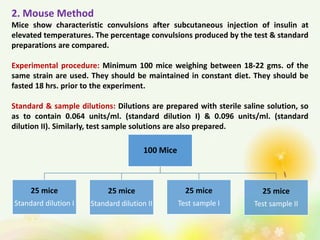
Experimental procedure: Minimum 100 mice weighing between 18-22 gms. of the
same strain are used. They should be maintained in constant diet. They should be
fasted 18 hrs. prior to the experiment.
Standard & sample dilutions: Dilutions are prepared with sterile saline solution, so
as to contain 0.064 units/ml. (standard dilution I) & 0.096 units/ml. (standard
dilution II). Similarly, test sample solutions are also prepared.
100 Mice
25 mice
Standard dilution I
25 mice
Standard dilution II
25 mice
Test sample I
25 mice
Test sample II
• Mice are put in an air incubator at 33ᵒC & observed for one & a half hr.
• The mice which convulse or die are taken out of the incubator & observed.
• These mice usually convulse severely but failure of the animal to upright itself
when placed on its back, should as will be considered as convulsion.
3. Rat Diaphragm method
• Sprague Dawley rats weighing 70-100 g are used.
• The animals are sacrificed during anesthesia & the diaphragms still attached
to the rib cages are carefully removed, released from the rib cages & adhering
connective & fat tissues, washed in PBS, spread out & divided into two equal
pieces as described by Muller & coworker (1194).
• For assaying the effects of insulin/ compounds/ drugs, the hemidiaphragms
are incubated in KRH buffer gassed with carbogen (95% O2/ 5% CO2) in the
presence of 5mM glucose.
4. Epididymal fat pad of rat
• Insulin like activity can be measured by the uptake of glucose into fat cells.
Adipose tissue from the epididymal fat pad of rats has been found to very
suitable.
• The difference of glucose concentration in the medium after incubation of
pieces of epididymal rat adipose tissue or measured oxygen consumption in
Warburg vessels, Radiolabelled 14C glucose, the 14CO2 is trapped & counted.
• The concentration is determined by immune- assay.
Bioassay of insulin