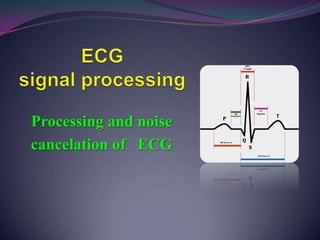
Processing and noise
cancelation of ECG
Introduction
•What is ECG?
•How is it generated?
•What type of information
does ECG tell?
•How can we record it ?
What is ECG ?[1]

         • Electrocardiogram (ECG)
is the physical interpretation of the electrical
    behavior created by the heart muscles.
                      ECG
      is the electrical activity of the heart
How is ECG generated?[2]
    • Heart Cardiac cells are negatively charged.
    •Losing this negativity is called depolarization which is the fundamental
    electrical activity of the heart [2] .

Depolarization propagates from cell to        This wave is transmitted to the entire
       cell producing a wave                       heart producing a current

                         This current can be detected using
                                  skin electrodes

 Skin Electrodes are put on the surface
              of the body


  The result is a periodic signal called
                   ECG
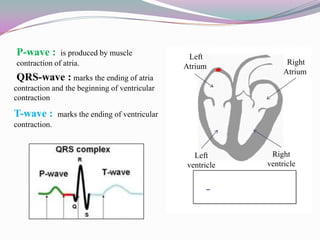
P-wave :      is produced by muscle               Left
contraction of atria.                                              Right
                                                 Atrium
                                                                  Atrium
QRS-wave : marks the ending of atria
contraction and the beginning of ventricular
contraction

T-wave :       marks the ending of ventricular
contraction.


                                                   Left       Right
                                                 ventricle   ventricle
What type of information does ECG tell? [2]
                          Any ECG gives two kinds of information

            First                                                      Second
the duration of the electrical                                the amount of electrical
  wave crossing the heart                                  activity through heart muscle


      decides whether                                               enables to find
       the electrical                                              whether the parts
     activity is normal                                             of the heart are
         or slow or                                                    strong or
          irregular                                                  overworked.


                                   For example
             a narrow and high QRS-wave indicates a physically strong heart
How can we record it ?[3]
    Special electrodes are put on the surface of the body as shown in the figure


After amplifying the recorded signal , the obtained ECG signal is contaminated
with different noises that must be cleared to get the best ECG .
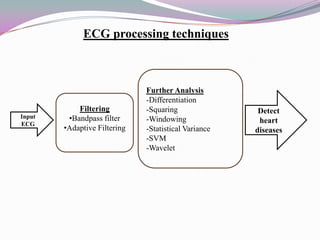
ECG processing techniques


                              Further Analysis
                              -Differentiation
            Filtering         -Squaring                Detect
Input    •Bandpass filter     -Windowing               heart
ECG
        •Adaptive Filtering   -Statistical Variance   diseases
                              -SVM
                              -Wavelet
Filtering
                 Filter is an electronic device that passes and
                 blocks certain frequencies. In most system,
                               noise is suppressed.


         The most common types of noises that occur during the
                       collection of ECG are


Power line Interface                                              Electrode Contact
   60 HZ and its                                                         noise
     multiples                                                      less than 0.5Hz
Effect of Power line Interface[5]
Effect of Electrode contact noise
                            • Movement of body
                               and respiration
• Lose of contact
Solution
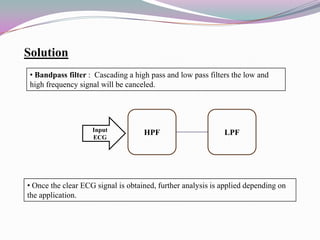
 • Bandpass filter : Cascading a high pass and low pass filters the low and
 high frequency signal will be canceled.


                    Input           HPF                      LPF
                    ECG


• Once the clear ECG signal is obtained, further analysis is applied depending on
the application.
EXAMPLE
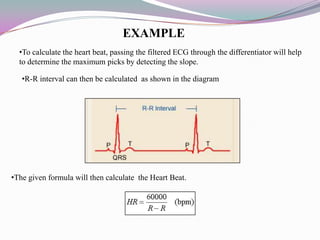
  •To calculate the heart beat, passing the filtered ECG through the differentiator will help
  to determine the maximum picks by detecting the slope.

   •R-R interval can then be calculated as shown in the diagram


•The given formula will then calculate the Heart Beat.
Adaptive Filtering Algorithms
  for Noise Cancellation of ECG Signal with reference signal[4]
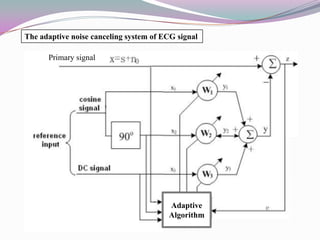
                          In this case two signals are required


       Primary signal                                             Reference Input
            which                                                   which is the
     has two components                                           common noises


Clean ECG (S) + Noise signal ( n0 )                    Estimated Noise signal (Y)


                    The adaptive filters essentially minimizes the
                    error between a primary input, which is the
                                  noisy ECG, and a
                    reference input, which is either noise that is
                           correlated in some way with the
                    noise in the primary input or a signal that is
                          correlated only with ECG in the
                                    primary input.
The adaptive noise canceling system of ECG signal

      Primary signal


                                        Adaptive
                                        Algorithm
Further Analysis

Wavelet transforms are used in detecting
irregularities in QRS section accurately.
Wavelet Energy based Diagnostic Distortion
(WEDD) for distortion measurement.
Heart Rate Variability (HRV) to measure
regulated emotional responding.
CONCLUSION
Using the different techniques in processing the ECG,
we hope to see accurate, robust ,and more advanced
tools in cardiac care.
We believe this will lead to put an end to heart disease
which is the number one killer.
THANK You
  Q /A
References
[1] L. Wang, “The ECG Signal Processing by ADSP-21062 Digital Signal Processor”,
 Thesis submitted to the College of Engineering and Mineral Resources at West Virginia
University,2005 .

[2] C. Saritha, V. Sukanya & Y. Narasimha Murthy, ECG Signal Analysis Using Wavelet
Transforms, February 2008 .
[3] http://www.adinstruments.com/, “Electrocardiogram and Heart Sounds”, An
Introduction to the recording and analysis of electrocardiograms, and the sounds of
the heart.

[4] Md. Zia Ur Rahman, R.A.Shaik & D V R. K. Reddy, “Noise Cancellation in ECG Signals
 using Computationally Simplified Adaptive Filtering Techniques: Application to
 Biotelemetry” ,

[5] S. Z. Islam1, S. Z. Islam2, R. Jidin3 & M. A. M. Ali4, “Performance Study of Adaptive
Filtering Algorithms for Noise Cancellation of ECG Signal”,

ECG Noise cancelling

  • 1.
  • 2.
  • 3.
    •What is ECG? •Howis it generated? •What type of information does ECG tell? •How can we record it ?
  • 4.
    What is ECG?[1] • Electrocardiogram (ECG) is the physical interpretation of the electrical behavior created by the heart muscles. ECG is the electrical activity of the heart
  • 5.
    How is ECGgenerated?[2] • Heart Cardiac cells are negatively charged. •Losing this negativity is called depolarization which is the fundamental electrical activity of the heart [2] . Depolarization propagates from cell to This wave is transmitted to the entire cell producing a wave heart producing a current This current can be detected using skin electrodes Skin Electrodes are put on the surface of the body The result is a periodic signal called ECG
  • 6.
    P-wave : is produced by muscle Left contraction of atria. Right Atrium Atrium QRS-wave : marks the ending of atria contraction and the beginning of ventricular contraction T-wave : marks the ending of ventricular contraction. Left Right ventricle ventricle
  • 7.
    What type ofinformation does ECG tell? [2] Any ECG gives two kinds of information First Second the duration of the electrical the amount of electrical wave crossing the heart activity through heart muscle decides whether enables to find the electrical whether the parts activity is normal of the heart are or slow or strong or irregular overworked. For example a narrow and high QRS-wave indicates a physically strong heart
  • 8.
    How can werecord it ?[3] Special electrodes are put on the surface of the body as shown in the figure After amplifying the recorded signal , the obtained ECG signal is contaminated with different noises that must be cleared to get the best ECG .
  • 9.
    ECG processing techniques Further Analysis -Differentiation Filtering -Squaring Detect Input •Bandpass filter -Windowing heart ECG •Adaptive Filtering -Statistical Variance diseases -SVM -Wavelet
  • 10.
    Filtering Filter is an electronic device that passes and blocks certain frequencies. In most system, noise is suppressed. The most common types of noises that occur during the collection of ECG are Power line Interface Electrode Contact 60 HZ and its noise multiples less than 0.5Hz
  • 11.
    Effect of Powerline Interface[5]
  • 12.
    Effect of Electrodecontact noise • Movement of body and respiration • Lose of contact
  • 13.
    Solution • Bandpassfilter : Cascading a high pass and low pass filters the low and high frequency signal will be canceled. Input HPF LPF ECG • Once the clear ECG signal is obtained, further analysis is applied depending on the application.
  • 14.
    EXAMPLE •Tocalculate the heart beat, passing the filtered ECG through the differentiator will help to determine the maximum picks by detecting the slope. •R-R interval can then be calculated as shown in the diagram •The given formula will then calculate the Heart Beat.
  • 15.
    Adaptive Filtering Algorithms for Noise Cancellation of ECG Signal with reference signal[4] In this case two signals are required Primary signal Reference Input which which is the has two components common noises Clean ECG (S) + Noise signal ( n0 ) Estimated Noise signal (Y) The adaptive filters essentially minimizes the error between a primary input, which is the noisy ECG, and a reference input, which is either noise that is correlated in some way with the noise in the primary input or a signal that is correlated only with ECG in the primary input.
  • 16.
    The adaptive noisecanceling system of ECG signal Primary signal Adaptive Algorithm
  • 17.
    Further Analysis Wavelet transformsare used in detecting irregularities in QRS section accurately. Wavelet Energy based Diagnostic Distortion (WEDD) for distortion measurement. Heart Rate Variability (HRV) to measure regulated emotional responding.
  • 18.
    CONCLUSION Using the differenttechniques in processing the ECG, we hope to see accurate, robust ,and more advanced tools in cardiac care. We believe this will lead to put an end to heart disease which is the number one killer.
  • 19.
  • 20.
    References [1] L. Wang,“The ECG Signal Processing by ADSP-21062 Digital Signal Processor”, Thesis submitted to the College of Engineering and Mineral Resources at West Virginia University,2005 . [2] C. Saritha, V. Sukanya & Y. Narasimha Murthy, ECG Signal Analysis Using Wavelet Transforms, February 2008 . [3] http://www.adinstruments.com/, “Electrocardiogram and Heart Sounds”, An Introduction to the recording and analysis of electrocardiograms, and the sounds of the heart. [4] Md. Zia Ur Rahman, R.A.Shaik & D V R. K. Reddy, “Noise Cancellation in ECG Signals using Computationally Simplified Adaptive Filtering Techniques: Application to Biotelemetry” , [5] S. Z. Islam1, S. Z. Islam2, R. Jidin3 & M. A. M. Ali4, “Performance Study of Adaptive Filtering Algorithms for Noise Cancellation of ECG Signal”,