Electroencephalography
(EEG)
Dr. Md. Kafiul Islam
Dept. of EEE, IUB
1st April, 2017
Outline
 Introduction
 About Brain Recordings
 What is EEG?
 Acquisition Techniques
 Biomedical Electronics! (Analog + Digital)
 Signal Analysis & Processing
 Interferences and Artifacts
 Applications
 Diagnosis of Neurological Disorders
 Brain-Computer Interface / Neural Prosthesis
 Basic Neuroscience, Sleep Study, Depression Study, Biometrics, etc.
 Conclusion
 Future Possibilities
 Limitation & Challenges
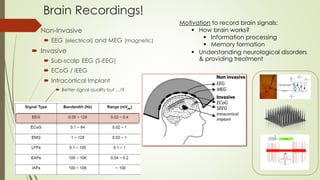
Brain Recordings!
 Non-Invasive
 EEG (electrical) and MEG (magnetic)
 Invasive
 Sub-scalp EEG (S-EEG)
 ECoG / iEEG
 Intracortical Implant
 Better signal quality but …!?
Motivation to record brain signals:
 How brain works?
 Information processing
 Memory formation
 Understanding neurological disorders
& providing treatment
What is EEG?
 Recording of the brain's spontaneous electrical activity over a period of time
by placing flat metal discs (electrodes) attached to the scalp.
 Measures voltage fluctuations resulting from ionic current within the neurons
of the brain.
 Scalp-EEG: Most popular brain recording technique
 Low cost
 Non-invasive
 Portable
 Reasonable temporal resolution
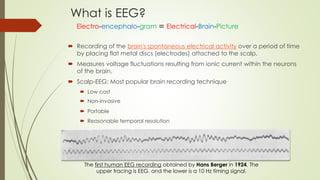
The first human EEG recording obtained by Hans Berger in 1924. The
upper tracing is EEG, and the lower is a 10 Hz timing signal.
Electro-encephalo-gram Electrical-Brain-Picture
EEG Acquisition
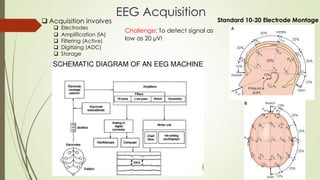
Standard 10-20 Electrode Montage Acquisition involves
 Electrodes
 Amplification (IA)
 Filtering (Active)
 Digitizing (ADC)
 Storage
Challenge: To detect signal as
low as 20 µV!
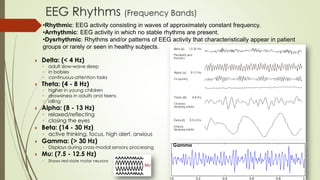
 Delta: (< 4 Hz)
◦ adult slow-wave sleep
◦ in babies
◦ continuous-attention tasks
 Theta: (4 - 8 Hz)
◦ higher in young children
◦ drowsiness in adults and teens
◦ idling
 Alpha: (8 - 13 Hz)
◦ relaxed/reflecting
◦ closing the eyes
 Beta: (14 - 30 Hz)
◦ active thinking, focus, high alert, anxious
 Gamma: (> 30 Hz)
◦ Displays during cross-modal sensory processing
 Mu: (7.5 - 12.5 Hz)
◦ Shows rest-state motor neurons
Gamma
•Rhythmic: EEG activity consisting in waves of approximately constant frequency.
•Arrhythmic: EEG activity in which no stable rhythms are present.
•Dysrhythmic: Rhythms and/or patterns of EEG activity that characteristically appear in patient
groups or rarely or seen in healthy subjects.
Artifacts & Interferences in EEG
Sources of Artifacts
 Environmental factors (e.g. power noise,
sound/optical interference, EM-coupling from
earth, etc.)
 Experiment factors (e.g. electrode position
altering, connecting wire movement, etc. due
to mainly subject motion )
 Physiological factors (e.g. EOG, ECG, EMG,
etc.)
Problems with Artifacts
 Can cause electronics saturation [1]
 High dynamic range required (Higher ENOB in ADC) [2]
 Increase false alarms in epileptic seizure
detection [ ]
 Mistakes in BCI classifications
0 0.2 0.4 0.6 0.8 1 1.2 1.4 1.6 1.8 2
x 10
5
-2
-1.5
-1
-0.5
0
0.5
1
1.5
2
x 10
-3
Time Sample
Voltage,V
[1]
260 265 270 275 280 285 290 295
-15
-10
-5
0
5
x 10
-4
Time, Second
Voltage,Volt
[2]
[ ]
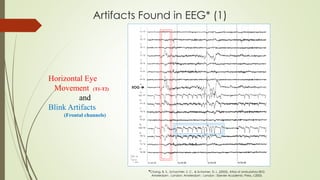
Artifacts Found in EEG* (1)
Horizontal Eye
Movement (T1-T2)
and
Blink Artifacts
(Frontal channels)
EOG 
*Chang, B. S., Schachter, S. C., & Schomer, D. L. (2005). Atlas of ambulatory EEG.
Amsterdam ; London: Amsterdam ; London : Elsevier Academic Press, c2005.
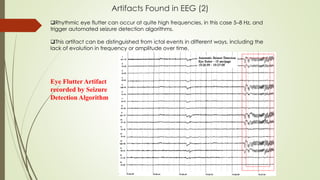
Artifacts Found in EEG (2)
Rhythmic eye flutter can occur at quite high frequencies, in this case 5–8 Hz, and
trigger automated seizure detection algorithms.
This artifact can be distinguished from ictal events in different ways, including the
lack of evolution in frequency or amplitude over time.
Eye Flutter Artifact
recorded by Seizure
Detection Algorithm
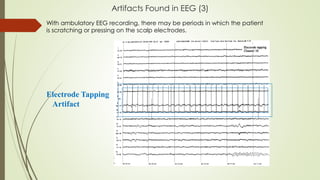
Artifacts Found in EEG (3)
Electrode Tapping
Artifact
With ambulatory EEG recording, there may be periods in which the patient
is scratching or pressing on the scalp electrodes.
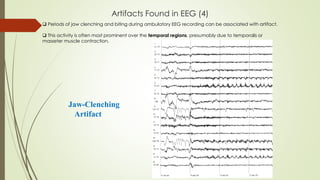
Artifacts Found in EEG (4)
Jaw-Clenching
Artifact
 Periods of jaw clenching and biting during ambulatory EEG recording can be associated with artifact.
 This activity is often most prominent over the temporal regions, presumably due to temporalis or
masseter muscle contraction.
Artifacts Found in EEG (5)
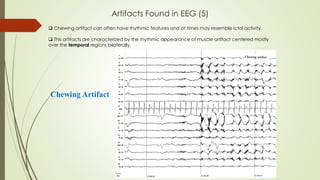
Chewing Artifact
 Chewing artifact can often have rhythmic features and at times may resemble ictal activity.
 This artifacts are characterized by the rhythmic appearance of muscle artifact centered mostly
over the temporal regions bilaterally.
Artifacts Found in EEG (6)
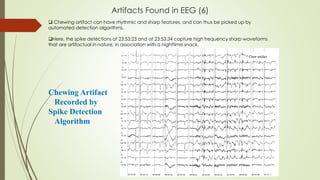
Chewing Artifact
Recorded by
Spike Detection
Algorithm
 Chewing artifact can have rhythmic and sharp features, and can thus be picked up by
automated detection algorithms.
Here, the spike detections at 23:53:23 and at 23:53:34 capture high frequency sharp waveforms
that are artifactual in nature, in association with a nighttime snack.
Artifacts Found in EEG (7)
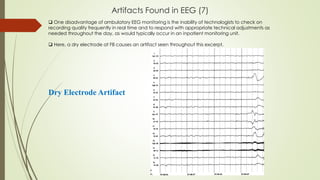
Dry Electrode Artifact
 One disadvantage of ambulatory EEG monitoring is the inability of technologists to check on
recording quality frequently in real time and to respond with appropriate technical adjustments as
needed throughout the day, as would typically occur in an inpatient monitoring unit.
 Here, a dry electrode at F8 causes an artifact seen throughout this excerpt.
Artifacts Found in EEG (8)
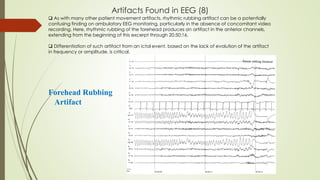
Forehead Rubbing
Artifact
 As with many other patient movement artifacts, rhythmic rubbing artifact can be a potentially
confusing finding on ambulatory EEG monitoring, particularly in the absence of concomitant video
recording. Here, rhythmic rubbing of the forehead produces an artifact in the anterior channels,
extending from the beginning of this excerpt through 20:50:16.
 Differentiation of such artifact from an ictal event, based on the lack of evolution of the artifact
in frequency or amplitude, is critical.
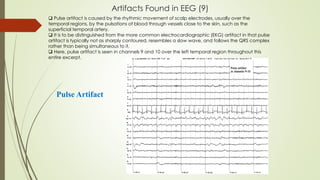
Artifacts Found in EEG (9)
Pulse Artifact
 Pulse artifact is caused by the rhythmic movement of scalp electrodes, usually over the
temporal regions, by the pulsations of blood through vessels close to the skin, such as the
superficial temporal artery.
 It is to be distinguished from the more common electrocardiographic (EKG) artifact in that pulse
artifact is typically not as sharply contoured, resembles a slow wave, and follows the QRS complex
rather than being simultaneous to it.
 Here, pulse artifact is seen in channels 9 and 10 over the left temporal region throughout this
entire excerpt.
Signal Analysis & Processing Techniques
 Fourier Transform / PSD
 Use of an extra sensor
 Adaptive filtering
 Accelerometer
 Gyroscope
 Contact Impedance Measurement
 A-priori user input required
 Wiener/Kalman/Particle Filtering
 Blind Source Separation
 ICA/CCA/MCA
 Time-series Analysis
 Wavelet transform / STFT
 Empirical Technique
 HHT/EMD/EEMD
Applications
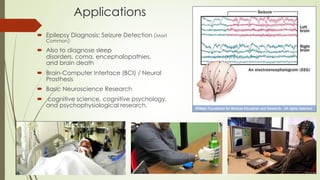
 Epilepsy Diagnosis: Seizure Detection Most
Common
 Also to diagnose sleep
disorders, coma, encephalopathies,
and brain death
 Brain-Computer Interface (BCI) / Neural
Prosthesis
 Basic Neuroscience Research
 cognitive science, cognitive psychology,
and psychophysiological research.
Limitations and Challenges
 Lower spatial resolution
 Lower SNR
 Low degree of freedom for Neural Prosthesis
 Only superficial info from brain’s electrical activity (No access to individual
neuron)
 High EEG channel density provide cross-talk noise
 More prone to Artifacts and Interferences
 Data transmission for wireless EEG
 Real-time EEG processing for high channel density is a major challenge
Thanks
Q & A

EEG guest lecture_iub_eee541

  • 1.
    Electroencephalography (EEG) Dr. Md. KafiulIslam Dept. of EEE, IUB 1st April, 2017
  • 2.
    Outline  Introduction  AboutBrain Recordings  What is EEG?  Acquisition Techniques  Biomedical Electronics! (Analog + Digital)  Signal Analysis & Processing  Interferences and Artifacts  Applications  Diagnosis of Neurological Disorders  Brain-Computer Interface / Neural Prosthesis  Basic Neuroscience, Sleep Study, Depression Study, Biometrics, etc.  Conclusion  Future Possibilities  Limitation & Challenges
  • 3.
    Brain Recordings!  Non-Invasive EEG (electrical) and MEG (magnetic)  Invasive  Sub-scalp EEG (S-EEG)  ECoG / iEEG  Intracortical Implant  Better signal quality but …!? Motivation to record brain signals:  How brain works?  Information processing  Memory formation  Understanding neurological disorders & providing treatment
  • 4.
    What is EEG? Recording of the brain's spontaneous electrical activity over a period of time by placing flat metal discs (electrodes) attached to the scalp.  Measures voltage fluctuations resulting from ionic current within the neurons of the brain.  Scalp-EEG: Most popular brain recording technique  Low cost  Non-invasive  Portable  Reasonable temporal resolution The first human EEG recording obtained by Hans Berger in 1924. The upper tracing is EEG, and the lower is a 10 Hz timing signal. Electro-encephalo-gram Electrical-Brain-Picture
  • 5.
    EEG Acquisition Standard 10-20Electrode Montage Acquisition involves  Electrodes  Amplification (IA)  Filtering (Active)  Digitizing (ADC)  Storage Challenge: To detect signal as low as 20 µV!
  • 6.
     Delta: (<4 Hz) ◦ adult slow-wave sleep ◦ in babies ◦ continuous-attention tasks  Theta: (4 - 8 Hz) ◦ higher in young children ◦ drowsiness in adults and teens ◦ idling  Alpha: (8 - 13 Hz) ◦ relaxed/reflecting ◦ closing the eyes  Beta: (14 - 30 Hz) ◦ active thinking, focus, high alert, anxious  Gamma: (> 30 Hz) ◦ Displays during cross-modal sensory processing  Mu: (7.5 - 12.5 Hz) ◦ Shows rest-state motor neurons Gamma •Rhythmic: EEG activity consisting in waves of approximately constant frequency. •Arrhythmic: EEG activity in which no stable rhythms are present. •Dysrhythmic: Rhythms and/or patterns of EEG activity that characteristically appear in patient groups or rarely or seen in healthy subjects.
  • 7.
    Artifacts & Interferencesin EEG Sources of Artifacts  Environmental factors (e.g. power noise, sound/optical interference, EM-coupling from earth, etc.)  Experiment factors (e.g. electrode position altering, connecting wire movement, etc. due to mainly subject motion )  Physiological factors (e.g. EOG, ECG, EMG, etc.) Problems with Artifacts  Can cause electronics saturation [1]  High dynamic range required (Higher ENOB in ADC) [2]  Increase false alarms in epileptic seizure detection [ ]  Mistakes in BCI classifications 0 0.2 0.4 0.6 0.8 1 1.2 1.4 1.6 1.8 2 x 10 5 -2 -1.5 -1 -0.5 0 0.5 1 1.5 2 x 10 -3 Time Sample Voltage,V [1] 260 265 270 275 280 285 290 295 -15 -10 -5 0 5 x 10 -4 Time, Second Voltage,Volt [2] [ ]
  • 8.
    Artifacts Found inEEG* (1) Horizontal Eye Movement (T1-T2) and Blink Artifacts (Frontal channels) EOG  *Chang, B. S., Schachter, S. C., & Schomer, D. L. (2005). Atlas of ambulatory EEG. Amsterdam ; London: Amsterdam ; London : Elsevier Academic Press, c2005.
  • 9.
    Artifacts Found inEEG (2) Rhythmic eye flutter can occur at quite high frequencies, in this case 5–8 Hz, and trigger automated seizure detection algorithms. This artifact can be distinguished from ictal events in different ways, including the lack of evolution in frequency or amplitude over time. Eye Flutter Artifact recorded by Seizure Detection Algorithm
  • 10.
    Artifacts Found inEEG (3) Electrode Tapping Artifact With ambulatory EEG recording, there may be periods in which the patient is scratching or pressing on the scalp electrodes.
  • 11.
    Artifacts Found inEEG (4) Jaw-Clenching Artifact  Periods of jaw clenching and biting during ambulatory EEG recording can be associated with artifact.  This activity is often most prominent over the temporal regions, presumably due to temporalis or masseter muscle contraction.
  • 12.
    Artifacts Found inEEG (5) Chewing Artifact  Chewing artifact can often have rhythmic features and at times may resemble ictal activity.  This artifacts are characterized by the rhythmic appearance of muscle artifact centered mostly over the temporal regions bilaterally.
  • 13.
    Artifacts Found inEEG (6) Chewing Artifact Recorded by Spike Detection Algorithm  Chewing artifact can have rhythmic and sharp features, and can thus be picked up by automated detection algorithms. Here, the spike detections at 23:53:23 and at 23:53:34 capture high frequency sharp waveforms that are artifactual in nature, in association with a nighttime snack.
  • 14.
    Artifacts Found inEEG (7) Dry Electrode Artifact  One disadvantage of ambulatory EEG monitoring is the inability of technologists to check on recording quality frequently in real time and to respond with appropriate technical adjustments as needed throughout the day, as would typically occur in an inpatient monitoring unit.  Here, a dry electrode at F8 causes an artifact seen throughout this excerpt.
  • 15.
    Artifacts Found inEEG (8) Forehead Rubbing Artifact  As with many other patient movement artifacts, rhythmic rubbing artifact can be a potentially confusing finding on ambulatory EEG monitoring, particularly in the absence of concomitant video recording. Here, rhythmic rubbing of the forehead produces an artifact in the anterior channels, extending from the beginning of this excerpt through 20:50:16.  Differentiation of such artifact from an ictal event, based on the lack of evolution of the artifact in frequency or amplitude, is critical.
  • 16.
    Artifacts Found inEEG (9) Pulse Artifact  Pulse artifact is caused by the rhythmic movement of scalp electrodes, usually over the temporal regions, by the pulsations of blood through vessels close to the skin, such as the superficial temporal artery.  It is to be distinguished from the more common electrocardiographic (EKG) artifact in that pulse artifact is typically not as sharply contoured, resembles a slow wave, and follows the QRS complex rather than being simultaneous to it.  Here, pulse artifact is seen in channels 9 and 10 over the left temporal region throughout this entire excerpt.
  • 17.
    Signal Analysis &Processing Techniques  Fourier Transform / PSD  Use of an extra sensor  Adaptive filtering  Accelerometer  Gyroscope  Contact Impedance Measurement  A-priori user input required  Wiener/Kalman/Particle Filtering  Blind Source Separation  ICA/CCA/MCA  Time-series Analysis  Wavelet transform / STFT  Empirical Technique  HHT/EMD/EEMD
  • 18.
    Applications  Epilepsy Diagnosis:Seizure Detection Most Common  Also to diagnose sleep disorders, coma, encephalopathies, and brain death  Brain-Computer Interface (BCI) / Neural Prosthesis  Basic Neuroscience Research  cognitive science, cognitive psychology, and psychophysiological research.
  • 19.
    Limitations and Challenges Lower spatial resolution  Lower SNR  Low degree of freedom for Neural Prosthesis  Only superficial info from brain’s electrical activity (No access to individual neuron)  High EEG channel density provide cross-talk noise  More prone to Artifacts and Interferences  Data transmission for wireless EEG  Real-time EEG processing for high channel density is a major challenge
  • 20.