Jain College of Engineering
T.S Nagar, Machhe, Belagavi-590014
Seminar on
“FOG COMPUTING”
Submitted By
MAHANTESH HIREMATH
(2JI13CS024)
Under the Guidance of
PROF. VIJAYALAXMI S. NAGANUR
Department of Computer science and Engineering
2016-2017
FOG COMPUTING
CONTENTS:
 Introduction.
 Existing System.
 Proposed System.
 Securing Clouds With Fog
 Security Issues.
 Example.
 Privacy Issues.
 Conclusion.
 References.
What Is FOG Computing.
 Fog Computing is a technology that extends cloud computing and services
to the edge of the network.
 It provides data, compute, storage and application services to the users like
cloud.
 Fog computing is an emerging technology that is basically used for Internet
of Things.
Fog
Cloud
Locations
Edge
Core
Simple Three Level Hierarchy
A simple three level hierarchy as shown in above Figure.
 In this framework, each smart thing is attached to one of Fog devices.
Fog devices could be interconnected and each of them is linked to the
Cloud.
 As Fog computing is implemented at the edge of the network, it
provides low latency, location awareness, and improves quality-of-
services (QoS) for streaming and real time applications.
EXISTING SYSTEM
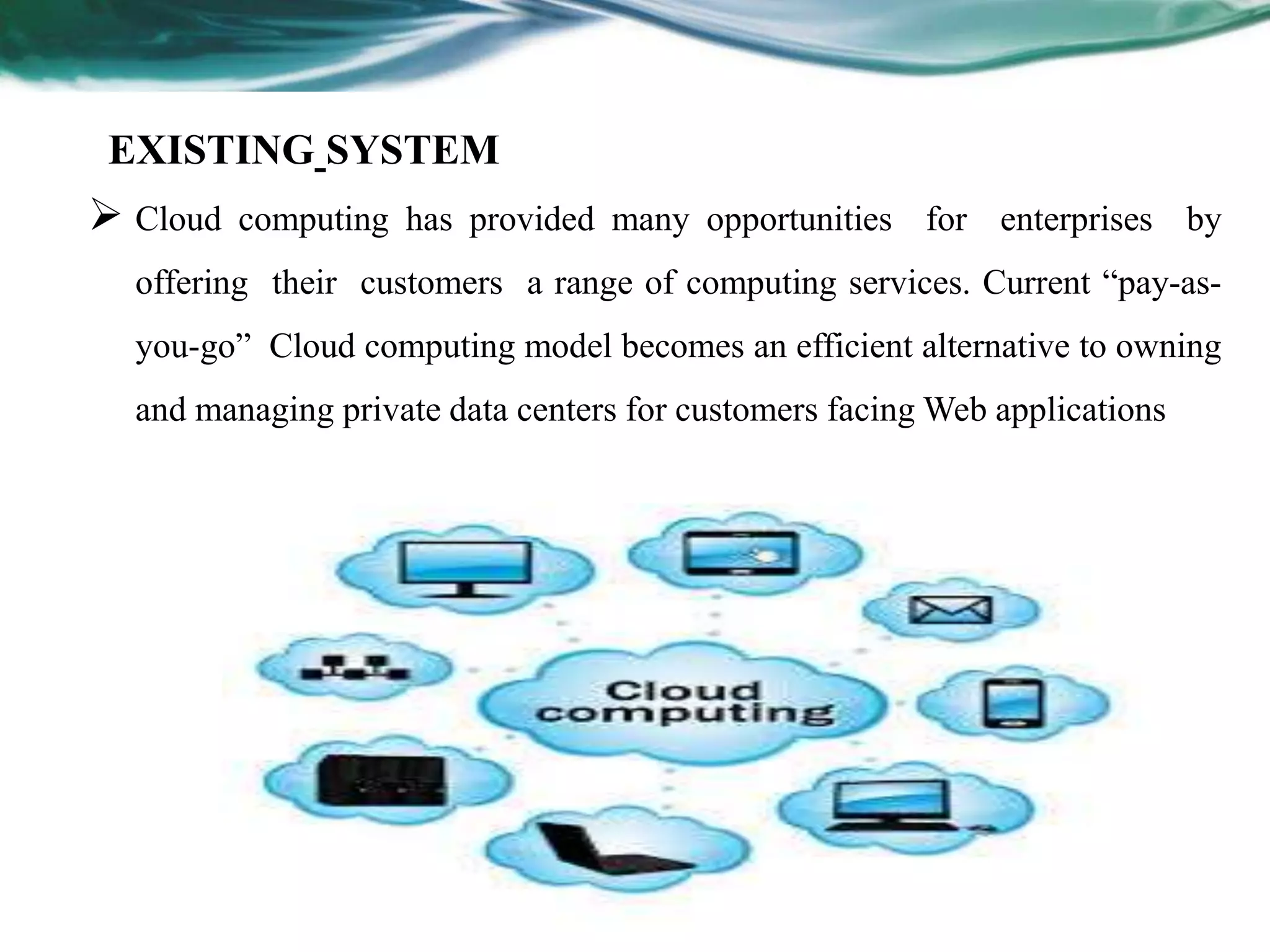
 Cloud computing has provided many opportunities for enterprises by
offering their customers a range of computing services. Current “pay-as-
you-go” Cloud computing model becomes an efficient alternative to owning
and managing private data centers for customers facing Web applications
DISADVANTAGES
 Existing data protection mechanisms such as encryption was failed in
securing the data from the attackers.
 It does not verify whether the user was authorized or not.
 Cloud computing security does not focus on ways of secure the data from
unauthorized access.
PROPOSED SYSTEM
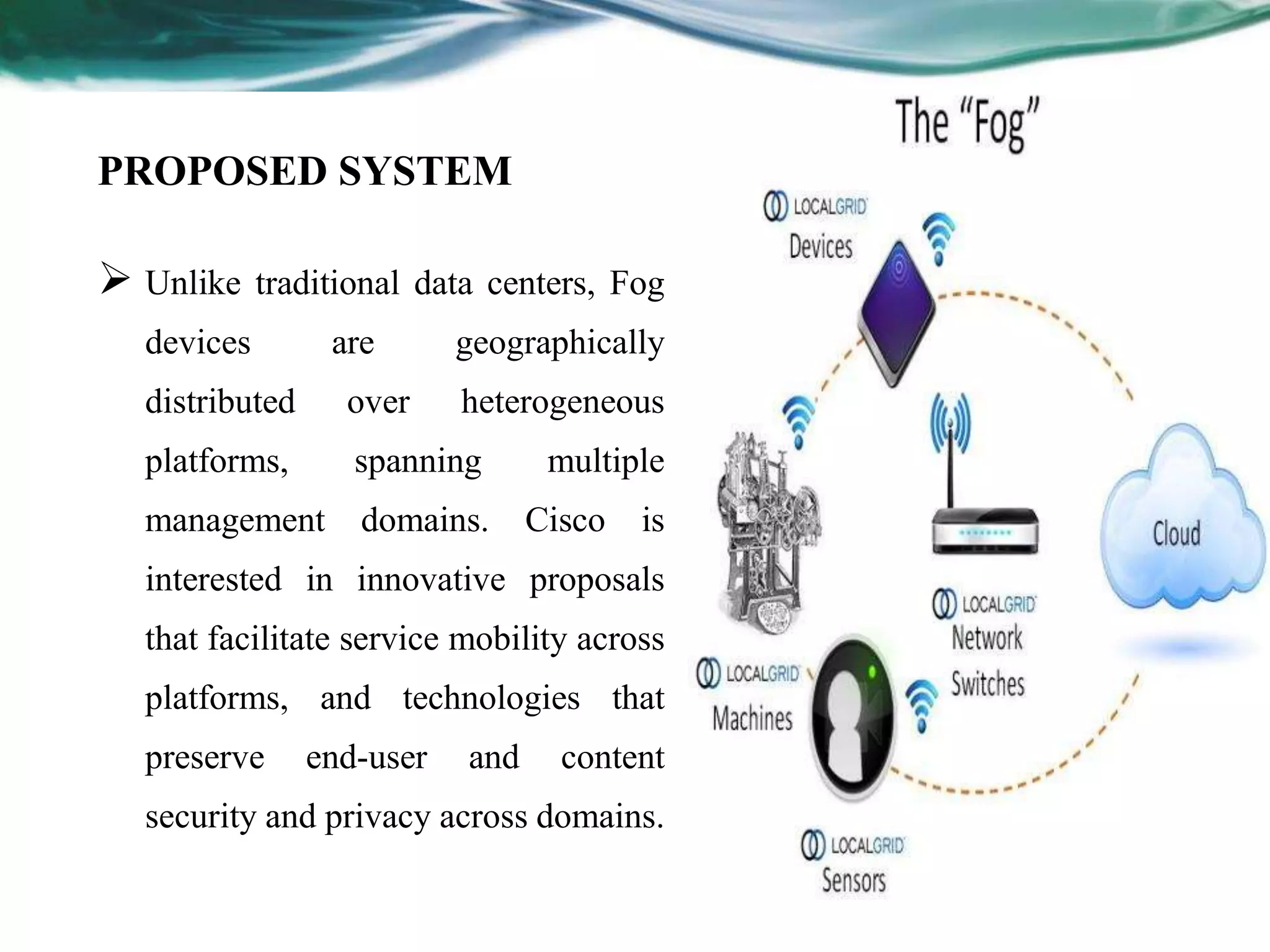
 Unlike traditional data centers, Fog
devices are geographically
distributed over heterogeneous
platforms, spanning multiple
management domains. Cisco is
interested in innovative proposals
that facilitate service mobility across
platforms, and technologies that
preserve end-user and content
security and privacy across domains.
ADVANTAGES
 Fog can be distinguished from Cloud by its proximity to end-users.
 The dense geographical distribution and its support for mobility.
 It provides low latency, location awareness, and improves quality-of-
services (QoS) and real time applications.
SECURING CLOUDS WITH FOG
User behavior profiling
• User profiling is a well-known technique that can be applied here to model
how, when, and how much a user accesses their information in the Cloud.
• Simple user specific features can serve to detect abnormal Cloud access based
partially upon the scale and scope of data transferred.
• Behaviour based security: a ‘normal user’ behaviour can be continuously
checked to determine whether abnormal access to a user’s information is
occurring.
Ex: Fraud detection applications.
Decoy system
 Decoy data, such as decoy documents, honey
pots and other bogus information can be
generated on demand and used for detecting
unauthorized access to information and to
poison the thief’s ex-filtrated information.
 Serving decoys will confuse an attacker into
believing they have ex-filtrated useful
information, when they have actually not.
Fog computing architecture
ADMIN
ADMIN
OPERATIONS
ANSWER TO
QUESTIONS
LOGIN
USER
LOGIN
SIGN UP
ANSWER TO
QUESTIONS
ENTER
USERNAME
ENTER
PASSWORD
VIEW MY
FILES
SEND
MAIL
DOWNLOAD
FILES
UPLOAD
FILES
ORIGINAL
DOCUMENT
DECOY
DOCUMENT
FOG COMPUTING
APPLICATIONS OF FOG
• Connected cars: Fog computing is ideal for Connected Vehicles (CV)
because real-time interactions will make communications between cars,
access points and traffic lights as safe and efficient as possible
• Smart grids: Fog computing allows fast, machine-to-machine (M2M)
handshakes and human to machine interactions (HMI), which would work
in cooperation with the cloud
Fig. Fog computing in smart grid
SECURITY ISSUES
The main security issues are authentication at different
levels of gateways as well as (in case of smart grids) at the smart meters
installed in the consumer’s home. Each smart meter and smart appliance
has an IP address. A malicious user can either tamper with its own smart
meter, report false readings, or spoof IP addresses.
EXAMPLE : MAN-IN –MIDDLE-ATTACK
In this subsection, we take man- in-the-middle attack as
an example to expose the security problems in Fog computing. In this
attack, gateways serving as Fog devices may be compromised or replaced by
fake ones .
PRIVACY ISSUES
In smart grids, privacy issues deal with hiding details, such as what
appliance was used at what time, while allowing correct summary
information for accurate charging.
CONCLUSION
With the increase of data theft attacks the security of user data is becoming
a serious issue for cloud service providers for which Fog Computing is a
paradigm which helps in monitoring the behavior of the user and providing
security to the user’s data. By using decoy technique in Fog can minimize
insider attacks in cloud. Fog provides unprecedented levels of security in the
Cloud and in social networks. The usage of fog computing can accelerate
the innovation process in ways that has never been seen before.
REFERENCES
[1] F. Bonomi, “Connected vehicles, the internet of things, and fog com-
puting,” in The Eighth ACM International Workshop on Vehicular Inter-
Networking (VANET), Las Vegas, USA, 2011.
[2] F. Bonomi, R. Milito, J. Zhu, and S. Addepalli, “Fog computing and its
role in the internet of things,” in Proceedings of the First Edition of the MCC
Workshop on Mobile Cloud Computing, ser. MCC’12. ACM,2012, pp. 13–16.
Thank You

Seminar ppt fog comp

  • 1.
    Jain College ofEngineering T.S Nagar, Machhe, Belagavi-590014 Seminar on “FOG COMPUTING” Submitted By MAHANTESH HIREMATH (2JI13CS024) Under the Guidance of PROF. VIJAYALAXMI S. NAGANUR Department of Computer science and Engineering 2016-2017
  • 2.
  • 3.
    CONTENTS:  Introduction.  ExistingSystem.  Proposed System.  Securing Clouds With Fog  Security Issues.  Example.  Privacy Issues.  Conclusion.  References.
  • 4.
    What Is FOGComputing.  Fog Computing is a technology that extends cloud computing and services to the edge of the network.  It provides data, compute, storage and application services to the users like cloud.  Fog computing is an emerging technology that is basically used for Internet of Things.
  • 5.
  • 6.
    A simple threelevel hierarchy as shown in above Figure.  In this framework, each smart thing is attached to one of Fog devices. Fog devices could be interconnected and each of them is linked to the Cloud.  As Fog computing is implemented at the edge of the network, it provides low latency, location awareness, and improves quality-of- services (QoS) for streaming and real time applications.
  • 7.
    EXISTING SYSTEM  Cloudcomputing has provided many opportunities for enterprises by offering their customers a range of computing services. Current “pay-as- you-go” Cloud computing model becomes an efficient alternative to owning and managing private data centers for customers facing Web applications
  • 8.
    DISADVANTAGES  Existing dataprotection mechanisms such as encryption was failed in securing the data from the attackers.  It does not verify whether the user was authorized or not.  Cloud computing security does not focus on ways of secure the data from unauthorized access.
  • 9.
    PROPOSED SYSTEM  Unliketraditional data centers, Fog devices are geographically distributed over heterogeneous platforms, spanning multiple management domains. Cisco is interested in innovative proposals that facilitate service mobility across platforms, and technologies that preserve end-user and content security and privacy across domains.
  • 10.
    ADVANTAGES  Fog canbe distinguished from Cloud by its proximity to end-users.  The dense geographical distribution and its support for mobility.  It provides low latency, location awareness, and improves quality-of- services (QoS) and real time applications.
  • 11.
  • 12.
    User behavior profiling •User profiling is a well-known technique that can be applied here to model how, when, and how much a user accesses their information in the Cloud. • Simple user specific features can serve to detect abnormal Cloud access based partially upon the scale and scope of data transferred. • Behaviour based security: a ‘normal user’ behaviour can be continuously checked to determine whether abnormal access to a user’s information is occurring. Ex: Fraud detection applications.
  • 13.
    Decoy system  Decoydata, such as decoy documents, honey pots and other bogus information can be generated on demand and used for detecting unauthorized access to information and to poison the thief’s ex-filtrated information.  Serving decoys will confuse an attacker into believing they have ex-filtrated useful information, when they have actually not.
  • 14.
    Fog computing architecture ADMIN ADMIN OPERATIONS ANSWERTO QUESTIONS LOGIN USER LOGIN SIGN UP ANSWER TO QUESTIONS ENTER USERNAME ENTER PASSWORD VIEW MY FILES SEND MAIL DOWNLOAD FILES UPLOAD FILES ORIGINAL DOCUMENT DECOY DOCUMENT FOG COMPUTING
  • 15.
    APPLICATIONS OF FOG •Connected cars: Fog computing is ideal for Connected Vehicles (CV) because real-time interactions will make communications between cars, access points and traffic lights as safe and efficient as possible
  • 16.
    • Smart grids:Fog computing allows fast, machine-to-machine (M2M) handshakes and human to machine interactions (HMI), which would work in cooperation with the cloud Fig. Fog computing in smart grid
  • 17.
    SECURITY ISSUES The mainsecurity issues are authentication at different levels of gateways as well as (in case of smart grids) at the smart meters installed in the consumer’s home. Each smart meter and smart appliance has an IP address. A malicious user can either tamper with its own smart meter, report false readings, or spoof IP addresses.
  • 18.
    EXAMPLE : MAN-IN–MIDDLE-ATTACK In this subsection, we take man- in-the-middle attack as an example to expose the security problems in Fog computing. In this attack, gateways serving as Fog devices may be compromised or replaced by fake ones .
  • 19.
    PRIVACY ISSUES In smartgrids, privacy issues deal with hiding details, such as what appliance was used at what time, while allowing correct summary information for accurate charging.
  • 20.
    CONCLUSION With the increaseof data theft attacks the security of user data is becoming a serious issue for cloud service providers for which Fog Computing is a paradigm which helps in monitoring the behavior of the user and providing security to the user’s data. By using decoy technique in Fog can minimize insider attacks in cloud. Fog provides unprecedented levels of security in the Cloud and in social networks. The usage of fog computing can accelerate the innovation process in ways that has never been seen before.
  • 21.
    REFERENCES [1] F. Bonomi,“Connected vehicles, the internet of things, and fog com- puting,” in The Eighth ACM International Workshop on Vehicular Inter- Networking (VANET), Las Vegas, USA, 2011. [2] F. Bonomi, R. Milito, J. Zhu, and S. Addepalli, “Fog computing and its role in the internet of things,” in Proceedings of the First Edition of the MCC Workshop on Mobile Cloud Computing, ser. MCC’12. ACM,2012, pp. 13–16.
  • 22.