FOG
COMPUTING
J.HariPriyanka
(11G21A0546)
Presented by
Contents:
1.What is fog computing?
2.What is need for fog computing?
3.Limitations overcome from cloud.
4.Cloud v/s fog
5.Applications
6.conclusion
What is fog computing?
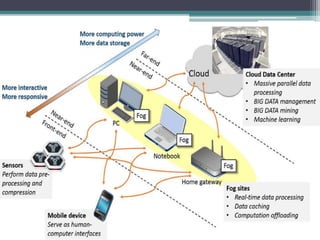
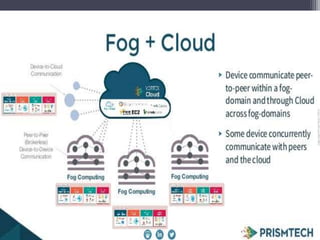
• Fog computing, also known as fogging/edge
computing, it is a model in which data,
processing and applications are concentrated in
devices at the network edge rather than existing
almost entirely in the cloud.
• The term "Fog Computing" was introduced by
the Cisco Systems as new model to ease wireless
data transfer to distributed devices int he
Internet of Things (IoT) network paradigm
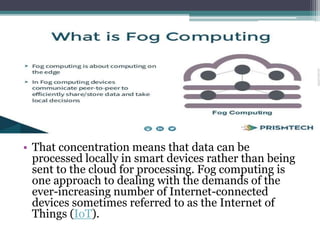
• That concentration means that data can be
processed locally in smart devices rather than being
sent to the cloud for processing. Fog computing is
one approach to dealing with the demands of the
ever-increasing number of Internet-connected
devices sometimes referred to as the Internet of
Things (IoT).
Fog computing is a term for placing some of
transactions and resources at the edge of the
cloud, rather than establishing channels for cloud
storage and utilization. Fog computing reduces
the need for bandwidth by not sending every bit
of information over cloud channels, and instead
aggregating it at certain access points. By using
this kind of distributed strategy, we can lower
costs and improve efficiencies.
What is the need for fog computing?
• Fog Computing extends the cloud computing
paradigm to the edge of the network. While fog
and cloud use the same resources (networking,
compute, and storage) and share many of the
same mechanisms and attributes
(virtualization, multi-tenancy) the extension is a
non-trivial one in that there exist some
fundamental differences stemming from the
reason fog computing was developed: to address
applications and services that do not fit the
paradigm of the cloud
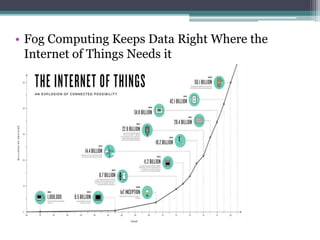
• Fog Computing Keeps Data Right Where the
Internet of Things Needs it
Limitations of cloud:
• cloud computing has so many advantages, it also
suffers from certain shortcomings too.
• High capacity(bandwidth)
• Client access link.
• High latency
• security
Limitations overcomes in fog:
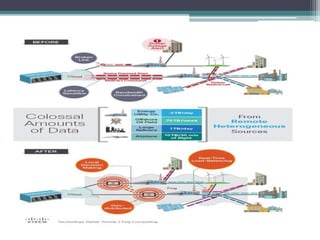
• reduction in data movement across the network
resulting in reduced congestion
• elimination of bottlenecks resulting from
centralized computing systems
• improved security of encrypted data as it stays
closer to the end user
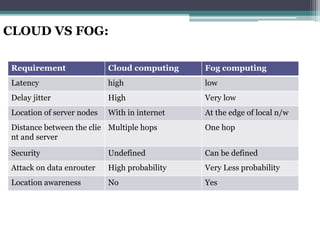
CLOUD VS FOG:
Requirement Cloud computing Fog computing
Latency high low
Delay jitter High Very low
Location of server nodes With in internet At the edge of local n/w
Distance between the clie
nt and server
Multiple hops One hop
Security Undefined Can be defined
Attack on data enrouter High probability Very Less probability
Location awareness No Yes
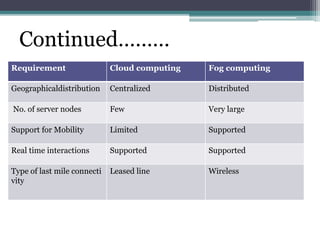
Requirement Cloud computing Fog computing
Geographicaldistribution Centralized Distributed
No. of server nodes Few Very large
Support for Mobility Limited Supported
Real time interactions Supported Supported
Type of last mile connecti
vity
Leased line Wireless
Continued………
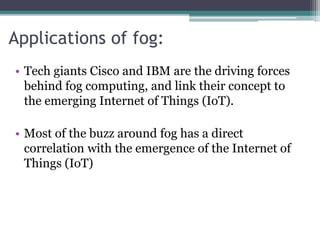
Applications of fog:
• Tech giants Cisco and IBM are the driving forces
behind fog computing, and link their concept to
the emerging Internet of Things (IoT).
• Most of the buzz around fog has a direct
correlation with the emergence of the Internet of
Things (IoT)
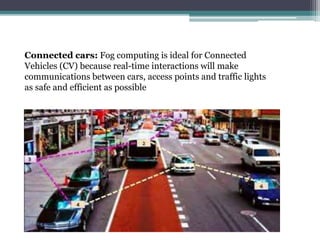
Connected cars: Fog computing is ideal for Connected
Vehicles (CV) because real-time interactions will make
communications between cars, access points and traffic lights
as safe and efficient as possible
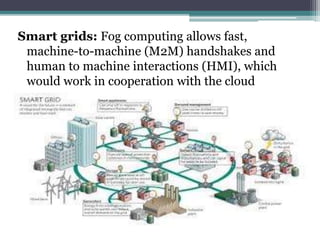
Smart grids: Fog computing allows fast,
machine-to-machine (M2M) handshakes and
human to machine interactions (HMI), which
would work in cooperation with the cloud
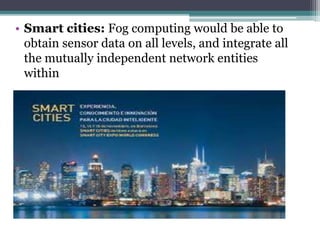
• Smart cities: Fog computing would be able to
obtain sensor data on all levels, and integrate all
the mutually independent network entities
within
• Health care: The cloud computing market for
healthcare is expected to reach $5.4 billion by
2017, and fog computing would allow this on a
more localized level.
Conclusion:Conclusion:
• fog computing will grow in helping the
emerging network paradigms that require
faster processing with less delay and delay ji
tter ,cloud computing would serve the
business community meeting their high end
computing demands lowering the cost based
on a utility pricing model
• REFERENCES:
• K.Hashizume, D.G. Rosado, E.Fernández-Medina,and E.B.
Fernandez, "An analysis of security issues for cloud
computing,"
• Journal of Internet Services and Applications
• , vol.4, no.5, pp. 1--13, 2013.
•
• M.M. Islam, S.Morshed, and P.Goswami, "Cloud computing:
A survey on its limitations and potential solutions,"
• International Journal of Computer Science Issues
• , vol.10, no.4, pp. 159--163, 2013.
•
• F.Bonomi, R.Milito, J.Zhu, and S.Addepalli, "Fog computing
and its role in the Internet of Things," in
• ACM SIGCOMM Workshop on Mobile cloud Computing
• , Helsinki, Finland, 2012, pp. 13--16
Thank you
Fog computing

Fog computing

  • 1.
  • 2.
    Contents: 1.What is fogcomputing? 2.What is need for fog computing? 3.Limitations overcome from cloud. 4.Cloud v/s fog 5.Applications 6.conclusion
  • 3.
    What is fogcomputing? • Fog computing, also known as fogging/edge computing, it is a model in which data, processing and applications are concentrated in devices at the network edge rather than existing almost entirely in the cloud. • The term "Fog Computing" was introduced by the Cisco Systems as new model to ease wireless data transfer to distributed devices int he Internet of Things (IoT) network paradigm
  • 4.
    • That concentrationmeans that data can be processed locally in smart devices rather than being sent to the cloud for processing. Fog computing is one approach to dealing with the demands of the ever-increasing number of Internet-connected devices sometimes referred to as the Internet of Things (IoT).
  • 5.
    Fog computing isa term for placing some of transactions and resources at the edge of the cloud, rather than establishing channels for cloud storage and utilization. Fog computing reduces the need for bandwidth by not sending every bit of information over cloud channels, and instead aggregating it at certain access points. By using this kind of distributed strategy, we can lower costs and improve efficiencies.
  • 7.
    What is theneed for fog computing? • Fog Computing extends the cloud computing paradigm to the edge of the network. While fog and cloud use the same resources (networking, compute, and storage) and share many of the same mechanisms and attributes (virtualization, multi-tenancy) the extension is a non-trivial one in that there exist some fundamental differences stemming from the reason fog computing was developed: to address applications and services that do not fit the paradigm of the cloud
  • 8.
    • Fog ComputingKeeps Data Right Where the Internet of Things Needs it
  • 9.
    Limitations of cloud: •cloud computing has so many advantages, it also suffers from certain shortcomings too. • High capacity(bandwidth) • Client access link. • High latency • security
  • 10.
    Limitations overcomes infog: • reduction in data movement across the network resulting in reduced congestion • elimination of bottlenecks resulting from centralized computing systems • improved security of encrypted data as it stays closer to the end user
  • 11.
    CLOUD VS FOG: RequirementCloud computing Fog computing Latency high low Delay jitter High Very low Location of server nodes With in internet At the edge of local n/w Distance between the clie nt and server Multiple hops One hop Security Undefined Can be defined Attack on data enrouter High probability Very Less probability Location awareness No Yes
  • 12.
    Requirement Cloud computingFog computing Geographicaldistribution Centralized Distributed No. of server nodes Few Very large Support for Mobility Limited Supported Real time interactions Supported Supported Type of last mile connecti vity Leased line Wireless Continued………
  • 15.
    Applications of fog: •Tech giants Cisco and IBM are the driving forces behind fog computing, and link their concept to the emerging Internet of Things (IoT). • Most of the buzz around fog has a direct correlation with the emergence of the Internet of Things (IoT)
  • 16.
    Connected cars: Fogcomputing is ideal for Connected Vehicles (CV) because real-time interactions will make communications between cars, access points and traffic lights as safe and efficient as possible
  • 17.
    Smart grids: Fogcomputing allows fast, machine-to-machine (M2M) handshakes and human to machine interactions (HMI), which would work in cooperation with the cloud
  • 18.
    • Smart cities:Fog computing would be able to obtain sensor data on all levels, and integrate all the mutually independent network entities within
  • 19.
    • Health care:The cloud computing market for healthcare is expected to reach $5.4 billion by 2017, and fog computing would allow this on a more localized level.
  • 21.
    Conclusion:Conclusion: • fog computingwill grow in helping the emerging network paradigms that require faster processing with less delay and delay ji tter ,cloud computing would serve the business community meeting their high end computing demands lowering the cost based on a utility pricing model
  • 22.
    • REFERENCES: • K.Hashizume,D.G. Rosado, E.Fernández-Medina,and E.B. Fernandez, "An analysis of security issues for cloud computing," • Journal of Internet Services and Applications • , vol.4, no.5, pp. 1--13, 2013. • • M.M. Islam, S.Morshed, and P.Goswami, "Cloud computing: A survey on its limitations and potential solutions," • International Journal of Computer Science Issues • , vol.10, no.4, pp. 159--163, 2013. • • F.Bonomi, R.Milito, J.Zhu, and S.Addepalli, "Fog computing and its role in the Internet of Things," in • ACM SIGCOMM Workshop on Mobile cloud Computing • , Helsinki, Finland, 2012, pp. 13--16
  • 23.