
FOG COMPUTING
MADE BY: PRANKIT MISHRA
141CC00007
CONTENTS
 Introduction
 Originator
 Fog Concept
 Need for FOG Computing
 Existing Systems – Cloud
 Limitations of Cloud
 Limitations overcomes in FOG
 Cloud V/S FOG
 Applications of FOG
 Before & After FOG
 Advantages of FOG
 Security issues in FOG
 Future Enhancements
 Conclusion
 Refrences
INTRODUCTION
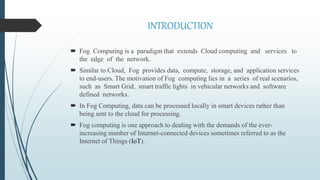
 Fog Computing is a paradigm that extends Cloud computing and services to
the edge of the network.
 Similar to Cloud, Fog provides data, compute, storage, and application services
to end-users. The motivation of Fog computing lies in a series of real scenarios,
such as Smart Grid, smart traffic lights in vehicular networks and software
defined networks.
 In Fog Computing, data can be processed locally in smart devices rather than
being sent to the cloud for processing.
 Fog computing is one approach to dealing with the demands of the ever-
increasing number of Internet-connected devices sometimes referred to as the
Internet of Things (IoT).
ORIGINATOR
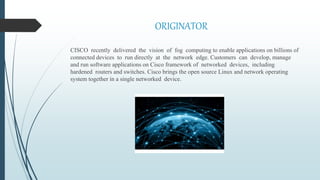
CISCO recently delivered the vision of fog computing to enable applications on billions of
connected devices to run directly at the network edge. Customers can develop, manage
and run software applications on Cisco framework of networked devices, including
hardened routers and switches. Cisco brings the open source Linux and network operating
system together in a single networked device.
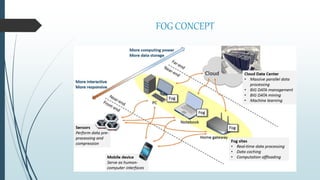
FOG CONCEPT
NEED FOR FOG COMPUTING
 Fog Computing extends the cloud computing paradigm to the edge
of the network. While fog and cloud use the same resources
(networking, compute, and storage) and share many of the same
mechanisms and attributes (virtualization, multi-tenancy) the
extension is a non-trivial one in that there exist some fundamental
differences stemming from the reason fog computing was
developed: to address applications and services that do not fit the
paradigm of the cloud
CONTINUED…
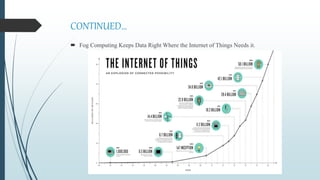
 Fog Computing Keeps Data Right Where the Internet of Things Needs it.
EXISTING SYSTEMS - CLOUD
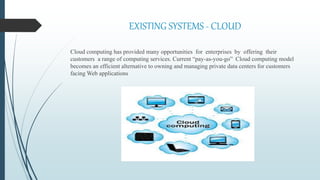
Cloud computing has provided many opportunities for enterprises by offering their
customers a range of computing services. Current “pay-as-you-go” Cloud computing model
becomes an efficient alternative to owning and managing private data centers for customers
facing Web applications
LIMITATIONS OF CLOUD
Cloud computing has so many advantages, it also suffers from certain shortcomings
too. Those are:
 High capacity(bandwidth)
 Client access link.
 High latency
 security
LIMITATIONS OVERCOMES IN FOG
 Reduction in data movement across the network resulting in reduced
congestion.
 Elimination of bottlenecks resulting from centralized computing
systems.
 Improved security of encrypted data as it stays closer to the end
user.
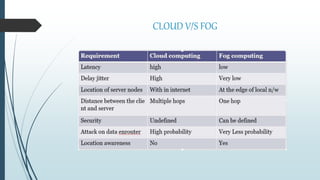
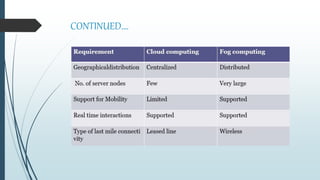
CLOUD V/S FOG
CONTINUED….
APPLICATIONS OF FOG
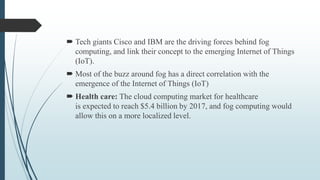
 Tech giants Cisco and IBM are the driving forces behind fog
computing, and link their concept to the emerging Internet of Things
(IoT).
 Most of the buzz around fog has a direct correlation with the
emergence of the Internet of Things (IoT)
 Health care: The cloud computing market for healthcare
is expected to reach $5.4 billion by 2017, and fog computing would
allow this on a more localized level.
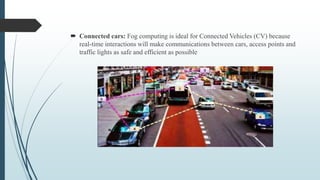
 Connected cars: Fog computing is ideal for Connected Vehicles (CV) because
real-time interactions will make communications between cars, access points and
traffic lights as safe and efficient as possible
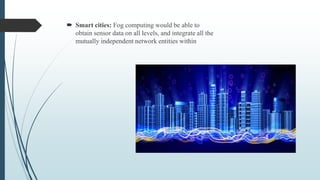
 Smart cities: Fog computing would be able to
obtain sensor data on all levels, and integrate all the
mutually independent network entities within
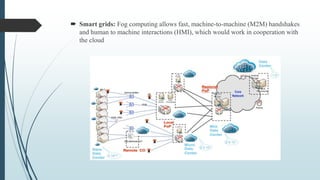
 Smart grids: Fog computing allows fast, machine-to-machine (M2M) handshakes
and human to machine interactions (HMI), which would work in cooperation with
the cloud
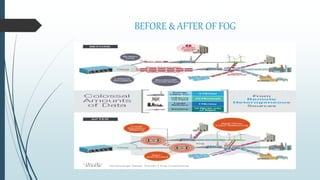
BEFORE & AFTER OF FOG
ADVANTAGES OF FOG
 Fog can be distinguished from Cloud by its proximity to end-users.
 The dense geographical distribution and its support for mobility.
 It provides low latency, location awareness, and improves quality-
of-services (QoS) and real time applications.
SECURITY ISSUES IN FOG
 The main security issues are authentication at different levels of gateways as
well as (in case of smart grids) at the smart meters installed in the consumer’s
home. Each smart meter and smart appliance has an IP address. A
malicious user can either tamper with its own smart meter, report false readings,
or spoof IP addresses.
FUTURE ENHANCEMENTS
 Future work will expand on the Fog computing paradigm in Smart Grid. In this
scenario, two models for Fog devices can be developed. Independent Fog devices
consult directly with the Cloud for periodic updates on price and demands, while
interconnected Fog devices may consult each other.
 Next, Fog computing based SDN in vehicular networks will receive due attention.
CONCLUSION
 Fog Computing will grow in helping the emerging network
paradigms that require faster processing with less delay
and delay jitter ,cloud computing would serve the business
community meeting their high end computing demands lowering the
cost based on a utility pricing model.
REFRENCES
 https://www.cisco.com/c/dam/en_us/solutions/trends/iot/.../computi
ng-overview.pdf
 http://internetofthingsagenda.techtarget.com/definition/fog-
computing-fogging
 www.forbes.com/sites/.../is-fog-computing-the-next-big-thing-in-
internet-of-things/
Fog computing : The new age Technology

Fog computing : The new age Technology

  • 1.
    FOG COMPUTING MADE BY:PRANKIT MISHRA 141CC00007
  • 2.
    CONTENTS  Introduction  Originator Fog Concept  Need for FOG Computing  Existing Systems – Cloud  Limitations of Cloud  Limitations overcomes in FOG  Cloud V/S FOG  Applications of FOG  Before & After FOG  Advantages of FOG  Security issues in FOG  Future Enhancements  Conclusion  Refrences
  • 3.
    INTRODUCTION  Fog Computingis a paradigm that extends Cloud computing and services to the edge of the network.  Similar to Cloud, Fog provides data, compute, storage, and application services to end-users. The motivation of Fog computing lies in a series of real scenarios, such as Smart Grid, smart traffic lights in vehicular networks and software defined networks.  In Fog Computing, data can be processed locally in smart devices rather than being sent to the cloud for processing.  Fog computing is one approach to dealing with the demands of the ever- increasing number of Internet-connected devices sometimes referred to as the Internet of Things (IoT).
  • 4.
    ORIGINATOR CISCO recently deliveredthe vision of fog computing to enable applications on billions of connected devices to run directly at the network edge. Customers can develop, manage and run software applications on Cisco framework of networked devices, including hardened routers and switches. Cisco brings the open source Linux and network operating system together in a single networked device.
  • 5.
  • 6.
    NEED FOR FOGCOMPUTING  Fog Computing extends the cloud computing paradigm to the edge of the network. While fog and cloud use the same resources (networking, compute, and storage) and share many of the same mechanisms and attributes (virtualization, multi-tenancy) the extension is a non-trivial one in that there exist some fundamental differences stemming from the reason fog computing was developed: to address applications and services that do not fit the paradigm of the cloud
  • 7.
    CONTINUED…  Fog ComputingKeeps Data Right Where the Internet of Things Needs it.
  • 8.
    EXISTING SYSTEMS -CLOUD Cloud computing has provided many opportunities for enterprises by offering their customers a range of computing services. Current “pay-as-you-go” Cloud computing model becomes an efficient alternative to owning and managing private data centers for customers facing Web applications
  • 9.
    LIMITATIONS OF CLOUD Cloudcomputing has so many advantages, it also suffers from certain shortcomings too. Those are:  High capacity(bandwidth)  Client access link.  High latency  security
  • 10.
    LIMITATIONS OVERCOMES INFOG  Reduction in data movement across the network resulting in reduced congestion.  Elimination of bottlenecks resulting from centralized computing systems.  Improved security of encrypted data as it stays closer to the end user.
  • 11.
  • 12.
  • 13.
  • 14.
     Tech giantsCisco and IBM are the driving forces behind fog computing, and link their concept to the emerging Internet of Things (IoT).  Most of the buzz around fog has a direct correlation with the emergence of the Internet of Things (IoT)  Health care: The cloud computing market for healthcare is expected to reach $5.4 billion by 2017, and fog computing would allow this on a more localized level.
  • 15.
     Connected cars:Fog computing is ideal for Connected Vehicles (CV) because real-time interactions will make communications between cars, access points and traffic lights as safe and efficient as possible
  • 16.
     Smart cities:Fog computing would be able to obtain sensor data on all levels, and integrate all the mutually independent network entities within
  • 17.
     Smart grids:Fog computing allows fast, machine-to-machine (M2M) handshakes and human to machine interactions (HMI), which would work in cooperation with the cloud
  • 18.
  • 19.
    ADVANTAGES OF FOG Fog can be distinguished from Cloud by its proximity to end-users.  The dense geographical distribution and its support for mobility.  It provides low latency, location awareness, and improves quality- of-services (QoS) and real time applications.
  • 20.
    SECURITY ISSUES INFOG  The main security issues are authentication at different levels of gateways as well as (in case of smart grids) at the smart meters installed in the consumer’s home. Each smart meter and smart appliance has an IP address. A malicious user can either tamper with its own smart meter, report false readings, or spoof IP addresses.
  • 21.
    FUTURE ENHANCEMENTS  Futurework will expand on the Fog computing paradigm in Smart Grid. In this scenario, two models for Fog devices can be developed. Independent Fog devices consult directly with the Cloud for periodic updates on price and demands, while interconnected Fog devices may consult each other.  Next, Fog computing based SDN in vehicular networks will receive due attention.
  • 22.
    CONCLUSION  Fog Computingwill grow in helping the emerging network paradigms that require faster processing with less delay and delay jitter ,cloud computing would serve the business community meeting their high end computing demands lowering the cost based on a utility pricing model.
  • 23.