Presented by:
Manoj V S MandavaFOG COMPUTING
CONTENTS
 Introduction
 What is fog computing?
 What is the need for fog computing?
 Limitations of Cloud
 Limitations Overcomes in Fog
 Cloud vs Fog
 Cloud + Fog
 Characteristics
 Applications
 Conclusion
 References
INTRODUCTION
 “Fog computing”, also known as fogging/edge computing, it is
a model in which data, processing and applications are
concentrated in devices at the network edge rather than
existing almost entirely in the cloud.
 The term "Fog Computing" was introduced by the Cisco
Systems as new model to ease wireless data transfer to
distributed devices in the Internet of Things (IoT) network
paradigm
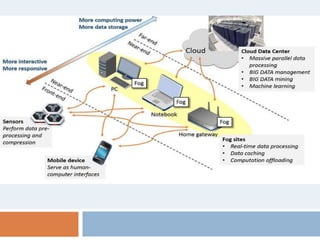
 The concentration means that data can be processed locally
in smart devices rather than being sent to the cloud for
processing. Fog computing is one approach to dealing with the
demands of the ever-increasing number of Internet-connected
devices sometimes referred to as the Internet of Things (IoT).
 Fog computing reduces the need for bandwidth by not sending
every bit of information over cloud channels, and instead
aggregating it at certain access points. By using this kind of
distributed strategy, we can lower costs and improve
efficiencies.
What is the need for fog computing?
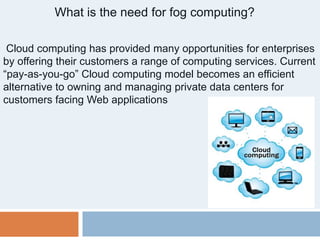
Cloud computing has provided many opportunities for enterprises
by offering their customers a range of computing services. Current
“pay-as-you-go” Cloud computing model becomes an efficient
alternative to owning and managing private data centers for
customers facing Web applications
Limitations of Cloud:
Cloud computing has so many advantages, it also suffers from certain
shortcomings too
High capacity(bandwidth)
Client access link.
High latency
Security
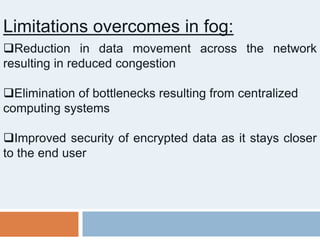
Reduction in data movement across the network
resulting in reduced congestion
Elimination of bottlenecks resulting from centralized
computing systems
Improved security of encrypted data as it stays closer
to the end user
Limitations overcomes in fog:
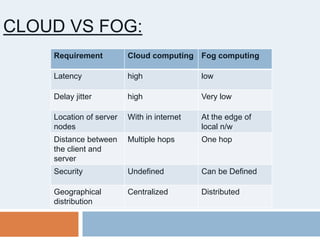
CLOUD VS FOG:
Requirement Cloud computing Fog computing
Latency high low
Delay jitter high Very low
Location of server
nodes
With in internet At the edge of
local n/w
Distance between
the client and
server
Multiple hops One hop
Security Undefined Can be Defined
Geographical
distribution
Centralized Distributed
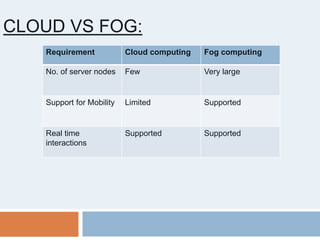
Requirement Cloud computing Fog computing
No. of server nodes Few Very large
Support for Mobility Limited Supported
Real time
interactions
Supported Supported
CLOUD VS FOG:
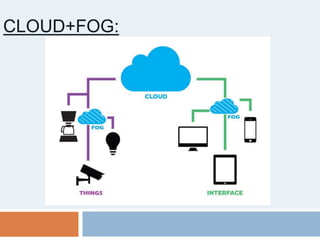
CLOUD+FOG:
CHARACTERISTICS:
olow latency
oGeographical distribution
oSupport for mobility
oReal time interactions
oHeterogeneity
oInteroperability
Applications:
According to CISCO the important areas where fog computing
would play a vital role are the following
•Connected car
•Smart Grid
•Smart Traffic Lights
Connected Cars:
Autonomous vehicle is the new trend taking place on the road.
Tesla is working on software to add automatic steering, enabling
literal "hands free" operations of the vehicle. Starting out with
testing and releasing self-parking features that don't require a
person behind the wheel. Within 2020 all new cars on the road will
have the capability to connect to cars nearby and internet. Fog
computing will be the best option for all internet connected
vehicles why because fog computing gives real time interaction.
Cars, access point and traffic lights will be able to interact with
each other and so it makes safe for all. At some point in time, the
connected car will start saving lives by reducing automobile
accidents
Smart Grids:
Smart grid is another application where fog computing is been
used. Based on demand for energy, its obtainability and low cost,
these smart devices can switch to other energies like solar and
winds. The edge process the data collected by fog collectors and
generate control command to the actuators. The filtered data are
consumed locally and the balance to the higher tiers for
visualization, real-time reports and transactional analytics. Fog
supports semi-permanent storage at the highest tier and
momentary storage at the lowest tier.
Smart Traffic lights:
Fog enables traffic signals to open lanes on sensing flashing lights
of the ambulance. It detects presence of pedestrian and bikers,
and measures the distance and speed of the close by vehicles.
Sensor lighting turns on, on indentifying movements and vice-
versa. Smart lights serves as fog devices synchronize to send
warning signals to the approaching vehicles. The interactions
between vehicle and access points are enhanced with WiFi, 3G,
road side units and smart traffic lights.
Fog computing will grow in helping the emerging network
paradigms that require faster processing with less delay and delay
jitter,cloud computing would serve the business community
meeting their high end computing demands lowering the cost
based on a utility pricing model
Conclusion:
 K.Hashizume, D.G. Rosado, E.Fernández-Medina,and E.B.
Fernandez, "An analysis of security issues for cloud
computing”,Journal of Internet Services and Applications
M.M. Islam, S.Morshed, and P.Goswami, "Cloud computing: A
survey on its limitations and potential solutions," • International
Journal of Computer Science Issues • , vol.10, no.4, pp. 159--163,
201
References:
Fog Computing
Fog Computing

Fog Computing

  • 1.
    Presented by: Manoj VS MandavaFOG COMPUTING
  • 2.
    CONTENTS  Introduction  Whatis fog computing?  What is the need for fog computing?  Limitations of Cloud  Limitations Overcomes in Fog  Cloud vs Fog  Cloud + Fog  Characteristics  Applications  Conclusion  References
  • 3.
    INTRODUCTION  “Fog computing”,also known as fogging/edge computing, it is a model in which data, processing and applications are concentrated in devices at the network edge rather than existing almost entirely in the cloud.  The term "Fog Computing" was introduced by the Cisco Systems as new model to ease wireless data transfer to distributed devices in the Internet of Things (IoT) network paradigm
  • 4.
     The concentrationmeans that data can be processed locally in smart devices rather than being sent to the cloud for processing. Fog computing is one approach to dealing with the demands of the ever-increasing number of Internet-connected devices sometimes referred to as the Internet of Things (IoT).  Fog computing reduces the need for bandwidth by not sending every bit of information over cloud channels, and instead aggregating it at certain access points. By using this kind of distributed strategy, we can lower costs and improve efficiencies.
  • 6.
    What is theneed for fog computing? Cloud computing has provided many opportunities for enterprises by offering their customers a range of computing services. Current “pay-as-you-go” Cloud computing model becomes an efficient alternative to owning and managing private data centers for customers facing Web applications
  • 7.
    Limitations of Cloud: Cloudcomputing has so many advantages, it also suffers from certain shortcomings too High capacity(bandwidth) Client access link. High latency Security
  • 8.
    Reduction in datamovement across the network resulting in reduced congestion Elimination of bottlenecks resulting from centralized computing systems Improved security of encrypted data as it stays closer to the end user Limitations overcomes in fog:
  • 9.
    CLOUD VS FOG: RequirementCloud computing Fog computing Latency high low Delay jitter high Very low Location of server nodes With in internet At the edge of local n/w Distance between the client and server Multiple hops One hop Security Undefined Can be Defined Geographical distribution Centralized Distributed
  • 10.
    Requirement Cloud computingFog computing No. of server nodes Few Very large Support for Mobility Limited Supported Real time interactions Supported Supported CLOUD VS FOG:
  • 11.
  • 12.
    CHARACTERISTICS: olow latency oGeographical distribution oSupportfor mobility oReal time interactions oHeterogeneity oInteroperability
  • 13.
    Applications: According to CISCOthe important areas where fog computing would play a vital role are the following •Connected car •Smart Grid •Smart Traffic Lights
  • 14.
    Connected Cars: Autonomous vehicleis the new trend taking place on the road. Tesla is working on software to add automatic steering, enabling literal "hands free" operations of the vehicle. Starting out with testing and releasing self-parking features that don't require a person behind the wheel. Within 2020 all new cars on the road will have the capability to connect to cars nearby and internet. Fog computing will be the best option for all internet connected vehicles why because fog computing gives real time interaction. Cars, access point and traffic lights will be able to interact with each other and so it makes safe for all. At some point in time, the connected car will start saving lives by reducing automobile accidents
  • 15.
    Smart Grids: Smart gridis another application where fog computing is been used. Based on demand for energy, its obtainability and low cost, these smart devices can switch to other energies like solar and winds. The edge process the data collected by fog collectors and generate control command to the actuators. The filtered data are consumed locally and the balance to the higher tiers for visualization, real-time reports and transactional analytics. Fog supports semi-permanent storage at the highest tier and momentary storage at the lowest tier.
  • 16.
    Smart Traffic lights: Fogenables traffic signals to open lanes on sensing flashing lights of the ambulance. It detects presence of pedestrian and bikers, and measures the distance and speed of the close by vehicles. Sensor lighting turns on, on indentifying movements and vice- versa. Smart lights serves as fog devices synchronize to send warning signals to the approaching vehicles. The interactions between vehicle and access points are enhanced with WiFi, 3G, road side units and smart traffic lights.
  • 17.
    Fog computing willgrow in helping the emerging network paradigms that require faster processing with less delay and delay jitter,cloud computing would serve the business community meeting their high end computing demands lowering the cost based on a utility pricing model Conclusion:
  • 18.
     K.Hashizume, D.G.Rosado, E.Fernández-Medina,and E.B. Fernandez, "An analysis of security issues for cloud computing”,Journal of Internet Services and Applications M.M. Islam, S.Morshed, and P.Goswami, "Cloud computing: A survey on its limitations and potential solutions," • International Journal of Computer Science Issues • , vol.10, no.4, pp. 159--163, 201 References: