Fog Computing
--Cloud near end user
Submitted by
Ayush Chaurasia
2014021017
Table of contents
1. Introduction
2. Why fog?
3. Architecture
4. Working
5. Fog computing framework
6. Load balancing mechanism
7. Security issues
8. MITM(men in the middle attack)
9. Privacy issue
10. Future of fog computing
11. conclusion
Introduction
• Also known as fogging
• introduced by CISCO in 2014.
• Offers decentralised resources like
• Computing
• Networking
• storage resources.
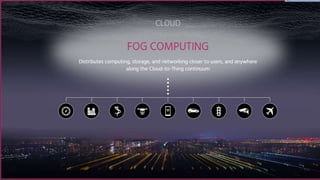
• Extension of cloud computing at the edge of the network
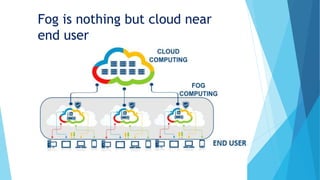
Fog is nothing but cloud near
end user
Why fog ?
• Fog computing saves lots of bandwidth.
• Privacy concerns.
• Maximum use of available resources
• use of user’s resources
• less number of idle resources
• Low network traffic.
• Less network latency.
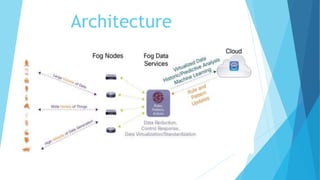
Architecture
Architecture( contd..)
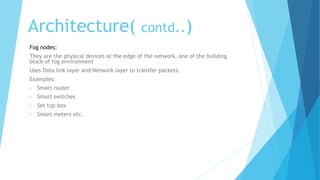
Fog nodes:
They are the physical devices at the edge of the network, one of the building
block of fog environment
Uses Data link layer and Network layer to transfer packets.
Examples:
• Smart router
• Smart switches
• Set top box
• Smart meters etc.
Architecture( contd..)
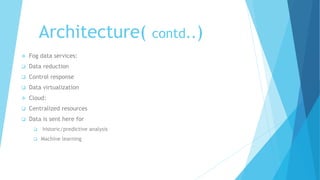
 Fog data services:
 Data reduction
 Control response
 Data virtualization
 Cloud:
 Centralized resources
 Data is sent here for
 historic/predictive analysis
 Machine learning
Working
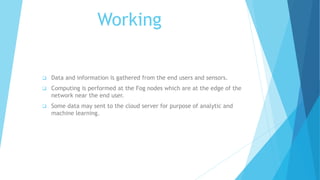
 Data and information is gathered from the end users and sensors.
 Computing is performed at the Fog nodes which are at the edge of the
network near the end user.
 Some data may sent to the cloud server for purpose of analytic and
machine learning.
Fog computing system framework
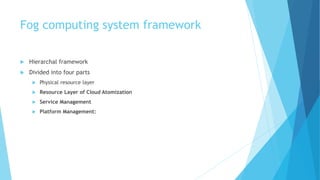
 Hierarchal framework
 Divided into four parts
 Physical resource layer
 Resource Layer of Cloud Atomization
 Service Management
 Platform Management:
Physical resource layer
Consist of
 centre of cyberspace.
 computing and storage resources of the edge node
 network resources among them.
Resource Layer of Cloud Atomization
 Core component of fog computing system
 It carries the cloud atomization on the resources of physical layer
 Atomises the physical node with high computing and storage resources
forming multi-virtual node.
 Node with the limited resource is atomised into a single virtual machine node.
Service Management
 cloud atomization management
 resources monitoring
 Load Balancing
 fault processing
 Some other functions, to achieve monitoring, Management and scheduling of
the resources of cloud atomization.
Platform Management
 Provides the interface services to users
 achieving security
 service
 management of resources
Fog computing system load balance
mechanisms
 Because of the dynamic nature of the fog computing load balancing is
required.
 Steps
 Define elements of the system
 Carry out cloud atomization process on the physical node
 Abstract physical node model into virtual machine node model.
 To achieve load balancing we perform graph portioning.
Security and privacy Issue
Main security issues are
 Authentication
 Intrusion
Other threats
 MITM (Men in the middle attack)
Authentication
 To prevent spoofing and tempering.
 Solutions
 Multicast authentication
 Diffe-Hellman key exchange
Intrusion detection
Methods for detection of Intrusion
• Signature based method
• Anomaly based methods
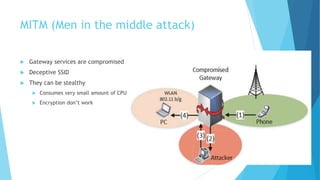
MITM (Men in the middle attack)
 Gateway services are compromised
 Deceptive SSID
 They can be stealthy
 Consumes very small amount of CPU
 Encryption don’t work
Privacy issue
 It deals with
 Hiding details about devices used and their time
 Allowing correct summary information.
 Privacy issue can be solved using encryption
 Batch verification technique is used instead of authentication
Future of fog computing
 New industries are coming out in the field of fog computing
 Fog-as-a-Servicea (FaaS).
 Municipality
 Telecom network provides
 Web scale company
 fog can also create business model like cloud
 Opportunities for creating new applications and services
Conclusion
 Fog computing is still in its new born state
 Advantages in several domains like smart grid IoT, IoE
 It is making smart devices smarter
 Plays crucial role in IoT.
 Complementary of cloud computing.
 Security issues still needs solution

Fog computing

  • 1.
    Fog Computing --Cloud nearend user Submitted by Ayush Chaurasia 2014021017
  • 2.
    Table of contents 1.Introduction 2. Why fog? 3. Architecture 4. Working 5. Fog computing framework 6. Load balancing mechanism 7. Security issues 8. MITM(men in the middle attack) 9. Privacy issue 10. Future of fog computing 11. conclusion
  • 4.
    Introduction • Also knownas fogging • introduced by CISCO in 2014. • Offers decentralised resources like • Computing • Networking • storage resources. • Extension of cloud computing at the edge of the network
  • 5.
    Fog is nothingbut cloud near end user
  • 6.
    Why fog ? •Fog computing saves lots of bandwidth. • Privacy concerns. • Maximum use of available resources • use of user’s resources • less number of idle resources • Low network traffic. • Less network latency.
  • 7.
  • 8.
    Architecture( contd..) Fog nodes: Theyare the physical devices at the edge of the network, one of the building block of fog environment Uses Data link layer and Network layer to transfer packets. Examples: • Smart router • Smart switches • Set top box • Smart meters etc.
  • 9.
    Architecture( contd..)  Fogdata services:  Data reduction  Control response  Data virtualization  Cloud:  Centralized resources  Data is sent here for  historic/predictive analysis  Machine learning
  • 10.
    Working  Data andinformation is gathered from the end users and sensors.  Computing is performed at the Fog nodes which are at the edge of the network near the end user.  Some data may sent to the cloud server for purpose of analytic and machine learning.
  • 11.
    Fog computing systemframework  Hierarchal framework  Divided into four parts  Physical resource layer  Resource Layer of Cloud Atomization  Service Management  Platform Management:
  • 12.
    Physical resource layer Consistof  centre of cyberspace.  computing and storage resources of the edge node  network resources among them.
  • 13.
    Resource Layer ofCloud Atomization  Core component of fog computing system  It carries the cloud atomization on the resources of physical layer  Atomises the physical node with high computing and storage resources forming multi-virtual node.  Node with the limited resource is atomised into a single virtual machine node.
  • 14.
    Service Management  cloudatomization management  resources monitoring  Load Balancing  fault processing  Some other functions, to achieve monitoring, Management and scheduling of the resources of cloud atomization.
  • 15.
    Platform Management  Providesthe interface services to users  achieving security  service  management of resources
  • 16.
    Fog computing systemload balance mechanisms  Because of the dynamic nature of the fog computing load balancing is required.  Steps  Define elements of the system  Carry out cloud atomization process on the physical node  Abstract physical node model into virtual machine node model.  To achieve load balancing we perform graph portioning.
  • 17.
    Security and privacyIssue Main security issues are  Authentication  Intrusion Other threats  MITM (Men in the middle attack)
  • 18.
    Authentication  To preventspoofing and tempering.  Solutions  Multicast authentication  Diffe-Hellman key exchange Intrusion detection Methods for detection of Intrusion • Signature based method • Anomaly based methods
  • 19.
    MITM (Men inthe middle attack)  Gateway services are compromised  Deceptive SSID  They can be stealthy  Consumes very small amount of CPU  Encryption don’t work
  • 20.
    Privacy issue  Itdeals with  Hiding details about devices used and their time  Allowing correct summary information.  Privacy issue can be solved using encryption  Batch verification technique is used instead of authentication
  • 21.
    Future of fogcomputing  New industries are coming out in the field of fog computing  Fog-as-a-Servicea (FaaS).  Municipality  Telecom network provides  Web scale company  fog can also create business model like cloud  Opportunities for creating new applications and services
  • 22.
    Conclusion  Fog computingis still in its new born state  Advantages in several domains like smart grid IoT, IoE  It is making smart devices smarter  Plays crucial role in IoT.  Complementary of cloud computing.  Security issues still needs solution