Seminar on
Fog Computing
Presented by:
Rawke Pranjali P.
Surnar Shital I.
1Fog Computing
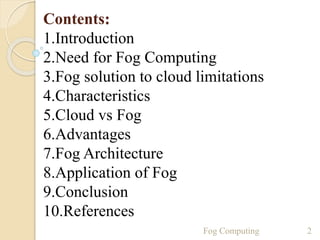
Contents:
1.Introduction
2.Need for Fog Computing
3.Fog solution to cloud limitations
4.Characteristics
5.Cloud vs Fog
6.Advantages
7.Fog Architecture
8.Application of Fog
9.Conclusion
10.References
2Fog Computing
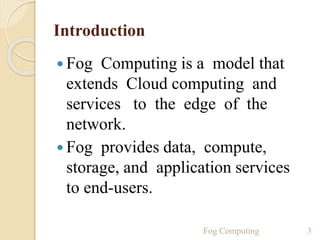
Introduction
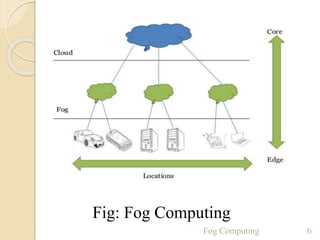
 Fog Computing is a model that
extends Cloud computing and
services to the edge of the
network.
 Fog provides data, compute,
storage, and application services
to end-users.
3Fog Computing
Need of fog computing
• Fog Computing keeps data right
where the Internet of Things needs
it.
• Fog computing was developed to
address applications and services
that do not fit the paradigm of the
cloud.
• Overcome Limitations of cloud
4Fog Computing
Fog – Solution to Cloud’s
Limitations
 Improved security of encrypted
data as it stays closer to the end
user
 Improves efficiency.
 Improves Latency.
5Fog Computing
Fig: Fog Computing
6Fog Computing
Characteristics
 Geographical distribution
 Support for mobility
 Edge location
 Real time interactions
 Interoperability
 Heterogeneity
7Fog Computing
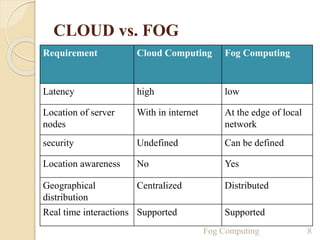
CLOUD vs. FOG
Requirement Cloud Computing Fog Computing
Latency high low
Location of server
nodes
With in internet At the edge of local
network
security Undefined Can be defined
Location awareness No Yes
Geographical
distribution
Centralized Distributed
Real time interactions Supported Supported
8Fog Computing
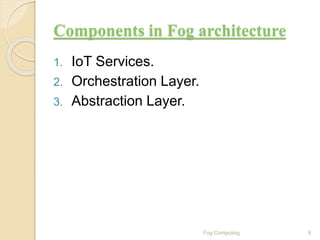
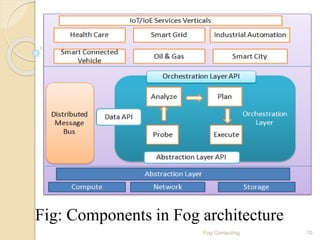
Components in Fog architecture
1. IoT Services.
2. Orchestration Layer.
3. Abstraction Layer.
9Fog Computing
Fig: Components in Fog architecture
10Fog Computing
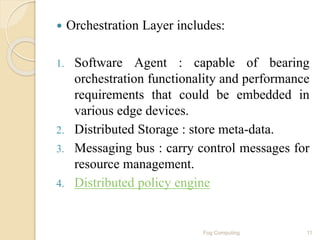
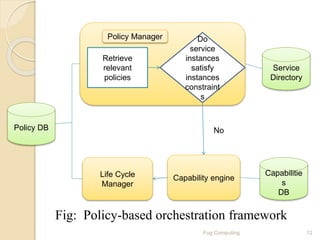
 Orchestration Layer includes:
1. Software Agent : capable of bearing
orchestration functionality and performance
requirements that could be embedded in
various edge devices.
2. Distributed Storage : store meta-data.
3. Messaging bus : carry control messages for
resource management.
4. Distributed policy engine
11Fog Computing
Fig: Policy-based orchestration framework
Retrieve
relevant
policies
Do
service
instances
satisfy
instances
constraint
s
Life Cycle
Manager
Capability engine
Service
Directory
Capabilitie
s
DB
Policy DB No
Policy Manager
12Fog Computing
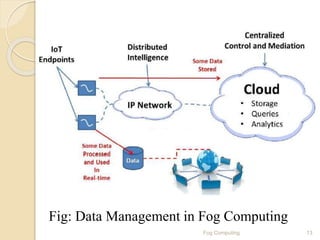
Fig: Data Management in Fog Computing
13Fog Computing
Advantages
 More Security provided.
 Low latency
 Real time applications.
 Fog can be distinguished from
Cloud by its proximity to end-
users.
 Consumes less amount of band
width
14Fog Computing
Applications of Fog
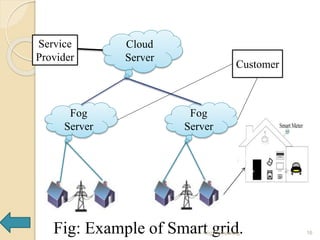
 Smart grids.
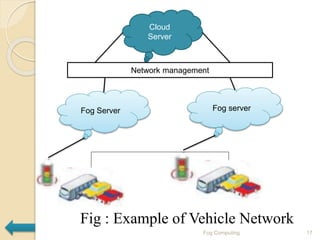
 Vehicle Networks.
 Smart Home.
 Health Data Management
 Smart City
 Augmented reality, cognitive systems,
and gaming
 Mobile Big Data Analytics
15Fog Computing
Fig: Example of Smart grid.
Cloud
Server
Fog
Server
Fog
Server
Service
Provider
Customer
16Fog Computing
Fig : Example of Vehicle Network
Fog Server Fog server
Cloud
Server
Network management
17Fog Computing
Conclusion
 We have analyzed fog computing and
its real time applications.
 Fog computing performs better than
cloud computing.
 Fog computing will grow in helping
the network paradigms that require
faster processing.
18Fog Computing
References
 Cisco RFP-2013-078. Fog Computing,
Ecosystem, Architecture and
Applications
 Computer Science and Information
System,2014 Federated Conference on
7-10 Sept. 2014
 Internet of Things by Rajkumar Buyya,
& Amir Vahid Dastjerdi, 1st Edition
 Fog Computing in the Internet of
Things, Rahmani,A.M., Liljeberg.
19Fog Computing
References (Cont…)
 International Journal of Research in
Engineering and Technology eISSN: 2319-
1163 | pISSN: 2321-7308.
 H. Madsen, G. Albeanu, B. Burtschy, and F.
Popentiu-Vladicescu. Reliability in the utility
computing era: Towards reliable fog
computing. In IWSSIP. IEEE.
 F. Bonomi, “Connected vehicles, the internet
of things, and fog com- puting,” in The Eighth
ACM International Workshop on Vehicular
Inter- Networking (VANET), Las Vegas,
USA, 2011.
20Fog Computing
Thank You...
21Fog Computing

Fog computing 000

  • 1.
    Seminar on Fog Computing Presentedby: Rawke Pranjali P. Surnar Shital I. 1Fog Computing
  • 2.
    Contents: 1.Introduction 2.Need for FogComputing 3.Fog solution to cloud limitations 4.Characteristics 5.Cloud vs Fog 6.Advantages 7.Fog Architecture 8.Application of Fog 9.Conclusion 10.References 2Fog Computing
  • 3.
    Introduction  Fog Computingis a model that extends Cloud computing and services to the edge of the network.  Fog provides data, compute, storage, and application services to end-users. 3Fog Computing
  • 4.
    Need of fogcomputing • Fog Computing keeps data right where the Internet of Things needs it. • Fog computing was developed to address applications and services that do not fit the paradigm of the cloud. • Overcome Limitations of cloud 4Fog Computing
  • 5.
    Fog – Solutionto Cloud’s Limitations  Improved security of encrypted data as it stays closer to the end user  Improves efficiency.  Improves Latency. 5Fog Computing
  • 6.
  • 7.
    Characteristics  Geographical distribution Support for mobility  Edge location  Real time interactions  Interoperability  Heterogeneity 7Fog Computing
  • 8.
    CLOUD vs. FOG RequirementCloud Computing Fog Computing Latency high low Location of server nodes With in internet At the edge of local network security Undefined Can be defined Location awareness No Yes Geographical distribution Centralized Distributed Real time interactions Supported Supported 8Fog Computing
  • 9.
    Components in Fogarchitecture 1. IoT Services. 2. Orchestration Layer. 3. Abstraction Layer. 9Fog Computing
  • 10.
    Fig: Components inFog architecture 10Fog Computing
  • 11.
     Orchestration Layerincludes: 1. Software Agent : capable of bearing orchestration functionality and performance requirements that could be embedded in various edge devices. 2. Distributed Storage : store meta-data. 3. Messaging bus : carry control messages for resource management. 4. Distributed policy engine 11Fog Computing
  • 12.
    Fig: Policy-based orchestrationframework Retrieve relevant policies Do service instances satisfy instances constraint s Life Cycle Manager Capability engine Service Directory Capabilitie s DB Policy DB No Policy Manager 12Fog Computing
  • 13.
    Fig: Data Managementin Fog Computing 13Fog Computing
  • 14.
    Advantages  More Securityprovided.  Low latency  Real time applications.  Fog can be distinguished from Cloud by its proximity to end- users.  Consumes less amount of band width 14Fog Computing
  • 15.
    Applications of Fog Smart grids.  Vehicle Networks.  Smart Home.  Health Data Management  Smart City  Augmented reality, cognitive systems, and gaming  Mobile Big Data Analytics 15Fog Computing
  • 16.
    Fig: Example ofSmart grid. Cloud Server Fog Server Fog Server Service Provider Customer 16Fog Computing
  • 17.
    Fig : Exampleof Vehicle Network Fog Server Fog server Cloud Server Network management 17Fog Computing
  • 18.
    Conclusion  We haveanalyzed fog computing and its real time applications.  Fog computing performs better than cloud computing.  Fog computing will grow in helping the network paradigms that require faster processing. 18Fog Computing
  • 19.
    References  Cisco RFP-2013-078.Fog Computing, Ecosystem, Architecture and Applications  Computer Science and Information System,2014 Federated Conference on 7-10 Sept. 2014  Internet of Things by Rajkumar Buyya, & Amir Vahid Dastjerdi, 1st Edition  Fog Computing in the Internet of Things, Rahmani,A.M., Liljeberg. 19Fog Computing
  • 20.
    References (Cont…)  InternationalJournal of Research in Engineering and Technology eISSN: 2319- 1163 | pISSN: 2321-7308.  H. Madsen, G. Albeanu, B. Burtschy, and F. Popentiu-Vladicescu. Reliability in the utility computing era: Towards reliable fog computing. In IWSSIP. IEEE.  F. Bonomi, “Connected vehicles, the internet of things, and fog com- puting,” in The Eighth ACM International Workshop on Vehicular Inter- Networking (VANET), Las Vegas, USA, 2011. 20Fog Computing
  • 21.