Fog computing
Domain : IoT
Technology:-
Project guide Name:
Miss Vrunda Bhonkar
Presented by:
Miss Chaitali Panvalkar
Roll no.:2201955
PRN no.:2030408246001
Department of information Technology
Institute of Petrochemical engineering
Dr. Babasaheb Ambedkar Technological University
Index
Internet of Things(IoT)
The Internet of Things (IoTs) can be described as connecting everyday
objects like smartphones, internet TVs, sensors and actuators to the
internet where the devices are intelligently linked together enabling
new forms of communication between things and people, and between
things themselves.
Now anyone, from anywhere ad anytime can have connectivity for
anything and it is expected that these connections will extend and
create an entirely advanced dynamic network of Iots .
Cloud Computing
o Cloud Computing is defined as storing and accessing of data and computing
services over the internet.
o It doesn’t store any data on the hard disk of your personal computer. In cloud
computing, you can access data from a remote server.
o The term “Cloud” came from a network design that was used by network engineers
to represent the location of various network devices and there inter-connection.
The shape of this network design was like a cloud.
o It is a pay-as-you-go service
o IoT applications generate a large amount of data. This data requires analysis to make
decisions for implementation and to take various actions.
o Transferring this data to the cloud leads to a number of issues, for example, latency,
excessive usage of bandwidth, delay in real-time responses, centralized location of data,
etc.
o To overcome these challenges, faced by IoT applications, in the cloud environment, the
term fog computing was introduced by Cisco in the year 2012.
o It promises to bring computation near to the end devices leading to minimization of
latency and efficient usage of bandwidth.
o With the increase in sensor-based devices, a large amount of data is generated. This data
needs storage as well as processing. Storing the data on the cloud is costly and adds to
more processing time.
o It places resources near to the end devices, decreasing the processing time and saving the
cost also.
Fog Computing
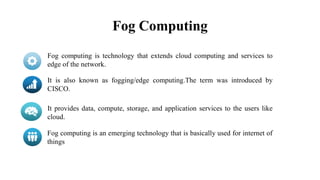
Fog computing is technology that extends cloud computing and services to
edge of the network.
It is also known as fogging/edge computing.The term was introduced by
CISCO.
It provides data, compute, storage, and application services to the users like
cloud.
Fog computing is an emerging technology that is basically used for internet of
things
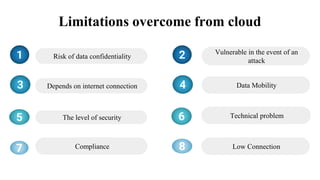
Limitations overcome from cloud
Risk of data confidentiality
Depends on internet connection
The level of security
1
3
5
Compliance
7
Vulnerable in the event of an
attack
2
4
6
8 Low Connection
Technical problem
Data Mobility
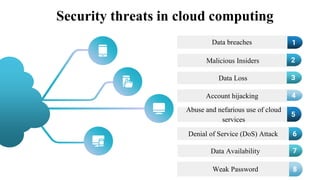
Security threats in cloud computing
Data breaches
Data Loss
Account hijacking
Malicious Insiders
1
2
3
4
Weak Password
Denial of Service (DoS) Attack
Data Availability
Abuse and nefarious use of cloud
services
5
6
7
8
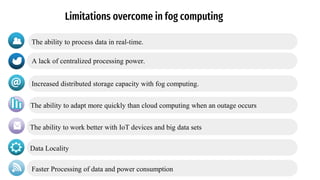
Limitations overcome in fog computing
A lack of centralized processing power.
The ability to process data in real-time.
Increased distributed storage capacity with fog computing.
The ability to adapt more quickly than cloud computing when an outage occurs
The ability to work better with IoT devices and big data sets
Data Locality
Faster Processing of data and power consumption
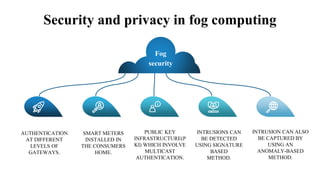
Security and privacy in fog computing
INTRUSION CAN ALSO
BE CAPTURED BY
USING AN
ANOMALY-BASED
METHOD.
PUBLIC KEY
INFRASTRUCTURE(P
KI) WHICH INVOLVE
MULTICAST
AUTHENTICATION.
INTRUSIONS CAN
BE DETECTED
USING SIGNATURE
BASED
METHOD.
SMART METERS
INSTALLED IN
THE CONSUMERS
HOME.
AUTHENTICATION
AT DIFFERENT
LEVELS OF
GATEWAYS.
Fog
security
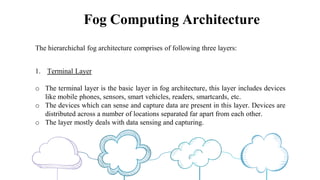
Fog Computing Architecture
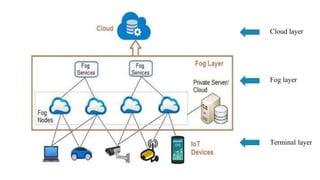
The hierarchichal fog architecture comprises of following three layers:
1. Terminal Layer
o The terminal layer is the basic layer in fog architecture, this layer includes devices
like mobile phones, sensors, smart vehicles, readers, smartcards, etc.
o The devices which can sense and capture data are present in this layer. Devices are
distributed across a number of locations separated far apart from each other.
o The layer mostly deals with data sensing and capturing.
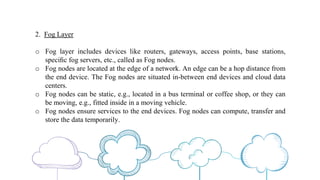
2. Fog Layer
o Fog layer includes devices like routers, gateways, access points, base stations,
specific fog servers, etc., called as Fog nodes.
o Fog nodes are located at the edge of a network. An edge can be a hop distance from
the end device. The Fog nodes are situated in-between end devices and cloud data
centers.
o Fog nodes can be static, e.g., located in a bus terminal or coffee shop, or they can
be moving, e.g., fitted inside in a moving vehicle.
o Fog nodes ensure services to the end devices. Fog nodes can compute, transfer and
store the data temporarily.
3. Cloud Layer
o This layer consists of devices that can provide large storage and machines (servers)
with high performance.
o This layer performs computation analysis and stores data permanently, for back-up
and permanent access to the users.
o The data centers are both scalable and provide compute resources on-demand basis.
o It acts as a back-up as well as provides permanent storage for data in a fog
architecture. Usually, data that isn’t required at the user proximity is stored in a
cloud layer.
Terminal layer
Fog layer
Cloud layer
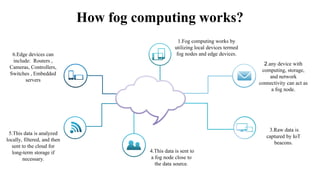
How fog computing works?
4.This data is sent to
a fog node close to
the data source.
5.This data is analyzed
locally, filtered, and then
sent to the cloud for
long-term storage if
necessary.
1.Fog computing works by
utilizing local devices termed
fog nodes and edge devices.
3.Raw data is
captured by IoT
beacons.
6.Edge devices can
include: Routers ,
Cameras, Controllers,
Switches , Embedded
servers
2.any device with
computing, storage,
and network
connectivity can act as
a fog node.
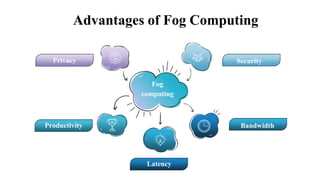
Advantages of Fog Computing
Productivity
Privacy
Bandwidth
Security
Latency
Fog
computing
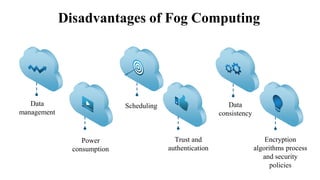
Disadvantages of Fog Computing
Data
management
Power
consumption
Scheduling
Trust and
authentication
Data
consistency
Encryption
algorithms process
and security
policies
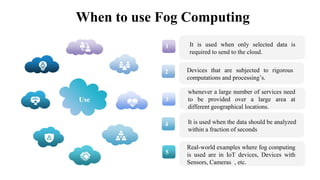
When to use Fog Computing
1
2
3
4
5
It is used when only selected data is
required to send to the cloud.
It is used when the data should be analyzed
within a fraction of seconds
whenever a large number of services need
to be provided over a large area at
different geographical locations.
Devices that are subjected to rigorous
computations and processing’s.
Real-world examples where fog computing
is used are in IoT devices, Devices with
Sensors, Cameras , etc.
Use
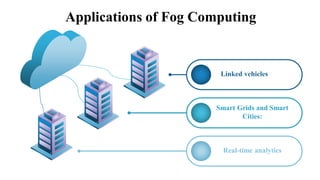
Applications of Fog Computing
Linked vehicles
Real-time analytics
Smart Grids and Smart
Cities:
Connected Cars
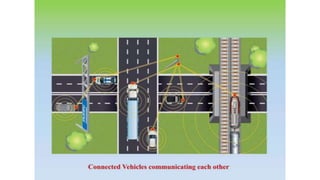
o Fog computing is ideal for connected vehicles (CV) because real-time interactions
will make communications between cars, access points and traffic lights as safe and
efficient as possible.
o At some points in time, the connected car will start saving lives by reducing
automobile accidents.
o Fog computing will be the best option for all internet connected vehicle because fog
computing gives real interaction.
Smart Grids
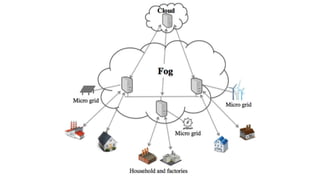
o Fog computing allows fast, machine-to-machine (M2M) handshakes and human to
machine interaction (HMI), which would work in cooperation with the cloud.
o Based om demand for energy, its obtainability and low cost, these smart devices can
switch to other energies like solar and winds. The edge process the data collected by
fog collectors and generate control command to the actuators.
o The filtered data are consumed locally and the balance to the higher tiers for
visualization, real-time reports and transactional analytic.
o Fog supports semi-permanent storage at the highsettier and momentary storage at the
lowest tier.
Decentralized Smart Building Control
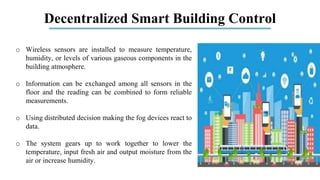
o Wireless sensors are installed to measure temperature,
humidity, or levels of various gaseous components in the
building atmosphere.
o Information can be exchanged among all sensors in the
floor and the reading can be combined to form reliable
measurements.
o Using distributed decision making the fog devices react to
data.
o The system gears up to work together to lower the
temperature, input fresh air and output moisture from the
air or increase humidity.
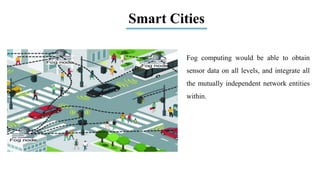
Smart Cities
Fog computing would be able to obtain
sensor data on all levels, and integrate all
the mutually independent network entities
within.
Conclusion
o With the increasing of data theft attacks the security of user data is becoming a
serious issue for clous service providers for which fog computing is a paradigm
which helps in monitoring the behaviour of the user and providing security to the
user’s data.
o By using decoy technique in fog can minimize insider attacks in cloud.
o Fog provides unprecedented levels of security in the cloud and in social networks.
o The usage of fog computing can accelerate the innovation process in ways that has
never been seen before. This includes self-healing, self-organizing and self-
learning applications foe industrial networks products.
Future Scope
Fog computing is the future for organizations. It has several
advantages over cloud computing. It can boost usability and
accessibility in various computing environments.
Cloud computing for IoT may fade away but fog computing will
take over. IoT is seeing an impressive growth rate and so it needs a
special infrastructure base that can handle all its requirements.
Fog application can be enhanced to manage a cloud environment
which has more than one cloud architecture. Fog computing is the
key to accomplish this critical work.
THANK YOU
References
1. Bonomi, Flavio (September 19–23, 2011). "Connected Vehicles, the Internet of Things,
and Fog Computing, The 8th ACM International Workshop on VehiculAr Inter-
NETworking (VANET 2011), Las Vegas, NV, USA". www.sigmobile.org.
Retrieved 2019-08-07.
2. "What Is Fog Computing? Webopedia Definition". www.webopedia.com.
Retrieved 2017-04-07.
3. Bonomi, F., Milito, R., Zhu, J., and Addepalli, S. Fog Computing and its Role in the
Internet of Things. In Proc of MCC (2012), pp. 13-16.[4].
4. "Fog brings the cloud closer to the ground: Cisco innovates in fog
computing". newsroom.cisco.com. Retrieved 2019-01-24.
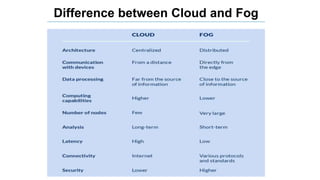
Difference between Cloud and Fog
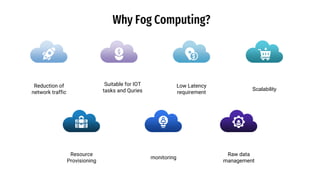
Why Fog Computing?
Reduction of
network traffic
Suitable for IOT
tasks and Quries Scalability
Low Latency
requirement
monitoring
Raw data
management
Resource
Provisioning
1
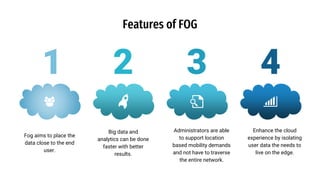
Features of FOG
2 3 4
Fog aims to place the
data close to the end
user.
Enhance the cloud
experience by isolating
user data the needs to
live on the edge.
Big data and
analytics can be done
faster with better
results.
Administrators are able
to support location
based mobility demands
and not have to traverse
the entire network.
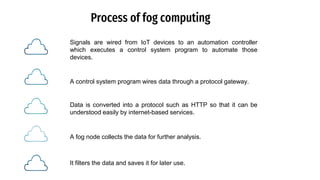
Process of fog computing
35%
Signals are wired from IoT devices to an automation controller
which executes a control system program to automate those
devices.
A control system program wires data through a protocol gateway.
Data is converted into a protocol such as HTTP so that it can be
understood easily by internet-based services.
A fog node collects the data for further analysis.
It filters the data and saves it for later use.
User behavior profiling
o User profiling is a well-known technique that can be applied here to model how, when,
and how much a user accesses their information in the cloud.
o Simple user specific features can serve to detect abnormal cloud access based partially
upon the scale and scope of data transferred.
o Behaviour based security: a ‘normal user’ bahavour can be continuously cheked to
determine whether abnormal access to a user’s information is occurring.
o Ex:Fraud detection applications.
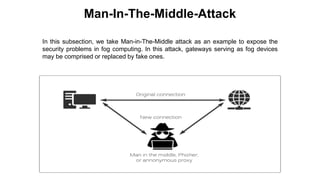
Man-In-The-Middle-Attack
In this subsection, we take Man-in-The-Middle attack as an example to expose the
security problems in fog computing. In this attack, gateways serving as fog devices
may be comprised or replaced by fake ones.
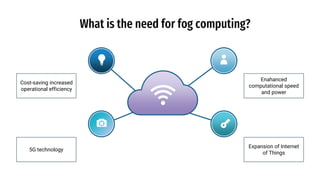
What is the need for fog computing?
Enahanced
computational speed
and power
Expansion of Internet
of Things
Cost-saving increased
operational efficiency
5G technology
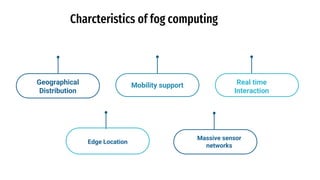
Charcteristics of fog computing
Geographical
Distribution
Real time
Interaction
Mobility support
Edge Location
Massive sensor
networks
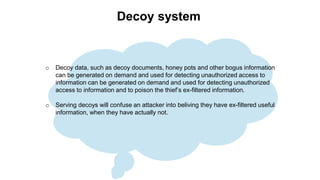
Decoy system
o Decoy data, such as decoy documents, honey pots and other bogus information
can be generated on demand and used for detecting unauthorized access to
information can be generated on demand and used for detecting unauthorized
access to information and to poison the thief’s ex-filtered information.
o Serving decoys will confuse an attacker into beliving they have ex-filtered useful
information, when they have actually not.
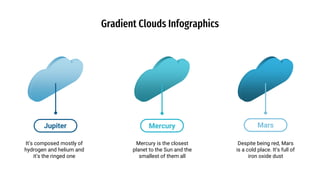
Gradient Clouds Infographics
Mercury
Jupiter Mars
Mercury is the closest
planet to the Sun and the
smallest of them all
Despite being red, Mars
is a cold place. It’s full of
iron oxide dust
It’s composed mostly of
hydrogen and helium and
it’s the ringed one
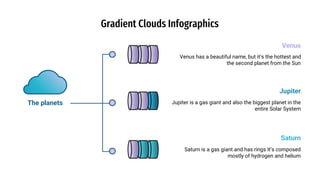
Gradient Clouds Infographics
Venus has a beautiful name, but it’s the hottest and
the second planet from the Sun
Jupiter is a gas giant and also the biggest planet in the
entire Solar System
Saturn is a gas giant and has rings It’s composed
mostly of hydrogen and helium
The planets
Venus
Jupiter
Saturn
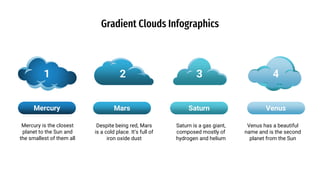
Gradient Clouds Infographics
Mercury is the closest
planet to the Sun and
the smallest of them all
Despite being red, Mars
is a cold place. It’s full of
iron oxide dust
Venus has a beautiful
name and is the second
planet from the Sun
Saturn is a gas giant,
composed mostly of
hydrogen and helium
1 2 3
Mercury Mars Saturn Venus
4
Gradient Clouds Infographics
Idea Money Feed Dialogue
Saturn is composed
mostly of
hydrogen and helium
Jupiter is the biggest
planet in the
Solar System
Venus has a beautiful
name, but also a
poisonous atmosphere
Neptune is the fourth-
largest planet in the Solar
System
Gradient Clouds Infographics
Yes, this is the ringed
one. It’s composed of
hydrogen and helium
Mercury is the closest
planet to the Sun and the
smallest of them all
Despite being red, Mars
is a cold place. It’s full of
iron oxide dust
Saturn
Mercury
Mars
Gradient Clouds Infographics
Mercury is the closest
planet to the Sun and
the smallest of them all
Saturn is a gas giant,
composed mostly of
hydrogen and helium
Jupiter is the fifth planet
from the Sun and the
biggest of them all
Venus has a beautiful
name and is the second
planet from the Sun
Saturn Jupiter Venus Mercury
Gradient Clouds Infographics
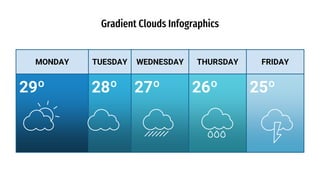
MONDAY TUESDAY WEDNESDAY THURSDAY FRIDAY
29º 28º 27º 26º 25º

semppt.pptx

  • 1.
    Fog computing Domain :IoT Technology:- Project guide Name: Miss Vrunda Bhonkar Presented by: Miss Chaitali Panvalkar Roll no.:2201955 PRN no.:2030408246001 Department of information Technology Institute of Petrochemical engineering Dr. Babasaheb Ambedkar Technological University
  • 2.
  • 3.
    Internet of Things(IoT) TheInternet of Things (IoTs) can be described as connecting everyday objects like smartphones, internet TVs, sensors and actuators to the internet where the devices are intelligently linked together enabling new forms of communication between things and people, and between things themselves. Now anyone, from anywhere ad anytime can have connectivity for anything and it is expected that these connections will extend and create an entirely advanced dynamic network of Iots .
  • 4.
    Cloud Computing o CloudComputing is defined as storing and accessing of data and computing services over the internet. o It doesn’t store any data on the hard disk of your personal computer. In cloud computing, you can access data from a remote server. o The term “Cloud” came from a network design that was used by network engineers to represent the location of various network devices and there inter-connection. The shape of this network design was like a cloud. o It is a pay-as-you-go service
  • 5.
    o IoT applicationsgenerate a large amount of data. This data requires analysis to make decisions for implementation and to take various actions. o Transferring this data to the cloud leads to a number of issues, for example, latency, excessive usage of bandwidth, delay in real-time responses, centralized location of data, etc. o To overcome these challenges, faced by IoT applications, in the cloud environment, the term fog computing was introduced by Cisco in the year 2012. o It promises to bring computation near to the end devices leading to minimization of latency and efficient usage of bandwidth. o With the increase in sensor-based devices, a large amount of data is generated. This data needs storage as well as processing. Storing the data on the cloud is costly and adds to more processing time. o It places resources near to the end devices, decreasing the processing time and saving the cost also.
  • 6.
    Fog Computing Fog computingis technology that extends cloud computing and services to edge of the network. It is also known as fogging/edge computing.The term was introduced by CISCO. It provides data, compute, storage, and application services to the users like cloud. Fog computing is an emerging technology that is basically used for internet of things
  • 7.
    Limitations overcome fromcloud Risk of data confidentiality Depends on internet connection The level of security 1 3 5 Compliance 7 Vulnerable in the event of an attack 2 4 6 8 Low Connection Technical problem Data Mobility
  • 8.
    Security threats incloud computing Data breaches Data Loss Account hijacking Malicious Insiders 1 2 3 4 Weak Password Denial of Service (DoS) Attack Data Availability Abuse and nefarious use of cloud services 5 6 7 8
  • 9.
    Limitations overcome infog computing A lack of centralized processing power. The ability to process data in real-time. Increased distributed storage capacity with fog computing. The ability to adapt more quickly than cloud computing when an outage occurs The ability to work better with IoT devices and big data sets Data Locality Faster Processing of data and power consumption
  • 10.
    Security and privacyin fog computing INTRUSION CAN ALSO BE CAPTURED BY USING AN ANOMALY-BASED METHOD. PUBLIC KEY INFRASTRUCTURE(P KI) WHICH INVOLVE MULTICAST AUTHENTICATION. INTRUSIONS CAN BE DETECTED USING SIGNATURE BASED METHOD. SMART METERS INSTALLED IN THE CONSUMERS HOME. AUTHENTICATION AT DIFFERENT LEVELS OF GATEWAYS. Fog security
  • 11.
    Fog Computing Architecture Thehierarchichal fog architecture comprises of following three layers: 1. Terminal Layer o The terminal layer is the basic layer in fog architecture, this layer includes devices like mobile phones, sensors, smart vehicles, readers, smartcards, etc. o The devices which can sense and capture data are present in this layer. Devices are distributed across a number of locations separated far apart from each other. o The layer mostly deals with data sensing and capturing.
  • 12.
    2. Fog Layer oFog layer includes devices like routers, gateways, access points, base stations, specific fog servers, etc., called as Fog nodes. o Fog nodes are located at the edge of a network. An edge can be a hop distance from the end device. The Fog nodes are situated in-between end devices and cloud data centers. o Fog nodes can be static, e.g., located in a bus terminal or coffee shop, or they can be moving, e.g., fitted inside in a moving vehicle. o Fog nodes ensure services to the end devices. Fog nodes can compute, transfer and store the data temporarily.
  • 13.
    3. Cloud Layer oThis layer consists of devices that can provide large storage and machines (servers) with high performance. o This layer performs computation analysis and stores data permanently, for back-up and permanent access to the users. o The data centers are both scalable and provide compute resources on-demand basis. o It acts as a back-up as well as provides permanent storage for data in a fog architecture. Usually, data that isn’t required at the user proximity is stored in a cloud layer.
  • 14.
  • 15.
    How fog computingworks? 4.This data is sent to a fog node close to the data source. 5.This data is analyzed locally, filtered, and then sent to the cloud for long-term storage if necessary. 1.Fog computing works by utilizing local devices termed fog nodes and edge devices. 3.Raw data is captured by IoT beacons. 6.Edge devices can include: Routers , Cameras, Controllers, Switches , Embedded servers 2.any device with computing, storage, and network connectivity can act as a fog node.
  • 16.
    Advantages of FogComputing Productivity Privacy Bandwidth Security Latency Fog computing
  • 17.
    Disadvantages of FogComputing Data management Power consumption Scheduling Trust and authentication Data consistency Encryption algorithms process and security policies
  • 18.
    When to useFog Computing 1 2 3 4 5 It is used when only selected data is required to send to the cloud. It is used when the data should be analyzed within a fraction of seconds whenever a large number of services need to be provided over a large area at different geographical locations. Devices that are subjected to rigorous computations and processing’s. Real-world examples where fog computing is used are in IoT devices, Devices with Sensors, Cameras , etc. Use
  • 19.
    Applications of FogComputing Linked vehicles Real-time analytics Smart Grids and Smart Cities:
  • 20.
    Connected Cars o Fogcomputing is ideal for connected vehicles (CV) because real-time interactions will make communications between cars, access points and traffic lights as safe and efficient as possible. o At some points in time, the connected car will start saving lives by reducing automobile accidents. o Fog computing will be the best option for all internet connected vehicle because fog computing gives real interaction.
  • 22.
    Smart Grids o Fogcomputing allows fast, machine-to-machine (M2M) handshakes and human to machine interaction (HMI), which would work in cooperation with the cloud. o Based om demand for energy, its obtainability and low cost, these smart devices can switch to other energies like solar and winds. The edge process the data collected by fog collectors and generate control command to the actuators. o The filtered data are consumed locally and the balance to the higher tiers for visualization, real-time reports and transactional analytic. o Fog supports semi-permanent storage at the highsettier and momentary storage at the lowest tier.
  • 24.
    Decentralized Smart BuildingControl o Wireless sensors are installed to measure temperature, humidity, or levels of various gaseous components in the building atmosphere. o Information can be exchanged among all sensors in the floor and the reading can be combined to form reliable measurements. o Using distributed decision making the fog devices react to data. o The system gears up to work together to lower the temperature, input fresh air and output moisture from the air or increase humidity.
  • 25.
    Smart Cities Fog computingwould be able to obtain sensor data on all levels, and integrate all the mutually independent network entities within.
  • 26.
    Conclusion o With theincreasing of data theft attacks the security of user data is becoming a serious issue for clous service providers for which fog computing is a paradigm which helps in monitoring the behaviour of the user and providing security to the user’s data. o By using decoy technique in fog can minimize insider attacks in cloud. o Fog provides unprecedented levels of security in the cloud and in social networks. o The usage of fog computing can accelerate the innovation process in ways that has never been seen before. This includes self-healing, self-organizing and self- learning applications foe industrial networks products.
  • 27.
    Future Scope Fog computingis the future for organizations. It has several advantages over cloud computing. It can boost usability and accessibility in various computing environments. Cloud computing for IoT may fade away but fog computing will take over. IoT is seeing an impressive growth rate and so it needs a special infrastructure base that can handle all its requirements. Fog application can be enhanced to manage a cloud environment which has more than one cloud architecture. Fog computing is the key to accomplish this critical work.
  • 28.
  • 29.
    References 1. Bonomi, Flavio(September 19–23, 2011). "Connected Vehicles, the Internet of Things, and Fog Computing, The 8th ACM International Workshop on VehiculAr Inter- NETworking (VANET 2011), Las Vegas, NV, USA". www.sigmobile.org. Retrieved 2019-08-07. 2. "What Is Fog Computing? Webopedia Definition". www.webopedia.com. Retrieved 2017-04-07. 3. Bonomi, F., Milito, R., Zhu, J., and Addepalli, S. Fog Computing and its Role in the Internet of Things. In Proc of MCC (2012), pp. 13-16.[4]. 4. "Fog brings the cloud closer to the ground: Cisco innovates in fog computing". newsroom.cisco.com. Retrieved 2019-01-24.
  • 30.
  • 31.
    Why Fog Computing? Reductionof network traffic Suitable for IOT tasks and Quries Scalability Low Latency requirement monitoring Raw data management Resource Provisioning
  • 32.
    1 Features of FOG 23 4 Fog aims to place the data close to the end user. Enhance the cloud experience by isolating user data the needs to live on the edge. Big data and analytics can be done faster with better results. Administrators are able to support location based mobility demands and not have to traverse the entire network.
  • 33.
    Process of fogcomputing 35% Signals are wired from IoT devices to an automation controller which executes a control system program to automate those devices. A control system program wires data through a protocol gateway. Data is converted into a protocol such as HTTP so that it can be understood easily by internet-based services. A fog node collects the data for further analysis. It filters the data and saves it for later use.
  • 34.
    User behavior profiling oUser profiling is a well-known technique that can be applied here to model how, when, and how much a user accesses their information in the cloud. o Simple user specific features can serve to detect abnormal cloud access based partially upon the scale and scope of data transferred. o Behaviour based security: a ‘normal user’ bahavour can be continuously cheked to determine whether abnormal access to a user’s information is occurring. o Ex:Fraud detection applications.
  • 35.
    Man-In-The-Middle-Attack In this subsection,we take Man-in-The-Middle attack as an example to expose the security problems in fog computing. In this attack, gateways serving as fog devices may be comprised or replaced by fake ones.
  • 36.
    What is theneed for fog computing? Enahanced computational speed and power Expansion of Internet of Things Cost-saving increased operational efficiency 5G technology
  • 37.
    Charcteristics of fogcomputing Geographical Distribution Real time Interaction Mobility support Edge Location Massive sensor networks
  • 38.
    Decoy system o Decoydata, such as decoy documents, honey pots and other bogus information can be generated on demand and used for detecting unauthorized access to information can be generated on demand and used for detecting unauthorized access to information and to poison the thief’s ex-filtered information. o Serving decoys will confuse an attacker into beliving they have ex-filtered useful information, when they have actually not.
  • 39.
    Gradient Clouds Infographics Mercury JupiterMars Mercury is the closest planet to the Sun and the smallest of them all Despite being red, Mars is a cold place. It’s full of iron oxide dust It’s composed mostly of hydrogen and helium and it’s the ringed one
  • 40.
    Gradient Clouds Infographics Venushas a beautiful name, but it’s the hottest and the second planet from the Sun Jupiter is a gas giant and also the biggest planet in the entire Solar System Saturn is a gas giant and has rings It’s composed mostly of hydrogen and helium The planets Venus Jupiter Saturn
  • 41.
    Gradient Clouds Infographics Mercuryis the closest planet to the Sun and the smallest of them all Despite being red, Mars is a cold place. It’s full of iron oxide dust Venus has a beautiful name and is the second planet from the Sun Saturn is a gas giant, composed mostly of hydrogen and helium 1 2 3 Mercury Mars Saturn Venus 4
  • 42.
    Gradient Clouds Infographics IdeaMoney Feed Dialogue Saturn is composed mostly of hydrogen and helium Jupiter is the biggest planet in the Solar System Venus has a beautiful name, but also a poisonous atmosphere Neptune is the fourth- largest planet in the Solar System
  • 43.
    Gradient Clouds Infographics Yes,this is the ringed one. It’s composed of hydrogen and helium Mercury is the closest planet to the Sun and the smallest of them all Despite being red, Mars is a cold place. It’s full of iron oxide dust Saturn Mercury Mars
  • 44.
    Gradient Clouds Infographics Mercuryis the closest planet to the Sun and the smallest of them all Saturn is a gas giant, composed mostly of hydrogen and helium Jupiter is the fifth planet from the Sun and the biggest of them all Venus has a beautiful name and is the second planet from the Sun Saturn Jupiter Venus Mercury
  • 45.
    Gradient Clouds Infographics MONDAYTUESDAY WEDNESDAY THURSDAY FRIDAY 29º 28º 27º 26º 25º