ARCHANA LISBON (IV MCA)
GUIDE:R.KAVITHA
RESEARCH PAPER
PRESENTATION
1
RESEARCH TOPIC
CLOUD AND FOG
COMPUTING
2
1. To understand the security issues in cloud
and to identify the appropriate security
techniques by Fog computing
2. To suggest any Algorithms for the future
challenges to be faced in Cloud
Computing.
3
1. Introduction to Cloud computing
2. Introduction to Fog computing.
3. Characteristics of FOG Computing.
4. Architecture of FOG computing.
5. Applications of FOG computing.
6. Why fog computing?
7. How Fog helps Cloud?
4
5
Cloud Definition
Cloud computing is a delivery platform which
promises a new way of accessing and storing
personal as well as business information.
Cloud computing, often referred to as simply
“ cloud,” is the delivery of on-demand
computing resources—everything from
applications to data centers—over the Internet
on a pay-for-use basis.
6
Cloud Providers
 Amazon
 Google
 Microsoft
 IBM
7
Breakfast in Paris, dinner
in London, data in
Washington
8
9
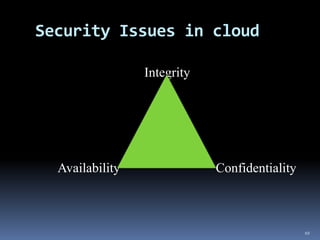
Security Issues in cloud
Integrity
Availability Confidentiality
10
Areas for security concerns
in cloud
(1) Data at rest
(2) Data in transit
(3) Authentication
(4) Separation between customers
(5) Cloud legal and regulatory issues and
(6) Incident response.
11
1.Dataatrest
2.Dataintransit
3.Authentication
4.Separationbetweencustomers
5.Cloudlegalandregulatoryissuesand
6.Incidentresponse.
12
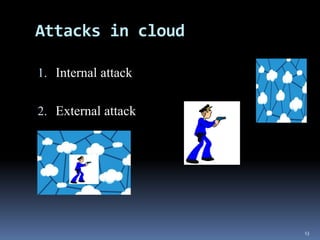
Attacks in cloud
1. Internal attack
2. External attack
13
Types of attackers
1. Random
2. Weak
3. Strong
4. Substantial
14
ISSUES WITH THE
CLOUD:
 Security issues
 Difficult to handle huge amount of the data.
15
Problems with Data
 Data Lost
 Data Theft
 Data Leakage
 Data Misuse
16
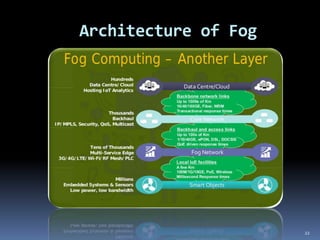
Fog Computing
 Fog computing is a paradigm which
extends cloud computing paradigm to the
edge of the network.
 The Terms Edge Computing and Fog
Computing are often used interchangeably.
 Similar to Cloud, Fog provides data,
compute, storage, and application services
to end-users. This enables new breed of
applications and services.
17
WHY DO WE NEED FOG?
When techniques and devices of IoT are getting
more involved in people’s life, current Cloud
computing paradigm can hardly satisfy their
requirements of mobility support, location
awareness and low latency
18
Cloud and Fog
19
Goal of Fog
 Improve efficiency
 Reduce the amount of data that needs to be
transported to the cloud for data processing
analysis and storage.
20
Overview of Fog
21
Architecture of Fog
22
Characteristics
Wide-spread geographical distribution
 Mobility
Very large number of node
 Predominant role of wireless access
23
Application of Fog
 Internet of things (IoT)
Example: Home Automation
Smart City
 Provides security for the data in cloud
24
How Fog provides data
Security In Cloud?
25
Techniques Used By Fog
 User Profiling
 Decoy Technique
26
User Profiling
 This method of behavior based
security is commonly used in fraud detection
applications.
 This technique usually observes the users
search behavior’s it can easily differentiate
between normal user and unauthorized user.
 This method is generally used in fraud
detection applications.
27
Decoy Technique
Decoy serves two purposes
1.Validating whether the data is authorized
2. Misleading the user with false or bogus
information
28
Example
29
How DECOY works?
Hash Message Authentication Code (HMAC)
MD5 processes a document of variable
length into a fixed length output of 128 bits.
1. Variable length to fixed length output.
2. Input n-bit blocks
3. Input divided into 512 bit blocks
4. Padding is done
5. Buffer initialization
6. Output 128 bit
30
MD 5 Algorithm
31
Advantages
(1) The detection of masquerade activity
(2) The confusion of the attacker and the additional
costs incurred to identify the real information from
bogus information.
3) The combination of the two techniques: The
combination of user behavior profiling with decoy
technology provides a strong evidence of illegal
access and helps improve accuracy of detection.
32
References
1. Salvatore J. Stolfo, Malek Ben Salem,Angelos D. Keromytis, Fog
Computing: Mitigating Insider DataTheft Attacks in the Cloud, IEEE
symposium on security and privacy workshop (SPW) year 2012
2. Brian M. Bowen, Shlomo Hershkop, Angelos D. Keromytis, Salvatore
J. Stolfo, Baiting Inside Attackers Using Decoy Documents,
Department of Computer Science, Columbia University,NewYork, NY
10027
3. Malek Ben Salem and Salvatore J. Stolfo, Decoy Document
Deployment for E_ective Masquerade Attack Detection, Computer
Science Department,Columbia University NewYork, NewYork 10027,
USA.
4.Flavio Bonomi, Rodolfo Milito, Jiang Zhu, Sateesh Addepalli, Fog
Computing and Its Role in the Internet ofThings, 170WTasman Dr.
San Jose, CA 95134, USA
33
34

cloud security using Fog Computing

  • 1.
    ARCHANA LISBON (IVMCA) GUIDE:R.KAVITHA RESEARCH PAPER PRESENTATION 1
  • 2.
    RESEARCH TOPIC CLOUD ANDFOG COMPUTING 2
  • 3.
    1. To understandthe security issues in cloud and to identify the appropriate security techniques by Fog computing 2. To suggest any Algorithms for the future challenges to be faced in Cloud Computing. 3
  • 4.
    1. Introduction toCloud computing 2. Introduction to Fog computing. 3. Characteristics of FOG Computing. 4. Architecture of FOG computing. 5. Applications of FOG computing. 6. Why fog computing? 7. How Fog helps Cloud? 4
  • 5.
  • 6.
    Cloud Definition Cloud computingis a delivery platform which promises a new way of accessing and storing personal as well as business information. Cloud computing, often referred to as simply “ cloud,” is the delivery of on-demand computing resources—everything from applications to data centers—over the Internet on a pay-for-use basis. 6
  • 7.
    Cloud Providers  Amazon Google  Microsoft  IBM 7
  • 8.
    Breakfast in Paris,dinner in London, data in Washington 8
  • 9.
  • 10.
    Security Issues incloud Integrity Availability Confidentiality 10
  • 11.
    Areas for securityconcerns in cloud (1) Data at rest (2) Data in transit (3) Authentication (4) Separation between customers (5) Cloud legal and regulatory issues and (6) Incident response. 11
  • 12.
  • 13.
    Attacks in cloud 1.Internal attack 2. External attack 13
  • 14.
    Types of attackers 1.Random 2. Weak 3. Strong 4. Substantial 14
  • 15.
    ISSUES WITH THE CLOUD: Security issues  Difficult to handle huge amount of the data. 15
  • 16.
    Problems with Data Data Lost  Data Theft  Data Leakage  Data Misuse 16
  • 17.
    Fog Computing  Fogcomputing is a paradigm which extends cloud computing paradigm to the edge of the network.  The Terms Edge Computing and Fog Computing are often used interchangeably.  Similar to Cloud, Fog provides data, compute, storage, and application services to end-users. This enables new breed of applications and services. 17
  • 18.
    WHY DO WENEED FOG? When techniques and devices of IoT are getting more involved in people’s life, current Cloud computing paradigm can hardly satisfy their requirements of mobility support, location awareness and low latency 18
  • 19.
  • 20.
    Goal of Fog Improve efficiency  Reduce the amount of data that needs to be transported to the cloud for data processing analysis and storage. 20
  • 21.
  • 22.
  • 23.
    Characteristics Wide-spread geographical distribution Mobility Very large number of node  Predominant role of wireless access 23
  • 24.
    Application of Fog Internet of things (IoT) Example: Home Automation Smart City  Provides security for the data in cloud 24
  • 25.
    How Fog providesdata Security In Cloud? 25
  • 26.
    Techniques Used ByFog  User Profiling  Decoy Technique 26
  • 27.
    User Profiling  Thismethod of behavior based security is commonly used in fraud detection applications.  This technique usually observes the users search behavior’s it can easily differentiate between normal user and unauthorized user.  This method is generally used in fraud detection applications. 27
  • 28.
    Decoy Technique Decoy servestwo purposes 1.Validating whether the data is authorized 2. Misleading the user with false or bogus information 28
  • 29.
  • 30.
    How DECOY works? HashMessage Authentication Code (HMAC) MD5 processes a document of variable length into a fixed length output of 128 bits. 1. Variable length to fixed length output. 2. Input n-bit blocks 3. Input divided into 512 bit blocks 4. Padding is done 5. Buffer initialization 6. Output 128 bit 30
  • 31.
  • 32.
    Advantages (1) The detectionof masquerade activity (2) The confusion of the attacker and the additional costs incurred to identify the real information from bogus information. 3) The combination of the two techniques: The combination of user behavior profiling with decoy technology provides a strong evidence of illegal access and helps improve accuracy of detection. 32
  • 33.
    References 1. Salvatore J.Stolfo, Malek Ben Salem,Angelos D. Keromytis, Fog Computing: Mitigating Insider DataTheft Attacks in the Cloud, IEEE symposium on security and privacy workshop (SPW) year 2012 2. Brian M. Bowen, Shlomo Hershkop, Angelos D. Keromytis, Salvatore J. Stolfo, Baiting Inside Attackers Using Decoy Documents, Department of Computer Science, Columbia University,NewYork, NY 10027 3. Malek Ben Salem and Salvatore J. Stolfo, Decoy Document Deployment for E_ective Masquerade Attack Detection, Computer Science Department,Columbia University NewYork, NewYork 10027, USA. 4.Flavio Bonomi, Rodolfo Milito, Jiang Zhu, Sateesh Addepalli, Fog Computing and Its Role in the Internet ofThings, 170WTasman Dr. San Jose, CA 95134, USA 33
  • 34.