Contents:
1.Introduction
2.What is fog computing?
3.What is need for fog computing?
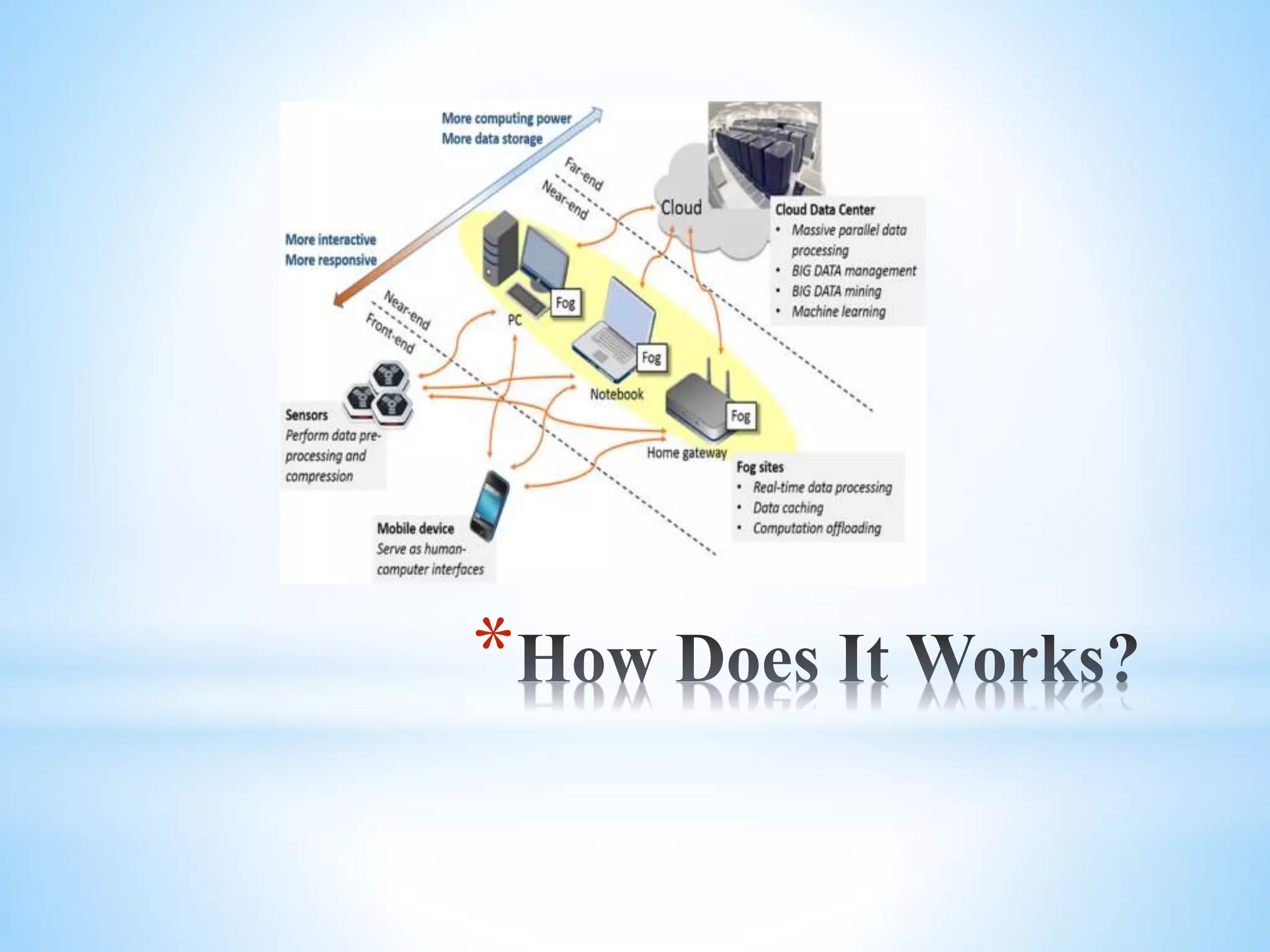
4.How Does It Works?
5.Limitations Of cloud.
6.Limitations Over come in Fog.
5.Cloud v/s fog.
6.Applications.
7.SECURITY ISSUES.
8.PRIVATE ISSUES.
9.Benfits Of Fog.
10.Conclusion
 Fog computing is a term created by Cisco that
refers to extending cloud computing to the edge
of an enterprise's network.
 It is also known as Edge Computing or fogging,
fog computing.
*
Cisco introduced its fog computing vision in
“January 2014” as a way of bringing cloud
computing capabilities to the edge of the network
and as a result, closer to the rapidly growing
number of connected devices and applications that
consume cloud services and generate increasingly
massive amounts of data.
By handling these services that make up the
Internet of Things (IoT) at the network edge, data
can in many cases be processed more efficiently
than if it needed to be sent to the cloud for
processing.
*
Fog Computing extends the cloud computing paradigm
to the edge of the network. While fog and cloud use the
same resources (networking, compute, and storage) and
share many of the same mechanisms and attributes
(virtualization, multi-tenancy) the extension is a non-
trivial one in that there exist some fundamental
differences stemming from the reason fog computing
was developed: to address applications and services that
do not fit the paradigm of the cloud.
*
*
 cloud computing has so many advantages, it
also suffers from certain shortcomings too.
 High capacity(bandwidth).
 Client access link.
 High latency.
 Security.
*
Reduction in data movement across the
network resulting in reduced congestion.
Elimination of bottlenecks resulting from
centralized computing systems.
Improved security of encrypted data as it stays
closer to the end user.
*
*
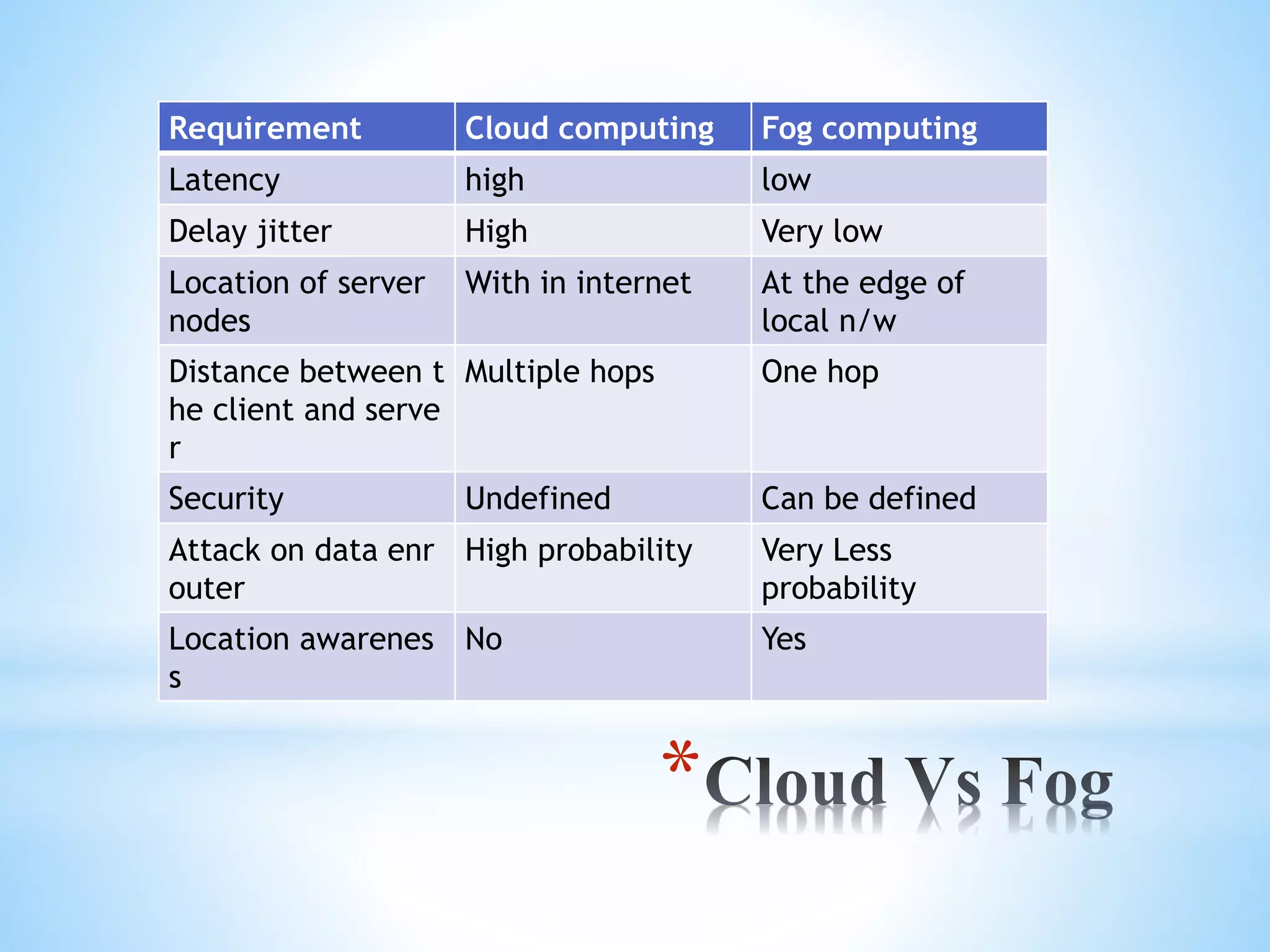
Requirement Cloud computing Fog computing
Latency high low
Delay jitter High Very low
Location of server
nodes
With in internet At the edge of
local n/w
Distance between t
he client and serve
r
Multiple hops One hop
Security Undefined Can be defined
Attack on data enr
outer
High probability Very Less
probability
Location awarenes
s
No Yes
Health care: The cloud computing market for healthcare
is expected to reach $5.4 billion by 2017, and fog computing would
allow this on a more localized level.
*
*
*
*
The main security issues are authentication at
different levels of gateways as well as (in case of
smart grids) at the smart meters installed in the
consumer’s home. Each smart meter and smart
appliance has an IP address. A malicious user
can either tamper with its own smart meter, report
false readings, or spoof IP addresses.
*
In smart grids, privacy issues deal with hiding details,
such as what appliance was used at what time,
while allowing correct summary information for
accurate charging.
*
Extending the cloud closer to the things that generate and
act on data benefits the business in the following ways:
● Better security: Protect your fog nodes using the same
policy, controls, and procedures you use in other
parts of your IT environment. Use the same physical
security and cybersecurity solutions.
● Deeper insights, with privacy control: Analyze sensitive
data locally instead of sending it to the cloud for
analysis. Your IT team can monitor and control the devices
that collect, analyze, and store data.
● Lower operating expense: Conserve network bandwidth
by processing selected data locally instead of
sending it to the cloud for analysis.
*
Fog computing will grow in helping the emerging network
paradigms faster processing with less delay and delay jitter
,cloud computing would serve the business community
meeting their high end computing demands lowering the
cost based on a utility pricing model.
*
Fog
Fog

Fog

  • 2.
    Contents: 1.Introduction 2.What is fogcomputing? 3.What is need for fog computing? 4.How Does It Works? 5.Limitations Of cloud. 6.Limitations Over come in Fog. 5.Cloud v/s fog. 6.Applications. 7.SECURITY ISSUES. 8.PRIVATE ISSUES. 9.Benfits Of Fog. 10.Conclusion
  • 3.
     Fog computingis a term created by Cisco that refers to extending cloud computing to the edge of an enterprise's network.  It is also known as Edge Computing or fogging, fog computing. *
  • 4.
    Cisco introduced itsfog computing vision in “January 2014” as a way of bringing cloud computing capabilities to the edge of the network and as a result, closer to the rapidly growing number of connected devices and applications that consume cloud services and generate increasingly massive amounts of data. By handling these services that make up the Internet of Things (IoT) at the network edge, data can in many cases be processed more efficiently than if it needed to be sent to the cloud for processing. *
  • 5.
    Fog Computing extendsthe cloud computing paradigm to the edge of the network. While fog and cloud use the same resources (networking, compute, and storage) and share many of the same mechanisms and attributes (virtualization, multi-tenancy) the extension is a non- trivial one in that there exist some fundamental differences stemming from the reason fog computing was developed: to address applications and services that do not fit the paradigm of the cloud. *
  • 6.
  • 7.
     cloud computinghas so many advantages, it also suffers from certain shortcomings too.  High capacity(bandwidth).  Client access link.  High latency.  Security. *
  • 8.
    Reduction in datamovement across the network resulting in reduced congestion. Elimination of bottlenecks resulting from centralized computing systems. Improved security of encrypted data as it stays closer to the end user. *
  • 9.
    * Requirement Cloud computingFog computing Latency high low Delay jitter High Very low Location of server nodes With in internet At the edge of local n/w Distance between t he client and serve r Multiple hops One hop Security Undefined Can be defined Attack on data enr outer High probability Very Less probability Location awarenes s No Yes
  • 12.
    Health care: Thecloud computing market for healthcare is expected to reach $5.4 billion by 2017, and fog computing would allow this on a more localized level. *
  • 13.
  • 14.
  • 15.
  • 16.
    The main securityissues are authentication at different levels of gateways as well as (in case of smart grids) at the smart meters installed in the consumer’s home. Each smart meter and smart appliance has an IP address. A malicious user can either tamper with its own smart meter, report false readings, or spoof IP addresses. *
  • 17.
    In smart grids,privacy issues deal with hiding details, such as what appliance was used at what time, while allowing correct summary information for accurate charging. *
  • 18.
    Extending the cloudcloser to the things that generate and act on data benefits the business in the following ways: ● Better security: Protect your fog nodes using the same policy, controls, and procedures you use in other parts of your IT environment. Use the same physical security and cybersecurity solutions. ● Deeper insights, with privacy control: Analyze sensitive data locally instead of sending it to the cloud for analysis. Your IT team can monitor and control the devices that collect, analyze, and store data. ● Lower operating expense: Conserve network bandwidth by processing selected data locally instead of sending it to the cloud for analysis. *
  • 19.
    Fog computing willgrow in helping the emerging network paradigms faster processing with less delay and delay jitter ,cloud computing would serve the business community meeting their high end computing demands lowering the cost based on a utility pricing model. *