Selection of the
Research Problem
What is selection??
Meaning
• Selection is the process by which the identified problem is
refined and structured by focusing on specific targets and
emphasising on certain variables
• We are cutting down the edges to reach a well structured
problem statement
• What is the purpose of the study?
• How much is already known?
• Is additional information necessary?
• What is to be ascertained or measured?
• How is it to be measured?
Factors affecting
the selection..
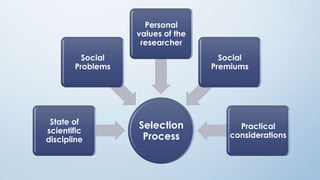
Selection
Process
State of
scientific
discipline
Social
Problems
Personal
values of the
researcher
Social
Premiums
Practical
considerations
Evaluating the
selection..
• Is the topic worth investigation?
• Is effective data collection possible?
• Is it feasible in terms of money /time?
• Will it enable the development of hypothesis or a theory?
Focus of Selection..
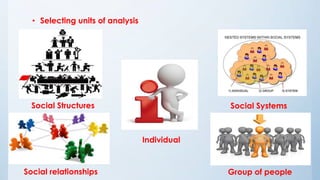
• Selecting units of analysis
Social Structures
Individual
Social Systems
Social relationships Group of people
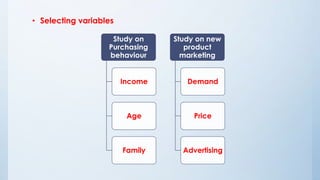
• Selecting variables
Study on
Purchasing
behaviour
Income
Age
Family
Study on new
product
marketing
Demand
Price
Advertising
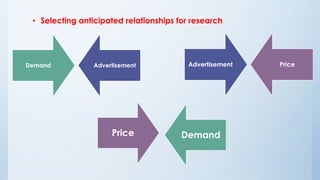
• Selecting anticipated relationships for research
Price Demand
Demand Advertisement Advertisement Price
Formulating
Research Question..
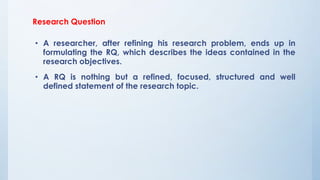
Research Question
• A researcher, after refining his research problem, ends up in
formulating the RQ, which describes the ideas contained in the
research objectives.
• A RQ is nothing but a refined, focused, structured and well
defined statement of the research topic.
Techniques of developing RQ
• Recording questions
• Reviewing Questions
• Classifying Questions
• Examining the questions
• Separate major or key questions
Types of Research Questions
• ‘What’ Questions
• ‘Why’ Questions
• ‘How’ Questions
Purpose of Research Questions
1. Define Scope of the research
2. Avoiding deflection or distraction
Phases of developing
a Research
Question...
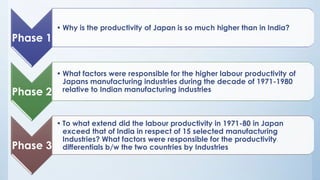
Phase 1
• Why is the productivity of Japan is so much higher than in India?
Phase 2
• What factors were responsible for the higher labour productivity of
Japans manufacturing industries during the decade of 1971-1980
relative to Indian manufacturing industries
Phase 3
• To what extend did the labour productivity in 1971-80 in Japan
exceed that of India in respect of 15 selected manufacturing
Industries? What factors were responsible for the productivity
differentials b/w the two countries by Industries
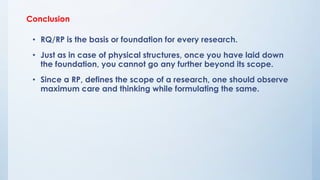
Conclusion
• RQ/RP is the basis or foundation for every research.
• Just as in case of physical structures, once you have laid down
the foundation, you cannot go any further beyond its scope.
• Since a RP, defines the scope of a research, one should observe
maximum care and thinking while formulating the same.
Reference
• Research methods, Ram Ahuja, Rawat Publications.
• Research Methodology Techniques and Trends, Dr. Y.K. Singh &
Dr. R.B. Bajpai, APH Publishing corporations.
• Research Methodology, K. Chakraworthy, Sumit Enterprises.
• Research Methods in Social Science, Chava Nachmias & David
Nachmias, Copyrighted.
• Research Methodology Methods And Techniques (2nd revised
Edition), C.R. Kothari, Vishwa Prakashan Publications.
• Methodology of Social Sciences, O.R. Krishnaswami, Himalaya
Publishing House.
Further Contribution
 Problems faced by small & medium retailers with respect to the
new FDI Policy on retail
 Impact of interest rate, inflation rate and exchange on index
performance (any index such as Nifty index etc.)
 Micro finance in Islamic economy
 Factors that lead to investment in mutual funds ( specific type of
MF)
 Comparative study between current government and former
government
 Study on the impact of Direct Cash Transfer system on the rural
economy

Selection of the research problem

  • 1.
  • 2.
  • 3.
    Meaning • Selection isthe process by which the identified problem is refined and structured by focusing on specific targets and emphasising on certain variables • We are cutting down the edges to reach a well structured problem statement
  • 4.
    • What isthe purpose of the study? • How much is already known? • Is additional information necessary? • What is to be ascertained or measured? • How is it to be measured?
  • 5.
  • 6.
    Selection Process State of scientific discipline Social Problems Personal values ofthe researcher Social Premiums Practical considerations
  • 7.
  • 8.
    • Is thetopic worth investigation? • Is effective data collection possible? • Is it feasible in terms of money /time? • Will it enable the development of hypothesis or a theory?
  • 9.
  • 10.
    • Selecting unitsof analysis Social Structures Individual Social Systems Social relationships Group of people
  • 11.
    • Selecting variables Studyon Purchasing behaviour Income Age Family Study on new product marketing Demand Price Advertising
  • 12.
    • Selecting anticipatedrelationships for research Price Demand Demand Advertisement Advertisement Price
  • 13.
  • 14.
    Research Question • Aresearcher, after refining his research problem, ends up in formulating the RQ, which describes the ideas contained in the research objectives. • A RQ is nothing but a refined, focused, structured and well defined statement of the research topic.
  • 15.
    Techniques of developingRQ • Recording questions • Reviewing Questions • Classifying Questions • Examining the questions • Separate major or key questions
  • 16.
    Types of ResearchQuestions • ‘What’ Questions • ‘Why’ Questions • ‘How’ Questions
  • 17.
    Purpose of ResearchQuestions 1. Define Scope of the research 2. Avoiding deflection or distraction
  • 18.
    Phases of developing aResearch Question...
  • 19.
    Phase 1 • Whyis the productivity of Japan is so much higher than in India? Phase 2 • What factors were responsible for the higher labour productivity of Japans manufacturing industries during the decade of 1971-1980 relative to Indian manufacturing industries Phase 3 • To what extend did the labour productivity in 1971-80 in Japan exceed that of India in respect of 15 selected manufacturing Industries? What factors were responsible for the productivity differentials b/w the two countries by Industries
  • 20.
    Conclusion • RQ/RP isthe basis or foundation for every research. • Just as in case of physical structures, once you have laid down the foundation, you cannot go any further beyond its scope. • Since a RP, defines the scope of a research, one should observe maximum care and thinking while formulating the same.
  • 21.
    Reference • Research methods,Ram Ahuja, Rawat Publications. • Research Methodology Techniques and Trends, Dr. Y.K. Singh & Dr. R.B. Bajpai, APH Publishing corporations. • Research Methodology, K. Chakraworthy, Sumit Enterprises. • Research Methods in Social Science, Chava Nachmias & David Nachmias, Copyrighted. • Research Methodology Methods And Techniques (2nd revised Edition), C.R. Kothari, Vishwa Prakashan Publications. • Methodology of Social Sciences, O.R. Krishnaswami, Himalaya Publishing House.
  • 22.
    Further Contribution  Problemsfaced by small & medium retailers with respect to the new FDI Policy on retail  Impact of interest rate, inflation rate and exchange on index performance (any index such as Nifty index etc.)  Micro finance in Islamic economy  Factors that lead to investment in mutual funds ( specific type of MF)  Comparative study between current government and former government  Study on the impact of Direct Cash Transfer system on the rural economy