



Research Idea Generation and
Research Question Formulation
Achyut Raj Pandey
Research Officer
Nepal Health Research Council
The measure of greatness in scientific idea is
the extent to which it stimulates thought and
opens up new lines of research.
-Paul M. Dirac
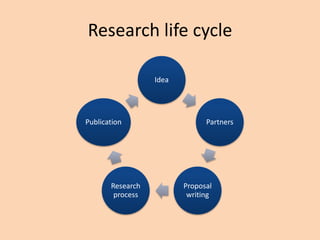
Research life cycle
Idea
Partners
Proposal
writing
Research
process
Publication
Generating research idea
• One of the most difficult aspects of research is
generating an idea.
• Research idea need to interesting and
workable.
• Researchers must understand what work has
been done on a given area.
You need to be
–Curious
–Courageous
–Creative
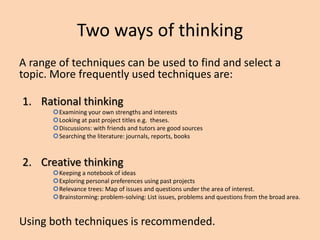
Two ways of thinking
A range of techniques can be used to find and select a
topic. More frequently used techniques are:
1. Rational thinking
Examining your own strengths and interests
Looking at past project titles e.g. theses.
Discussions: with friends and tutors are good sources
Searching the literature: journals, reports, books
2. Creative thinking
Keeping a notebook of ideas
Exploring personal preferences using past projects
Relevance trees: Map of issues and questions under the area of interest.
Brainstorming: problem-solving: List issues, problems and questions from the broad area.
Using both techniques is recommended.
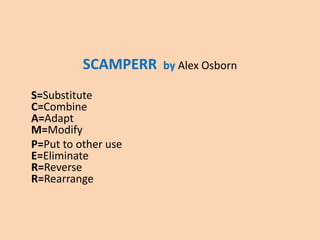
SCAMPERR by Alex Osborn
S=Substitute
C=Combine
A=Adapt
M=Modify
P=Put to other use
E=Eliminate
R=Reverse
R=Rearrange
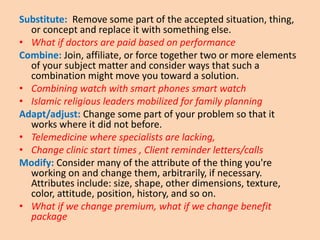
Substitute: Remove some part of the accepted situation, thing,
or concept and replace it with something else.
• What if doctors are paid based on performance
Combine: Join, affiliate, or force together two or more elements
of your subject matter and consider ways that such a
combination might move you toward a solution.
• Combining watch with smart phones smart watch
• Islamic religious leaders mobilized for family planning
Adapt/adjust: Change some part of your problem so that it
works where it did not before.
• Telemedicine where specialists are lacking,
• Change clinic start times , Client reminder letters/calls
Modify: Consider many of the attribute of the thing you're
working on and change them, arbitrarily, if necessary.
Attributes include: size, shape, other dimensions, texture,
color, attitude, position, history, and so on.
• What if we change premium, what if we change benefit
package
Put to other use: Modify the intention of the subject. Think about
why it exists, what it is used for, what it's supposed to do.
Challenge all of these assumptions and suggest new and unusual
purposes.
• Can certain types of services be delegated to nurses
Eliminate: Arbitrarily remove any or all elements of your subject,
simplify, reduce to core functionality
• What if we eliminate users fee in health facilities
• Reduce information gathered on repeat client health history
forms
Reverse/Rearrange: Change the direction or orientation. Turn it
upside-down, inside-out, or make it go backwards, against the
direction it was intended to go or be used.
• Require late patients to reschedule rather than be worked into
the schedule.
There's going to be nothing left for human
beings to do but the more creative types of
endeavor.”
- Isaac Asimov, 1988
What Blocks Creativity
• Fear of Failure
• Allergy to Ambiguity
• Conformity
• Resource Myopia
• Rigidity
Steps of generating research ideas
• Do some background reading
• Start narrowing down your area
• Mapping ideas
• Refining the ideas
• Researching the main ideas through literature
review
• Taking notes and deciding the topic
• Examining originality
Ideas are cheap and don’t get too hung over by
them
Generate as many ideas as possible and forget
about constraints first
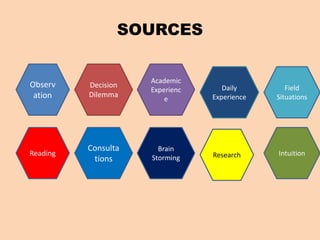
SOURCES
Decision
Dilemma
Academic
Experienc
e
Daily
Experience
Field
Situations
Consulta
tions
Brain
Storming Research Intuition
Observ
ation
Reading
Translating idea to research
• For the idea to develop; research idea should
be of genuine interest to researcher.
• “its not possible to have a research question in
mind and not be curious at the same time”
• After you come up with an idea, you need to
decide on what aspects of that idea you will
emphasize.
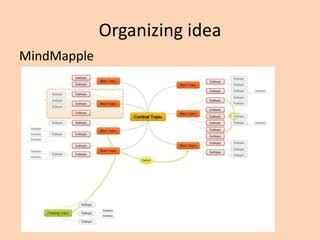
Organizing idea
MindMapple
From research idea to research topic
• Once a researcher has identified an overall
research idea, they should begin to narrow
the topic down to a particular aspect of the
idea that is realistic and feasible to research.
• You can focus a topic by settings (schools), a
specific population, or to a particular research
problem (emotional and behavioral
problems).
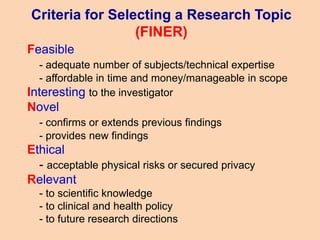
Criteria for Selecting a Research Topic
(FINER)
Feasible
- adequate number of subjects/technical expertise
- affordable in time and money/manageable in scope
Interesting to the investigator
Novel
- confirms or extends previous findings
- provides new findings
Ethical
- acceptable physical risks or secured privacy
Relevant
- to scientific knowledge
- to clinical and health policy
- to future research directions
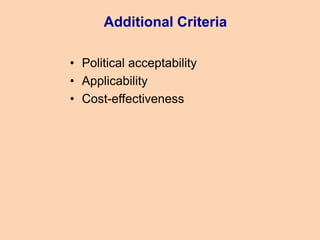
Additional Criteria
• Political acceptability
• Applicability
• Cost-effectiveness
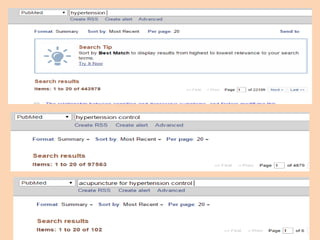
Why is it important to focus a topic?
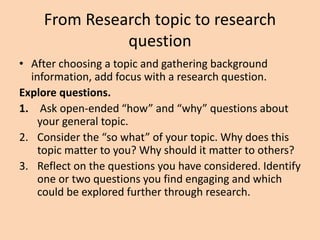
From Research topic to research
question
• After choosing a topic and gathering background
information, add focus with a research question.
Explore questions.
1. Ask open-ended “how” and “why” questions about
your general topic.
2. Consider the “so what” of your topic. Why does this
topic matter to you? Why should it matter to others?
3. Reflect on the questions you have considered. Identify
one or two questions you find engaging and which
could be explored further through research.
Contd..
Determine and evaluate your research question
• What aspect of the more general topic you will explore?
• Is your research question clear?
• Is your research question focused?
Hypothesize
• After you’ve come up with a question, consider the path
your answer might take. - If you are making an argument,
what will you say? - Why does your argument matter? -
How might others challenge your argument? - What kind of
sources will you need to support your argument?
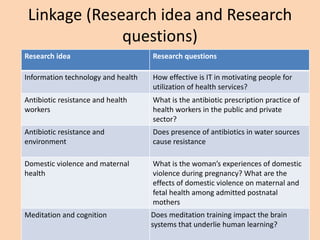
Linkage (Research idea and Research
questions)
Research idea Research questions
Information technology and health How effective is IT in motivating people for
utilization of health services?
Antibiotic resistance and health
workers
What is the antibiotic prescription practice of
health workers in the public and private
sector?
Antibiotic resistance and
environment
Does presence of antibiotics in water sources
cause resistance
Domestic violence and maternal
health
What is the woman’s experiences of domestic
violence during pregnancy? What are the
effects of domestic violence on maternal and
fetal health among admitted postnatal
mothers
Meditation and cognition Does meditation training impact the brain
systems that underlie human learning?
Conclusion
• The technique of research idea generation is
rational thinking and creative thinking.
• Unless the research ideas are written and
focused; it can not be developed.
• Research questions need to be specific and
focused.
"The best way to have a good idea is to
have a lot of ideas."
- Linus Pauling
Thank You

Research idea generation

  • 1.
    Research Idea Generationand Research Question Formulation Achyut Raj Pandey Research Officer Nepal Health Research Council
  • 2.
    The measure ofgreatness in scientific idea is the extent to which it stimulates thought and opens up new lines of research. -Paul M. Dirac
  • 3.
  • 4.
    Generating research idea •One of the most difficult aspects of research is generating an idea. • Research idea need to interesting and workable. • Researchers must understand what work has been done on a given area.
  • 5.
    You need tobe –Curious –Courageous –Creative
  • 6.
    Two ways ofthinking A range of techniques can be used to find and select a topic. More frequently used techniques are: 1. Rational thinking Examining your own strengths and interests Looking at past project titles e.g. theses. Discussions: with friends and tutors are good sources Searching the literature: journals, reports, books 2. Creative thinking Keeping a notebook of ideas Exploring personal preferences using past projects Relevance trees: Map of issues and questions under the area of interest. Brainstorming: problem-solving: List issues, problems and questions from the broad area. Using both techniques is recommended.
  • 7.
    SCAMPERR by AlexOsborn S=Substitute C=Combine A=Adapt M=Modify P=Put to other use E=Eliminate R=Reverse R=Rearrange
  • 8.
    Substitute: Remove somepart of the accepted situation, thing, or concept and replace it with something else. • What if doctors are paid based on performance Combine: Join, affiliate, or force together two or more elements of your subject matter and consider ways that such a combination might move you toward a solution. • Combining watch with smart phones smart watch • Islamic religious leaders mobilized for family planning Adapt/adjust: Change some part of your problem so that it works where it did not before. • Telemedicine where specialists are lacking, • Change clinic start times , Client reminder letters/calls Modify: Consider many of the attribute of the thing you're working on and change them, arbitrarily, if necessary. Attributes include: size, shape, other dimensions, texture, color, attitude, position, history, and so on. • What if we change premium, what if we change benefit package
  • 9.
    Put to otheruse: Modify the intention of the subject. Think about why it exists, what it is used for, what it's supposed to do. Challenge all of these assumptions and suggest new and unusual purposes. • Can certain types of services be delegated to nurses Eliminate: Arbitrarily remove any or all elements of your subject, simplify, reduce to core functionality • What if we eliminate users fee in health facilities • Reduce information gathered on repeat client health history forms Reverse/Rearrange: Change the direction or orientation. Turn it upside-down, inside-out, or make it go backwards, against the direction it was intended to go or be used. • Require late patients to reschedule rather than be worked into the schedule.
  • 10.
    There's going tobe nothing left for human beings to do but the more creative types of endeavor.” - Isaac Asimov, 1988
  • 11.
    What Blocks Creativity •Fear of Failure • Allergy to Ambiguity • Conformity • Resource Myopia • Rigidity
  • 12.
    Steps of generatingresearch ideas • Do some background reading • Start narrowing down your area • Mapping ideas • Refining the ideas • Researching the main ideas through literature review • Taking notes and deciding the topic • Examining originality
  • 13.
    Ideas are cheapand don’t get too hung over by them Generate as many ideas as possible and forget about constraints first
  • 14.
  • 15.
    Translating idea toresearch • For the idea to develop; research idea should be of genuine interest to researcher. • “its not possible to have a research question in mind and not be curious at the same time” • After you come up with an idea, you need to decide on what aspects of that idea you will emphasize.
  • 16.
  • 17.
    From research ideato research topic • Once a researcher has identified an overall research idea, they should begin to narrow the topic down to a particular aspect of the idea that is realistic and feasible to research. • You can focus a topic by settings (schools), a specific population, or to a particular research problem (emotional and behavioral problems).
  • 18.
    Criteria for Selectinga Research Topic (FINER) Feasible - adequate number of subjects/technical expertise - affordable in time and money/manageable in scope Interesting to the investigator Novel - confirms or extends previous findings - provides new findings Ethical - acceptable physical risks or secured privacy Relevant - to scientific knowledge - to clinical and health policy - to future research directions
  • 19.
    Additional Criteria • Politicalacceptability • Applicability • Cost-effectiveness
  • 20.
    Why is itimportant to focus a topic?
  • 22.
    From Research topicto research question • After choosing a topic and gathering background information, add focus with a research question. Explore questions. 1. Ask open-ended “how” and “why” questions about your general topic. 2. Consider the “so what” of your topic. Why does this topic matter to you? Why should it matter to others? 3. Reflect on the questions you have considered. Identify one or two questions you find engaging and which could be explored further through research.
  • 23.
    Contd.. Determine and evaluateyour research question • What aspect of the more general topic you will explore? • Is your research question clear? • Is your research question focused? Hypothesize • After you’ve come up with a question, consider the path your answer might take. - If you are making an argument, what will you say? - Why does your argument matter? - How might others challenge your argument? - What kind of sources will you need to support your argument?
  • 24.
    Linkage (Research ideaand Research questions) Research idea Research questions Information technology and health How effective is IT in motivating people for utilization of health services? Antibiotic resistance and health workers What is the antibiotic prescription practice of health workers in the public and private sector? Antibiotic resistance and environment Does presence of antibiotics in water sources cause resistance Domestic violence and maternal health What is the woman’s experiences of domestic violence during pregnancy? What are the effects of domestic violence on maternal and fetal health among admitted postnatal mothers Meditation and cognition Does meditation training impact the brain systems that underlie human learning?
  • 25.
    Conclusion • The techniqueof research idea generation is rational thinking and creative thinking. • Unless the research ideas are written and focused; it can not be developed. • Research questions need to be specific and focused.
  • 26.
    "The best wayto have a good idea is to have a lot of ideas." - Linus Pauling
  • 27.