RESEARCH PROBLEM
Topics
 Research problem
 Selecting the Problem
 Do‟s and Don'ts in selecting the problem
 Practice Research Questions
 Necessity of defining research question
 Techniques involved in research question
(i) Research Problem
 A research problem, in general, refers to some
difficulty which a researcher experiences in the
context of either a theoretical or practical situation
and wants to obtain a solution for the same.
 Research problem should satisfy following conditions
to qualify as research problem.
At least two possible outcome
 Is television going to survive in digital eye or will it
become obsolete like digital camera? (two)
 What are the factors motivate young people to commit
violence? (may be more than two)
There might be possible one outcome want as objective by
researcher :
 Television is not going to survive in digital eye.(Check
True or not)
Outcome doesn‟t have equal chance
 What will you get if you toss a coin? (equal chance)
 Is television going to survive in digital eye or will it
become obsolete like digital camera?
 What are the factors motivate young people to
commit violence?
(ii) Selecting the problem
 The research problem undertaken for study must be carefully selected.
An „angle‟ for your research can come from insights stemming from:
 personal experience
 theory
 observations
 engagement with the literature
 Subject which is overdone should not be normally
chosen, for it will be a difficult task to throw any
new light in such a case.
(iii) Do‟s and Don‟t in Selecting the Problem
(iii)Do‟s and Don‟t in Selecting the Problem
 Controversial subject should not become the choice
of an average researcher.
(iii) Do‟s and Don‟t in Selecting the Problem
Research Question should be clear.
 Unclear: Why are social networking sites harmful?
 Clear: How are online users experiencing or addressing privacy
issues on such social networking sites as MySpace and Facebook?
 Which social networking site? (My space and Facebook)
 Type of harm (privacy issues)
 Who gets harm? (users)
(iii) Do‟s and Don‟t in Selecting the Problem
Research Question should be focused.
 Unfocused: What is the effect on the environment from global warming?
 Focused: How is glacial melting affecting penguins in Antarctica?
 So broad (Can‟t answer in college level paper)
 specific cause (glacial melting)
 specific place (Antarctica)
 specific group affected (Penguin)
(iii) Do‟s and Don‟t in Selecting the Problem
Research Question should be appropriately complex.
 Too simple: How are doctors addressing diabetes in the India?
 Appropriately Complex: What are common traits of those suffering from diabetes
in India, and how can these commonalities be used to aid the medical community in
prevention of the disease?
 Simple question (if looked up online, get answered immediately. No role of analysis)
 Complex one require significant investigation and evaluation.
Go back
(iii) Do‟s and Don‟t in Selecting the Problem
 The subject selected for research should be familiar
and feasible so that the related research material
or sources of research are within one‟s reach.
 Other factors such as cost and time also considered.
(iii) Do‟s and Don‟t in Selecting the Problem
 The selection of a problem must be preceded by a
preliminary study (not necessary if it is already done )
 when the field of inquiry is relatively new and does not
have available a set of well developed techniques, a
brief feasibility study must always be undertaken.
(iv) Judge this Questions
 Is television going to survive in digital era or will it become obsolete
like digital camera?
iv) Judge this Questions
 Does negative news interest people more than positive news?
iv) Judge this Questions
 What are the factors motivate young people to commit violence?
iv) Judge this Questions
 What factors contribute to a low turnout among
women voters in elections in Pakistan?
iv) Judge this Questions
 Do students think about the career options first
before choosing education or careers come second?
(v) Necessity of defining the problem
“Clearly stated research problem is half solved”
ill defined problem may create hurdles like
 What data are to be collected?
 What characteristics of data are relevant and need to
be studied?
 What relations are to be explored.
 What techniques are to be used for the purpose?
Research Question
 Why is productivity in Japan so much higher than in
India?
 What sort of productivity is being referred to?
 With what industries the same is related?
 With what period of time the productivity is being talked
about?
(vi) Techniques Involved in Defining a
Problem
 Defining a research problem properly and clearly
is a crucial part of a research study and must in no
case be accomplished hurriedly.
 It contains five steps:
(a)Statement of the problem in a general way
 Define the problem in general way
Ex: Does negative news interest people more than positive news?
 Narrow it down by rethinking over the problem. (Consider feasibility of problem)
Ex: Does negative news such as robbery, corruption interest people more than positive
news like country economic growth ?
 How to define in general way?
 Study the related subject thoroughly
 Do preliminary survey or pilot survey
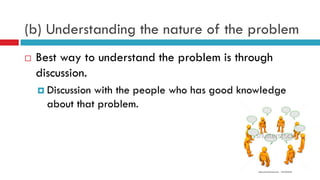
(b) Understanding the nature of the problem
 Best way to understand the problem is through
discussion.
 Discussion with the people who has good knowledge
about that problem.
(c) Surveying the available literature
 Survey all the research which are already
undertaken in related problem.
 It helps to
 Narrow down the problem
 To identify research gaps
 Gives new ideas in related area
 Helps for research design
(d) Developing the ideas through discussions
 Discussion always produces useful information.
 Various new ideas can be developed through such an exercise.
 Researcher must discuss his/her problem with his/ her colleagues and others
who have enough experience in the same area or in working on similar
problems. This is known as experience survey.
(e) Rephrasing the research problem
 Rephrase the research problem in to operational term.
 Initial research question: Why is productivity in Japan so much
higher than in India?
 After, the problem has understood, available literature has
taken place and discussion over the problem has taken
place, the question has rephrased.
 Rephrased Research question: What factors were responsible for
the higher labor productivity of Japan‟s manufacturing industries
during the decade 1971 to 1980 relative to India‟s
manufacturing industries?”

Research problem

  • 1.
  • 2.
    Topics  Research problem Selecting the Problem  Do‟s and Don'ts in selecting the problem  Practice Research Questions  Necessity of defining research question  Techniques involved in research question
  • 3.
    (i) Research Problem A research problem, in general, refers to some difficulty which a researcher experiences in the context of either a theoretical or practical situation and wants to obtain a solution for the same.  Research problem should satisfy following conditions to qualify as research problem.
  • 4.
    At least twopossible outcome  Is television going to survive in digital eye or will it become obsolete like digital camera? (two)  What are the factors motivate young people to commit violence? (may be more than two) There might be possible one outcome want as objective by researcher :  Television is not going to survive in digital eye.(Check True or not)
  • 5.
    Outcome doesn‟t haveequal chance  What will you get if you toss a coin? (equal chance)  Is television going to survive in digital eye or will it become obsolete like digital camera?  What are the factors motivate young people to commit violence?
  • 6.
    (ii) Selecting theproblem  The research problem undertaken for study must be carefully selected. An „angle‟ for your research can come from insights stemming from:  personal experience  theory  observations  engagement with the literature
  • 7.
     Subject whichis overdone should not be normally chosen, for it will be a difficult task to throw any new light in such a case. (iii) Do‟s and Don‟t in Selecting the Problem
  • 8.
    (iii)Do‟s and Don‟tin Selecting the Problem  Controversial subject should not become the choice of an average researcher.
  • 9.
    (iii) Do‟s andDon‟t in Selecting the Problem Research Question should be clear.  Unclear: Why are social networking sites harmful?  Clear: How are online users experiencing or addressing privacy issues on such social networking sites as MySpace and Facebook?  Which social networking site? (My space and Facebook)  Type of harm (privacy issues)  Who gets harm? (users)
  • 10.
    (iii) Do‟s andDon‟t in Selecting the Problem Research Question should be focused.  Unfocused: What is the effect on the environment from global warming?  Focused: How is glacial melting affecting penguins in Antarctica?  So broad (Can‟t answer in college level paper)  specific cause (glacial melting)  specific place (Antarctica)  specific group affected (Penguin)
  • 11.
    (iii) Do‟s andDon‟t in Selecting the Problem Research Question should be appropriately complex.  Too simple: How are doctors addressing diabetes in the India?  Appropriately Complex: What are common traits of those suffering from diabetes in India, and how can these commonalities be used to aid the medical community in prevention of the disease?  Simple question (if looked up online, get answered immediately. No role of analysis)  Complex one require significant investigation and evaluation. Go back
  • 12.
    (iii) Do‟s andDon‟t in Selecting the Problem  The subject selected for research should be familiar and feasible so that the related research material or sources of research are within one‟s reach.  Other factors such as cost and time also considered.
  • 13.
    (iii) Do‟s andDon‟t in Selecting the Problem  The selection of a problem must be preceded by a preliminary study (not necessary if it is already done )  when the field of inquiry is relatively new and does not have available a set of well developed techniques, a brief feasibility study must always be undertaken.
  • 14.
    (iv) Judge thisQuestions  Is television going to survive in digital era or will it become obsolete like digital camera?
  • 15.
    iv) Judge thisQuestions  Does negative news interest people more than positive news?
  • 16.
    iv) Judge thisQuestions  What are the factors motivate young people to commit violence?
  • 17.
    iv) Judge thisQuestions  What factors contribute to a low turnout among women voters in elections in Pakistan?
  • 18.
    iv) Judge thisQuestions  Do students think about the career options first before choosing education or careers come second?
  • 19.
    (v) Necessity ofdefining the problem “Clearly stated research problem is half solved” ill defined problem may create hurdles like  What data are to be collected?  What characteristics of data are relevant and need to be studied?  What relations are to be explored.  What techniques are to be used for the purpose?
  • 20.
    Research Question  Whyis productivity in Japan so much higher than in India?  What sort of productivity is being referred to?  With what industries the same is related?  With what period of time the productivity is being talked about?
  • 21.
    (vi) Techniques Involvedin Defining a Problem  Defining a research problem properly and clearly is a crucial part of a research study and must in no case be accomplished hurriedly.  It contains five steps:
  • 22.
    (a)Statement of theproblem in a general way  Define the problem in general way Ex: Does negative news interest people more than positive news?  Narrow it down by rethinking over the problem. (Consider feasibility of problem) Ex: Does negative news such as robbery, corruption interest people more than positive news like country economic growth ?  How to define in general way?  Study the related subject thoroughly  Do preliminary survey or pilot survey
  • 23.
    (b) Understanding thenature of the problem  Best way to understand the problem is through discussion.  Discussion with the people who has good knowledge about that problem.
  • 24.
    (c) Surveying theavailable literature  Survey all the research which are already undertaken in related problem.  It helps to  Narrow down the problem  To identify research gaps  Gives new ideas in related area  Helps for research design
  • 25.
    (d) Developing theideas through discussions  Discussion always produces useful information.  Various new ideas can be developed through such an exercise.  Researcher must discuss his/her problem with his/ her colleagues and others who have enough experience in the same area or in working on similar problems. This is known as experience survey.
  • 26.
    (e) Rephrasing theresearch problem  Rephrase the research problem in to operational term.  Initial research question: Why is productivity in Japan so much higher than in India?  After, the problem has understood, available literature has taken place and discussion over the problem has taken place, the question has rephrased.  Rephrased Research question: What factors were responsible for the higher labor productivity of Japan‟s manufacturing industries during the decade 1971 to 1980 relative to India‟s manufacturing industries?”