H R B M C A
E U S E O R
M D B X C S
E P L E O R
The Research
Problem
by: Rochelle May M. Canlas
Key Concepts
2. The Research Problems
2.1 Sources of a Research Problem
2.2 Topic Identification
2.3 Elements of a Research Problem
2.4 Characteristics of a Good Research Problem
Mouly (1978) defined research as
process of arriving at effective
solutions to problems through
systematic collection, analysis and
interpretation of data.
What is a research?
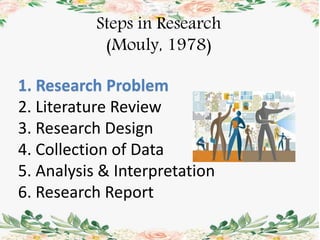
Steps in Research
(Mouly, 1978)
1. Research Problem
2. Literature Review
3. Research Design
4. Collection of Data
5. Analysis & Interpretation
6. Research Report
What is a problem?
Problem can be anything disturbing
to our minds, intentions, and social
aspects
Problem is a set of conditions
needing discussion, a solution and
information
What is a problem?
Problem means question or issue
raised to examine or addressed for
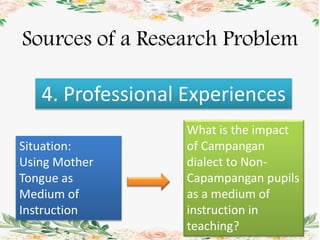
consideration or solution
 It implies the possibility of
empirical investigation of data
collection and analysis
What is a problem?
R.S. Woodworth defines problem as a
situation for which we have no ready
and successful response by instinct
or by previous acquired habit. We
must find out what to do. The
solution can be found out only after
an investigation.
What is a research problem ?
 It is a problem that someone
would like to investigate
 It is the aspect the researcher
worried about, think about and
wants to find a solution
What is a research problem ?
 The research problem is an issue or
concern that an investigator presents
and justifies in a research study.
 A research problem is anything that a
person find unsatisfactory or unsettling,
a difficulty of some sort, a state of
affairs that need to be changed.
What is a research problem?
According to Kerlinger, “A problem is
an interrogative sentence or
statement that asks what relation
exists between two or more
variable. The answer to question will
provide what is having sought in the
research.

What is a research problem ?
Research problems consist of:
• Areas of concern
• Conditions to be improved
• Difficulties to be eliminated
• Questions seeking answers
• Introduce the importance of topic
• Creates reader interest
• Anchors the research questions,
hypotheses, and assumptions to follow.
• Place the topic into a particular context
• Provide framework for reporting the
results.
What are the importance of a
research problem ?
Research Problems should have in
general Theoretical, Conceptual and
Contextual justifications.
• Look in the opening paragraphs.
• What was the issue or problem that the researcher
wanted to address?
• What is the concern being addressed “behind” this
study?
• Why was the study undertaken in the first place?
• Why is this study important?
Where is the Research Problem
Located?
A research problem is an educational
issue or problem in the study
Differences Among Topic, Problem,
Purpose and Questions
 A research topic is the broad subject
matter being addressed in a study.
 A purpose is the major intent or
objective of the study.
Differences Among Topic, Problem,
Purpose and Questions
 Research questions are questions
the researcher would like
answered or addressed in the
study.
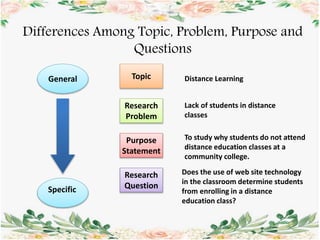
Differences Among Topic, Problem, Purpose and
Questions
General
Specific
Topic
Research
Problem
Purpose
Statement
Research
Question
Distance Learning
Lack of students in distance
classes
To study why students do not attend
distance education classes at a
community college.
Does the use of web site technology
in the classroom determine students
from enrolling in a distance
education class?
A research problem is the broad
subject matter being addressed in a
study.
A research question is the major
intent or objective of the study.
Research problem is a problem that
someone would like to investigate
A research topic is an educational
issue or problem in the study
Mouly (1978) defined research topic as
process of arriving at effective solutions
to problems through systematic collect,
analyisis and interpretation of data.
Sources
of a Research
Problem
We once made a research before.
Share your experience on how you
end up with your research
problem.
Where did you get your idea for
your research problem?
Sources of a Research Problem
1. Deductions from Theories
There are many ways of expressing
theories, some are formal and informal.
Research is a process of theory
development and theory-testing.
Theories are ideas about how things
relate to each other.
Sources of a Research Problem
The researcher may asks the question
“What relationships between variables
will be observed?”
From a theory, a researcher can formulate
a research problem or hypothesis stating
the expected findings in certain empirical
situation.
Sources of a Research Problem
Learning Theory
(Behaviorism)
What is the impact of learning
environment to the behavior of
the pupils towards academics?
Sources of a Research Problem
The idea that distance learners have
more needs than on-campus students
is a theory.
the on-campus students
have more needs than
distance learners
Sources of a Research Problem
2. Interviewing
Professionals
Sources of a Research Problem
3. Personal Experiences
The researcher experienced being a poor child but
excelled in academics. The researcher can make a
study about his experience and study the impact of
poverty to academic performance of pupils.
Sources of a Research Problem
4. Professional Experiences
Situation:
Using Mother
Tongue as
Medium of
Instruction
What is the impact
of Campangan
dialect to Non-
Capampangan pupils
as a medium of
instruction in
teaching?
Sources of a Research Problem
Share something about your
personal or professional
experiences or problems that you
may use as your research problem.
Sources of a Research Problem
5. Social Issues
Sources of a Research Problem
6. Relevant Literature
and Media
Topic Identification
• Can you study the problem?
• Do you have access to the research site?
• Do you have the time, resources and skills to
carry out the research?
• Should you study the problem?
• Does it advance knowledge?
• Does it contribute to practice?
Can and Should the Problem Be
Researched?
GUIDELINES IN SELECTING OF A
RESEARCH PROBLEM
1. The research problem is must be
chosen by the researcher himself. This
is to avoid blaming of others or offering
excuses for any obstacles encountered.
2. It is must bewithin the interest of the
reseacher.
GUIDELINES IN SELECTION OF A
RESEARCH PROBLEM
3. It is must be the specialization of the
researcher. This will make him work
easier because he is working in
familiar grounds.
4. It is be within the ability of the
researcher to finance.
Elements of a Research
Problem
Elements of a Research
Problem
1. Objective or aim of the
problem which is to be
investigated.
Why there is a need for
research?
Elements of a Research
Problem
2. The topic or theme which
needs to be investigated.
What is to be
researched?
Elements of a Research
Problem
3. The time dimension of a
decision problem is always
the future.
When is the research to
be performed?
Elements of a Research
Problem
4. The area or location in
which the study is to be
conducted.
Where we need to
conduct the study?
Elements of a Research
Problem
5. Population or universe
from whom the data needs to
be gathered.
Who are the respondents/
participants?
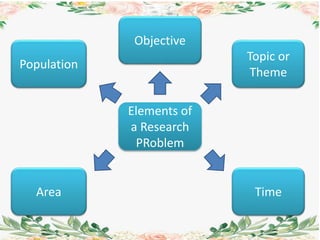
Elements of
a Research
PRoblem
TimeArea
Population
Topic or
Theme
Objective
Evaluation
What are the 5 elements
of a research problem?
The study will conduct to assess the relationship
between the parental participation and community
involvement to school activities and pupils’ learning
motivation of the elementary pupils in Betis,
GuaGua and Bacolor Elementary School during the
academic year 2015-2016.
Identify the elements of the research problem.
• Objectives
• Topic
• Time
• Area
• Population
Characteristics of a Good
Research Problem
Characteristics of a Good
Research Problem
1.
• Observation or other data
collection in the real world can
provide the answer.
• Always consider the available
resources.
Characteristics of a Good
Research Problem
2. Theoretical and Practical
Significance
• Research have the varying levels of
importance to different people in
terms of their benefit.
• A research should be important
and worth of investigating.
Characteristics of a Good
Research Problem
3. Original (Novelty)
Characteristics of a Good
Research Problem
4. Relevance
• It is important to understand whether
the findings of a research can be
useful in terms of their relevance to
the situation.
Characteristics of a Good
Research Problem
5. Feasibility
It concerns the possibility of whether
the research problem can be conducted
in terms of means, resources, cost and
time to complete the study
Characteristics of a Good Reserch
Problem
To investigate whether there can be a life in
Mars
•Competencies: Knowledge, experience skills
and ability
•Availability and accessibility
•Availability of adequate financial
resources
Characteristics of a Good
Research Problem
6. Narrow Down Problem
• It should be specific research
problem
• Identify a specific problem area from
the general problem that is well-
defined, clear and practically
manageable
Characteristics of a Good
Research Problem
I want to make a research
about online learning.
I will make a research about
the impact of online learning
to 21st century learners
pupils.
Characteristics of a Good
Research Problem
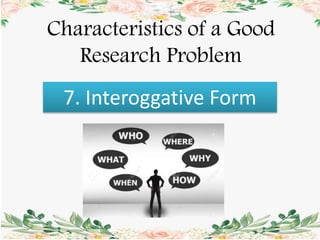
7. Interoggative Form
Characteristics of a Good
Research Problem
8. Ethical Consideration
• It is prudent practice to remain within the
confines of accceptable ways of doing things.
• It is morally inappropriate to enter into the
private lives of individuals
• The respondents may not cooperate and refuse
to take part or simply to give the right
informationin research projects involve sensitive
questions.
Characteristics of a Good
Research Problem
9. Interesting
Characteristics of a Good
Research Problem
10. Current
Characteristics of a Good
Research Problem
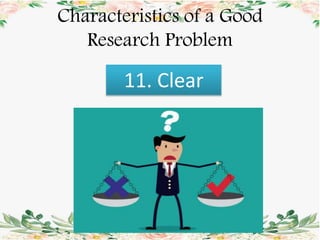
11. Clear
Characteristics of a Good
Research Problem
Unclear: Why social networking sites
are harmful?
Clear: How are online users
experiencing or addressing privacy issue
on such social networking sites as
Facebook and Twitter?
Characteristics of a Good Research
Problem
(Andrew and Hildebrand, 1982)
Characteristics of a Good
Research Problem
1. The problem reflects felt needs
2. It must be based on factual evidence
3. It should suggest meaningful and testable
hypotheses.
4. The problems should be relevant and
manageable
Other Characteristics of a
Good Research Problem
Characteristics of a Good
Research Problem
1. It is based on the work of others.
2. It can be replicated and doable .
3. It is based on some logical rationale and
tied to theory. In a way that it has the
potential to suggest directions for future
research.
4. It generates new questions or is cyclical in
nature.
Characteristics of a Good
Research Problem
5. It addresses directly or indirectly some real
problem in the world.
6. It clearly states the variables or constructs
to be examined.
7. The researcher is sincerely interested
and/or invested in this research.
Other Characteristics of a Good
Research Problem
1. The problem can be stated clearly and
concisely.
2.The problem generates research questions.
3. It is grounded in theory.
4. It relates to one or more academic fields of
study.
5. It has a base in the research literature.
Other Characteristics of a Good
Research Problem
6.It has potential significance/importance.
7. It is do-able within the time frame, budget.
8. Sufficient data are available or can be
obtained.
9. The researcher’s methodological strengths
can be applied to the problem.
10. The problem is new; it is not already
answered sufficiently.
Characteristics of a Good
Research Problem
Characteristics should reflect SMART
•S-SPECIFIC
•M-MEASURABLE
•A-ATTAINABLE/ACHIEVABLE
•R-REALISTIC
•T-TIME BOUNDED
Importance of a Good
Research Problem
Importance of a Good Research
Problem
• The research problem serves as a
foundation of a research study; like
a building and its foundation
• If it is well-formulated, you can
expect a good study to follow.
Steps in Formulating
Research Topic
Steps in Formulating a Research
Topic
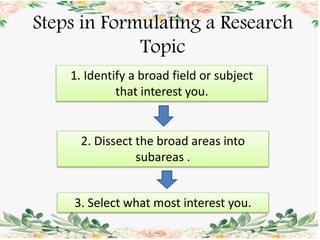
1. Identify a broad field or subject
that interest you.
2. Dissect the broad areas into
subareas .
3. Select what most interest you.
Steps in Formulating a Research
Topic
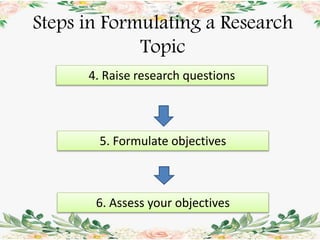
4. Raise research questions
5. Formulate objectives
6. Assess your objectives
Ways of Stating a
Research Problem
Ways of Stating a Research
Problem
1. Problem Statement
General overview with just
information about the scope and
purpose of the study to provide an
initial understanding of the research
The study will conduct to assess the relationship between
the parental participation and community involvement to
school activities and pupils’ learning motivation of the
elementary pupils in the three selected elementary
school during the academic year 2015-2016.
Parental participation and
community involvement vis-a-vis
pupils' academic performance
Ways of Stating a Research
Problem
2. Research Questions
It is more specific focused
questions that communicate in
greater detail the nature of the
study.
1.How may the parents assess the parental participation
to school activities as to:
1.1attendance to activities;
1.2communication with the school; and
1.3assistance to the pupils?
2.How may the teachers assess the community involvement to school
activities as to:
2.1community-school partnership;
2.2community-parents partnership; and
2.3community-pupils partnership?
3. What is the pupils’ level of learning motivation?
4.Is there a significant relationship between parental participation and
teachers’ assessment on community involvement to school activities and
pupils’ learning motivation?
In the elements of research problem,
objectives answer the question why.
Problem statement and Research
Questions are the two ways of
stating a research problem
SUMMAR
YAs a human beings we are curious about
the unknows. We ask many questions and
try to find out answers to them. However,
not every can be a research problem.
A research problem has to indicate the
possibility of empirical investigation that is
data collection and analysis.
SUMMAR
YIn order to make your research problem
appropriate, we need to follow the some
guidelines, which we discussed earlier.
What is important is to study the research
problem while taking into account these
characteristics and assessing whether the
research problem meets these
requirements.
SUMMAR
YAll of the above characteristics need to be
applied to a good research problem to
make it thorough and conclusive.
Without these the research may fall apart,
the problem may not appear to be fully
solved for the general structure of the
problem may not seem clear and
consistent.
1. Research problem should be general.
2. All problem can be a research problem.
3. A research problem has to indicate the
possibility of empirical investigation.
4. Research problem has 6 elements.
5. Research Problems should have in general
Theoretical, Conceptual and Contextual
justifications.
Evaluation
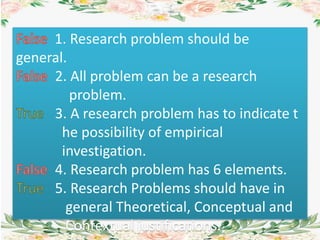
1. Research problem should be
general.
2. All problem can be a research
problem.
3. A research problem has to indicate t
he possibility of empirical
investigation.
4. Research problem has 6 elements.
5. Research Problems should have in
general Theoretical, Conceptual and
Contextual justifications.
Sources
• http://libguides.usc.edu/writingguide/introducti
on/researchproblem
• https://library.sacredheart.edu/c.php?g=29803&
p=185918
• https://www.scribbr.com/dissertation-writing-
roadmap/example-research-problem-definition/
• https://explorable.com/defining-a-research-
problem

RESEARCH PROBLEM

  • 3.
    H R BM C A E U S E O R
  • 5.
    M D BX C S E P L E O R
  • 7.
  • 8.
    Key Concepts 2. TheResearch Problems 2.1 Sources of a Research Problem 2.2 Topic Identification 2.3 Elements of a Research Problem 2.4 Characteristics of a Good Research Problem
  • 9.
    Mouly (1978) definedresearch as process of arriving at effective solutions to problems through systematic collection, analysis and interpretation of data. What is a research?
  • 10.
    Steps in Research (Mouly,1978) 1. Research Problem 2. Literature Review 3. Research Design 4. Collection of Data 5. Analysis & Interpretation 6. Research Report
  • 11.
    What is aproblem? Problem can be anything disturbing to our minds, intentions, and social aspects Problem is a set of conditions needing discussion, a solution and information
  • 12.
    What is aproblem? Problem means question or issue raised to examine or addressed for consideration or solution  It implies the possibility of empirical investigation of data collection and analysis
  • 13.
    What is aproblem? R.S. Woodworth defines problem as a situation for which we have no ready and successful response by instinct or by previous acquired habit. We must find out what to do. The solution can be found out only after an investigation.
  • 14.
    What is aresearch problem ?  It is a problem that someone would like to investigate  It is the aspect the researcher worried about, think about and wants to find a solution
  • 15.
    What is aresearch problem ?  The research problem is an issue or concern that an investigator presents and justifies in a research study.  A research problem is anything that a person find unsatisfactory or unsettling, a difficulty of some sort, a state of affairs that need to be changed.
  • 16.
    What is aresearch problem? According to Kerlinger, “A problem is an interrogative sentence or statement that asks what relation exists between two or more variable. The answer to question will provide what is having sought in the research.
  • 17.
    What is aresearch problem ? Research problems consist of: • Areas of concern • Conditions to be improved • Difficulties to be eliminated • Questions seeking answers
  • 18.
    • Introduce theimportance of topic • Creates reader interest • Anchors the research questions, hypotheses, and assumptions to follow. • Place the topic into a particular context • Provide framework for reporting the results. What are the importance of a research problem ?
  • 19.
    Research Problems shouldhave in general Theoretical, Conceptual and Contextual justifications.
  • 20.
    • Look inthe opening paragraphs. • What was the issue or problem that the researcher wanted to address? • What is the concern being addressed “behind” this study? • Why was the study undertaken in the first place? • Why is this study important? Where is the Research Problem Located?
  • 21.
    A research problemis an educational issue or problem in the study Differences Among Topic, Problem, Purpose and Questions  A research topic is the broad subject matter being addressed in a study.
  • 22.
     A purposeis the major intent or objective of the study. Differences Among Topic, Problem, Purpose and Questions  Research questions are questions the researcher would like answered or addressed in the study.
  • 23.
    Differences Among Topic,Problem, Purpose and Questions General Specific Topic Research Problem Purpose Statement Research Question Distance Learning Lack of students in distance classes To study why students do not attend distance education classes at a community college. Does the use of web site technology in the classroom determine students from enrolling in a distance education class?
  • 24.
    A research problemis the broad subject matter being addressed in a study.
  • 25.
    A research questionis the major intent or objective of the study.
  • 26.
    Research problem isa problem that someone would like to investigate
  • 27.
    A research topicis an educational issue or problem in the study
  • 28.
    Mouly (1978) definedresearch topic as process of arriving at effective solutions to problems through systematic collect, analyisis and interpretation of data.
  • 29.
  • 30.
    We once madea research before. Share your experience on how you end up with your research problem. Where did you get your idea for your research problem?
  • 31.
    Sources of aResearch Problem 1. Deductions from Theories There are many ways of expressing theories, some are formal and informal. Research is a process of theory development and theory-testing. Theories are ideas about how things relate to each other.
  • 32.
    Sources of aResearch Problem The researcher may asks the question “What relationships between variables will be observed?” From a theory, a researcher can formulate a research problem or hypothesis stating the expected findings in certain empirical situation.
  • 33.
    Sources of aResearch Problem Learning Theory (Behaviorism) What is the impact of learning environment to the behavior of the pupils towards academics?
  • 34.
    Sources of aResearch Problem The idea that distance learners have more needs than on-campus students is a theory. the on-campus students have more needs than distance learners
  • 35.
    Sources of aResearch Problem 2. Interviewing Professionals
  • 36.
    Sources of aResearch Problem 3. Personal Experiences The researcher experienced being a poor child but excelled in academics. The researcher can make a study about his experience and study the impact of poverty to academic performance of pupils.
  • 37.
    Sources of aResearch Problem 4. Professional Experiences Situation: Using Mother Tongue as Medium of Instruction What is the impact of Campangan dialect to Non- Capampangan pupils as a medium of instruction in teaching?
  • 38.
    Sources of aResearch Problem Share something about your personal or professional experiences or problems that you may use as your research problem.
  • 39.
    Sources of aResearch Problem 5. Social Issues
  • 40.
    Sources of aResearch Problem 6. Relevant Literature and Media
  • 41.
  • 42.
    • Can youstudy the problem? • Do you have access to the research site? • Do you have the time, resources and skills to carry out the research? • Should you study the problem? • Does it advance knowledge? • Does it contribute to practice? Can and Should the Problem Be Researched?
  • 43.
    GUIDELINES IN SELECTINGOF A RESEARCH PROBLEM 1. The research problem is must be chosen by the researcher himself. This is to avoid blaming of others or offering excuses for any obstacles encountered. 2. It is must bewithin the interest of the reseacher.
  • 44.
    GUIDELINES IN SELECTIONOF A RESEARCH PROBLEM 3. It is must be the specialization of the researcher. This will make him work easier because he is working in familiar grounds. 4. It is be within the ability of the researcher to finance.
  • 45.
    Elements of aResearch Problem
  • 46.
    Elements of aResearch Problem 1. Objective or aim of the problem which is to be investigated. Why there is a need for research?
  • 47.
    Elements of aResearch Problem 2. The topic or theme which needs to be investigated. What is to be researched?
  • 48.
    Elements of aResearch Problem 3. The time dimension of a decision problem is always the future. When is the research to be performed?
  • 49.
    Elements of aResearch Problem 4. The area or location in which the study is to be conducted. Where we need to conduct the study?
  • 50.
    Elements of aResearch Problem 5. Population or universe from whom the data needs to be gathered. Who are the respondents/ participants?
  • 51.
  • 52.
    Evaluation What are the5 elements of a research problem?
  • 53.
    The study willconduct to assess the relationship between the parental participation and community involvement to school activities and pupils’ learning motivation of the elementary pupils in Betis, GuaGua and Bacolor Elementary School during the academic year 2015-2016. Identify the elements of the research problem. • Objectives • Topic • Time • Area • Population
  • 54.
    Characteristics of aGood Research Problem
  • 55.
    Characteristics of aGood Research Problem 1. • Observation or other data collection in the real world can provide the answer. • Always consider the available resources.
  • 56.
    Characteristics of aGood Research Problem 2. Theoretical and Practical Significance • Research have the varying levels of importance to different people in terms of their benefit. • A research should be important and worth of investigating.
  • 57.
    Characteristics of aGood Research Problem 3. Original (Novelty)
  • 58.
    Characteristics of aGood Research Problem 4. Relevance • It is important to understand whether the findings of a research can be useful in terms of their relevance to the situation.
  • 59.
    Characteristics of aGood Research Problem 5. Feasibility It concerns the possibility of whether the research problem can be conducted in terms of means, resources, cost and time to complete the study
  • 60.
    Characteristics of aGood Reserch Problem To investigate whether there can be a life in Mars •Competencies: Knowledge, experience skills and ability •Availability and accessibility •Availability of adequate financial resources
  • 61.
    Characteristics of aGood Research Problem 6. Narrow Down Problem • It should be specific research problem • Identify a specific problem area from the general problem that is well- defined, clear and practically manageable
  • 62.
    Characteristics of aGood Research Problem I want to make a research about online learning. I will make a research about the impact of online learning to 21st century learners pupils.
  • 63.
    Characteristics of aGood Research Problem 7. Interoggative Form
  • 64.
    Characteristics of aGood Research Problem 8. Ethical Consideration • It is prudent practice to remain within the confines of accceptable ways of doing things. • It is morally inappropriate to enter into the private lives of individuals • The respondents may not cooperate and refuse to take part or simply to give the right informationin research projects involve sensitive questions.
  • 65.
    Characteristics of aGood Research Problem 9. Interesting
  • 66.
    Characteristics of aGood Research Problem 10. Current
  • 67.
    Characteristics of aGood Research Problem 11. Clear
  • 68.
    Characteristics of aGood Research Problem Unclear: Why social networking sites are harmful? Clear: How are online users experiencing or addressing privacy issue on such social networking sites as Facebook and Twitter?
  • 69.
    Characteristics of aGood Research Problem (Andrew and Hildebrand, 1982)
  • 70.
    Characteristics of aGood Research Problem 1. The problem reflects felt needs 2. It must be based on factual evidence 3. It should suggest meaningful and testable hypotheses. 4. The problems should be relevant and manageable
  • 71.
    Other Characteristics ofa Good Research Problem
  • 72.
    Characteristics of aGood Research Problem 1. It is based on the work of others. 2. It can be replicated and doable . 3. It is based on some logical rationale and tied to theory. In a way that it has the potential to suggest directions for future research. 4. It generates new questions or is cyclical in nature.
  • 73.
    Characteristics of aGood Research Problem 5. It addresses directly or indirectly some real problem in the world. 6. It clearly states the variables or constructs to be examined. 7. The researcher is sincerely interested and/or invested in this research.

  • 74.
    Other Characteristics ofa Good Research Problem 1. The problem can be stated clearly and concisely. 2.The problem generates research questions. 3. It is grounded in theory. 4. It relates to one or more academic fields of study. 5. It has a base in the research literature.
  • 75.
    Other Characteristics ofa Good Research Problem 6.It has potential significance/importance. 7. It is do-able within the time frame, budget. 8. Sufficient data are available or can be obtained. 9. The researcher’s methodological strengths can be applied to the problem. 10. The problem is new; it is not already answered sufficiently.
  • 76.
    Characteristics of aGood Research Problem Characteristics should reflect SMART •S-SPECIFIC •M-MEASURABLE •A-ATTAINABLE/ACHIEVABLE •R-REALISTIC •T-TIME BOUNDED
  • 77.
    Importance of aGood Research Problem
  • 78.
    Importance of aGood Research Problem • The research problem serves as a foundation of a research study; like a building and its foundation • If it is well-formulated, you can expect a good study to follow.
  • 79.
  • 80.
    Steps in Formulatinga Research Topic 1. Identify a broad field or subject that interest you. 2. Dissect the broad areas into subareas . 3. Select what most interest you.
  • 81.
    Steps in Formulatinga Research Topic 4. Raise research questions 5. Formulate objectives 6. Assess your objectives
  • 82.
    Ways of Statinga Research Problem
  • 83.
    Ways of Statinga Research Problem 1. Problem Statement General overview with just information about the scope and purpose of the study to provide an initial understanding of the research
  • 84.
    The study willconduct to assess the relationship between the parental participation and community involvement to school activities and pupils’ learning motivation of the elementary pupils in the three selected elementary school during the academic year 2015-2016. Parental participation and community involvement vis-a-vis pupils' academic performance
  • 85.
    Ways of Statinga Research Problem 2. Research Questions It is more specific focused questions that communicate in greater detail the nature of the study.
  • 86.
    1.How may theparents assess the parental participation to school activities as to: 1.1attendance to activities; 1.2communication with the school; and 1.3assistance to the pupils? 2.How may the teachers assess the community involvement to school activities as to: 2.1community-school partnership; 2.2community-parents partnership; and 2.3community-pupils partnership? 3. What is the pupils’ level of learning motivation? 4.Is there a significant relationship between parental participation and teachers’ assessment on community involvement to school activities and pupils’ learning motivation?
  • 87.
    In the elementsof research problem, objectives answer the question why.
  • 88.
    Problem statement andResearch Questions are the two ways of stating a research problem
  • 89.
    SUMMAR YAs a humanbeings we are curious about the unknows. We ask many questions and try to find out answers to them. However, not every can be a research problem. A research problem has to indicate the possibility of empirical investigation that is data collection and analysis.
  • 90.
    SUMMAR YIn order tomake your research problem appropriate, we need to follow the some guidelines, which we discussed earlier. What is important is to study the research problem while taking into account these characteristics and assessing whether the research problem meets these requirements.
  • 91.
    SUMMAR YAll of theabove characteristics need to be applied to a good research problem to make it thorough and conclusive. Without these the research may fall apart, the problem may not appear to be fully solved for the general structure of the problem may not seem clear and consistent.
  • 92.
    1. Research problemshould be general. 2. All problem can be a research problem. 3. A research problem has to indicate the possibility of empirical investigation. 4. Research problem has 6 elements. 5. Research Problems should have in general Theoretical, Conceptual and Contextual justifications. Evaluation
  • 93.
    1. Research problemshould be general. 2. All problem can be a research problem. 3. A research problem has to indicate t he possibility of empirical investigation. 4. Research problem has 6 elements. 5. Research Problems should have in general Theoretical, Conceptual and Contextual justifications.
  • 95.
    Sources • http://libguides.usc.edu/writingguide/introducti on/researchproblem • https://library.sacredheart.edu/c.php?g=29803& p=185918 •https://www.scribbr.com/dissertation-writing- roadmap/example-research-problem-definition/ • https://explorable.com/defining-a-research- problem