LA SALLE-LA SALLE-
STATEMENT OF THE
PROBLEM
HEART OF THE THESIS
Presented by MS. DAPHNIE S. MONTEVERDE
LA SALLE-LA SALLE-
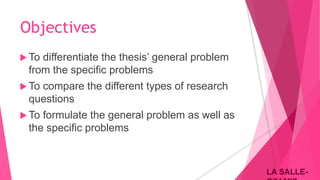
Objectives
 To differentiate the thesis’ general problem
from the specific problems
 To compare the different types of research
questions
 To formulate the general problem as well as
the specific problems
LA SALLE-LA SALLE-
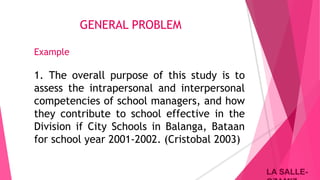
GENERAL PROBLEM
Example
1. The overall purpose of this study is to
assess the intrapersonal and interpersonal
competencies of school managers, and how
they contribute to school effective in the
Division if City Schools in Balanga, Bataan
for school year 2001-2002. (Cristobal 2003)
LA SALLE-LA SALLE-
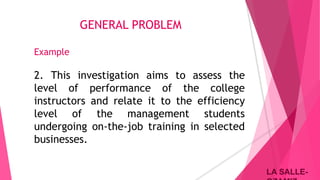
GENERAL PROBLEM
Example
2. This investigation aims to assess the
level of performance of the college
instructors and relate it to the efficiency
level of the management students
undergoing on-the-job training in selected
businesses.
LA SALLE-LA SALLE-
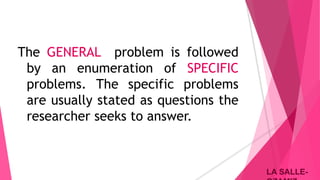
The GENERAL problem is followed
by an enumeration of SPECIFIC
problems. The specific problems
are usually stated as questions the
researcher seeks to answer.
LA SALLE-LA SALLE-
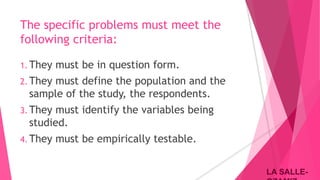
The specific problems must meet the
following criteria:
1. They must be in question form.
2. They must define the population and the
sample of the study, the respondents.
3. They must identify the variables being
studied.
4. They must be empirically testable.
LA SALLE-LA SALLE-
Two General
Types of Questions
LA SALLE-LA SALLE-
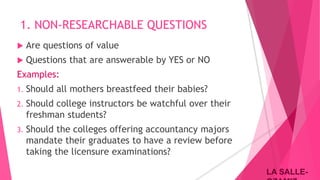
1. NON-RESEARCHABLE QUESTIONS
 Are questions of value
 Questions that are answerable by YES or NO
Examples:
1. Should all mothers breastfeed their babies?
2. Should college instructors be watchful over their
freshman students?
3. Should the colleges offering accountancy majors
mandate their graduates to have a review before
taking the licensure examinations?
LA SALLE-LA SALLE-
2. RESEARCHABLE QUESTIONS
 are questions of value, opinions, or policy
raised to accumulate data.
 Formulating a clear, significant question
prepares the researcher for subsequent
decision-making over research design, data
collection, and data analysis.
 The basic form of a research questions
involves the use of question words:
5 wives and 1 husband
LA SALLE-LA SALLE-
Types of Research
Questions
Dickoff et al., as cited in Wilson, 1990)
LA SALLE-LA SALLE-
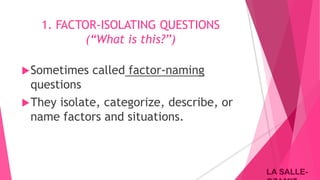
1. FACTOR-ISOLATING QUESTIONS
(“What is this?”)
Sometimes called factor-naming
questions
They isolate, categorize, describe, or
name factors and situations.
LA SALLE-LA SALLE-
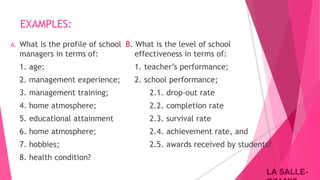
EXAMPLES:
A. What is the profile of school
managers in terms of:
1. age;
2. management experience;
3. management training;
4. home atmosphere;
5. educational attainment
6. home atmosphere;
7. hobbies;
8. health condition?
B. What is the level of school
effectiveness in terms of:
1. teacher’s performance;
2. school performance;
2.1. drop-out rate
2.2. completion rate
2.3. survival rate
2.4. achievement rate, and
2.5. awards received by students?
LA SALLE-LA SALLE-
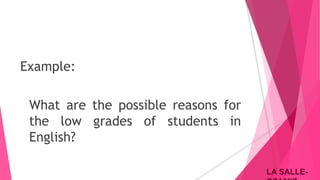
Example:
What are the possible reasons for
the low grades of students in
English?
LA SALLE-LA SALLE-
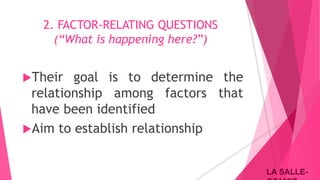
2. FACTOR-RELATING QUESTIONS
(“What is happening here?”)
Their goal is to determine the
relationship among factors that
have been identified
Aim to establish relationship
LA SALLE-LA SALLE-
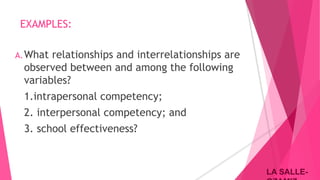
EXAMPLES:
A.What relationships and interrelationships are
observed between and among the following
variables?
1.intrapersonal competency;
2. interpersonal competency; and
3. school effectiveness?
LA SALLE-LA SALLE-
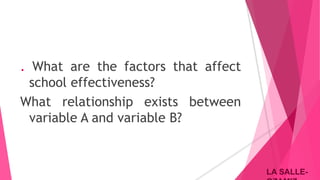
. What are the factors that affect
school effectiveness?
What relationship exists between
variable A and variable B?
LA SALLE-LA SALLE-
3. SITUATION-RELATING QUESTIONS
(“What will happen if…?”)
Usually yield hypotheses testing or
experimental study designs in
which the researcher manipulates
the variables to see what will
happen.
LA SALLE-LA SALLE-
Examples:
1. What are the effects of the traditional methods of
teaching to the level of performance of tourism
students?
2. How do the management procedures applied by the
head waiters affect the level of customer satisfaction
as experienced by selected regular clients of Jollibee
stores in Pampanga?
3. How significantly different is the performance of the
morning call center agents to that of the evening call
center agents?
LA SALLE-LA SALLE-
4. SITUATION-PRODUCING QUESTIONS
(“How can I make it happen?”)
 These questions establish explicit goals for
actions, develop plan or prescriptions to
achieve goals , and specify the conditions
under which these goals will be
accomplished.
LA SALLE-LA SALLE-
Examples:
1. Based on the findings, what human relation
intervention can be adopted to enhance or improve
school effectiveness.
2. How can catering services be organized to promote
job satisfaction?
3. What policy is to be formulated to manage the
personnel in government agencies effectively?
4. What part of the curriculum should be enhanced or
improved?

Statement of the Problem

  • 1.
    LA SALLE-LA SALLE- STATEMENTOF THE PROBLEM HEART OF THE THESIS Presented by MS. DAPHNIE S. MONTEVERDE
  • 2.
    LA SALLE-LA SALLE- Objectives To differentiate the thesis’ general problem from the specific problems  To compare the different types of research questions  To formulate the general problem as well as the specific problems
  • 3.
    LA SALLE-LA SALLE- GENERALPROBLEM Example 1. The overall purpose of this study is to assess the intrapersonal and interpersonal competencies of school managers, and how they contribute to school effective in the Division if City Schools in Balanga, Bataan for school year 2001-2002. (Cristobal 2003)
  • 4.
    LA SALLE-LA SALLE- GENERALPROBLEM Example 2. This investigation aims to assess the level of performance of the college instructors and relate it to the efficiency level of the management students undergoing on-the-job training in selected businesses.
  • 5.
    LA SALLE-LA SALLE- TheGENERAL problem is followed by an enumeration of SPECIFIC problems. The specific problems are usually stated as questions the researcher seeks to answer.
  • 6.
    LA SALLE-LA SALLE- Thespecific problems must meet the following criteria: 1. They must be in question form. 2. They must define the population and the sample of the study, the respondents. 3. They must identify the variables being studied. 4. They must be empirically testable.
  • 7.
    LA SALLE-LA SALLE- TwoGeneral Types of Questions
  • 8.
    LA SALLE-LA SALLE- 1.NON-RESEARCHABLE QUESTIONS  Are questions of value  Questions that are answerable by YES or NO Examples: 1. Should all mothers breastfeed their babies? 2. Should college instructors be watchful over their freshman students? 3. Should the colleges offering accountancy majors mandate their graduates to have a review before taking the licensure examinations?
  • 9.
    LA SALLE-LA SALLE- 2.RESEARCHABLE QUESTIONS  are questions of value, opinions, or policy raised to accumulate data.  Formulating a clear, significant question prepares the researcher for subsequent decision-making over research design, data collection, and data analysis.  The basic form of a research questions involves the use of question words: 5 wives and 1 husband
  • 10.
    LA SALLE-LA SALLE- Typesof Research Questions Dickoff et al., as cited in Wilson, 1990)
  • 11.
    LA SALLE-LA SALLE- 1.FACTOR-ISOLATING QUESTIONS (“What is this?”) Sometimes called factor-naming questions They isolate, categorize, describe, or name factors and situations.
  • 12.
    LA SALLE-LA SALLE- EXAMPLES: A.What is the profile of school managers in terms of: 1. age; 2. management experience; 3. management training; 4. home atmosphere; 5. educational attainment 6. home atmosphere; 7. hobbies; 8. health condition? B. What is the level of school effectiveness in terms of: 1. teacher’s performance; 2. school performance; 2.1. drop-out rate 2.2. completion rate 2.3. survival rate 2.4. achievement rate, and 2.5. awards received by students?
  • 13.
    LA SALLE-LA SALLE- Example: Whatare the possible reasons for the low grades of students in English?
  • 14.
    LA SALLE-LA SALLE- 2.FACTOR-RELATING QUESTIONS (“What is happening here?”) Their goal is to determine the relationship among factors that have been identified Aim to establish relationship
  • 15.
    LA SALLE-LA SALLE- EXAMPLES: A.Whatrelationships and interrelationships are observed between and among the following variables? 1.intrapersonal competency; 2. interpersonal competency; and 3. school effectiveness?
  • 16.
    LA SALLE-LA SALLE- .What are the factors that affect school effectiveness? What relationship exists between variable A and variable B?
  • 17.
    LA SALLE-LA SALLE- 3.SITUATION-RELATING QUESTIONS (“What will happen if…?”) Usually yield hypotheses testing or experimental study designs in which the researcher manipulates the variables to see what will happen.
  • 18.
    LA SALLE-LA SALLE- Examples: 1.What are the effects of the traditional methods of teaching to the level of performance of tourism students? 2. How do the management procedures applied by the head waiters affect the level of customer satisfaction as experienced by selected regular clients of Jollibee stores in Pampanga? 3. How significantly different is the performance of the morning call center agents to that of the evening call center agents?
  • 19.
    LA SALLE-LA SALLE- 4.SITUATION-PRODUCING QUESTIONS (“How can I make it happen?”)  These questions establish explicit goals for actions, develop plan or prescriptions to achieve goals , and specify the conditions under which these goals will be accomplished.
  • 20.
    LA SALLE-LA SALLE- Examples: 1.Based on the findings, what human relation intervention can be adopted to enhance or improve school effectiveness. 2. How can catering services be organized to promote job satisfaction? 3. What policy is to be formulated to manage the personnel in government agencies effectively? 4. What part of the curriculum should be enhanced or improved?