Excel Books 1- 1 UNIT Block 1 Introduction to Research Methodology Research Fundamentals and Terminology
Defining Research Research Is the  Systematic  Approach Towards  Purposeful Investigation  Through  Formulation  of  Hypothesis,   Collection of Data  on Relevant Variables,  Analysis  and  Interpretation  of Results and Reaching  Conclusion  Either in the Form of a  Solution  or Certain  Generalization .
Objectives of Research To Obtain Familiarity of a Phenomena To Determine the Association or Independence of an Activity To Determine the Characteristics of an Individual or A Group of Activities  and the Frequency of Its Occurrence
Application of Research in Management Marketing Human Resource Management Production Finance and Accounting Information Technology Materials Planning and Production Control Purchasing Advertising and Sales Promotion Social Responsibility Related Issues Even beyond functional areas, we have scope to do research.
Features of A Good Research Study Objectivity :   It must answer the research question. Control:  It shall ensure adequate control over independent variable Generalisability:  It should have same result when applied in identical  applications Free from Personal Bias:  It must be free from personal bias. Systematic:  It must have various interrelated steps that lead another step. Reproducible:   It must give approximately the same result when applied to  population having similar characteristics.
Points to Remember  Purpose clearly detailed Research design thoroughly planned High ethical standards applied Limitations frankly revealed A complete and proper analysis Findings presented unambiguously Decision based conclusion
Types of Research Studies Fundamental or Basic Research :  primarily intended to find out certain basic  principles like John Robinson’s Imperfect Competition Theory in Economics,  Maslow’s Hierarchy of Needs Theory etc.  Applied Research :  application of available scientific methods in social science  research which helps to contradict, alter or modify any existing theory or theories  and helps to formulate policies.  Descriptive Research :  a fact finding approach generalizing a cross- sectional study of  the present situation. For example, a study on problems of industrial relations in  India with an inter disciplinary approach which is classified under conclusive  research. Cont….
Historical Research  : a   research on past social forces which have shaped the  present. For example, to study the present state of Indian labor we may research  on past historical forces. Formulative or Exploratory Research :   a   research   which investigate any problem with  suitable hypothesis. It is particularly important for clarification of any concept and  throwing new light for further research on principles of developing hypothesis and  its testing with statistical tools. Experimental Research  : a research which enable us to quantify the findings, to apply  the statistical and mathematical tools and to measure the results thus quantified.  It is also quantified under conclusive research Ex-Post Facto Research :  an empirical enquiry for situation that have already  occurred. For example market failure of a product if studied or researched later  may be categorized under ex- post research.
Types of Research Case Study Approach:   a research particularly initiated at micro level. For example  study of particular industrial unit, study of some banking units etc, Survey Research:  a  research which involve study of population  or sample based  on  some questionnaire to find out intended characterstics Evaluation Research:  a  research which is directed to study or evaluate the  performance of any programs/projects that have already been implemented.
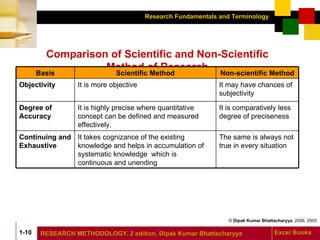
Comparison of Scientific and Non-Scientific Method of Research Basis Scientific Method Non-scientific Method Objectivity It is more objective It may have chances of subjectivity Degree of Accuracy It is highly precise where quantitative concept can be defined and measured effectively. It is comparatively less degree of preciseness Continuing and Exhaustive It takes cognizance of the existing knowledge and helps in accumulation of systematic knowledge  which is continuous and unending The same is always not true in every situation
Organization of the Research Function Technical Expertise Objective(s) of Research Studies Economic Considerations Standing/Reputation of the Agency
Concept Mapping It is a special form of diagram for  exploring  knowledge and  gathering  and  sharing  information. It is a diagram showing the  relationships  between  concepts . The main uses of the concept map are: Develop an understanding of a body of knowledge. Explore new information and relationships Access prior knowledge Gather new knowledge and information Share knowledge and information generated Design structures such as written document  Problem-solving option

myBskool

  • 1.
    Excel Books 1-1 UNIT Block 1 Introduction to Research Methodology Research Fundamentals and Terminology
  • 2.
    Defining Research ResearchIs the Systematic Approach Towards Purposeful Investigation Through Formulation of Hypothesis, Collection of Data on Relevant Variables, Analysis and Interpretation of Results and Reaching Conclusion Either in the Form of a Solution or Certain Generalization .
  • 3.
    Objectives of ResearchTo Obtain Familiarity of a Phenomena To Determine the Association or Independence of an Activity To Determine the Characteristics of an Individual or A Group of Activities and the Frequency of Its Occurrence
  • 4.
    Application of Researchin Management Marketing Human Resource Management Production Finance and Accounting Information Technology Materials Planning and Production Control Purchasing Advertising and Sales Promotion Social Responsibility Related Issues Even beyond functional areas, we have scope to do research.
  • 5.
    Features of AGood Research Study Objectivity : It must answer the research question. Control: It shall ensure adequate control over independent variable Generalisability: It should have same result when applied in identical applications Free from Personal Bias: It must be free from personal bias. Systematic: It must have various interrelated steps that lead another step. Reproducible: It must give approximately the same result when applied to population having similar characteristics.
  • 6.
    Points to Remember Purpose clearly detailed Research design thoroughly planned High ethical standards applied Limitations frankly revealed A complete and proper analysis Findings presented unambiguously Decision based conclusion
  • 7.
    Types of ResearchStudies Fundamental or Basic Research : primarily intended to find out certain basic principles like John Robinson’s Imperfect Competition Theory in Economics, Maslow’s Hierarchy of Needs Theory etc. Applied Research : application of available scientific methods in social science research which helps to contradict, alter or modify any existing theory or theories and helps to formulate policies. Descriptive Research : a fact finding approach generalizing a cross- sectional study of the present situation. For example, a study on problems of industrial relations in India with an inter disciplinary approach which is classified under conclusive research. Cont….
  • 8.
    Historical Research : a research on past social forces which have shaped the present. For example, to study the present state of Indian labor we may research on past historical forces. Formulative or Exploratory Research : a research which investigate any problem with suitable hypothesis. It is particularly important for clarification of any concept and throwing new light for further research on principles of developing hypothesis and its testing with statistical tools. Experimental Research : a research which enable us to quantify the findings, to apply the statistical and mathematical tools and to measure the results thus quantified. It is also quantified under conclusive research Ex-Post Facto Research : an empirical enquiry for situation that have already occurred. For example market failure of a product if studied or researched later may be categorized under ex- post research.
  • 9.
    Types of ResearchCase Study Approach: a research particularly initiated at micro level. For example study of particular industrial unit, study of some banking units etc, Survey Research: a research which involve study of population or sample based on some questionnaire to find out intended characterstics Evaluation Research: a research which is directed to study or evaluate the performance of any programs/projects that have already been implemented.
  • 10.
    Comparison of Scientificand Non-Scientific Method of Research Basis Scientific Method Non-scientific Method Objectivity It is more objective It may have chances of subjectivity Degree of Accuracy It is highly precise where quantitative concept can be defined and measured effectively. It is comparatively less degree of preciseness Continuing and Exhaustive It takes cognizance of the existing knowledge and helps in accumulation of systematic knowledge which is continuous and unending The same is always not true in every situation
  • 11.
    Organization of theResearch Function Technical Expertise Objective(s) of Research Studies Economic Considerations Standing/Reputation of the Agency
  • 12.
    Concept Mapping Itis a special form of diagram for exploring knowledge and gathering and sharing information. It is a diagram showing the relationships between concepts . The main uses of the concept map are: Develop an understanding of a body of knowledge. Explore new information and relationships Access prior knowledge Gather new knowledge and information Share knowledge and information generated Design structures such as written document Problem-solving option