WELCOME
Presented by
Vikrant Vishnu Padge
MSc. Horticulture (Vegetable Science)
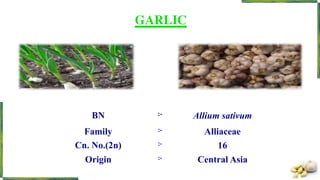
BN :- Allium sativum
Family :- Alliaceae
Cn. No.(2n) :- 16
Origin :- Central Asia
GARLIC
 INTRODUCTION :-
Used as Spice and condiments throughout the India.
Garlic promotes the wellbeing of the heart, immune systems with
antioxidant properties
Helps to maintain healthy blood circulation.
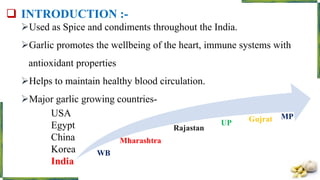
Major garlic growing countries-
USA
Egypt
China
Korea
India
 INTRODUCTION :-
Used as Spice and condiments throughout the India.
Garlic promotes the wellbeing of the heart, immune systems with
antioxidant properties
Helps to maintain healthy blood circulation.
Major garlic growing countries-
USA
Egypt
China
Korea
India
MPGujrat
Mharashtra
Rajastan
UP
WB
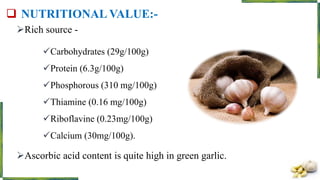
 NUTRITIONAL VALUE:-
Rich source -
Ascorbic acid content is quite high in green garlic.
Carbohydrates (29g/100g)
Protein (6.3g/100g)
Phosphorous (310 mg/100g)
Thiamine (0.16 mg/100g)
Riboflavine (0.23mg/100g)
Calcium (30mg/100g).
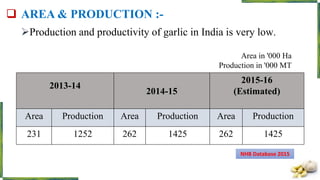
 AREA & PRODUCTION :-
Production and productivity of garlic in India is very low.
2013-14
2014-15
2015-16
(Estimated)
Area Production Area Production Area Production
231 1252 262 1425 262 1425
NHB Database 2015
Area in '000 Ha
Production in '000 MT
 CLIMATE :-
Wide range of climatic conditions.
Cannot stand too hot or too cold weather.
Prefers moderate temperature in summer as well as in winter.
Short days promote secondary growth and suppressed bulbing.
Optimum temperature for bulb formation : 25-300C
Elevations of 1000 to 1300 m above MSL.
 SOIL :-
Well drained, fertile soils suited.
Soil pH between 6 to 7.
Soil should be well tilled to provide a loose growing bed for bulb
development.
The soil must be kept evenly moist because dry soil will cause
irregularly shaped bulbs.
Tolerate salinity : 5.60 to 7.80 dsm-1 EC.
 VARIETIES:-
The varieties developed by NHRDF (National Horticultural Research
and Development Foundation, Nasik, Maharashtra)
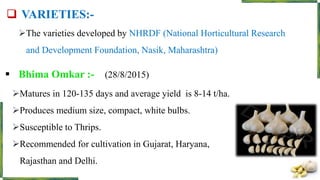
 Bhima Omkar :- (28/8/2015)
Matures in 120-135 days and average yield is 8-14 t/ha.
Produces medium size, compact, white bulbs.
Susceptible to Thrips.
Recommended for cultivation in Gujarat, Haryana,
Rajasthan and Delhi.
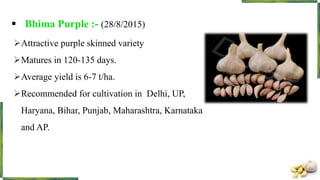
 Bhima Purple :- (28/8/2015)
Attractive purple skinned variety
Matures in 120-135 days.
Average yield is 6-7 t/ha.
Recommended for cultivation in Delhi, UP,
Haryana, Bihar, Punjab, Maharashtra, Karnataka
and AP.
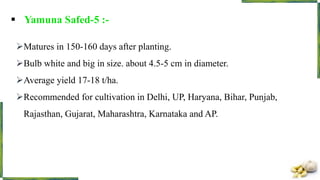
 Yamuna Safed-5 :-
Matures in 150-160 days after planting.
Bulb white and big in size. about 4.5-5 cm in diameter.
Average yield 17-18 t/ha.
Recommended for cultivation in Delhi, UP, Haryana, Bihar, Punjab,
Rajasthan, Gujarat, Maharashtra, Karnataka and AP.
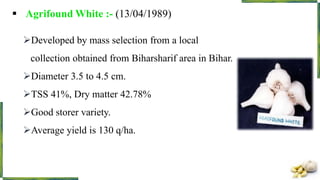
 Agrifound White :- (13/04/1989)
Developed by mass selection from a local
collection obtained from Biharsharif area in Bihar.
Diameter 3.5 to 4.5 cm.
TSS 41%, Dry matter 42.78%
Good storer variety.
Average yield is 130 q/ha.
 Ooty-1
 Singapore red
 OTHER IMPORTANT VARIETIES:-
 Madrasii
 Cerole
 Tabiti
 Rajali
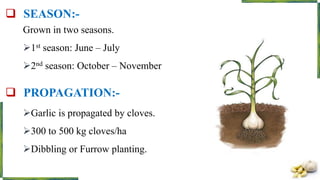
 PROPAGATION:-
Grown in two seasons.
1st season: June – July
2nd season: October – November
 SEASON:-
Garlic is propagated by cloves.
300 to 500 kg cloves/ha
Dibbling or Furrow planting.
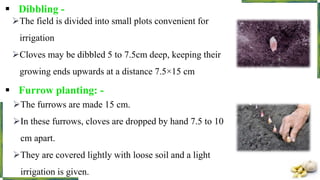
 Dibbling -
The field is divided into small plots convenient for
irrigation
Cloves may be dibbled 5 to 7.5cm deep, keeping their
growing ends upwards at a distance 7.5×15 cm
 Furrow planting: -
The furrows are made 15 cm.
In these furrows, cloves are dropped by hand 7.5 to 10
cm apart.
They are covered lightly with loose soil and a light
irrigation is given.
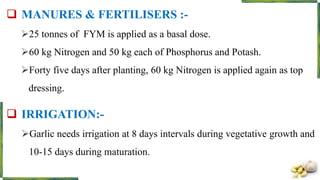
 MANURES & FERTILISERS :-
25 tonnes of FYM is applied as a basal dose.
60 kg Nitrogen and 50 kg each of Phosphorus and Potash.
Forty five days after planting, 60 kg Nitrogen is applied again as top
dressing.
 IRRIGATION:-
Garlic needs irrigation at 8 days intervals during vegetative growth and
10-15 days during maturation.
 HARVESTING:-
Ready in 4 ½ to 5 months
Maturity indices- leaves start turing yellowish or brownish and show
signs of drying.
Plants are pulled out and tied into small bundles
Keep them in field for 2-3 days.
 YIELD:-
50 to 110 q/ha.
 PLANT PROTECTION :-
 Important Pests-
 Thrips-
Thrips cause withering of leaves.
Controlled by spraying Methyl dematon 25 EC 1 ml/lit.
 Nematode-
Controlled by the application of Carbofuran 3 G 1 kg
a.i./ha 30 days after planting.
 Important Diseases-
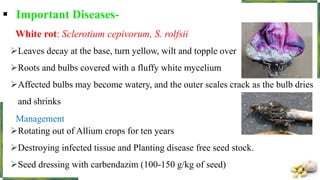
White rot: Sclerotium cepivorum, S. rolfsii
Leaves decay at the base, turn yellow, wilt and topple over
Roots and bulbs covered with a fluffy white mycelium
Affected bulbs may become watery, and the outer scales crack as the bulb dries
and shrinks
Management
Rotating out of Allium crops for ten years
Destroying infected tissue and Planting disease free seed stock.
Seed dressing with carbendazim (100-150 g/kg of seed)
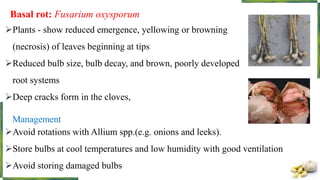
Basal rot: Fusarium oxysporum
Plants - show reduced emergence, yellowing or browning
(necrosis) of leaves beginning at tips
Reduced bulb size, bulb decay, and brown, poorly developed
root systems
Deep cracks form in the cloves,
Management
Avoid rotations with Allium spp.(e.g. onions and leeks).
Store bulbs at cool temperatures and low humidity with good ventilation
Avoid storing damaged bulbs
 REFFERENCES:-
 Vegetable Crops production technology
- M.S.Fageria, B.R.Choudhari, R.S.Dhaka
 TNAU Agritech Portal
 NHRDF (National Horticultural Research and Development Foundation,
Nasik, Maharashtra)
 A text book of Glaustus of Olericulture
- R. Selvakumar
Production technology of Garlic

Production technology of Garlic

  • 1.
    WELCOME Presented by Vikrant VishnuPadge MSc. Horticulture (Vegetable Science)
  • 2.
    BN :- Alliumsativum Family :- Alliaceae Cn. No.(2n) :- 16 Origin :- Central Asia GARLIC
  • 3.
     INTRODUCTION :- Usedas Spice and condiments throughout the India. Garlic promotes the wellbeing of the heart, immune systems with antioxidant properties Helps to maintain healthy blood circulation. Major garlic growing countries- USA Egypt China Korea India
  • 4.
     INTRODUCTION :- Usedas Spice and condiments throughout the India. Garlic promotes the wellbeing of the heart, immune systems with antioxidant properties Helps to maintain healthy blood circulation. Major garlic growing countries- USA Egypt China Korea India MPGujrat Mharashtra Rajastan UP WB
  • 5.
     NUTRITIONAL VALUE:- Richsource - Ascorbic acid content is quite high in green garlic. Carbohydrates (29g/100g) Protein (6.3g/100g) Phosphorous (310 mg/100g) Thiamine (0.16 mg/100g) Riboflavine (0.23mg/100g) Calcium (30mg/100g).
  • 6.
     AREA &PRODUCTION :- Production and productivity of garlic in India is very low. 2013-14 2014-15 2015-16 (Estimated) Area Production Area Production Area Production 231 1252 262 1425 262 1425 NHB Database 2015 Area in '000 Ha Production in '000 MT
  • 7.
     CLIMATE :- Widerange of climatic conditions. Cannot stand too hot or too cold weather. Prefers moderate temperature in summer as well as in winter. Short days promote secondary growth and suppressed bulbing. Optimum temperature for bulb formation : 25-300C Elevations of 1000 to 1300 m above MSL.
  • 8.
     SOIL :- Welldrained, fertile soils suited. Soil pH between 6 to 7. Soil should be well tilled to provide a loose growing bed for bulb development. The soil must be kept evenly moist because dry soil will cause irregularly shaped bulbs. Tolerate salinity : 5.60 to 7.80 dsm-1 EC.
  • 9.
     VARIETIES:- The varietiesdeveloped by NHRDF (National Horticultural Research and Development Foundation, Nasik, Maharashtra)  Bhima Omkar :- (28/8/2015) Matures in 120-135 days and average yield is 8-14 t/ha. Produces medium size, compact, white bulbs. Susceptible to Thrips. Recommended for cultivation in Gujarat, Haryana, Rajasthan and Delhi.
  • 10.
     Bhima Purple:- (28/8/2015) Attractive purple skinned variety Matures in 120-135 days. Average yield is 6-7 t/ha. Recommended for cultivation in Delhi, UP, Haryana, Bihar, Punjab, Maharashtra, Karnataka and AP.
  • 11.
     Yamuna Safed-5:- Matures in 150-160 days after planting. Bulb white and big in size. about 4.5-5 cm in diameter. Average yield 17-18 t/ha. Recommended for cultivation in Delhi, UP, Haryana, Bihar, Punjab, Rajasthan, Gujarat, Maharashtra, Karnataka and AP.
  • 12.
     Agrifound White:- (13/04/1989) Developed by mass selection from a local collection obtained from Biharsharif area in Bihar. Diameter 3.5 to 4.5 cm. TSS 41%, Dry matter 42.78% Good storer variety. Average yield is 130 q/ha.
  • 13.
     Ooty-1  Singaporered  OTHER IMPORTANT VARIETIES:-  Madrasii  Cerole  Tabiti  Rajali
  • 14.
     PROPAGATION:- Grown intwo seasons. 1st season: June – July 2nd season: October – November  SEASON:- Garlic is propagated by cloves. 300 to 500 kg cloves/ha Dibbling or Furrow planting.
  • 15.
     Dibbling - Thefield is divided into small plots convenient for irrigation Cloves may be dibbled 5 to 7.5cm deep, keeping their growing ends upwards at a distance 7.5×15 cm  Furrow planting: - The furrows are made 15 cm. In these furrows, cloves are dropped by hand 7.5 to 10 cm apart. They are covered lightly with loose soil and a light irrigation is given.
  • 16.
     MANURES &FERTILISERS :- 25 tonnes of FYM is applied as a basal dose. 60 kg Nitrogen and 50 kg each of Phosphorus and Potash. Forty five days after planting, 60 kg Nitrogen is applied again as top dressing.  IRRIGATION:- Garlic needs irrigation at 8 days intervals during vegetative growth and 10-15 days during maturation.
  • 17.
     HARVESTING:- Ready in4 ½ to 5 months Maturity indices- leaves start turing yellowish or brownish and show signs of drying. Plants are pulled out and tied into small bundles Keep them in field for 2-3 days.  YIELD:- 50 to 110 q/ha.
  • 18.
     PLANT PROTECTION:-  Important Pests-  Thrips- Thrips cause withering of leaves. Controlled by spraying Methyl dematon 25 EC 1 ml/lit.  Nematode- Controlled by the application of Carbofuran 3 G 1 kg a.i./ha 30 days after planting.
  • 19.
     Important Diseases- Whiterot: Sclerotium cepivorum, S. rolfsii Leaves decay at the base, turn yellow, wilt and topple over Roots and bulbs covered with a fluffy white mycelium Affected bulbs may become watery, and the outer scales crack as the bulb dries and shrinks Management Rotating out of Allium crops for ten years Destroying infected tissue and Planting disease free seed stock. Seed dressing with carbendazim (100-150 g/kg of seed)
  • 20.
    Basal rot: Fusariumoxysporum Plants - show reduced emergence, yellowing or browning (necrosis) of leaves beginning at tips Reduced bulb size, bulb decay, and brown, poorly developed root systems Deep cracks form in the cloves, Management Avoid rotations with Allium spp.(e.g. onions and leeks). Store bulbs at cool temperatures and low humidity with good ventilation Avoid storing damaged bulbs
  • 21.
     REFFERENCES:-  VegetableCrops production technology - M.S.Fageria, B.R.Choudhari, R.S.Dhaka  TNAU Agritech Portal  NHRDF (National Horticultural Research and Development Foundation, Nasik, Maharashtra)  A text book of Glaustus of Olericulture - R. Selvakumar

Editor's Notes

  • #2 >Wish >Prod. Tech. of Garlic
  • #3 2nd most imp crop from alliaceae family after onion
  • #4 Garlic play imp role in evry kitchen of india
  • #8 Basically garlic is cool season crop…but…
  • #14 Ooty-1 (TNAU)
  • #15 5-10 mm diameter, wt. of 3.6 to 5.8 g