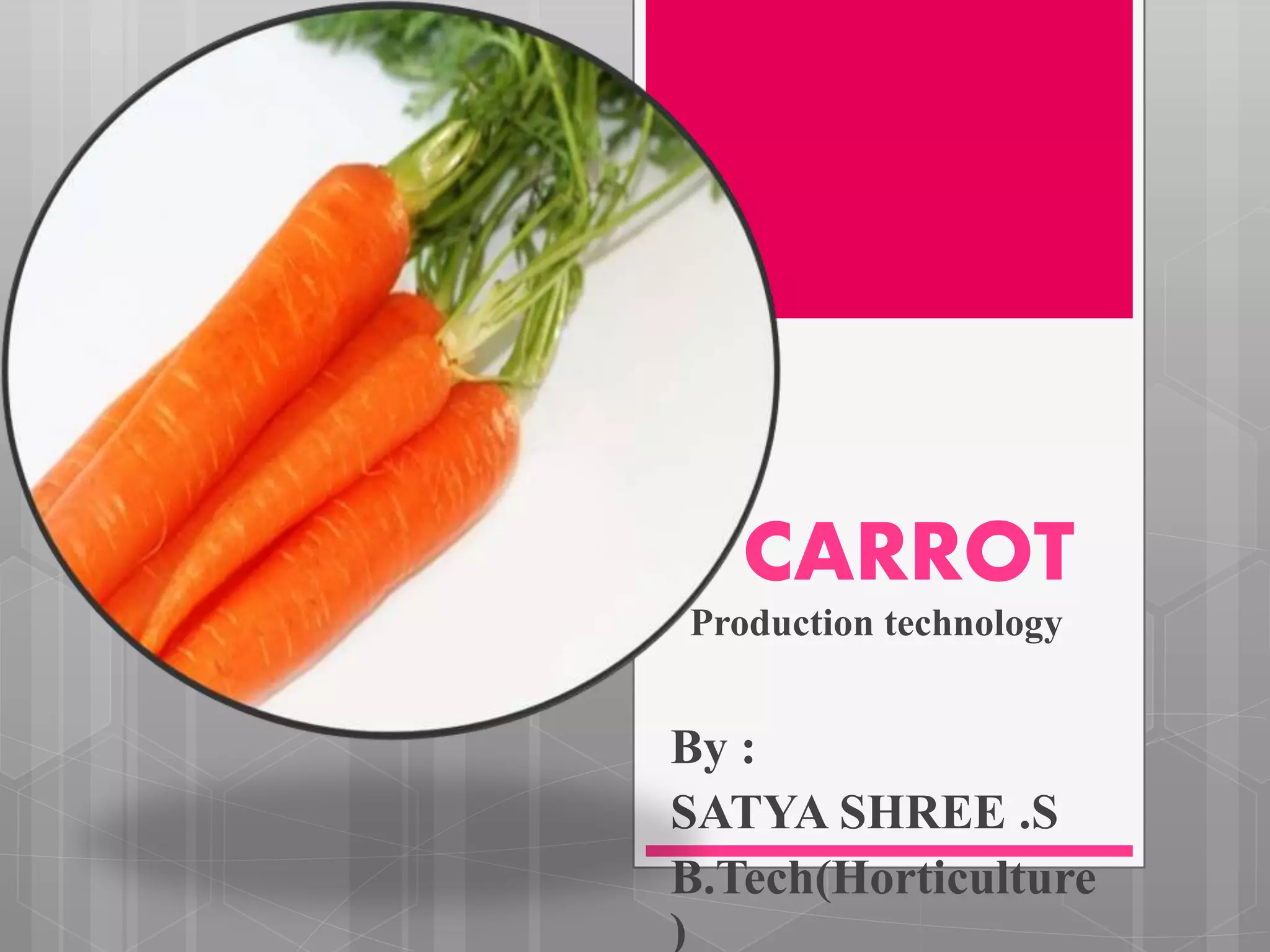
CARROT
Production technology
By :
SATYA SHREE .S
B.Tech(Horticulture
)
CARROT :
 Botanical Name :
 Daucus carota
 Family : Umbelliferae/
Apiaceae..
 Origin: Afghanisthan
Introduced-13th century
 Chromosome no: 2n=18
 Edible Part: Root(tap root)
 Orange carrot –Genetic variant(16th century)
 “Coloured carrots” require less breeding efforts.
Nutritional value :
Nutritional value :
Water 88%
Sugar 7%
Protein 1%
Fibre 1%
ash 1%
fat 0.2%
 Carotenes ------- vitamin A(liver cells)
 It has beta carotene,vitamins,falcarinol minerals
and anti oxidants in ample amounts.
 The flavanoid compounds –skin, lung and cavity
cancers.
 It also prevents cardio vascular diseases.
Botany :
 Annual or biennial herb.
 Erect/branched stem of 30-120cm
high arising from a thick fleshy root.
 Leaves are pinnatifid.
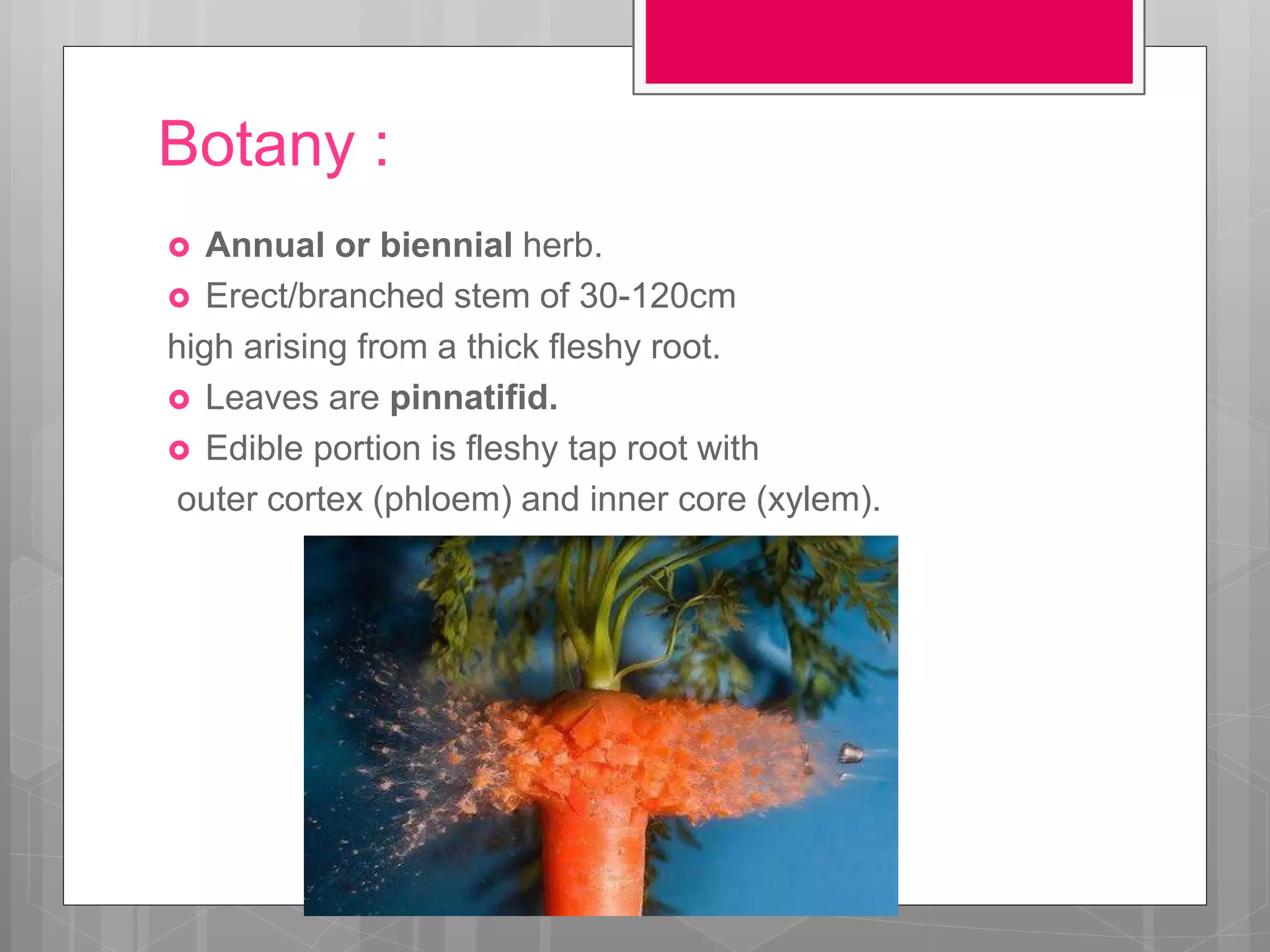
 Edible portion is fleshy tap root with
outer cortex (phloem) and inner core (xylem).
Flower :
• Individual flowers are borne on
undivided pedicels originating
from a common node.
• Cluster –compound umbel
Smaller umbels –umbellets.
• Centripetal arrangement :
the oldest flowers -near the edge
youngest flowers - in the center.
• Flowers change sex -stamens
release pollens before the stigma
is receptive.
• Bisexual: yellow or white…
Area and production :
 Current world production-25 million tonnes
1.China 2.Russia 3.United states
Carrots are largely grown in California
and so it dubs itself as “The carrot
capital of the world”…
Grimway carrots- california.
In india,,,,since it is a cool season crop
(15-20c) will develop good colour.
South India -Nilgiris and Bangalore.
North India – Punjab,Hariana and
Rajasthan .
Main carrot growing states :
 Uttar Pradesh,
 Assam,
 Karnataka,
 Andhra Pradesh,
 Punjab and
 Haryana.
 Pusa Rudhira is an improved carrot variety
released from IARI, New Delhi.(red)
 (393.75q/ha)37% higher than local variety.
 Pusa Asita - black carrot variety.(good appetizer)
 Indian pink –crunchy and delicious
Cultivars and varieties :
 Based on shape of roots
 1. Long rooted: 25cm or more in length,
these perform well in comparatively light
soil.
 2. Half- long rooted: Length does not
usually exceed 20cm.
 3. Short-stump rooted: These cultivars are
small suitable for growing in heavy soils.
Based on temperature response :
 Temperate or European: Annual and
require low temperature of 4.8-10°c for
flowering.
 Do not produce seeds in the plains of
India, e.g., Nantes, Chantenay, etc.
 Tropical or Asiatic: Do not require any low
temperature treatment for flowering, they
seed freely in the plains of India.
 More of anthocyanin and less carotene.
 Hills :Ooty 1,Early Nantes ,New Korda.
 Plains :India Gold ,Pusa kesar ,Half Long
Danvers.
ASIATIC /
TROPICAL:
Pusa Kesar :
 Improved cultivar.
 Developed by recombination breeding from a
cross between ‘LOCAL RED’ and ‘NANTES
HALF LONG’
 It is high and quick growing.
 Roots remain in the field for longer period without
bolting.
 Can tolerate high temperature.
 High carotene content(38mg/100g)
90-110 days, 30 ton/ha
Pusa Meghali :
 Developed and recommended by IARI
 Cross between NANTES and PUSA
KESAR.
 The roots are long tapering, orange with
self-coloured core.
 Foliage growth is medium.
 The branching and forking of roots is very
less.
Sel .233
 Developed by Punjab Agricultural
University,1978.
 Cross between NANTES and NO. 29.
 Leaves are dark green in colour, roots are
15-18cm long.
 Smooth orange with light orange core.
 Forking and cracking are less.
 Ready for harvest in 90-100days.
Hisar Gairic (HC 1):
 Developed through
mass selection from the germplasm
collected from various parts
of the country.
 Matures in 120days.
 Light green leaves, long roots, less fibre and
forking.
 Carotene content 96.2mg/100g of fresh weight.
 Suitable for early sowing.
TEMPERATE /
EUROPEAN :
Nantes :
 Well shaped roots,
 scarlet orange in colour,
 cylindrical in shape,
 With stumped end forming
a small thin tail.
 The skin is thin and flesh
is sweet.
 It is ready in 120days.
Imperator :
 Long ,cylindrical and highly
uniform but tapers towards
the end.
 The best carrots for rabbits.
 Size :20-28cm,thickness :4 cm,ends with a
pointed tip.
 More fibrous core.
 Deeply orange,not so sweet and good for
storage..
 High yield…
Chantenay :
 Roots are attractive deep reddish
Orange and smooth.
 Thick shoulders somewhat square,
 Flesh tender, sweet and fine textured.
 It takes about 120 days.
 Excellent for canning and storage.
Danvers :
 Danvers are medium-length
carrots, conical in shape, and
thicker than Imperators.
 The end of the root is tapered.
 Suitable for both the processing
and commercial fresh market
industries.
 Yellow core
Ooty 1:
 Selection from local type.
 Long and slightly tapering.
 Deep orange and suitable for all seasons.
 It takes about 100-110 days.
 1800 m above MSL.
 Central core thin, fleshy and palatable.
 Free from premature bolting and resistant to powdery
mildew, leaf spot and drought.
 Rich in beta carotene.
 Yields about 49.1tonnes/ha.
Hybrids :
 Hybrids are being developed by utilising Male
sterile lines.
(IARI,NewDelhi.IIVR,Varanasi.PAU,Ludhiana.
SKUAST,Srinagar.)
 Some of the hybrids are:
1. Samson 196
2. Bangor
3. Carson
4. Oranza
5. Premia
6. Cerumba
7. Desi Red
Climate :
 Cool season crop.
 Spring summer and autumn crop - hills
winter crop -plains of North India.
 Temperature plays an important role in
germination.
 Seed germination takes place at 7.2- 23.9°c.
 Root growth and development occurs at 18.3-
23.9°c.
 Tropical type produces roots even at 25°c.
 European types require low temperature for
development of roots.
Soil :
 Deep and well drained friable soil gives
long, smooth, slender roots.
 For early crop sandy loam is preferred.
 In heavy soils, short stump rooted varieties
having round and heart-shaped roots are
preferred.
 pH is 6.6-7.1
Land preparation :
 Soil is ploughed to fine
tilth.
 Utmost care is taken to
remove clods and stones.
 Land is then made to
ridges and furrows at
30-45 cm apart in small plots of convenient
size for irrigation.
Sowing :
 South and Central Jan –feb
India hills : June –July
Oct -Nov
 Northern plains : Aug -Dec
 Hills : Mar – Apr
 Treat with fungicides like Thiram to avoid
damping off and other diseases..
 Seed rate varies from 8-10kg/ha depending
upon variety.
 Seeds are sown on ridges or on flat beds
either by dibbling in lines or by broadcasting.
 Seeds are sown at the depth of 1cm.
Irrigation and Interculture :
 Light irrigation -after sowing.
 Irrigation interval:10-12days
in winter
5-6days in summer .
 2-3days prior to harvest-withheld irrigation.
 Soil should be hoed frequently to allow proper
aeration and to prevent discolouration of
crown.
 Weeding should be done at initial stages.
Manuring :
 20-25 tonnes of FYM.
 40-50kg N, 40-50kg P and 80-100kg K is
recommended.
 Entire dose of FYM, half N and full P and K are to
be applied as basal dose at the time of final land
preparation .
 Remaining dose of N can be applied at the time of
first hoeing.
 If optimum dose of N is exceeded, the contents of
carotene, Vit C and sugars decrease considerably.
Harvesting :
 Harvesting should be done at correct maturity stage
viz., 70-85 days after sowing.
 Light irrigation should be given just before harvest for
easy pulling of roots.
 In flat ground, top is removed close to ground and
roots are dug out with spade.
Yield :
 Yield varies with season, climate and varieties
etc.,
 Tropical types 20-30 tonnes/ha
 European types 10-15 tonnes/ha.
Post harvest handling :
 Soon after harvesting ,they are graded
according to the size,diameter and length.
 Storage under ambient temp.
 Topped and untopped carrots differ ..in shelf
life.
MAJOR CONSTRAINTS :
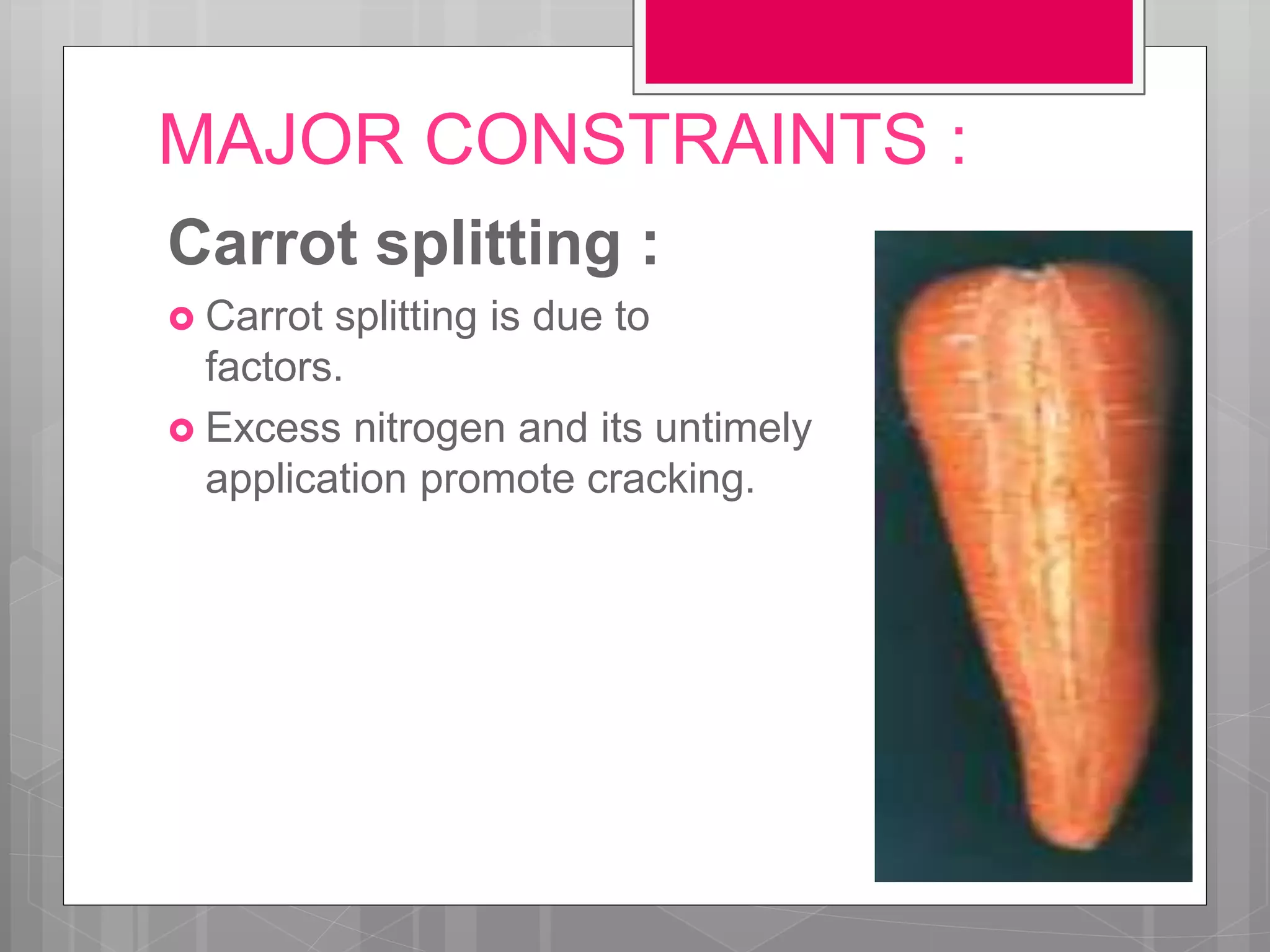
Carrot splitting :
 Carrot splitting is due to genetic
factors.
 Excess nitrogen and its untimely
application promote cracking.
Cavity spot :
 Primarily caused by calcium deficiency
induced by excess potassium.
 Symptoms appear as a cavity in cortex.
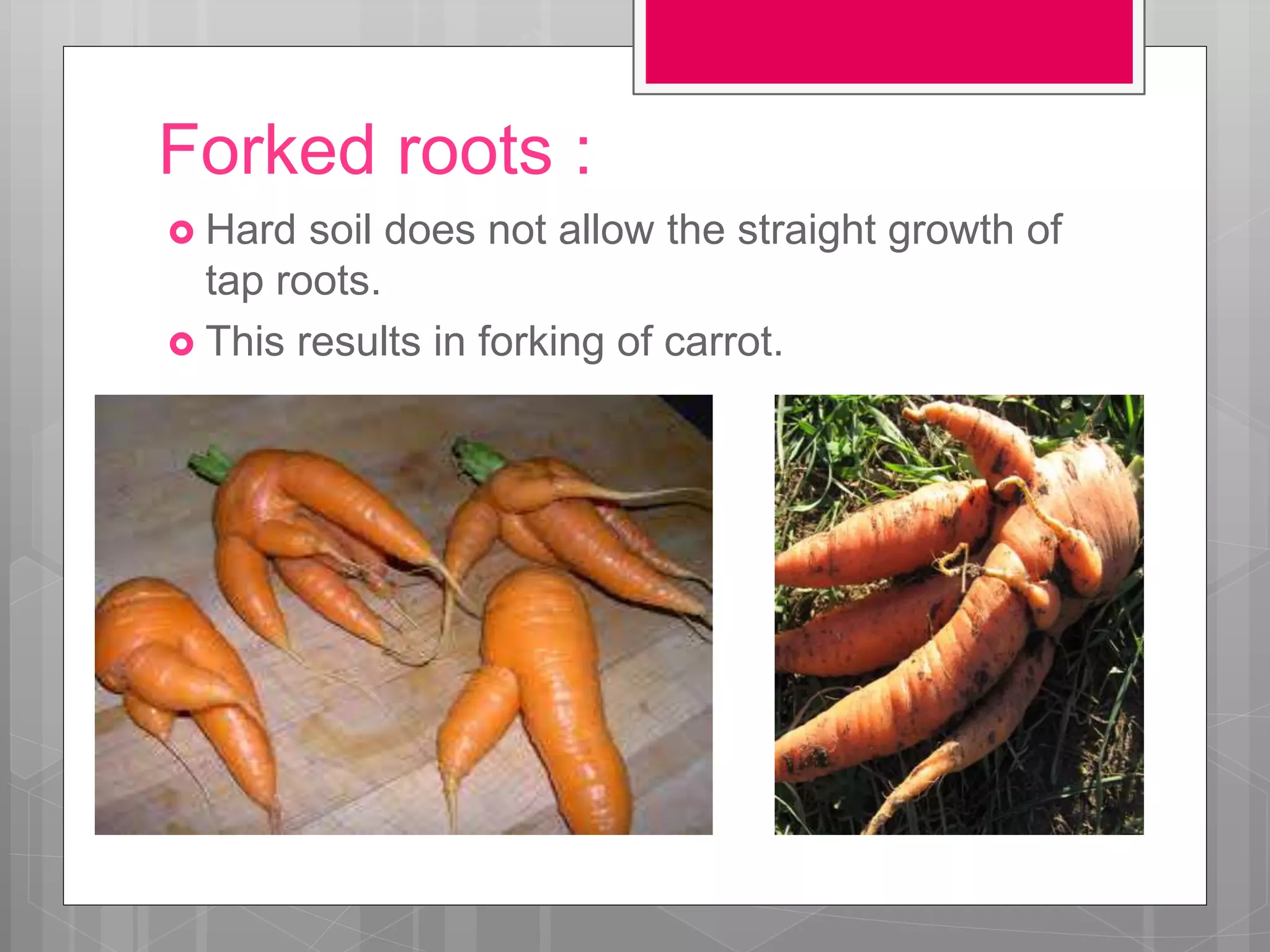
Forked roots :
 Hard soil does not allow the straight growth of
tap roots.
 This results in forking of carrot.
Leaf spot or cercospora blight
 Leaf spot initiated by cercospora carotae.
 Elongated lesions along the edge of the leaf
segment, resulting in a
lateral curling.
 Entire leaves and
 petiole may die on severe
infection.
 Control measures include seed
treatment with
fungicides, dipping seeds in
0.01 per cent mercuric
chloride solution for 5 minutes.
Powdery mildew :
 Powdery mildew caused by Erysiphae
sometimes become a major disease of carrot.
 White powdery growth on leaves and later
spread on flowers, stems and fruits.
 Control measures include dusting wetable
sulphur
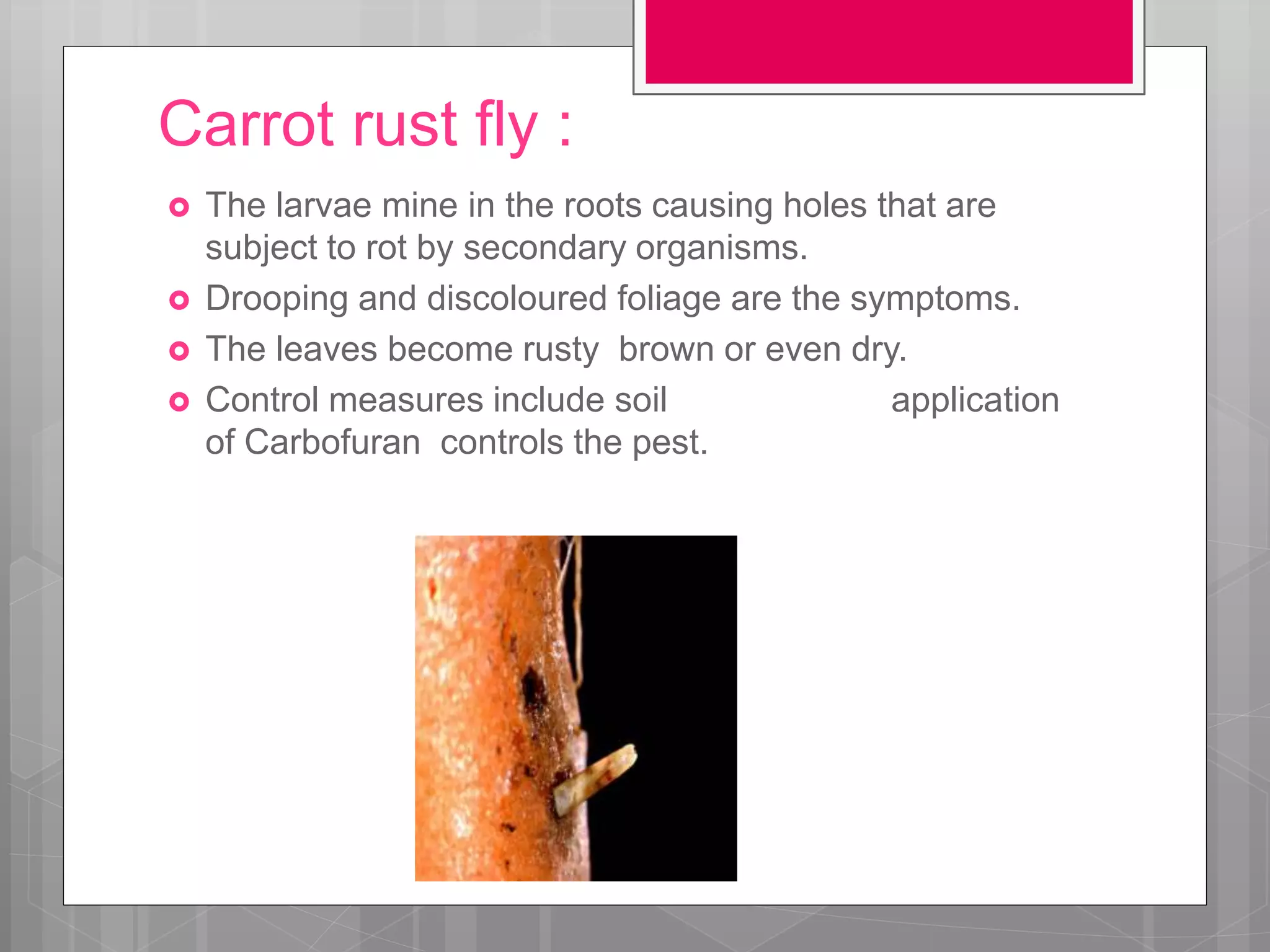
Carrot rust fly :
 The larvae mine in the roots causing holes that are
subject to rot by secondary organisms.
 Drooping and discoloured foliage are the symptoms.
 The leaves become rusty brown or even dry.
 Control measures include soil application
of Carbofuran controls the pest.
Nematodes :
 The most important nematode damaging
carrots is a species of Pratylenchus.
 They cause roots to be forked and make
unmarketable.
 Nematode number can be reduced by
growing Tagetes.
 Soil treatment with Nemagon or sannema or
DD can also appreciably reduce the
nematode population.
SEED PRODUCTION :
 . GROW VIGOROUS PLANTS
 Grow plants at the same time of the year, the
same way you would usually do.
 Root to seed method :
Those root are called stecklings.
 Carrot is grown by seeds.the seed production
is done by two methods :
root to seed method -genetic purity
seed to seed method – certified seed
 Root rot is very high in seed to seed method .
 Seed rate :5-6 kg
 When germination percent is low ..seed rate
can be increased .
Roguing :
 During vegetative growth-offtypes removed
based on leaf characters.
 Flowering,fruiting, maturity periods-roguing
effective ..(removal of diseased)
 2. VERNALIZE ROOTS
Carrots require 6-8 weeks of cold treatment at 5-
6°C for floral induction.
carrot crop :
 summer - leave them in the field instead and let
them experience the winter.
Remove the dead and drying leafs, thinning of
atleast 5cm apart done, covered with mulch.
 Leaf will regrow and after several weeks a seed
stalk will appear, this is seed to seed method.
In this method the losses are high and as the
roots are cannot be examined the quality cant be
checked.
 Seed yield can be increased –spray 750 ppm
GA3….at 8 to 10 leaf stage .
 The root to seed method is more reliable.
 Harvest the roots when you usually would.and
remove off types
 trim the tops to 2-4cm and air dry till no
moisture is present on it.
 Pack it in paper bags with equal amount of
wood shavingsand place it in polyethylene
bags 2-5°C
 puncture the bags after several days when
you find moisture droplets accumilate inside.
3. GROW VERNALIZED PLANTS
Plant the vernalized roots and water it well.
 Seed stalk development will be evident after
4-6 weeks.
 Control of microbial the pest infection is
essential.
 Carrot seeds can only be produced true to
type if wild carrot is not growing nearby. This
wild carrot cross pollinates and leads to white
coloured roots.
Harvesting ;drying and seed extraction
 Umbels are fully ripen.-fully matured heads.
 Dried within 5-6 days on open sun.
 Seeds extracted by beating dried umbels with
sticks.
 Seeds should be cleaned that there is no
chaff or other inert matter.
 Seed dried at 8.0% moisture .
 SEED YIELD :1200 kg-2000 kg /ha..
Pollination :
Pollination-through bees and flies.
 it can be done with a brush to but the seed set
would be low.
 4-6 weeks after pollination the seeds turn
brown.
 Harvesting must be done before the seed
cracks in paper bags to dry completely.
 Remove the spines by rubbing the dry seed
 carrot seeds have no dormancy period.
 Store in a moisture free container.
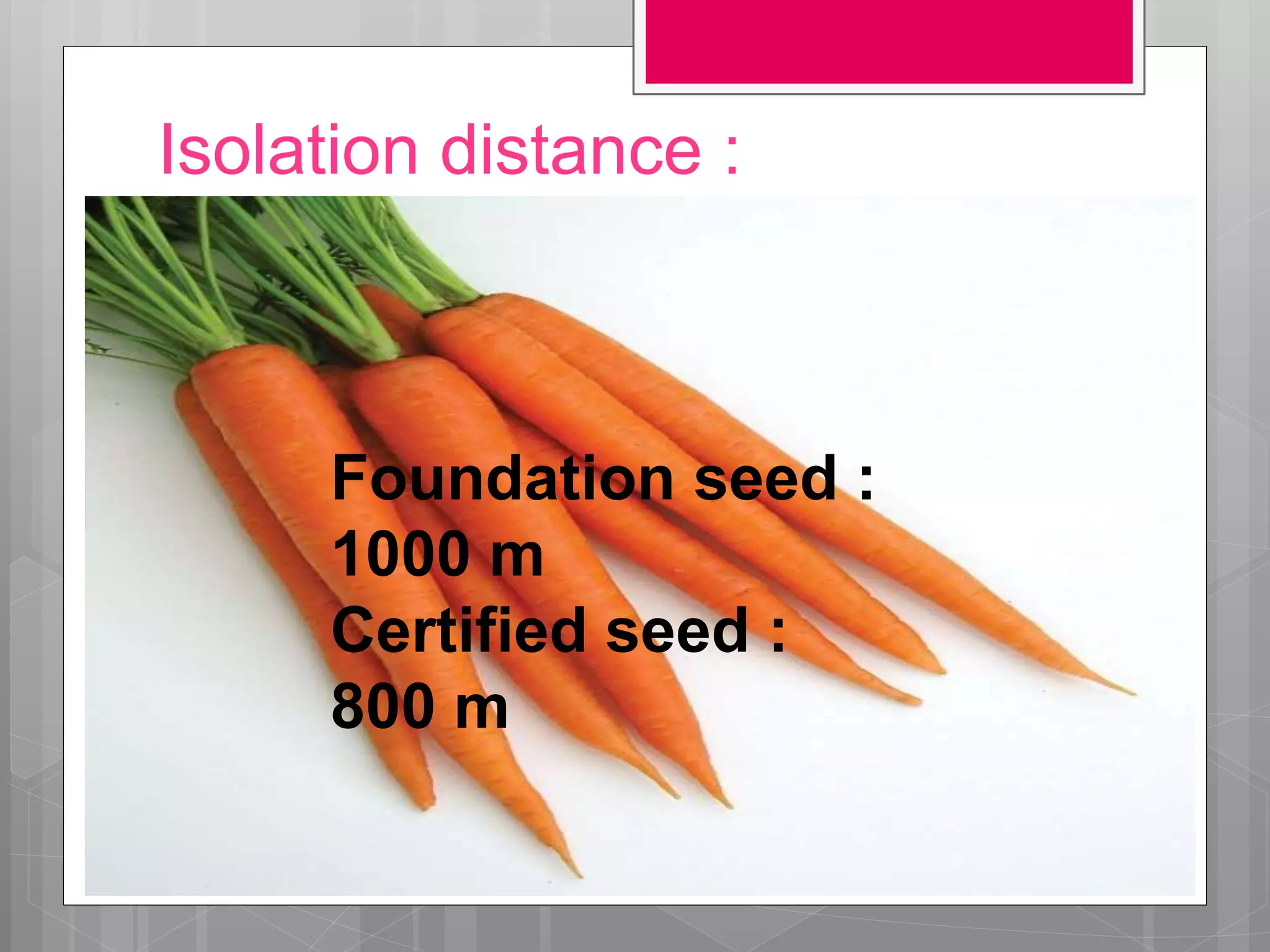
Isolation distance :
Foundation seed :
1000 m
Certified seed :
800 m
Methods of consumption and uses
 Only 3% -carotene –raw carrot.
 Increased to 39% by pulping,cooking….
 Greens -edible vegetable,( toxic
alkaloids).harvested before significant root
development.
 In north India “GAJAR KA HALWA”(carrot dessert),
which has carrots grated and cooked in milk until
the whole mixture is solid, after which nuts and
butter are added.
 Carrot cakes, carrot puddings, jam, fresh juice are
also available .
Fun facts about carrot :
 The worlds longest carrot was in 2007 and it was
5.839m.
 The heaviest carrot recorded in 1998 was 9.02 kg
 Both the words Daucas carota means orange.
 Carrots were first grown as a medicine not a food.
 An average person consumes 10,866 carrots in a
lifetime.
 The crisp texture of a carrot is a result of the cell
walls being stiff with the indigestible food fibre .
 The classic bugs bunny carrot is the danvers type.
THANK YOU

Carrot production technology

  • 1.
    CARROT Production technology By : SATYASHREE .S B.Tech(Horticulture )
  • 2.
    CARROT :  BotanicalName :  Daucus carota  Family : Umbelliferae/ Apiaceae..  Origin: Afghanisthan Introduced-13th century  Chromosome no: 2n=18  Edible Part: Root(tap root)  Orange carrot –Genetic variant(16th century)  “Coloured carrots” require less breeding efforts.
  • 3.
    Nutritional value : Nutritionalvalue : Water 88% Sugar 7% Protein 1% Fibre 1% ash 1% fat 0.2%  Carotenes ------- vitamin A(liver cells)  It has beta carotene,vitamins,falcarinol minerals and anti oxidants in ample amounts.  The flavanoid compounds –skin, lung and cavity cancers.  It also prevents cardio vascular diseases.
  • 4.
    Botany :  Annualor biennial herb.  Erect/branched stem of 30-120cm high arising from a thick fleshy root.  Leaves are pinnatifid.  Edible portion is fleshy tap root with outer cortex (phloem) and inner core (xylem).
  • 5.
    Flower : • Individualflowers are borne on undivided pedicels originating from a common node. • Cluster –compound umbel Smaller umbels –umbellets. • Centripetal arrangement : the oldest flowers -near the edge youngest flowers - in the center. • Flowers change sex -stamens release pollens before the stigma is receptive. • Bisexual: yellow or white…
  • 6.
    Area and production:  Current world production-25 million tonnes 1.China 2.Russia 3.United states
  • 7.
    Carrots are largelygrown in California and so it dubs itself as “The carrot capital of the world”… Grimway carrots- california. In india,,,,since it is a cool season crop (15-20c) will develop good colour. South India -Nilgiris and Bangalore. North India – Punjab,Hariana and Rajasthan .
  • 8.
    Main carrot growingstates :  Uttar Pradesh,  Assam,  Karnataka,  Andhra Pradesh,  Punjab and  Haryana.  Pusa Rudhira is an improved carrot variety released from IARI, New Delhi.(red)  (393.75q/ha)37% higher than local variety.  Pusa Asita - black carrot variety.(good appetizer)  Indian pink –crunchy and delicious
  • 9.
    Cultivars and varieties:  Based on shape of roots  1. Long rooted: 25cm or more in length, these perform well in comparatively light soil.  2. Half- long rooted: Length does not usually exceed 20cm.  3. Short-stump rooted: These cultivars are small suitable for growing in heavy soils.
  • 10.
    Based on temperatureresponse :  Temperate or European: Annual and require low temperature of 4.8-10°c for flowering.  Do not produce seeds in the plains of India, e.g., Nantes, Chantenay, etc.  Tropical or Asiatic: Do not require any low temperature treatment for flowering, they seed freely in the plains of India.  More of anthocyanin and less carotene.  Hills :Ooty 1,Early Nantes ,New Korda.  Plains :India Gold ,Pusa kesar ,Half Long Danvers.
  • 11.
  • 12.
    Pusa Kesar : Improved cultivar.  Developed by recombination breeding from a cross between ‘LOCAL RED’ and ‘NANTES HALF LONG’  It is high and quick growing.  Roots remain in the field for longer period without bolting.  Can tolerate high temperature.  High carotene content(38mg/100g) 90-110 days, 30 ton/ha
  • 13.
    Pusa Meghali : Developed and recommended by IARI  Cross between NANTES and PUSA KESAR.  The roots are long tapering, orange with self-coloured core.  Foliage growth is medium.  The branching and forking of roots is very less.
  • 14.
    Sel .233  Developedby Punjab Agricultural University,1978.  Cross between NANTES and NO. 29.  Leaves are dark green in colour, roots are 15-18cm long.  Smooth orange with light orange core.  Forking and cracking are less.  Ready for harvest in 90-100days.
  • 15.
    Hisar Gairic (HC1):  Developed through mass selection from the germplasm collected from various parts of the country.  Matures in 120days.  Light green leaves, long roots, less fibre and forking.  Carotene content 96.2mg/100g of fresh weight.  Suitable for early sowing.
  • 16.
  • 17.
    Nantes :  Wellshaped roots,  scarlet orange in colour,  cylindrical in shape,  With stumped end forming a small thin tail.  The skin is thin and flesh is sweet.  It is ready in 120days.
  • 18.
    Imperator :  Long,cylindrical and highly uniform but tapers towards the end.  The best carrots for rabbits.  Size :20-28cm,thickness :4 cm,ends with a pointed tip.  More fibrous core.  Deeply orange,not so sweet and good for storage..  High yield…
  • 19.
    Chantenay :  Rootsare attractive deep reddish Orange and smooth.  Thick shoulders somewhat square,  Flesh tender, sweet and fine textured.  It takes about 120 days.  Excellent for canning and storage.
  • 20.
    Danvers :  Danversare medium-length carrots, conical in shape, and thicker than Imperators.  The end of the root is tapered.  Suitable for both the processing and commercial fresh market industries.  Yellow core
  • 21.
    Ooty 1:  Selectionfrom local type.  Long and slightly tapering.  Deep orange and suitable for all seasons.  It takes about 100-110 days.  1800 m above MSL.  Central core thin, fleshy and palatable.  Free from premature bolting and resistant to powdery mildew, leaf spot and drought.  Rich in beta carotene.  Yields about 49.1tonnes/ha.
  • 22.
    Hybrids :  Hybridsare being developed by utilising Male sterile lines. (IARI,NewDelhi.IIVR,Varanasi.PAU,Ludhiana. SKUAST,Srinagar.)  Some of the hybrids are: 1. Samson 196 2. Bangor 3. Carson 4. Oranza 5. Premia 6. Cerumba 7. Desi Red
  • 23.
    Climate :  Coolseason crop.  Spring summer and autumn crop - hills winter crop -plains of North India.  Temperature plays an important role in germination.  Seed germination takes place at 7.2- 23.9°c.  Root growth and development occurs at 18.3- 23.9°c.  Tropical type produces roots even at 25°c.  European types require low temperature for development of roots.
  • 24.
    Soil :  Deepand well drained friable soil gives long, smooth, slender roots.  For early crop sandy loam is preferred.  In heavy soils, short stump rooted varieties having round and heart-shaped roots are preferred.  pH is 6.6-7.1
  • 25.
    Land preparation : Soil is ploughed to fine tilth.  Utmost care is taken to remove clods and stones.  Land is then made to ridges and furrows at 30-45 cm apart in small plots of convenient size for irrigation.
  • 26.
    Sowing :  Southand Central Jan –feb India hills : June –July Oct -Nov  Northern plains : Aug -Dec  Hills : Mar – Apr  Treat with fungicides like Thiram to avoid damping off and other diseases..
  • 27.
     Seed ratevaries from 8-10kg/ha depending upon variety.  Seeds are sown on ridges or on flat beds either by dibbling in lines or by broadcasting.  Seeds are sown at the depth of 1cm.
  • 28.
    Irrigation and Interculture:  Light irrigation -after sowing.  Irrigation interval:10-12days in winter 5-6days in summer .  2-3days prior to harvest-withheld irrigation.  Soil should be hoed frequently to allow proper aeration and to prevent discolouration of crown.  Weeding should be done at initial stages.
  • 29.
    Manuring :  20-25tonnes of FYM.  40-50kg N, 40-50kg P and 80-100kg K is recommended.  Entire dose of FYM, half N and full P and K are to be applied as basal dose at the time of final land preparation .  Remaining dose of N can be applied at the time of first hoeing.  If optimum dose of N is exceeded, the contents of carotene, Vit C and sugars decrease considerably.
  • 30.
    Harvesting :  Harvestingshould be done at correct maturity stage viz., 70-85 days after sowing.  Light irrigation should be given just before harvest for easy pulling of roots.  In flat ground, top is removed close to ground and roots are dug out with spade.
  • 31.
    Yield :  Yieldvaries with season, climate and varieties etc.,  Tropical types 20-30 tonnes/ha  European types 10-15 tonnes/ha. Post harvest handling :  Soon after harvesting ,they are graded according to the size,diameter and length.  Storage under ambient temp.  Topped and untopped carrots differ ..in shelf life.
  • 32.
    MAJOR CONSTRAINTS : Carrotsplitting :  Carrot splitting is due to genetic factors.  Excess nitrogen and its untimely application promote cracking.
  • 33.
    Cavity spot : Primarily caused by calcium deficiency induced by excess potassium.  Symptoms appear as a cavity in cortex.
  • 34.
    Forked roots : Hard soil does not allow the straight growth of tap roots.  This results in forking of carrot.
  • 35.
    Leaf spot orcercospora blight  Leaf spot initiated by cercospora carotae.  Elongated lesions along the edge of the leaf segment, resulting in a lateral curling.  Entire leaves and  petiole may die on severe infection.  Control measures include seed treatment with fungicides, dipping seeds in 0.01 per cent mercuric chloride solution for 5 minutes.
  • 36.
    Powdery mildew : Powdery mildew caused by Erysiphae sometimes become a major disease of carrot.  White powdery growth on leaves and later spread on flowers, stems and fruits.  Control measures include dusting wetable sulphur
  • 37.
    Carrot rust fly:  The larvae mine in the roots causing holes that are subject to rot by secondary organisms.  Drooping and discoloured foliage are the symptoms.  The leaves become rusty brown or even dry.  Control measures include soil application of Carbofuran controls the pest.
  • 38.
    Nematodes :  Themost important nematode damaging carrots is a species of Pratylenchus.  They cause roots to be forked and make unmarketable.  Nematode number can be reduced by growing Tagetes.  Soil treatment with Nemagon or sannema or DD can also appreciably reduce the nematode population.
  • 39.
    SEED PRODUCTION : . GROW VIGOROUS PLANTS  Grow plants at the same time of the year, the same way you would usually do.  Root to seed method : Those root are called stecklings.
  • 40.
     Carrot isgrown by seeds.the seed production is done by two methods : root to seed method -genetic purity seed to seed method – certified seed  Root rot is very high in seed to seed method .  Seed rate :5-6 kg  When germination percent is low ..seed rate can be increased .
  • 41.
    Roguing :  Duringvegetative growth-offtypes removed based on leaf characters.  Flowering,fruiting, maturity periods-roguing effective ..(removal of diseased)
  • 42.
     2. VERNALIZEROOTS Carrots require 6-8 weeks of cold treatment at 5- 6°C for floral induction. carrot crop :  summer - leave them in the field instead and let them experience the winter. Remove the dead and drying leafs, thinning of atleast 5cm apart done, covered with mulch.  Leaf will regrow and after several weeks a seed stalk will appear, this is seed to seed method. In this method the losses are high and as the roots are cannot be examined the quality cant be checked.  Seed yield can be increased –spray 750 ppm GA3….at 8 to 10 leaf stage .
  • 43.
     The rootto seed method is more reliable.  Harvest the roots when you usually would.and remove off types  trim the tops to 2-4cm and air dry till no moisture is present on it.  Pack it in paper bags with equal amount of wood shavingsand place it in polyethylene bags 2-5°C  puncture the bags after several days when you find moisture droplets accumilate inside.
  • 44.
    3. GROW VERNALIZEDPLANTS Plant the vernalized roots and water it well.  Seed stalk development will be evident after 4-6 weeks.  Control of microbial the pest infection is essential.  Carrot seeds can only be produced true to type if wild carrot is not growing nearby. This wild carrot cross pollinates and leads to white coloured roots.
  • 45.
    Harvesting ;drying andseed extraction  Umbels are fully ripen.-fully matured heads.  Dried within 5-6 days on open sun.  Seeds extracted by beating dried umbels with sticks.  Seeds should be cleaned that there is no chaff or other inert matter.  Seed dried at 8.0% moisture .  SEED YIELD :1200 kg-2000 kg /ha..
  • 47.
    Pollination : Pollination-through beesand flies.  it can be done with a brush to but the seed set would be low.  4-6 weeks after pollination the seeds turn brown.  Harvesting must be done before the seed cracks in paper bags to dry completely.  Remove the spines by rubbing the dry seed  carrot seeds have no dormancy period.  Store in a moisture free container.
  • 48.
    Isolation distance : Foundationseed : 1000 m Certified seed : 800 m
  • 50.
    Methods of consumptionand uses  Only 3% -carotene –raw carrot.  Increased to 39% by pulping,cooking….  Greens -edible vegetable,( toxic alkaloids).harvested before significant root development.  In north India “GAJAR KA HALWA”(carrot dessert), which has carrots grated and cooked in milk until the whole mixture is solid, after which nuts and butter are added.  Carrot cakes, carrot puddings, jam, fresh juice are also available .
  • 51.
    Fun facts aboutcarrot :  The worlds longest carrot was in 2007 and it was 5.839m.  The heaviest carrot recorded in 1998 was 9.02 kg  Both the words Daucas carota means orange.  Carrots were first grown as a medicine not a food.  An average person consumes 10,866 carrots in a lifetime.  The crisp texture of a carrot is a result of the cell walls being stiff with the indigestible food fibre .  The classic bugs bunny carrot is the danvers type.
  • 55.