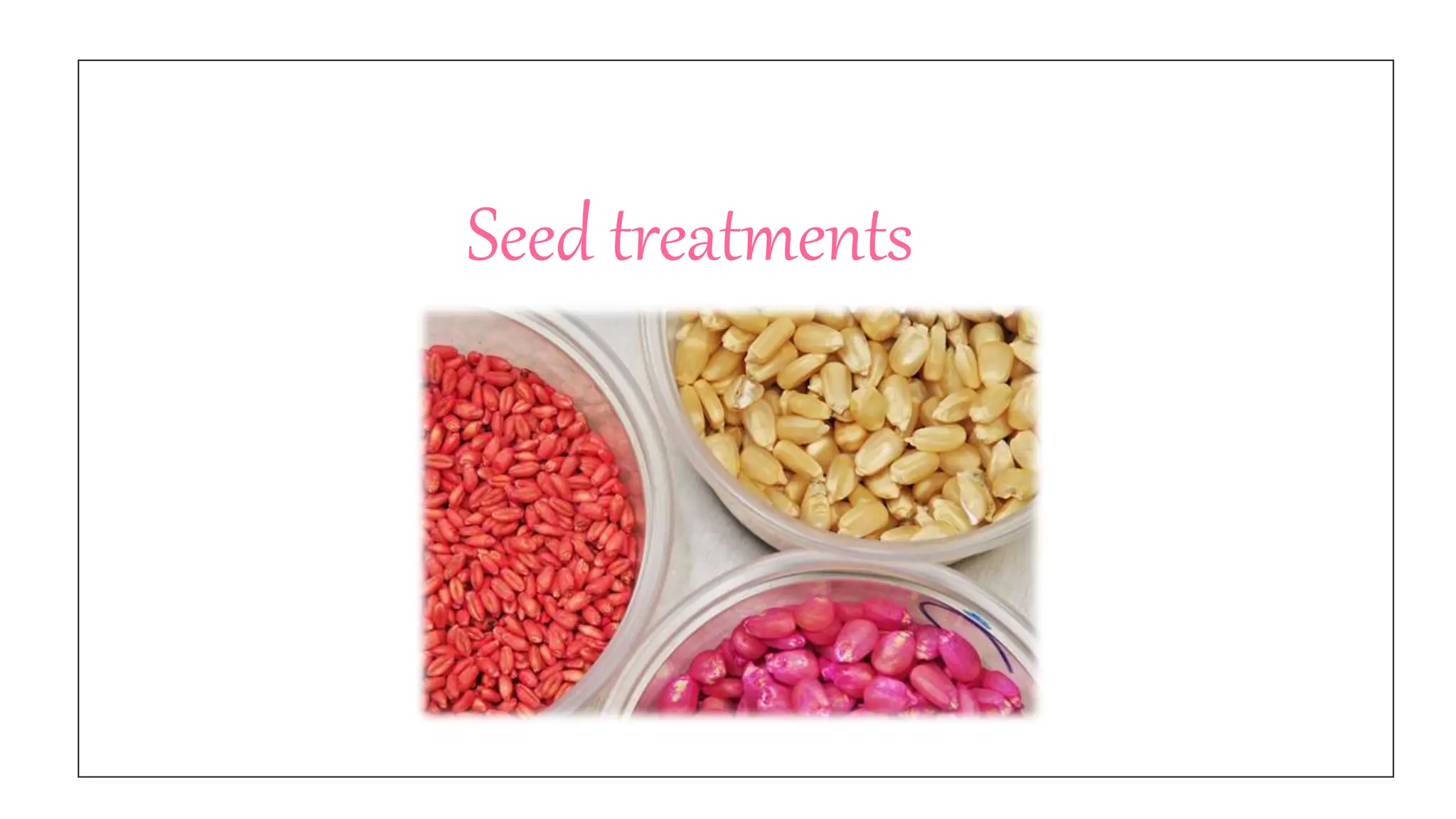
Seed treatments
Seed treatment
• Refers to application of any treatment by chemical, physical or
biological means
• Purpose –
To break the dormancy of seeds
to alter / accelerate the germination
To improve seedling growth
to protect the seed from pest & disease during storage
To tide over adverse conditions – seed hardening
To improve storability of seeds
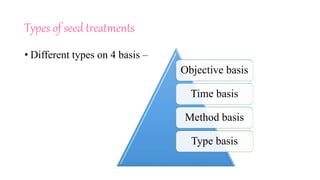
Types of seed treatments
• Different types on 4 basis –
Objective basis
Time basis
Method basis
Type basis
1) Objective basis
• Breaking dormancy
• Augmenting germination
• Improving seedling growth
• Improving storability through decelerating senescence,
discouraging pests & diseases by disinfection, disinfestation
& protection, direct application of nutrients & protectants to
seed, seed colouring
2) Time basis
1) Presowing seed treatment –
a) dormancy breaking treatments
b) germination augmenting treatments
c) seed coating treatments
d) seed protection treatments
2) Prestorage seed treatments –
a) Halogenation
b) Antioxidant treatment
c) seed sanitation – disinfection, disinfestation
d) seed fumigation
3) Method basis –
a) Mechanical
b) Physical
c) Chemical
d) Biological
4) Type basis –
a) Dry
b)Wet
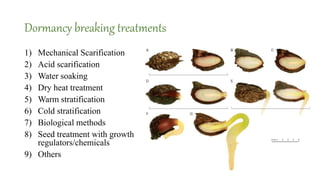
Dormancy breaking treatments
1) Mechanical Scarification
2) Acid scarification
3) Water soaking
4) Dry heat treatment
5) Warm stratification
6) Cold stratification
7) Biological methods
8) Seed treatment with growth
regulators/chemicals
9) Others
Mechanical Scarification
Used for large quantities of hard coated seeds
Concrete mixer with sharp gravel or sand, sand paper, crushed glass
etc
Care should be taken to avoid over treatment
Eg- Acacia nilotica
Albizzia lebbek
Cassia fistula
Delonix regia
Santalum album etc
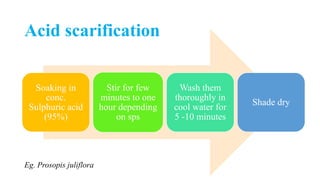
Acid scarification
Soaking in
conc.
Sulphuric acid
(95%)
Stir for few
minutes to one
hour depending
on sps
Wash them
thoroughly in
cool water for
5 -10 minutes
Shade dry
Eg. Prosopis juliflora
Dry heat treatment -
Spread the light inflammable litter over the fruits & ignite it
Adjusting heat of fire to achieve maximum effect on pericarp without embryo
damage
need experience
Tectona grandis – 45 to 50 degree Celsius showed 50% germination
Water soaking –
To soften hard seeds & to leach out chemical inhibitors
Soaking in cold water for few hours to several days – safe & simple treatment
for most of the small seeds – 2 to 48 hours (depending on species)
Eg. Acacia nilotica, Albizzia amara, Grevillea robusta etc
Soaking in boiling water – leguminous seeds, oak & chestnut (1/2 minute)
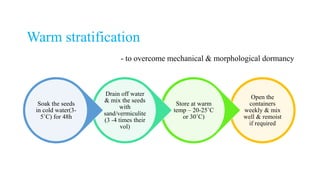
Warm stratification
Open the
containers
weekly & mix
well & remoist
if required
Store at warm
temp – 20-25˚C
or 30˚C)
Drain off water
& mix the seeds
with
sand/vermiculite
(3 -4 times their
vol)
Soak the seeds
in cold water(3-
5˚C) for 48h
- to overcome mechanical & morphological dormancy
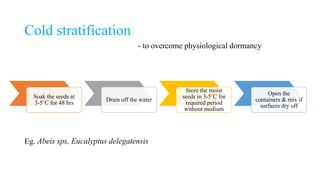
Cold stratification
Soak the seeds at
3-5˚C for 48 hrs
Drain off the water
Store the moist
seeds in 3-5˚C for
required period
without medium
Open the
containers & mix if
surfaces dry off
- to overcome physiological dormancy
Eg. Abeis sps, Eucalyptus delegatensis
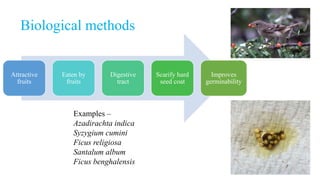
Biological methods
Attractive
fruits
Eaten by
fruits
Digestive
tract
Scarify hard
seed coat
Improves
germinability
Examples –
Azadirachta indica
Syzygium cumini
Ficus religiosa
Santalum album
Ficus benghalensis
Seed treatment with growth regulators/chemicals
• Endogenous dormancy (due to the presence of inhibitors) - apply growth regulators at the
low level to break dormancy
• GA & Cytokinin and kinetin – Conc.100-1000 ppm used to break dormancy
• KNO3 - 2% for breaking the dormancy of light requiring seeds. Eg. Oats, Barley and
Tomato
• Nitrogenous compounds like Thiourea, Hydroxylamine, Nitric acid, Nitrate can be used for
breaking dormancy - Thiourea for breaking dormancy for both light and chilling treatment
requiring seeds (e.g.) lettuce - thiourea @ 10-2 to 10-3 M is used
• Ethrel can be used for breaking the dormancy of cotton seed (due to the presence of ABA in
pericarp of seed)
• Sulfhydryl compounds like 2 mercapto ethanol and 2,3 dimercapto ethanol can also be used
• Plant products like strigol (root exudation from striga parasite host plant) can also be used
for breaking the seed dormancy
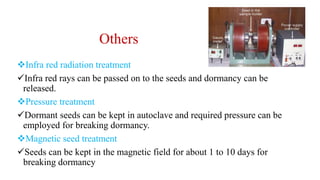
Others
Infra red radiation treatment
Infra red rays can be passed on to the seeds and dormancy can be
released.
Pressure treatment
Dormant seeds can be kept in autoclave and required pressure can be
employed for breaking dormancy.
Magnetic seed treatment
Seeds can be kept in the magnetic field for about 1 to 10 days for
breaking dormancy
• Infusion of bioactive chemicals into seed by
soaking them in nutrient solutions
• Soaking followed by shade drying
Seed infusion/fortification
• Infusion of bioactive chemicals into seed by
soaking them in organic solvents containing
dissolved nutrients
• Organic solvents get rapidly evaporated at room
temp
Dry permeation
• Involves 2-3 cycles of wetting – drying for specific
durations to impart resistance to seeds against
drought
• Chemicals (drought resistance) are dissolved in
water before soaking of seeds
Seed hardening
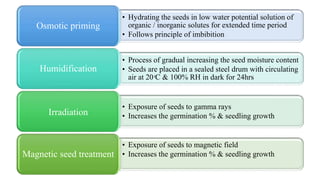
Germination augmenting treatments
• Hydrating the seeds in low water potential solution of
organic / inorganic solutes for extended time period
• Follows principle of imbibition
Osmotic priming
• Process of gradual increasing the seed moisture content
• Seeds are placed in a sealed steel drum with circulating
air at 20 ͦC & 100% RH in dark for 24hrs
Humidification
• Exposure of seeds to gamma rays
• Increases the germination % & seedling growth
Irradiation
• Exposure of seeds to magnetic field
• Increases the germination % & seedling growth
Magnetic seed treatment
Seed coating treatments
a) Seed pelleting – enclosing seed inside small quantity of inert
material – to facilitate precision planting
b) Seed coating – process of applying useful materials to form layer of
thin coating over seed without altering shape
c) Fluid drilling or gel seeding – germinating seed in aerated water
until radicle emergence & then mix in viscous gel followed by
sowing – prevents seedling injury & maintain seed moisture
d) Seed colouring – colouring using natural / artificial dyes to prevent
inadvertent use of treated seeds for food purposes
e) Biological seed coating – treating seeds with beneficial micro
organisms for sustained plant growth
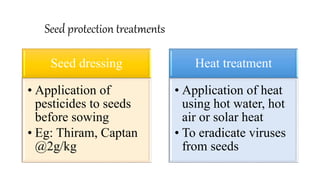
Seed protection treatments
Seed dressing
• Application of
pesticides to seeds
before sowing
• Eg: Thiram, Captan
@2g/kg
Heat treatment
• Application of heat
using hot water, hot
air or solar heat
• To eradicate viruses
from seeds
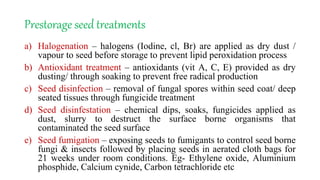
Prestorage seed treatments
a) Halogenation – halogens (Iodine, cl, Br) are applied as dry dust /
vapour to seed before storage to prevent lipid peroxidation process
b) Antioxidant treatment – antioxidants (vit A, C, E) provided as dry
dusting/ through soaking to prevent free radical production
c) Seed disinfection – removal of fungal spores within seed coat/ deep
seated tissues through fungicide treatment
d) Seed disinfestation – chemical dips, soaks, fungicides applied as
dust, slurry to destruct the surface borne organisms that
contaminated the seed surface
e) Seed fumigation – exposing seeds to fumigants to control seed borne
fungi & insects followed by placing seeds in aerated cloth bags for
21 weeks under room conditions. Eg- Ethylene oxide, Aluminium
phosphide, Calcium cynide, Carbon tetrachloride etc
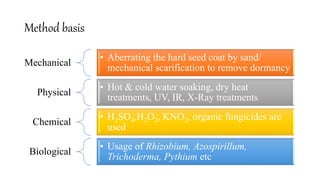
Method basis
Mechanical
• Aberrating the hard seed coat by sand/
mechanical scarification to remove dormancy
Physical
• Hot & cold water soaking, dry heat
treatments, UV, IR, X-Ray treatments
Chemical
• H2SO4,H2O2, KNO3, organic fungicides are
used
Biological
• Usage of Rhizobium, Azospirillum,
Trichoderma, Pythium etc
Seed treatment equipment's
 Seed pelletizer
 Seed coaters
 Seed treating drum
 Gustafson slurry treater
 Fumigation chamber
Thank you

Seed treatments.pptx

  • 1.
  • 2.
    Seed treatment • Refersto application of any treatment by chemical, physical or biological means • Purpose – To break the dormancy of seeds to alter / accelerate the germination To improve seedling growth to protect the seed from pest & disease during storage To tide over adverse conditions – seed hardening To improve storability of seeds
  • 3.
    Types of seedtreatments • Different types on 4 basis – Objective basis Time basis Method basis Type basis
  • 4.
    1) Objective basis •Breaking dormancy • Augmenting germination • Improving seedling growth • Improving storability through decelerating senescence, discouraging pests & diseases by disinfection, disinfestation & protection, direct application of nutrients & protectants to seed, seed colouring
  • 5.
    2) Time basis 1)Presowing seed treatment – a) dormancy breaking treatments b) germination augmenting treatments c) seed coating treatments d) seed protection treatments 2) Prestorage seed treatments – a) Halogenation b) Antioxidant treatment c) seed sanitation – disinfection, disinfestation d) seed fumigation 3) Method basis – a) Mechanical b) Physical c) Chemical d) Biological 4) Type basis – a) Dry b)Wet
  • 6.
    Dormancy breaking treatments 1)Mechanical Scarification 2) Acid scarification 3) Water soaking 4) Dry heat treatment 5) Warm stratification 6) Cold stratification 7) Biological methods 8) Seed treatment with growth regulators/chemicals 9) Others
  • 7.
    Mechanical Scarification Used forlarge quantities of hard coated seeds Concrete mixer with sharp gravel or sand, sand paper, crushed glass etc Care should be taken to avoid over treatment Eg- Acacia nilotica Albizzia lebbek Cassia fistula Delonix regia Santalum album etc
  • 8.
    Acid scarification Soaking in conc. Sulphuricacid (95%) Stir for few minutes to one hour depending on sps Wash them thoroughly in cool water for 5 -10 minutes Shade dry Eg. Prosopis juliflora
  • 9.
    Dry heat treatment- Spread the light inflammable litter over the fruits & ignite it Adjusting heat of fire to achieve maximum effect on pericarp without embryo damage need experience Tectona grandis – 45 to 50 degree Celsius showed 50% germination Water soaking – To soften hard seeds & to leach out chemical inhibitors Soaking in cold water for few hours to several days – safe & simple treatment for most of the small seeds – 2 to 48 hours (depending on species) Eg. Acacia nilotica, Albizzia amara, Grevillea robusta etc Soaking in boiling water – leguminous seeds, oak & chestnut (1/2 minute)
  • 10.
    Warm stratification Open the containers weekly& mix well & remoist if required Store at warm temp – 20-25˚C or 30˚C) Drain off water & mix the seeds with sand/vermiculite (3 -4 times their vol) Soak the seeds in cold water(3- 5˚C) for 48h - to overcome mechanical & morphological dormancy
  • 11.
    Cold stratification Soak theseeds at 3-5˚C for 48 hrs Drain off the water Store the moist seeds in 3-5˚C for required period without medium Open the containers & mix if surfaces dry off - to overcome physiological dormancy Eg. Abeis sps, Eucalyptus delegatensis
  • 12.
    Biological methods Attractive fruits Eaten by fruits Digestive tract Scarifyhard seed coat Improves germinability Examples – Azadirachta indica Syzygium cumini Ficus religiosa Santalum album Ficus benghalensis
  • 13.
    Seed treatment withgrowth regulators/chemicals • Endogenous dormancy (due to the presence of inhibitors) - apply growth regulators at the low level to break dormancy • GA & Cytokinin and kinetin – Conc.100-1000 ppm used to break dormancy • KNO3 - 2% for breaking the dormancy of light requiring seeds. Eg. Oats, Barley and Tomato • Nitrogenous compounds like Thiourea, Hydroxylamine, Nitric acid, Nitrate can be used for breaking dormancy - Thiourea for breaking dormancy for both light and chilling treatment requiring seeds (e.g.) lettuce - thiourea @ 10-2 to 10-3 M is used • Ethrel can be used for breaking the dormancy of cotton seed (due to the presence of ABA in pericarp of seed) • Sulfhydryl compounds like 2 mercapto ethanol and 2,3 dimercapto ethanol can also be used • Plant products like strigol (root exudation from striga parasite host plant) can also be used for breaking the seed dormancy
  • 14.
    Others Infra red radiationtreatment Infra red rays can be passed on to the seeds and dormancy can be released. Pressure treatment Dormant seeds can be kept in autoclave and required pressure can be employed for breaking dormancy. Magnetic seed treatment Seeds can be kept in the magnetic field for about 1 to 10 days for breaking dormancy
  • 15.
    • Infusion ofbioactive chemicals into seed by soaking them in nutrient solutions • Soaking followed by shade drying Seed infusion/fortification • Infusion of bioactive chemicals into seed by soaking them in organic solvents containing dissolved nutrients • Organic solvents get rapidly evaporated at room temp Dry permeation • Involves 2-3 cycles of wetting – drying for specific durations to impart resistance to seeds against drought • Chemicals (drought resistance) are dissolved in water before soaking of seeds Seed hardening Germination augmenting treatments
  • 16.
    • Hydrating theseeds in low water potential solution of organic / inorganic solutes for extended time period • Follows principle of imbibition Osmotic priming • Process of gradual increasing the seed moisture content • Seeds are placed in a sealed steel drum with circulating air at 20 ͦC & 100% RH in dark for 24hrs Humidification • Exposure of seeds to gamma rays • Increases the germination % & seedling growth Irradiation • Exposure of seeds to magnetic field • Increases the germination % & seedling growth Magnetic seed treatment
  • 17.
    Seed coating treatments a)Seed pelleting – enclosing seed inside small quantity of inert material – to facilitate precision planting b) Seed coating – process of applying useful materials to form layer of thin coating over seed without altering shape c) Fluid drilling or gel seeding – germinating seed in aerated water until radicle emergence & then mix in viscous gel followed by sowing – prevents seedling injury & maintain seed moisture d) Seed colouring – colouring using natural / artificial dyes to prevent inadvertent use of treated seeds for food purposes e) Biological seed coating – treating seeds with beneficial micro organisms for sustained plant growth
  • 18.
    Seed protection treatments Seeddressing • Application of pesticides to seeds before sowing • Eg: Thiram, Captan @2g/kg Heat treatment • Application of heat using hot water, hot air or solar heat • To eradicate viruses from seeds
  • 19.
    Prestorage seed treatments a)Halogenation – halogens (Iodine, cl, Br) are applied as dry dust / vapour to seed before storage to prevent lipid peroxidation process b) Antioxidant treatment – antioxidants (vit A, C, E) provided as dry dusting/ through soaking to prevent free radical production c) Seed disinfection – removal of fungal spores within seed coat/ deep seated tissues through fungicide treatment d) Seed disinfestation – chemical dips, soaks, fungicides applied as dust, slurry to destruct the surface borne organisms that contaminated the seed surface e) Seed fumigation – exposing seeds to fumigants to control seed borne fungi & insects followed by placing seeds in aerated cloth bags for 21 weeks under room conditions. Eg- Ethylene oxide, Aluminium phosphide, Calcium cynide, Carbon tetrachloride etc
  • 20.
    Method basis Mechanical • Aberratingthe hard seed coat by sand/ mechanical scarification to remove dormancy Physical • Hot & cold water soaking, dry heat treatments, UV, IR, X-Ray treatments Chemical • H2SO4,H2O2, KNO3, organic fungicides are used Biological • Usage of Rhizobium, Azospirillum, Trichoderma, Pythium etc
  • 21.
    Seed treatment equipment's Seed pelletizer  Seed coaters  Seed treating drum  Gustafson slurry treater  Fumigation chamber
  • 22.