SEED QUALITY ENHANCEMENT
K. VANANGAMUDI
vanangamudi.tnau@gmail.com
09894904745
WHY?
 Time from sowing to seedling establishment is
crucial
 Exposed to wide range of environmental stresses
 Harmful micro-organisms
 Destruction by seed, soil and air borne pathogens
 Damage by insects
 Cold, frost, temperature and moisture effects
 Monsoon failure, severe drought
 Problem soils, competition from weeds and toxic
effects of chemicals present in soil
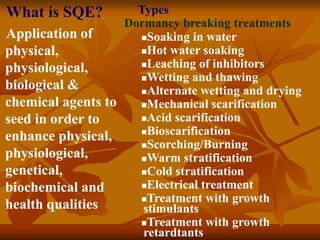
Dormancy breaking treatments
Soaking in water
Hot water soaking
Leaching of inhibitors
Wetting and thawing
Alternate wetting and drying
Mechanical scarification
Acid scarification
Bioscarification
Scorching/Burning
Warm stratification
Cold stratification
Electrical treatment
Treatment with growth
stimulants
Treatment with growth
retardtants
Types
What is SQE?
Application of
physical,
physiological,
biological &
chemical agents to
seed in order to
enhance physical,
physiological,
genetical,
biochemical and
health qualities
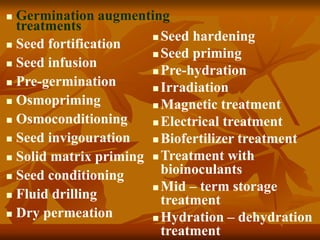
 Germination augmenting
treatments
 Seed fortification
 Seed infusion
 Pre-germination
 Osmopriming
 Osmoconditioning
 Seed invigouration
 Solid matrix priming
 Seed conditioning
 Fluid drilling
 Dry permeation
 Seed hardening
 Seed priming
 Pre-hydration
 Irradiation
 Magnetic treatment
 Electrical treatment
 Biofertilizer treatment
 Treatment with
bioinoculants
 Mid – term storage
treatment
 Hydration – dehydration
treatment
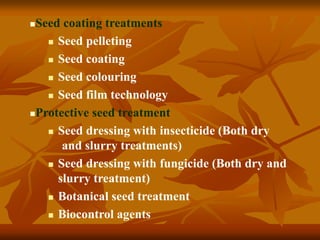
Seed coating treatments
 Seed pelleting
 Seed coating
 Seed colouring
 Seed film technology
Protective seed treatment
 Seed dressing with insecticide (Both dry
and slurry treatments)
 Seed dressing with fungicide (Both dry and
slurry treatment)
 Botanical seed treatment
 Biocontrol agents
SEED HARDENING
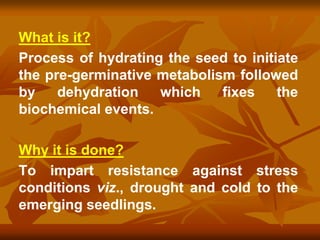
What is it?
Process of hydrating the seed to initiate
the pre-germinative metabolism followed
by dehydration which fixes the
biochemical events.
Why it is done?
To impart resistance against stress
conditions viz., drought and cold to the
emerging seedlings.
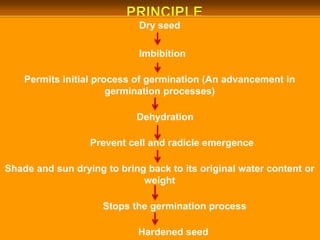
Dry seed
Imbibition
Permits initial process of germination (An advancement in
germination processes)
Dehydration
Prevent cell and radicle emergence
Shade and sun drying to bring back to its original water content or
weight
Stops the germination process
Hardened seed
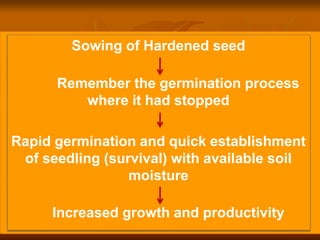
Sowing of Hardened seed
Remember the germination process
where it had stopped
Rapid germination and quick establishment
of seedling (survival) with available soil
moisture
Increased growth and productivity
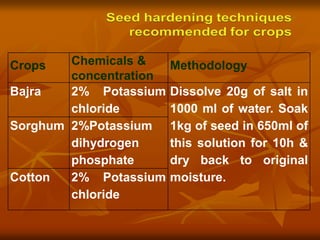
Crops Chemicals &
concentration
Methodology
Bajra 2% Potassium
chloride
Dissolve 20g of salt in
1000 ml of water. Soak
1kg of seed in 650ml of
this solution for 10h &
dry back to original
moisture.
Sorghum 2%Potassium
dihydrogen
phosphate
Cotton 2% Potassium
chloride
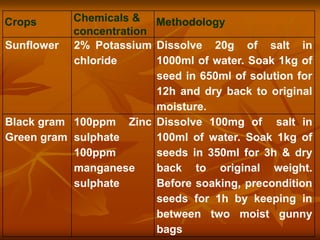
Crops Chemicals &
concentration
Methodology
Sunflower 2% Potassium
chloride
Dissolve 20g of salt in
1000ml of water. Soak 1kg of
seed in 650ml of solution for
12h and dry back to original
moisture.
Black gram
Green gram
100ppm Zinc
sulphate
100ppm
manganese
sulphate
Dissolve 100mg of salt in
100ml of water. Soak 1kg of
seeds in 350ml for 3h & dry
back to original weight.
Before soaking, precondition
seeds for 1h by keeping in
between two moist gunny
bags
FLUID DRILLING
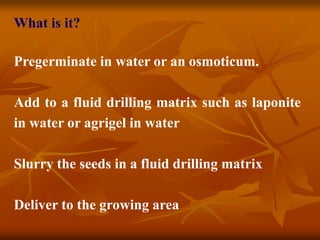
What is it?
Pregerminate in water or an osmoticum.
Add to a fluid drilling matrix such as laponite
in water or agrigel in water
Slurry the seeds in a fluid drilling matrix
Deliver to the growing area
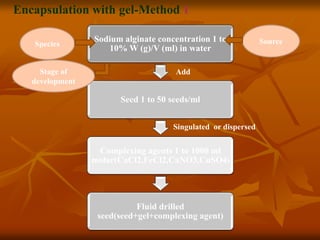
Encapsulation with gel-Method 1
Sodium alginate concentration 1 to
10% W (g)/V (ml) in water
Seed 1 to 50 seeds/ml
Complexing agents 1 to 1000 ml
molar(CaCl2,FeCl2,CaNO3,CuSO4)
Fluid drilled
seed(seed+gel+complexing agent)
Species Source
Stage of
development
Add
Singulated or dispersed
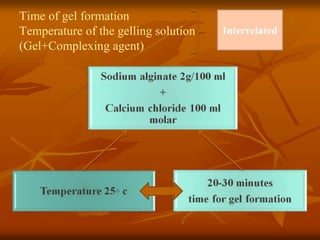
Time of gel formation
Temperature of the gelling solution
(Gel+Complexing agent)
Interrelated
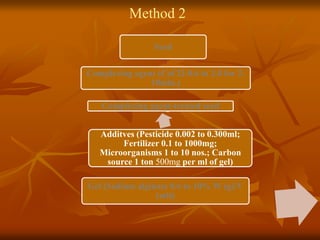
Method 2
Seed
Complexing agent (CaCl2-0.6 to 2.0 for 2-
10min.)
Additves (Pesticide 0.002 to 0.300ml;
Fertilizer 0.1 to 1000mg;
Microorganisms 1 to 10 nos.; Carbon
source 1 ton 500mg per ml of gel)
Complexing agent-treated seed
Gel (Sodium alginate 0.6 to 10% W (g)/V
(ml))
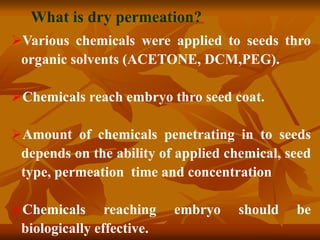
DRY PERMEATION
Various chemicals were applied to seeds thro
organic solvents (ACETONE, DCM,PEG).
Chemicals reach embryo thro seed coat.
Amount of chemicals penetrating in to seeds
depends on the ability of applied chemical, seed
type, permeation time and concentration
Chemicals reaching embryo should be
biologically effective.
What is dry permeation?
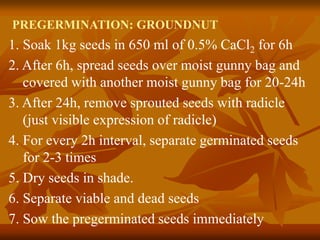
PREGERMINATION
PREGERMINATION: GROUNDNUT
1. Soak 1kg seeds in 650 ml of 0.5% CaCl2 for 6h
2. After 6h, spread seeds over moist gunny bag and
covered with another moist gunny bag for 20-24h
3. After 24h, remove sprouted seeds with radicle
(just visible expression of radicle)
4. For every 2h interval, separate germinated seeds
for 2-3 times
5. Dry seeds in shade.
6. Separate viable and dead seeds
7. Sow the pregerminated seeds immediately
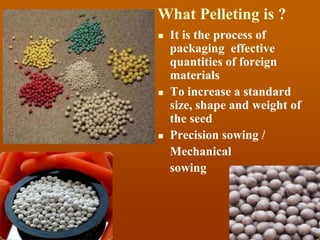
What Pelleting is ?
 It is the process of
packaging effective
quantities of foreign
materials
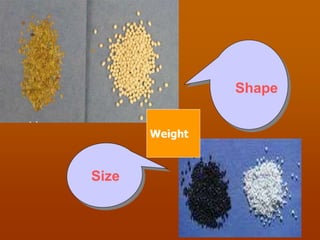
 To increase a standard
size, shape and weight of
the seed
 Precision sowing /
Mechanical
sowing
Size
Shape
Weight
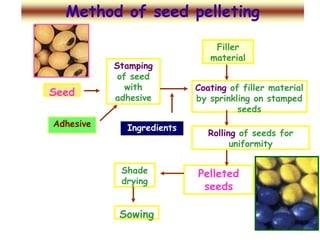
Filler
material
Seed
Stamping
of seed
with
adhesive
Coating of filler material
by sprinkling on stamped
seeds
Adhesive
Shade
drying
Pelleted
seeds
Sowing
Rolling of seeds for
uniformity
Ingredients
Method of seed pelleting
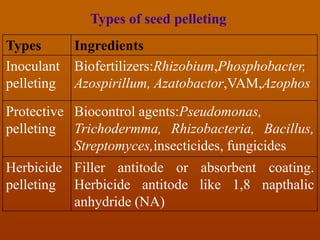
Types Ingredients
Inoculant
pelleting
Biofertilizers:Rhizobium,Phosphobacter,
Azospirillum, Azatobactor,VAM,Azophos
Protective
pelleting
Biocontrol agents:Pseudomonas,
Trichodermma, Rhizobacteria, Bacillus,
Streptomyces,insecticides, fungicides
Herbicide
pelleting
Filler antitode or absorbent coating.
Herbicide antitode like 1,8 napthalic
anhydride (NA)
Types of seed pelleting
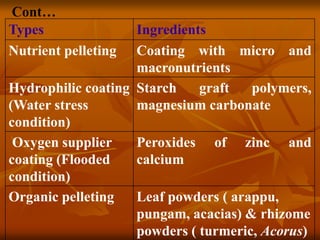
Types Ingredients
Nutrient pelleting Coating with micro and
macronutrients
Hydrophilic coating
(Water stress
condition)
Starch graft polymers,
magnesium carbonate
Oxygen supplier
coating (Flooded
condition)
Peroxides of zinc and
calcium
Organic pelleting Leaf powders ( arappu,
pungam, acacias) & rhizome
powders ( turmeric, Acorus)
Cont…
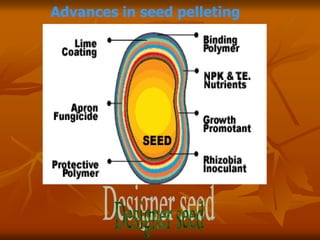
Advances in seed pelleting
SEED FILM COATING
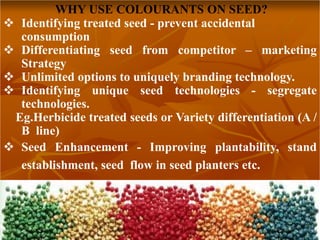
WHY USE COLOURANTS ON SEED?
 Identifying treated seed - prevent accidental
consumption
 Differentiating seed from competitor – marketing
Strategy
 Unlimited options to uniquely branding technology.
 Identifying unique seed technologies - segregate
technologies.
Eg.Herbicide treated seeds or Variety differentiation (A /
B line)
 Seed Enhancement - Improving plantability, stand
establishment, seed flow in seed planters etc.
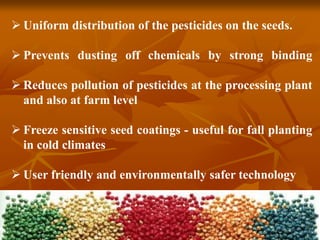
 Uniform distribution of the pesticides on the seeds.
 Prevents dusting off chemicals by strong binding
 Reduces pollution of pesticides at the processing plant
and also at farm level
 Freeze sensitive seed coatings - useful for fall planting
in cold climates
 User friendly and environmentally safer technology
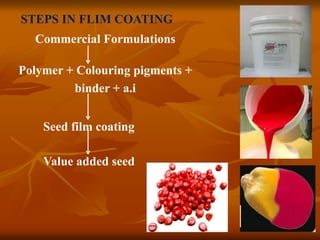
Commercial Formulations
Polymer + Colouring pigments +
binder + a.i
Seed film coating
Value added seed
STEPS IN FLIM COATING
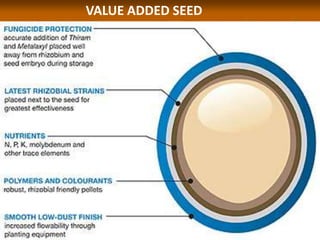
VALUE ADDED SEED
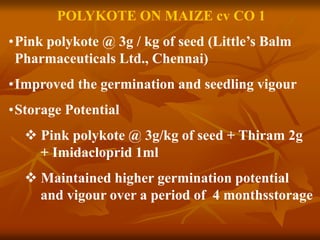
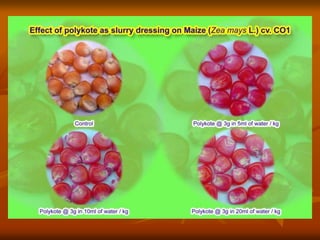
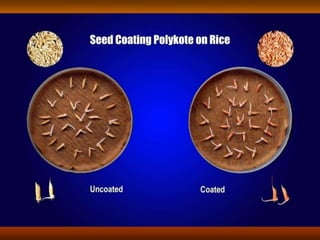
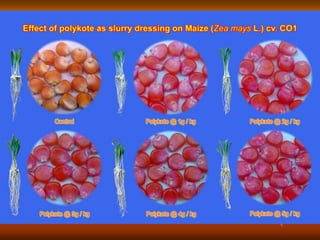
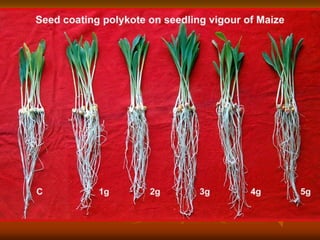
POLYKOTE ON MAIZE cv CO 1
•Pink polykote @ 3g / kg of seed (Little’s Balm
Pharmaceuticals Ltd., Chennai)
•Improved the germination and seedling vigour
•Storage Potential
 Pink polykote @ 3g/kg of seed + Thiram 2g
+ Imidacloprid 1ml
 Maintained higher germination potential
and vigour over a period of 4 monthsstorage
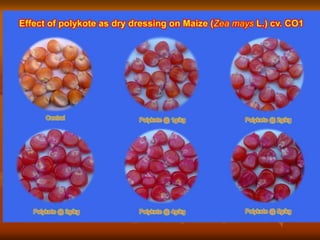
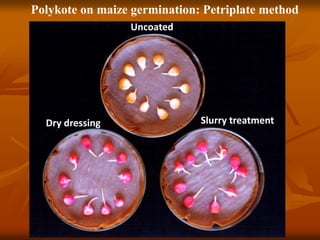
Polykote on maize germination: Petriplate method
Uncoated
Dry dressing Slurry treatment
Uncoated
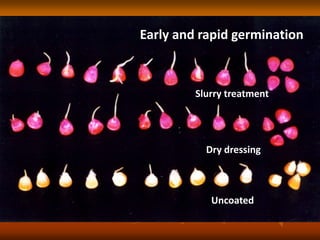
Dry dressing
Slurry treatment
Early and rapid germination
Uncoated
Slurry treatment
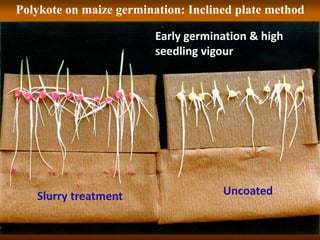
Polykote on maize germination: Inclined plate method
Early germination & high
seedling vigour
Seed Priming
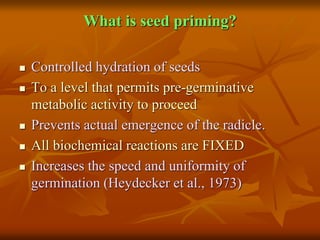
What is seed priming?
 Controlled hydration of seeds
 To a level that permits pre-germinative
metabolic activity to proceed
 Prevents actual emergence of the radicle.
 All biochemical reactions are FIXED
 Increases the speed and uniformity of
germination (Heydecker et al., 1973)
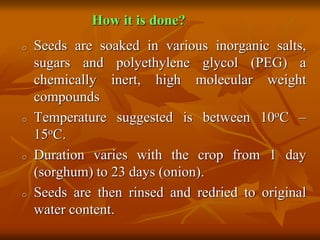
How it is done?
o Seeds are soaked in various inorganic salts,
sugars and polyethylene glycol (PEG) a
chemically inert, high molecular weight
compounds
o Temperature suggested is between 10oC –
15oC.
o Duration varies with the crop from 1 day
(sorghum) to 23 days (onion).
o Seeds are then rinsed and redried to original
water content.
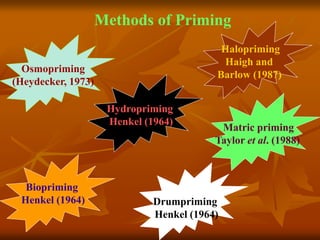
Methods of Priming
Hydropriming
Henkel (1964)
Osmopriming
(Heydecker, 1973)
Matric priming
Taylor et al. (1988)
Halopriming
Haigh and
Barlow (1987)
Drumpriming
Henkel (1964)
Biopriming
Henkel (1964)
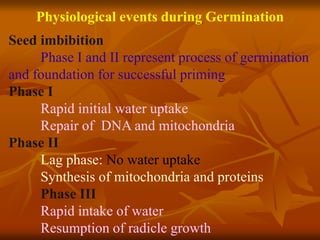
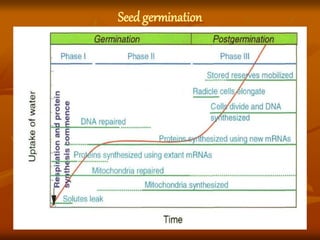
Physiological events during Germination
Seed imbibition
Phase I and II represent process of germination
and foundation for successful priming
Phase I
Rapid initial water uptake
Repair of DNA and mitochondria
Phase II
Lag phase: No water uptake
Synthesis of mitochondria and proteins
Phase III
Rapid intake of water
Resumption of radicle growth
Seedgermination
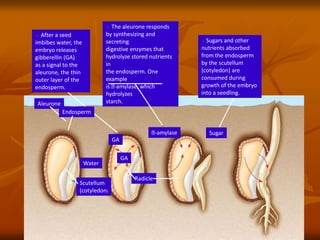
2 The aleurone responds
by synthesizing and
secreting
digestive enzymes that
hydrolyze stored nutrients
in
the endosperm. One
example
is -amylase, which
hydrolyzes
starch.
Aleurone
Endosperm
Water
Scutellum
(cotyledon)
GA
GA
-amylase
Radicle
Sugar
1 After a seed
imbibes water, the
embryo releases
gibberellin (GA)
as a signal to the
aleurone, the thin
outer layer of the
endosperm.
3 Sugars and other
nutrients absorbed
from the endosperm
by the scutellum
(cotyledon) are
consumed during
growth of the embryo
into a seedling.
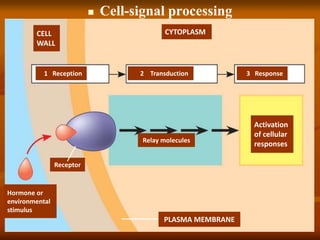
 Cell-signal processing
CELL
WALL
CYTOPLASM
1 Reception 2 Transduction 3 Response
Receptor
Relay molecules
Activation
of cellular
responses
Hormone or
environmental
stimulus
PLASMA MEMBRANE
1 Reception 2 Transduction 3 Response
CYTOPLASM
PLASMA
MEMBRANE
Phytochrome
activated
by light
Cell
wall
Light
cGMP
Second messenger
produced
Specific
protein
kinase 1
activated
Transcription
factor 1 NUCLEUS
P
P
Transcription
Translation
De-etiolation
(greening)
response
proteins
Ca2+
Ca2+ channel
opened
Specific
protein
kinase 2
activated
Transcription
factor 2
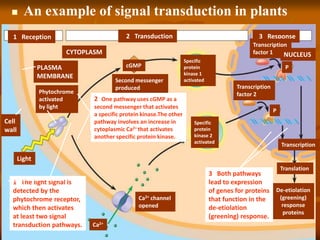
 An example of signal transduction in plants
1 The light signal is
detected by the
phytochrome receptor,
which then activates
at least two signal
transduction pathways.
2 One pathway uses cGMP as a
second messenger that activates
a specific protein kinase.The other
pathway involves an increase in
cytoplasmic Ca2+ that activates
another specific protein kinase.
3 Both pathways
lead to expression
of genes for proteins
that function in the
de-etiolation
(greening) response.
Expansin
CELL WALL
Cell wall
enzymes
Cross-linking
cell wall
polysaccharides
Microfibril
H+ H+
H+
H+
H+
H+
H+
H+
H+
ATP
PLASMA MEMBRANE
Plasma
membrane
Cell
wall
Nucleus
Vacuole
Cytoplasm
H2O
CYTOPLASM
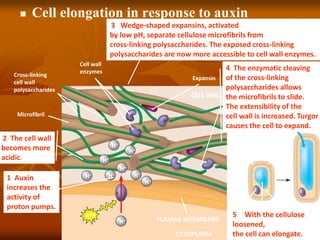
 Cell elongation in response to auxin
1 Auxin
increases the
activity of
proton pumps.
4 The enzymatic cleaving
of the cross-linking
polysaccharides allows
the microfibrils to slide.
The extensibility of the
cell wall is increased. Turgor
causes the cell to expand.
2 The cell wall
becomes more
acidic.
5 With the cellulose
loosened,
the cell can elongate.
3 Wedge-shaped expansins, activated
by low pH, separate cellulose microfibrils from
cross-linking polysaccharides. The exposed cross-linking
polysaccharides are now more accessible to cell wall enzymes.
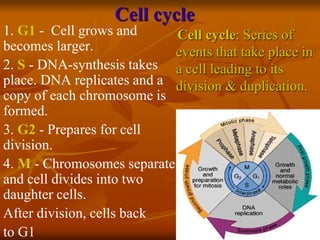
Cell cycle
1. G1 - Cell grows and
becomes larger.
2. S - DNA-synthesis takes
place. DNA replicates and a
copy of each chromosome is
formed.
3. G2 - Prepares for cell
division.
4. M - Chromosomes separate
and cell divides into two
daughter cells.
After division, cells back
to G1
Cell cycle: Series of
events that take place in
a cell leading to its
division & duplication.
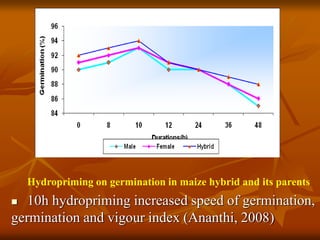
Hydropriming on germination in maize hybrid and its parents
 10h hydropriming increased speed of germination,
germination and vigour index (Ananthi, 2008)
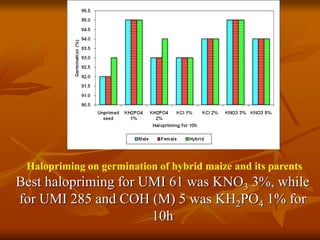
Halopriming on germination of hybrid maize and its parents
Best halopriming for UMI 61 was KNO3 3%, while
for UMI 285 and COH (M) 5 was KH2PO4 1% for
10h
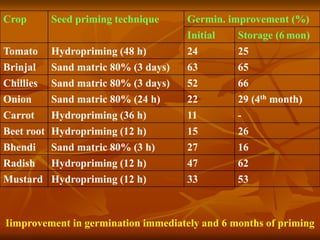
Crop Seed priming technique Germin. improvement (%)
Initial Storage (6 mon)
Tomato Hydropriming (48 h) 24 25
Brinjal Sand matric 80% (3 days) 63 65
Chillies Sand matric 80% (3 days) 52 66
Onion Sand matric 80% (24 h) 22 29 (4th month)
Carrot Hydropriming (36 h) 11 -
Beet root Hydropriming (12 h) 15 26
Bhendi Sand matric 80% (3 h) 27 16
Radish Hydropriming (12 h) 47 62
Mustard Hydropriming (12 h) 33 53
Iimprovement in germination immediately and 6 months of priming
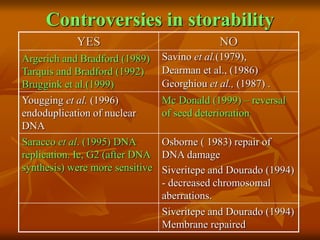
Controversies in storability
YES NO
Argerich and Bradford (1989)
Tarquis and Bradford (1992)
Bruggink et al.(1999)
Savino et al.(1979),
Dearman et al., (1986)
Georghiou et al., (1987) .
Yougging et al. (1996)
endoduplication of nuclear
DNA
Mc Donald (1999) – reversal
of seed deterioration
Saracco et al. (1995) DNA
replication. Ie, G2 (after DNA
synthesis) were more sensitive
Osborne ( 1983) repair of
DNA damage
Siveritepe and Dourado (1994)
- decreased chromosomal
aberrations.
Siveritepe and Dourado (1994)
Membrane repaired
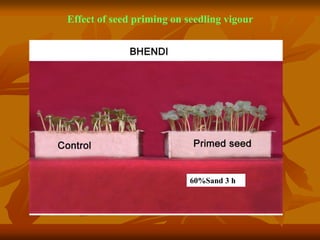
Effect of seed priming on seedling vigour
60%Sand 3 h
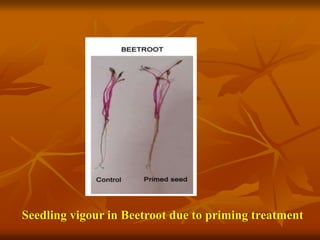
Seedling vigour in Beetroot due to priming treatment
Biopriming
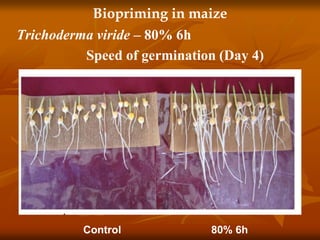
Biopriming in maize
Trichoderma viride – 80% 6h
Speed of germination (Day 4)
Control 80% 6h
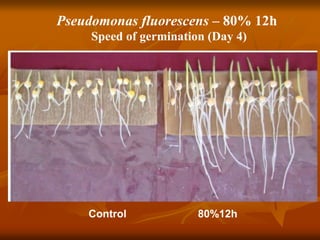
Pseudomonas fluorescens – 80% 12h
Speed of germination (Day 4)
Control 80%12h
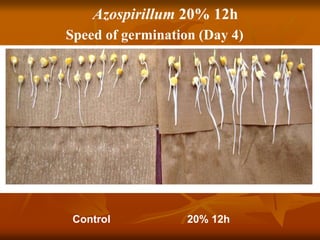
Azospirillum 20% 12h
Speed of germination (Day 4)
Control 20% 12h
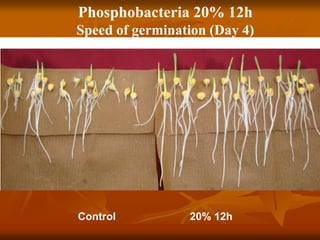
Phosphobacteria 20% 12h
Speed of germination (Day 4)
Control 20% 12h
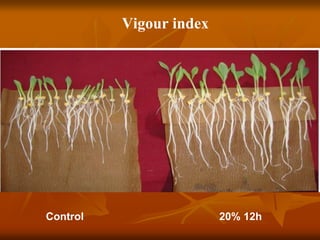
Vigour index
Control 20% 12h
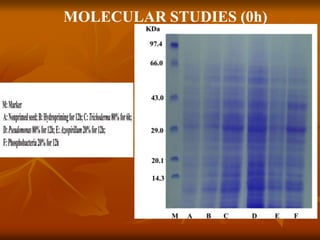
MOLECULAR STUDIES (0h)
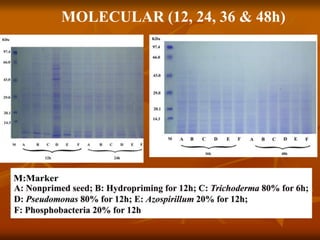
MOLECULAR (12, 24, 36 & 48h)
ANATOMICAL STUDIES
Control P.f 80% 12h
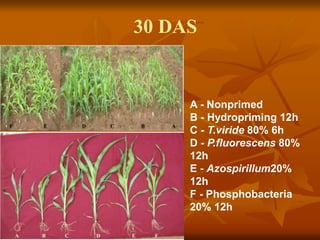
30 DAS
A - Nonprimed
B - Hydropriming 12h
C - T.viride 80% 6h
D - P.fluorescens 80%
12h
E - Azospirillum20%
12h
F - Phosphobacteria
20% 12h
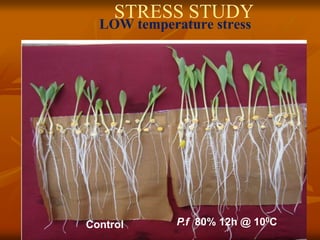
STRESS STUDY
LOW temperature stress
Control P.f 80% 12h @ 100C
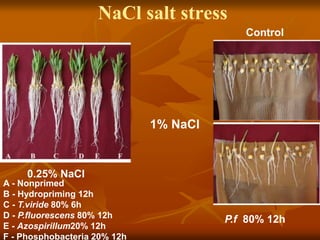
NaCl salt stress
Control
P.f 80% 12h
0.25% NaCl
1% NaCl
A - Nonprimed
B - Hydropriming 12h
C - T.viride 80% 6h
D - P.fluorescens 80% 12h
E - Azospirillum20% 12h
F - Phosphobacteria 20% 12h
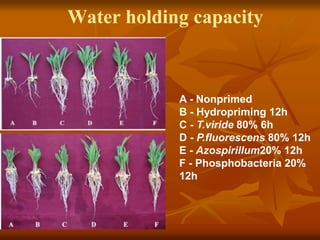
Water holding capacity
A - Nonprimed
B - Hydropriming 12h
C - T.viride 80% 6h
D - P.fluorescens 80% 12h
E - Azospirillum20% 12h
F - Phosphobacteria 20%
12h
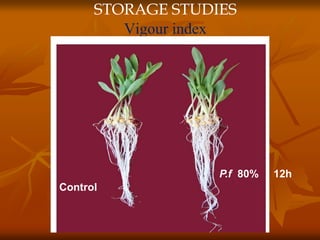
STORAGE STUDIES
Vigour index
Control
P.f 80% 12h
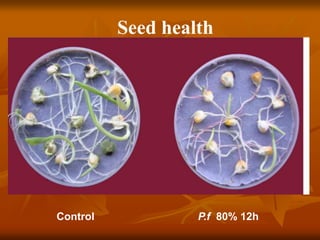
Seed health
Control P.f 80% 12h
Seed Quality Enhancement

Seed Quality Enhancement

  • 1.
    SEED QUALITY ENHANCEMENT K.VANANGAMUDI vanangamudi.tnau@gmail.com 09894904745
  • 2.
    WHY?  Time fromsowing to seedling establishment is crucial  Exposed to wide range of environmental stresses  Harmful micro-organisms  Destruction by seed, soil and air borne pathogens  Damage by insects  Cold, frost, temperature and moisture effects  Monsoon failure, severe drought  Problem soils, competition from weeds and toxic effects of chemicals present in soil
  • 3.
    Dormancy breaking treatments Soakingin water Hot water soaking Leaching of inhibitors Wetting and thawing Alternate wetting and drying Mechanical scarification Acid scarification Bioscarification Scorching/Burning Warm stratification Cold stratification Electrical treatment Treatment with growth stimulants Treatment with growth retardtants Types What is SQE? Application of physical, physiological, biological & chemical agents to seed in order to enhance physical, physiological, genetical, biochemical and health qualities
  • 4.
     Germination augmenting treatments Seed fortification  Seed infusion  Pre-germination  Osmopriming  Osmoconditioning  Seed invigouration  Solid matrix priming  Seed conditioning  Fluid drilling  Dry permeation  Seed hardening  Seed priming  Pre-hydration  Irradiation  Magnetic treatment  Electrical treatment  Biofertilizer treatment  Treatment with bioinoculants  Mid – term storage treatment  Hydration – dehydration treatment
  • 5.
    Seed coating treatments Seed pelleting  Seed coating  Seed colouring  Seed film technology Protective seed treatment  Seed dressing with insecticide (Both dry and slurry treatments)  Seed dressing with fungicide (Both dry and slurry treatment)  Botanical seed treatment  Biocontrol agents
  • 6.
  • 7.
    What is it? Processof hydrating the seed to initiate the pre-germinative metabolism followed by dehydration which fixes the biochemical events. Why it is done? To impart resistance against stress conditions viz., drought and cold to the emerging seedlings.
  • 8.
    Dry seed Imbibition Permits initialprocess of germination (An advancement in germination processes) Dehydration Prevent cell and radicle emergence Shade and sun drying to bring back to its original water content or weight Stops the germination process Hardened seed
  • 9.
    Sowing of Hardenedseed Remember the germination process where it had stopped Rapid germination and quick establishment of seedling (survival) with available soil moisture Increased growth and productivity
  • 10.
    Crops Chemicals & concentration Methodology Bajra2% Potassium chloride Dissolve 20g of salt in 1000 ml of water. Soak 1kg of seed in 650ml of this solution for 10h & dry back to original moisture. Sorghum 2%Potassium dihydrogen phosphate Cotton 2% Potassium chloride
  • 11.
    Crops Chemicals & concentration Methodology Sunflower2% Potassium chloride Dissolve 20g of salt in 1000ml of water. Soak 1kg of seed in 650ml of solution for 12h and dry back to original moisture. Black gram Green gram 100ppm Zinc sulphate 100ppm manganese sulphate Dissolve 100mg of salt in 100ml of water. Soak 1kg of seeds in 350ml for 3h & dry back to original weight. Before soaking, precondition seeds for 1h by keeping in between two moist gunny bags
  • 12.
  • 13.
    What is it? Pregerminatein water or an osmoticum. Add to a fluid drilling matrix such as laponite in water or agrigel in water Slurry the seeds in a fluid drilling matrix Deliver to the growing area
  • 14.
    Encapsulation with gel-Method1 Sodium alginate concentration 1 to 10% W (g)/V (ml) in water Seed 1 to 50 seeds/ml Complexing agents 1 to 1000 ml molar(CaCl2,FeCl2,CaNO3,CuSO4) Fluid drilled seed(seed+gel+complexing agent) Species Source Stage of development Add Singulated or dispersed
  • 15.
    Time of gelformation Temperature of the gelling solution (Gel+Complexing agent) Interrelated
  • 16.
    Method 2 Seed Complexing agent(CaCl2-0.6 to 2.0 for 2- 10min.) Additves (Pesticide 0.002 to 0.300ml; Fertilizer 0.1 to 1000mg; Microorganisms 1 to 10 nos.; Carbon source 1 ton 500mg per ml of gel) Complexing agent-treated seed Gel (Sodium alginate 0.6 to 10% W (g)/V (ml))
  • 17.
  • 18.
    Various chemicals wereapplied to seeds thro organic solvents (ACETONE, DCM,PEG). Chemicals reach embryo thro seed coat. Amount of chemicals penetrating in to seeds depends on the ability of applied chemical, seed type, permeation time and concentration Chemicals reaching embryo should be biologically effective. What is dry permeation?
  • 19.
  • 20.
    PREGERMINATION: GROUNDNUT 1. Soak1kg seeds in 650 ml of 0.5% CaCl2 for 6h 2. After 6h, spread seeds over moist gunny bag and covered with another moist gunny bag for 20-24h 3. After 24h, remove sprouted seeds with radicle (just visible expression of radicle) 4. For every 2h interval, separate germinated seeds for 2-3 times 5. Dry seeds in shade. 6. Separate viable and dead seeds 7. Sow the pregerminated seeds immediately
  • 22.
    What Pelleting is?  It is the process of packaging effective quantities of foreign materials  To increase a standard size, shape and weight of the seed  Precision sowing / Mechanical sowing
  • 23.
  • 24.
    Filler material Seed Stamping of seed with adhesive Coating offiller material by sprinkling on stamped seeds Adhesive Shade drying Pelleted seeds Sowing Rolling of seeds for uniformity Ingredients Method of seed pelleting
  • 25.
    Types Ingredients Inoculant pelleting Biofertilizers:Rhizobium,Phosphobacter, Azospirillum, Azatobactor,VAM,Azophos Protective pelleting Biocontrolagents:Pseudomonas, Trichodermma, Rhizobacteria, Bacillus, Streptomyces,insecticides, fungicides Herbicide pelleting Filler antitode or absorbent coating. Herbicide antitode like 1,8 napthalic anhydride (NA) Types of seed pelleting
  • 26.
    Types Ingredients Nutrient pelletingCoating with micro and macronutrients Hydrophilic coating (Water stress condition) Starch graft polymers, magnesium carbonate Oxygen supplier coating (Flooded condition) Peroxides of zinc and calcium Organic pelleting Leaf powders ( arappu, pungam, acacias) & rhizome powders ( turmeric, Acorus) Cont…
  • 27.
  • 28.
  • 29.
    WHY USE COLOURANTSON SEED?  Identifying treated seed - prevent accidental consumption  Differentiating seed from competitor – marketing Strategy  Unlimited options to uniquely branding technology.  Identifying unique seed technologies - segregate technologies. Eg.Herbicide treated seeds or Variety differentiation (A / B line)  Seed Enhancement - Improving plantability, stand establishment, seed flow in seed planters etc.
  • 30.
     Uniform distributionof the pesticides on the seeds.  Prevents dusting off chemicals by strong binding  Reduces pollution of pesticides at the processing plant and also at farm level  Freeze sensitive seed coatings - useful for fall planting in cold climates  User friendly and environmentally safer technology
  • 31.
    Commercial Formulations Polymer +Colouring pigments + binder + a.i Seed film coating Value added seed STEPS IN FLIM COATING
  • 32.
  • 33.
    POLYKOTE ON MAIZEcv CO 1 •Pink polykote @ 3g / kg of seed (Little’s Balm Pharmaceuticals Ltd., Chennai) •Improved the germination and seedling vigour •Storage Potential  Pink polykote @ 3g/kg of seed + Thiram 2g + Imidacloprid 1ml  Maintained higher germination potential and vigour over a period of 4 monthsstorage
  • 38.
    Polykote on maizegermination: Petriplate method Uncoated Dry dressing Slurry treatment
  • 39.
  • 40.
    Uncoated Slurry treatment Polykote onmaize germination: Inclined plate method Early germination & high seedling vigour
  • 42.
  • 43.
    What is seedpriming?  Controlled hydration of seeds  To a level that permits pre-germinative metabolic activity to proceed  Prevents actual emergence of the radicle.  All biochemical reactions are FIXED  Increases the speed and uniformity of germination (Heydecker et al., 1973)
  • 44.
    How it isdone? o Seeds are soaked in various inorganic salts, sugars and polyethylene glycol (PEG) a chemically inert, high molecular weight compounds o Temperature suggested is between 10oC – 15oC. o Duration varies with the crop from 1 day (sorghum) to 23 days (onion). o Seeds are then rinsed and redried to original water content.
  • 45.
    Methods of Priming Hydropriming Henkel(1964) Osmopriming (Heydecker, 1973) Matric priming Taylor et al. (1988) Halopriming Haigh and Barlow (1987) Drumpriming Henkel (1964) Biopriming Henkel (1964)
  • 46.
    Physiological events duringGermination Seed imbibition Phase I and II represent process of germination and foundation for successful priming Phase I Rapid initial water uptake Repair of DNA and mitochondria Phase II Lag phase: No water uptake Synthesis of mitochondria and proteins Phase III Rapid intake of water Resumption of radicle growth
  • 47.
  • 48.
    2 The aleuroneresponds by synthesizing and secreting digestive enzymes that hydrolyze stored nutrients in the endosperm. One example is -amylase, which hydrolyzes starch. Aleurone Endosperm Water Scutellum (cotyledon) GA GA -amylase Radicle Sugar 1 After a seed imbibes water, the embryo releases gibberellin (GA) as a signal to the aleurone, the thin outer layer of the endosperm. 3 Sugars and other nutrients absorbed from the endosperm by the scutellum (cotyledon) are consumed during growth of the embryo into a seedling.
  • 50.
     Cell-signal processing CELL WALL CYTOPLASM 1Reception 2 Transduction 3 Response Receptor Relay molecules Activation of cellular responses Hormone or environmental stimulus PLASMA MEMBRANE
  • 51.
    1 Reception 2Transduction 3 Response CYTOPLASM PLASMA MEMBRANE Phytochrome activated by light Cell wall Light cGMP Second messenger produced Specific protein kinase 1 activated Transcription factor 1 NUCLEUS P P Transcription Translation De-etiolation (greening) response proteins Ca2+ Ca2+ channel opened Specific protein kinase 2 activated Transcription factor 2  An example of signal transduction in plants 1 The light signal is detected by the phytochrome receptor, which then activates at least two signal transduction pathways. 2 One pathway uses cGMP as a second messenger that activates a specific protein kinase.The other pathway involves an increase in cytoplasmic Ca2+ that activates another specific protein kinase. 3 Both pathways lead to expression of genes for proteins that function in the de-etiolation (greening) response.
  • 52.
    Expansin CELL WALL Cell wall enzymes Cross-linking cellwall polysaccharides Microfibril H+ H+ H+ H+ H+ H+ H+ H+ H+ ATP PLASMA MEMBRANE Plasma membrane Cell wall Nucleus Vacuole Cytoplasm H2O CYTOPLASM  Cell elongation in response to auxin 1 Auxin increases the activity of proton pumps. 4 The enzymatic cleaving of the cross-linking polysaccharides allows the microfibrils to slide. The extensibility of the cell wall is increased. Turgor causes the cell to expand. 2 The cell wall becomes more acidic. 5 With the cellulose loosened, the cell can elongate. 3 Wedge-shaped expansins, activated by low pH, separate cellulose microfibrils from cross-linking polysaccharides. The exposed cross-linking polysaccharides are now more accessible to cell wall enzymes.
  • 53.
    Cell cycle 1. G1- Cell grows and becomes larger. 2. S - DNA-synthesis takes place. DNA replicates and a copy of each chromosome is formed. 3. G2 - Prepares for cell division. 4. M - Chromosomes separate and cell divides into two daughter cells. After division, cells back to G1 Cell cycle: Series of events that take place in a cell leading to its division & duplication.
  • 54.
    Hydropriming on germinationin maize hybrid and its parents  10h hydropriming increased speed of germination, germination and vigour index (Ananthi, 2008)
  • 55.
    Halopriming on germinationof hybrid maize and its parents Best halopriming for UMI 61 was KNO3 3%, while for UMI 285 and COH (M) 5 was KH2PO4 1% for 10h
  • 56.
    Crop Seed primingtechnique Germin. improvement (%) Initial Storage (6 mon) Tomato Hydropriming (48 h) 24 25 Brinjal Sand matric 80% (3 days) 63 65 Chillies Sand matric 80% (3 days) 52 66 Onion Sand matric 80% (24 h) 22 29 (4th month) Carrot Hydropriming (36 h) 11 - Beet root Hydropriming (12 h) 15 26 Bhendi Sand matric 80% (3 h) 27 16 Radish Hydropriming (12 h) 47 62 Mustard Hydropriming (12 h) 33 53 Iimprovement in germination immediately and 6 months of priming
  • 57.
    Controversies in storability YESNO Argerich and Bradford (1989) Tarquis and Bradford (1992) Bruggink et al.(1999) Savino et al.(1979), Dearman et al., (1986) Georghiou et al., (1987) . Yougging et al. (1996) endoduplication of nuclear DNA Mc Donald (1999) – reversal of seed deterioration Saracco et al. (1995) DNA replication. Ie, G2 (after DNA synthesis) were more sensitive Osborne ( 1983) repair of DNA damage Siveritepe and Dourado (1994) - decreased chromosomal aberrations. Siveritepe and Dourado (1994) Membrane repaired
  • 58.
    Effect of seedpriming on seedling vigour 60%Sand 3 h
  • 59.
    Seedling vigour inBeetroot due to priming treatment
  • 60.
  • 61.
    Biopriming in maize Trichodermaviride – 80% 6h Speed of germination (Day 4) Control 80% 6h
  • 62.
    Pseudomonas fluorescens –80% 12h Speed of germination (Day 4) Control 80%12h
  • 63.
    Azospirillum 20% 12h Speedof germination (Day 4) Control 20% 12h
  • 64.
    Phosphobacteria 20% 12h Speedof germination (Day 4) Control 20% 12h
  • 65.
  • 66.
  • 67.
  • 68.
  • 69.
    30 DAS A -Nonprimed B - Hydropriming 12h C - T.viride 80% 6h D - P.fluorescens 80% 12h E - Azospirillum20% 12h F - Phosphobacteria 20% 12h
  • 70.
    STRESS STUDY LOW temperaturestress Control P.f 80% 12h @ 100C
  • 71.
    NaCl salt stress Control P.f80% 12h 0.25% NaCl 1% NaCl A - Nonprimed B - Hydropriming 12h C - T.viride 80% 6h D - P.fluorescens 80% 12h E - Azospirillum20% 12h F - Phosphobacteria 20% 12h
  • 72.
    Water holding capacity A- Nonprimed B - Hydropriming 12h C - T.viride 80% 6h D - P.fluorescens 80% 12h E - Azospirillum20% 12h F - Phosphobacteria 20% 12h
  • 73.
  • 74.