Indian Journal of Fundamental and Applied Life Sciences ISSN: 2231– 6345 (Online)
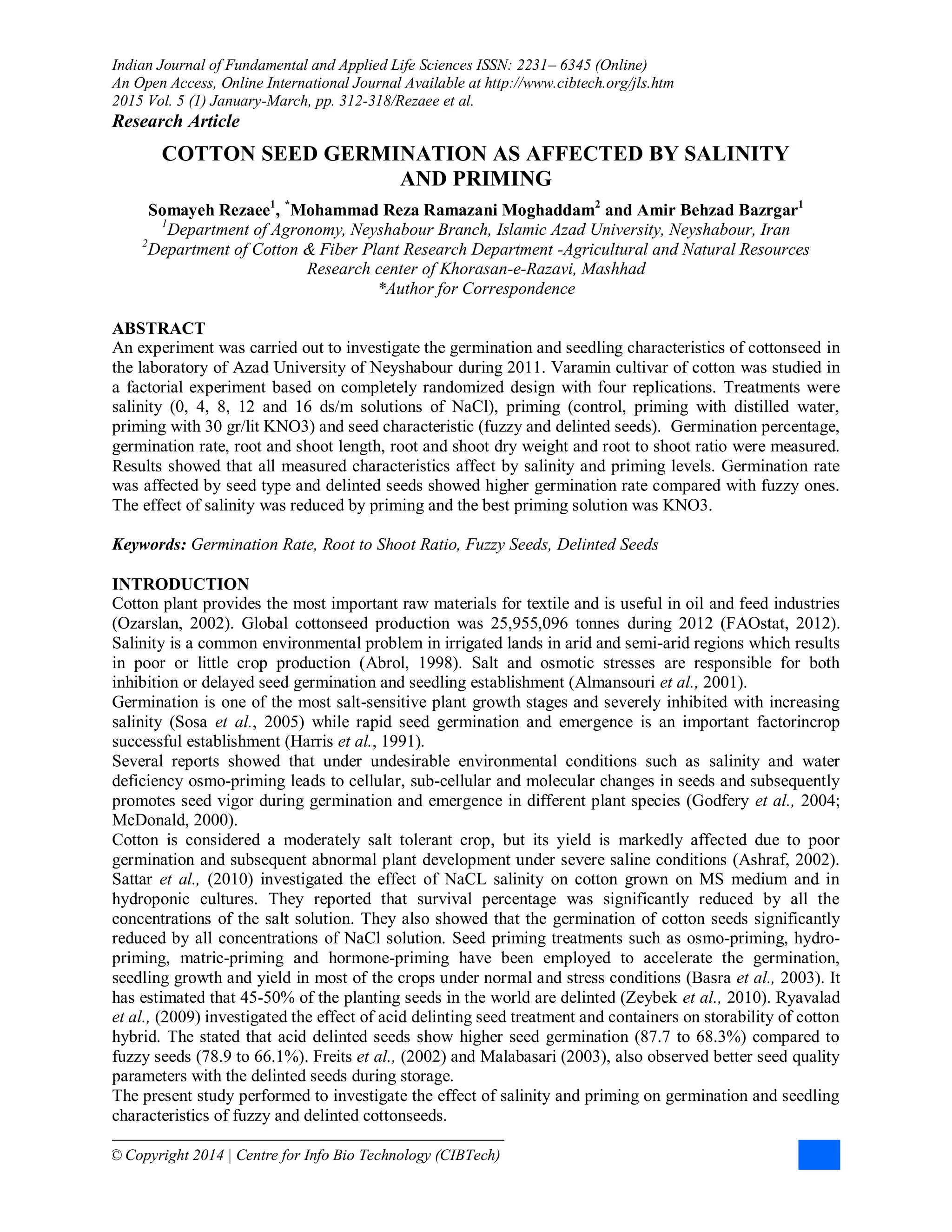
An Open Access, Online International Journal Available at http://www.cibtech.org/jls.htm
2015 Vol. 5 (1) January-March, pp. 312-318/Rezaee et al.
Research Article
© Copyright 2014 | Centre for Info Bio Technology (CIBTech)
COTTON SEED GERMINATION AS AFFECTED BY SALINITY
AND PRIMING
Somayeh Rezaee1
, *
Mohammad Reza Ramazani Moghaddam2
and Amir Behzad Bazrgar1
1
Department of Agronomy, Neyshabour Branch, Islamic Azad University, Neyshabour, Iran
2
Department of Cotton & Fiber Plant Research Department -Agricultural and Natural Resources
Research center of Khorasan-e-Razavi, Mashhad
*Author for Correspondence
ABSTRACT
An experiment was carried out to investigate the germination and seedling characteristics of cottonseed in
the laboratory of Azad University of Neyshabour during 2011. Varamin cultivar of cotton was studied in
a factorial experiment based on completely randomized design with four replications. Treatments were
salinity (0, 4, 8, 12 and 16 ds/m solutions of NaCl), priming (control, priming with distilled water,
priming with 30 gr/lit KNO3) and seed characteristic (fuzzy and delinted seeds). Germination percentage,
germination rate, root and shoot length, root and shoot dry weight and root to shoot ratio were measured.
Results showed that all measured characteristics affect by salinity and priming levels. Germination rate
was affected by seed type and delinted seeds showed higher germination rate compared with fuzzy ones.
The effect of salinity was reduced by priming and the best priming solution was KNO3.
Keywords: Germination Rate, Root to Shoot Ratio, Fuzzy Seeds, Delinted Seeds
INTRODUCTION
Cotton plant provides the most important raw materials for textile and is useful in oil and feed industries
(Ozarslan, 2002). Global cottonseed production was 25,955,096 tonnes during 2012 (FAOstat, 2012).
Salinity is a common environmental problem in irrigated lands in arid and semi-arid regions which results
in poor or little crop production (Abrol, 1998). Salt and osmotic stresses are responsible for both
inhibition or delayed seed germination and seedling establishment (Almansouri et al., 2001).
Germination is one of the most salt-sensitive plant growth stages and severely inhibited with increasing
salinity (Sosa et al., 2005) while rapid seed germination and emergence is an important factorincrop
successful establishment (Harris et al., 1991).
Several reports showed that under undesirable environmental conditions such as salinity and water
deficiency osmo-priming leads to cellular, sub-cellular and molecular changes in seeds and subsequently
promotes seed vigor during germination and emergence in different plant species (Godfery et al., 2004;
McDonald, 2000).
Cotton is considered a moderately salt tolerant crop, but its yield is markedly affected due to poor
germination and subsequent abnormal plant development under severe saline conditions (Ashraf, 2002).
Sattar et al., (2010) investigated the effect of NaCL salinity on cotton grown on MS medium and in
hydroponic cultures. They reported that survival percentage was significantly reduced by all the
concentrations of the salt solution. They also showed that the germination of cotton seeds significantly
reduced by all concentrations of NaCl solution. Seed priming treatments such as osmo-priming, hydro-
priming, matric-priming and hormone-priming have been employed to accelerate the germination,
seedling growth and yield in most of the crops under normal and stress conditions (Basra et al., 2003). It
has estimated that 45-50% of the planting seeds in the world are delinted (Zeybek et al., 2010). Ryavalad
et al., (2009) investigated the effect of acid delinting seed treatment and containers on storability of cotton
hybrid. The stated that acid delinted seeds show higher seed germination (87.7 to 68.3%) compared to
fuzzy seeds (78.9 to 66.1%). Freits et al., (2002) and Malabasari (2003), also observed better seed quality
parameters with the delinted seeds during storage.
The present study performed to investigate the effect of salinity and priming on germination and seedling
characteristics of fuzzy and delinted cottonseeds.
Indian Journal of Fundamental and Applied Life Sciences ISSN: 2231– 6345 (Online)
An Open Access, Online International Journal Available at http://www.cibtech.org/jls.htm
2015 Vol. 5 (1) January-March, pp. 312-318/Rezaee et al.
Research Article
© Copyright 2014 | Centre for Info Bio Technology (CIBTech)
MATERIALS AND METHODS
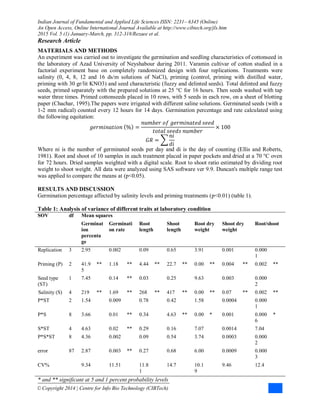
An experiment was carried out to investigate the germination and seedling characteristics of cottonseed in
the laboratory of Azad University of Neyshabour during 2011. Varamin cultivar of cotton studied in a
factorial experiment base on completely randomized design with four replications. Treatments were
salinity (0, 4, 8, 12 and 16 ds/m solutions of NaCl), priming (control, priming with distilled water,
priming with 30 gr/lit KNO3) and seed characteristic (fuzzy and delinted seeds). Total delinted and fuzzy
seeds, primed separately with the prepared solutions at 25 °C for 16 hours. Then seeds washed with tap
water three times. Primed cottonseeds placed in 10 rows, with 5 seeds in each row, on a sheet of blotting
paper (Chachar, 1995).The papers were irrigated with different saline solutions. Germinated seeds (with a
1-2 mm radical) counted every 12 hours for 14 days. Germination percentage and rate calculated using
the following equitation:
𝑔𝑒𝑟𝑚𝑖𝑛𝑎𝑡𝑖𝑜𝑛 % =
𝑛𝑢𝑚𝑏𝑒𝑟 𝑜𝑓 𝑔𝑒𝑟𝑚𝑖𝑛𝑎𝑡𝑒𝑑 𝑠𝑒𝑒𝑑
𝑡𝑜𝑡𝑎𝑙 𝑠𝑒𝑒𝑑𝑠 𝑛𝑢𝑚𝑏𝑒𝑟
× 100
𝐺𝑅 =
𝑛𝑖
𝑑𝑖
Where ni is the number of germinated seeds per day and di is the day of counting (Ellis and Roberts,
1981). Root and shoot of 10 samples in each treatment placed in paper pockets and dried at a 70 °C oven
for 72 hours. Dried samples weighted with a digital scale. Root to shoot ratio estimated by dividing root
weight to shoot weight. All data were analyzed using SAS software ver 9.9. Duncan's multiple range test
was applied to compare the means at (p<0.05).
RESULTS AND DISCUSSION
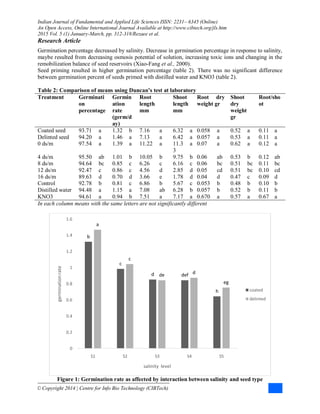
Germination percentage affected by salinity levels and priming treatments (p<0.01) (table 1).
Table 1: Analysis of variance of different traits at laboratory condition
SOV df Mean squares
Germinat
ion
percenta
ge
Germinati
on rate
Root
length
Shoot
length
Root dry
weight
Shoot dry
weight
Root/shoot
Replication 3 2.95 0.002 0.09 0.65 3.91 0.001 0.000
1
Priming (P) 2 41.9
5
** 1.18 ** 4.44 ** 22.7 ** 0.00 ** 0.004 ** 0.002 **
Seed type
(ST)
1 7.45 0.14 ** 0.03 0.25 9.63 0.003 0.000
2
Salinity (S) 4 219 ** 1.69 ** 268 ** 417 ** 0.00 ** 0.07 ** 0.002 **
P*ST 2 1.54 0.009 0.78 0.42 1.58 0.0004 0.000
1
P*S 8 3.66 0.01 ** 0.34 4.63 ** 0.00 * 0.001 0.000
6
*
S*ST 4 4.63 0.02 ** 0.29 0.16 7.07 0.0014 7.04
P*S*ST 8 4.36 0.002 0.09 0.54 3.74 0.0003 0.000
2
error 87 2.87 0.003 ** 0.27 0.68 6.00 0.0009 0.000
3
CV% 9.34 11.51 11.8
1
14.7 10.1
9
9.46 12.4
* and ** significant at 5 and 1 percent probability levels
Indian Journal of Fundamental and Applied Life Sciences ISSN: 2231– 6345 (Online)
An Open Access, Online International Journal Available at http://www.cibtech.org/jls.htm
2015 Vol. 5 (1) January-March, pp. 312-318/Rezaee et al.
Research Article
© Copyright 2014 | Centre for Info Bio Technology (CIBTech)
Germination percentage decreased by salinity. Decrease in germination percentage in response to salinity,
maybe resulted from decreasing osmosis potential of solution, increasing toxic ions and changing in the
remobilization balance of seed reservoirs (Xiao-Fang et al., 2000).
Seed priming resulted in higher germination percentage (table 2). There was no significant difference
between germination percent of seeds primed with distilled water and KNO3 (table 2).
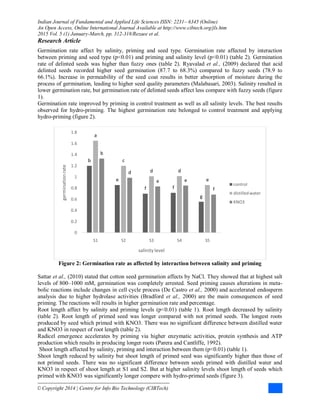
Table 2: Comparison of means using Duncan’s test at laboratory
Treatment Germinati
on
percentage
Germin
ation
rate
(germ/d
ay)
Root
length
mm
Shoot
length
mm
Root dry
weight gr
Shoot
dry
weight
gr
Root/sho
ot
Coated seed 93.71 a 1.32 b 7.16 a 6.32 a 0.058 a 0.52 a 0.11 a
Delinted seed 94.20 a 1.46 a 7.13 a 6.42 a 0.057 a 0.53 a 0.11 a
0 ds/m 97.54 a 1.39 a 11.22 a 11.3
3
a 0.07 a 0.62 a 0.12 a
4 ds/m 95.50 ab 1.01 b 10.05 b 9.75 b 0.06 ab 0.53 b 0.12 ab
8 ds/m 94.64 bc 0.85 c 6.26 c 6.16 c 0.06 bc 0.51 bc 0.11 bc
12 ds/m 92.47 c 0.86 c 4.56 d 2.85 d 0.05 cd 0.51 bc 0.10 cd
16 ds/m 89.63 d 0.70 d 3.66 e 1.78 d 0.04 d 0.47 c 0.09 d
Control 92.78 b 0.81 c 6.86 b 5.67 c 0.053 b 0.48 b 0.10 b
Distilled water 94.48 a 1.15 a 7.08 ab 6.28 b 0.057 b 0.52 b 0.11 b
KNO3 94.61 a 0.94 b 7.51 a 7.17 a 0.670 a 0.57 a 0.67 a
In each column means with the same letters are not significantly different
Figure 1: Germination rate as affected by interaction between salinity and seed type
b
c
d def
h
a
c
de d
eg
0
0.2
0.4
0.6
0.8
1
1.2
1.4
1.6
S1 S2 S3 S4 S5
germinationrate
salinity level
coated
delinted
Indian Journal of Fundamental and Applied Life Sciences ISSN: 2231– 6345 (Online)
An Open Access, Online International Journal Available at http://www.cibtech.org/jls.htm
2015 Vol. 5 (1) January-March, pp. 312-318/Rezaee et al.
Research Article
© Copyright 2014 | Centre for Info Bio Technology (CIBTech)
Germination rate affect by salinity, priming and seed type. Germination rate affected by interaction
between priming and seed type (p<0.01) and priming and salinity level (p<0.01) (table 2). Germination
rate of delinted seeds was higher than fuzzy ones (table 2). Ryavalad et al., (2009) declared that acid
delinted seeds recorded higher seed germination (87.7 to 68.3%) compared to fuzzy seeds (78.9 to
66.1%). Increase in permeability of the seed coat results in better absorption of moisture during the
process of germination, leading to higher seed quality parameters (Malabasari, 2003). Salinity resulted in
lower germination rate, but germination rate of delinted seeds affect less compare with fuzzy seeds (figure
1).
Germination rate improved by priming in control treatment as well as all salinity levels. The best results
observed for hydro-priming. The highest germination rate belonged to control treatment and applying
hydro-priming (figure 2).
Figure 2: Germination rate as affected by interaction between salinity and priming
Sattar et al., (2010) stated that cotton seed germination affects by NaCl. They showed that at highest salt
levels of 800–1000 mM, germination was completely arrested. Seed priming causes alterations in meta-
bolic reactions include changes in cell cycle process (De Castro et al., 2000) and accelerated endosperm
analysis due to higher hydrolase activities (Bradford et al., 2000) are the main consequences of seed
priming. The reactions will results in higher germination rate and percentage.
Root length affect by salinity and priming levels (p<0.01) (table 1). Root length decreased by salinity
(table 2). Root length of primed seed was longer compared with not primed seeds. The longest roots
produced by seed which primed with KNO3. There was no significant difference between distilled water
and KNO3 in respect of root length (table 2).
Radicel emergence accelerates by priming via higher enzymatic activities, protein synthesis and ATP
production which results in producing longer roots (Parera and Cantliffe, 1992).
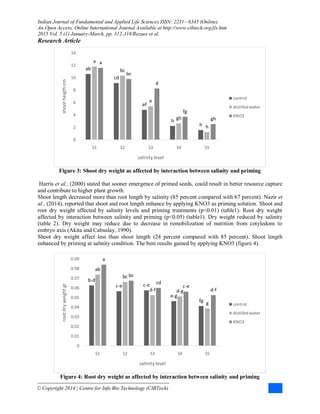
Shoot length affected by salinity, priming and interaction between them (p<0.01) (table 1).
Shoot length reduced by salinity but shoot length of primed seed was significantly higher than those of
not primed seeds. There was no significant difference between seeds primed with distilled water and
KNO3 in respect of shoot length at S1 and S2. But at higher salinity levels shoot length of seeds which
primed with KNO3 was significantly longer compere with hydro-primed seeds (figure 3).
b
e
f f
g
a
c
d d
e
b
d
e e
f
0
0.2
0.4
0.6
0.8
1
1.2
1.4
1.6
1.8
S1 S2 S3 S4 S5
germinationrate
salinity level
control
distilledwater
KNO3
Indian Journal of Fundamental and Applied Life Sciences ISSN: 2231– 6345 (Online)
An Open Access, Online International Journal Available at http://www.cibtech.org/jls.htm
2015 Vol. 5 (1) January-March, pp. 312-318/Rezaee et al.
Research Article
© Copyright 2014 | Centre for Info Bio Technology (CIBTech)
Figure 3: Shoot dry weight as affected by interaction between salinity and priming
Harris et al., (2000) stated that sooner emergence of primed seeds, could result in better resource capture
and contribute to higher plant growth.
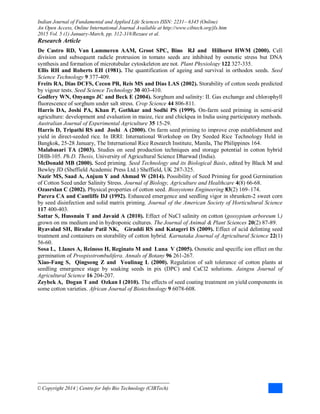
Shoot length decreased more than root length by salinity (85 percent compared with 67 percent). Nazir et
al., (2014), reported that shoot and root length enhance by applying KNO3 as priming solution. Shoot and
root dry weight affected by salinity levels and priming treatments (p<0.01) (table1). Root dry weight
affected by interaction between salinity and priming (p<0.05) (table1). Dry weight reduced by salinity
(table 2). Dry weight may reduce due to decrease in remobilization of nutrition from cotyledons to
embryo axis (Akita and Cabuslay, 1990).
Shoot dry weight affect less than shoot length (24 percent compared with 85 percent). Shoot length
enhanced by priming at salinity condition. The best results gained by applying KNO3 (figure 4).
Figure 4: Root dry weight as affected by interaction between salinity and priming
ab
cd
ef
h
h
a
bc
e
gh
h
a
bc
d
fg
gh
0
2
4
6
8
10
12
14
S1 S2 S3 S4 S5
shootheigthcm
salinity level
control
distilledwater
KNO3
b-d
c-e c-e
e-g
fg
ab
bc
d-f d-g
g
a
bc
cd
c-e
d-f
0
0.01
0.02
0.03
0.04
0.05
0.06
0.07
0.08
0.09
S1 S2 S3 S4 S5
rootdryweightgr
salinity level
control
distilledwater
KNO3
Indian Journal of Fundamental and Applied Life Sciences ISSN: 2231– 6345 (Online)
An Open Access, Online International Journal Available at http://www.cibtech.org/jls.htm
2015 Vol. 5 (1) January-March, pp. 312-318/Rezaee et al.
Research Article
© Copyright 2014 | Centre for Info Bio Technology (CIBTech)
Root to shoot ratio increased at S2 and S3, but higher salinity levels resulted in root/shoot reduction. The
increase in root to shoot ratio may be due to higher cell wall extensibility and higher metabolic processes
of roots at saline condition (Afzal et al., 2002).
Root/shoot increased by priming at all salinity levels. The best results gained by applying KNO3 (figure
5).
Figure 5: Root/shoot as affected by interaction between salinity and priming
Conclusion
Results showed that cotton seed germination is sensitive to salinity. Seed priming resulted in better
germination and plantlet characteristics. Between two priming solutions the best results gained by
applying KNO3 salinity conditions but the highest germination observed for hydro-primed seeds.
Between measured traits, germination rate affect by seed type. Seed fuzz resulted in lower germination
rate due to lower water uptake. Root and shoot length and dry weight reduced by salinity but root to shoot
ratio increased at S2 and S3 and then reduced in higher salt concentrations.
REFERENCES
Abrol IP, Yadav JSP and Massoud F (1988). Salt affected soils and their management, Food and
Agricultural Organization of the United Nations (FAO), Soils Bulletin 39.
Afzal I, Basra SMA, Ahmad R and Iqbal A (2002). Effect of different seed vigor enhancement
techniques on hybrid maize (Zea mays L.). Pakistan Journal of Agricultural Sciences 39 109-112.
Akita AS and Cabuslay GS (1990). Physiological basis of differential response to salinity in rice
cultivars. Plant Soil 123 227-294.
Almansouri M, Kinet JM and Lutts S (2001). Effect of salt and osmotic stresses on germination in
durum wheat (Triticum durum Desf.). Plant Soil 231 243–254.
Ashraf M (2002). Salt tolerance of cotton: some new advances. Critical Reviews in Plant Sciences 21(1)
1-30.
Basra SM, Zia AN, Mahmood T, Afzal A and Khaliq A (2003). Comparison of different in vigor
techniques in wheat (Triricum aestivum L.) seeds. Pakistan Journal of Arid Agriculture 5 11-16.
Bradford KJ, Chen F, Cooley MB, Dahal P, Downie B, Fukunaga KK, Gee OH, Gurusinghe S,
Mella RA, Nonogaki H, Wu CT, Yang H and Yim KO (2000). In: Gene Expression Prior to Radicle
Emergence in Imbibed Tomato Seeds, edited by Black M 231-251.
Chachar QI (1995). Aspects of root growth in cotton seedlings. Ph.D. Thesis submitted to University of
Wales, Bangor, UK.
a-e
a-e
a-d
c-e
[CELLRANGE]
a-c
[CELLRANGE]
a-e
b-e
[CELLRANGE][CELLRANGE] [CELLRANGE]
a-e a-e a-e
0
0.02
0.04
0.06
0.08
0.1
0.12
0.14
S1 S2 S3 S4 S5
root/shoot
salinity level
control
distilledwater
KNO3
Indian Journal of Fundamental and Applied Life Sciences ISSN: 2231– 6345 (Online)
An Open Access, Online International Journal Available at http://www.cibtech.org/jls.htm
2015 Vol. 5 (1) January-March, pp. 312-318/Rezaee et al.
Research Article
© Copyright 2014 | Centre for Info Bio Technology (CIBTech)
De Castro RD, Van Lammeren AAM, Groot SPC, Bino RJ and Hilhorst HWM (2000). Cell
division and subsequent radicle protrusion in tomato seeds are inhibited by osmotic stress but DNA
synthesis and formation of microtubular cytoskeleton are not. Plant Physiology 122 327-335.
Ellis RH and Roberts EH (1981). The quantification of ageing and survival in orthodox seeds. Seed
Science Technology 9 377-409.
Freits RA, Dias DCFS, Cecon PR, Reis MS and Dias LAS (2002). Storability of cotton seeds predicted
by vigour tests. Seed Science Technology 30 403-410.
Godfery WN, Onyango JC and Beck E (2004). Sorghum and salinity: II. Gas exchange and chlorophyll
fluorescence of sorghum under salt stress. Crop Science 44 806-811.
Harris DA, Joshi PA, Khan P, Gothkar and Sodhi PS (1999). On-farm seed priming in semi-arid
agriculture: development and evaluation in maize, rice and chickpea in India using participatory methods.
Australian Journal of Experimental Agriculture 35 15-29.
Harris D, Tripathi RS and Joshi A (2000). On farm seed priming to improve crop establishment and
yield in direct-seeded rice. In IRRI: International Workshop on Dry Seeded Rice Technology Held in
Bangkok, 25-28 January, The International Rice Research Institute, Manila, The Philippines 164.
Malabasari TA (2003). Studies on seed production techniques and storage potential in cotton hybrid
DHB-105. Ph.D. Thesis, University of Agricultural Science Dharwad (India).
McDonald MB (2000). Seed priming. Seed Technology and its Biological Basis, edited by Black M and
Bewley JD (Sheffield Academic Press Ltd.) Sheffield, UK 287-325.
Nazir MS, Saad A, Anjum Y and Ahmad W (2014). Possibility of Seed Priming for good Germination
of Cotton Seed under Salinity Stress. Journal of Biology, Agriculture and Healthcare 4(8) 66-68.
Ozasrslan C (2002). Physical properties of cotton seed. Biosystems Engineering 83(2) 169–174.
Parera CA and Cantliffe DJ (1992). Enhanced emergence and seedling vigor in shrunken-2 sweet corn
by seed disinfection and solid matrix priming. Journal of the American Society of Horticultural Science
117 400-403.
Sattar S, Hussnain T and Javaid A (2010). Effect of NaCl salinity on cotton (gossypium arboreum l.)
grown on ms medium and in hydroponic cultures. The Journal of Animal & Plant Sciences 20(2) 87-89.
Ryavalad SH, Biradar Patil NK, Giraddi RS and Katageri IS (2009). Effect of acid delinting seed
treatment and containers on storability of cotton hybrid. Karnataka Journal of Agricultural Science 22(1)
56-60.
Sosa L, Llanes A, Reinoso H, Reginato M and Luna V (2005). Osmotic and specific ion effect on the
germination of Prospisstrombulifera. Annals of Botany 96 261-267.
Xiao-Fang S, Qingsong Z and Youlinag L (2000). Regulation of salt tolerance of cotton plants at
seedling emergence stage by soaking seeds in pix (DPC) and CaCl2 solutions. Jaingsu Journal of
Agricultural Science 16 204-207.
Zeybek A, Dogan T and Ozkan I (2010). The effects of seed coating treatment on yield components in
some cotton varieties. African Journal of Biotechnology 9 6078-608.

rezaee ramezani bazrgar 2015

  • 1.
    Indian Journal ofFundamental and Applied Life Sciences ISSN: 2231– 6345 (Online) An Open Access, Online International Journal Available at http://www.cibtech.org/jls.htm 2015 Vol. 5 (1) January-March, pp. 312-318/Rezaee et al. Research Article © Copyright 2014 | Centre for Info Bio Technology (CIBTech) COTTON SEED GERMINATION AS AFFECTED BY SALINITY AND PRIMING Somayeh Rezaee1 , * Mohammad Reza Ramazani Moghaddam2 and Amir Behzad Bazrgar1 1 Department of Agronomy, Neyshabour Branch, Islamic Azad University, Neyshabour, Iran 2 Department of Cotton & Fiber Plant Research Department -Agricultural and Natural Resources Research center of Khorasan-e-Razavi, Mashhad *Author for Correspondence ABSTRACT An experiment was carried out to investigate the germination and seedling characteristics of cottonseed in the laboratory of Azad University of Neyshabour during 2011. Varamin cultivar of cotton was studied in a factorial experiment based on completely randomized design with four replications. Treatments were salinity (0, 4, 8, 12 and 16 ds/m solutions of NaCl), priming (control, priming with distilled water, priming with 30 gr/lit KNO3) and seed characteristic (fuzzy and delinted seeds). Germination percentage, germination rate, root and shoot length, root and shoot dry weight and root to shoot ratio were measured. Results showed that all measured characteristics affect by salinity and priming levels. Germination rate was affected by seed type and delinted seeds showed higher germination rate compared with fuzzy ones. The effect of salinity was reduced by priming and the best priming solution was KNO3. Keywords: Germination Rate, Root to Shoot Ratio, Fuzzy Seeds, Delinted Seeds INTRODUCTION Cotton plant provides the most important raw materials for textile and is useful in oil and feed industries (Ozarslan, 2002). Global cottonseed production was 25,955,096 tonnes during 2012 (FAOstat, 2012). Salinity is a common environmental problem in irrigated lands in arid and semi-arid regions which results in poor or little crop production (Abrol, 1998). Salt and osmotic stresses are responsible for both inhibition or delayed seed germination and seedling establishment (Almansouri et al., 2001). Germination is one of the most salt-sensitive plant growth stages and severely inhibited with increasing salinity (Sosa et al., 2005) while rapid seed germination and emergence is an important factorincrop successful establishment (Harris et al., 1991). Several reports showed that under undesirable environmental conditions such as salinity and water deficiency osmo-priming leads to cellular, sub-cellular and molecular changes in seeds and subsequently promotes seed vigor during germination and emergence in different plant species (Godfery et al., 2004; McDonald, 2000). Cotton is considered a moderately salt tolerant crop, but its yield is markedly affected due to poor germination and subsequent abnormal plant development under severe saline conditions (Ashraf, 2002). Sattar et al., (2010) investigated the effect of NaCL salinity on cotton grown on MS medium and in hydroponic cultures. They reported that survival percentage was significantly reduced by all the concentrations of the salt solution. They also showed that the germination of cotton seeds significantly reduced by all concentrations of NaCl solution. Seed priming treatments such as osmo-priming, hydro- priming, matric-priming and hormone-priming have been employed to accelerate the germination, seedling growth and yield in most of the crops under normal and stress conditions (Basra et al., 2003). It has estimated that 45-50% of the planting seeds in the world are delinted (Zeybek et al., 2010). Ryavalad et al., (2009) investigated the effect of acid delinting seed treatment and containers on storability of cotton hybrid. The stated that acid delinted seeds show higher seed germination (87.7 to 68.3%) compared to fuzzy seeds (78.9 to 66.1%). Freits et al., (2002) and Malabasari (2003), also observed better seed quality parameters with the delinted seeds during storage. The present study performed to investigate the effect of salinity and priming on germination and seedling characteristics of fuzzy and delinted cottonseeds.
  • 2.
    Indian Journal ofFundamental and Applied Life Sciences ISSN: 2231– 6345 (Online) An Open Access, Online International Journal Available at http://www.cibtech.org/jls.htm 2015 Vol. 5 (1) January-March, pp. 312-318/Rezaee et al. Research Article © Copyright 2014 | Centre for Info Bio Technology (CIBTech) MATERIALS AND METHODS An experiment was carried out to investigate the germination and seedling characteristics of cottonseed in the laboratory of Azad University of Neyshabour during 2011. Varamin cultivar of cotton studied in a factorial experiment base on completely randomized design with four replications. Treatments were salinity (0, 4, 8, 12 and 16 ds/m solutions of NaCl), priming (control, priming with distilled water, priming with 30 gr/lit KNO3) and seed characteristic (fuzzy and delinted seeds). Total delinted and fuzzy seeds, primed separately with the prepared solutions at 25 °C for 16 hours. Then seeds washed with tap water three times. Primed cottonseeds placed in 10 rows, with 5 seeds in each row, on a sheet of blotting paper (Chachar, 1995).The papers were irrigated with different saline solutions. Germinated seeds (with a 1-2 mm radical) counted every 12 hours for 14 days. Germination percentage and rate calculated using the following equitation: 𝑔𝑒𝑟𝑚𝑖𝑛𝑎𝑡𝑖𝑜𝑛 % = 𝑛𝑢𝑚𝑏𝑒𝑟 𝑜𝑓 𝑔𝑒𝑟𝑚𝑖𝑛𝑎𝑡𝑒𝑑 𝑠𝑒𝑒𝑑 𝑡𝑜𝑡𝑎𝑙 𝑠𝑒𝑒𝑑𝑠 𝑛𝑢𝑚𝑏𝑒𝑟 × 100 𝐺𝑅 = 𝑛𝑖 𝑑𝑖 Where ni is the number of germinated seeds per day and di is the day of counting (Ellis and Roberts, 1981). Root and shoot of 10 samples in each treatment placed in paper pockets and dried at a 70 °C oven for 72 hours. Dried samples weighted with a digital scale. Root to shoot ratio estimated by dividing root weight to shoot weight. All data were analyzed using SAS software ver 9.9. Duncan's multiple range test was applied to compare the means at (p<0.05). RESULTS AND DISCUSSION Germination percentage affected by salinity levels and priming treatments (p<0.01) (table 1). Table 1: Analysis of variance of different traits at laboratory condition SOV df Mean squares Germinat ion percenta ge Germinati on rate Root length Shoot length Root dry weight Shoot dry weight Root/shoot Replication 3 2.95 0.002 0.09 0.65 3.91 0.001 0.000 1 Priming (P) 2 41.9 5 ** 1.18 ** 4.44 ** 22.7 ** 0.00 ** 0.004 ** 0.002 ** Seed type (ST) 1 7.45 0.14 ** 0.03 0.25 9.63 0.003 0.000 2 Salinity (S) 4 219 ** 1.69 ** 268 ** 417 ** 0.00 ** 0.07 ** 0.002 ** P*ST 2 1.54 0.009 0.78 0.42 1.58 0.0004 0.000 1 P*S 8 3.66 0.01 ** 0.34 4.63 ** 0.00 * 0.001 0.000 6 * S*ST 4 4.63 0.02 ** 0.29 0.16 7.07 0.0014 7.04 P*S*ST 8 4.36 0.002 0.09 0.54 3.74 0.0003 0.000 2 error 87 2.87 0.003 ** 0.27 0.68 6.00 0.0009 0.000 3 CV% 9.34 11.51 11.8 1 14.7 10.1 9 9.46 12.4 * and ** significant at 5 and 1 percent probability levels
  • 3.
    Indian Journal ofFundamental and Applied Life Sciences ISSN: 2231– 6345 (Online) An Open Access, Online International Journal Available at http://www.cibtech.org/jls.htm 2015 Vol. 5 (1) January-March, pp. 312-318/Rezaee et al. Research Article © Copyright 2014 | Centre for Info Bio Technology (CIBTech) Germination percentage decreased by salinity. Decrease in germination percentage in response to salinity, maybe resulted from decreasing osmosis potential of solution, increasing toxic ions and changing in the remobilization balance of seed reservoirs (Xiao-Fang et al., 2000). Seed priming resulted in higher germination percentage (table 2). There was no significant difference between germination percent of seeds primed with distilled water and KNO3 (table 2). Table 2: Comparison of means using Duncan’s test at laboratory Treatment Germinati on percentage Germin ation rate (germ/d ay) Root length mm Shoot length mm Root dry weight gr Shoot dry weight gr Root/sho ot Coated seed 93.71 a 1.32 b 7.16 a 6.32 a 0.058 a 0.52 a 0.11 a Delinted seed 94.20 a 1.46 a 7.13 a 6.42 a 0.057 a 0.53 a 0.11 a 0 ds/m 97.54 a 1.39 a 11.22 a 11.3 3 a 0.07 a 0.62 a 0.12 a 4 ds/m 95.50 ab 1.01 b 10.05 b 9.75 b 0.06 ab 0.53 b 0.12 ab 8 ds/m 94.64 bc 0.85 c 6.26 c 6.16 c 0.06 bc 0.51 bc 0.11 bc 12 ds/m 92.47 c 0.86 c 4.56 d 2.85 d 0.05 cd 0.51 bc 0.10 cd 16 ds/m 89.63 d 0.70 d 3.66 e 1.78 d 0.04 d 0.47 c 0.09 d Control 92.78 b 0.81 c 6.86 b 5.67 c 0.053 b 0.48 b 0.10 b Distilled water 94.48 a 1.15 a 7.08 ab 6.28 b 0.057 b 0.52 b 0.11 b KNO3 94.61 a 0.94 b 7.51 a 7.17 a 0.670 a 0.57 a 0.67 a In each column means with the same letters are not significantly different Figure 1: Germination rate as affected by interaction between salinity and seed type b c d def h a c de d eg 0 0.2 0.4 0.6 0.8 1 1.2 1.4 1.6 S1 S2 S3 S4 S5 germinationrate salinity level coated delinted
  • 4.
    Indian Journal ofFundamental and Applied Life Sciences ISSN: 2231– 6345 (Online) An Open Access, Online International Journal Available at http://www.cibtech.org/jls.htm 2015 Vol. 5 (1) January-March, pp. 312-318/Rezaee et al. Research Article © Copyright 2014 | Centre for Info Bio Technology (CIBTech) Germination rate affect by salinity, priming and seed type. Germination rate affected by interaction between priming and seed type (p<0.01) and priming and salinity level (p<0.01) (table 2). Germination rate of delinted seeds was higher than fuzzy ones (table 2). Ryavalad et al., (2009) declared that acid delinted seeds recorded higher seed germination (87.7 to 68.3%) compared to fuzzy seeds (78.9 to 66.1%). Increase in permeability of the seed coat results in better absorption of moisture during the process of germination, leading to higher seed quality parameters (Malabasari, 2003). Salinity resulted in lower germination rate, but germination rate of delinted seeds affect less compare with fuzzy seeds (figure 1). Germination rate improved by priming in control treatment as well as all salinity levels. The best results observed for hydro-priming. The highest germination rate belonged to control treatment and applying hydro-priming (figure 2). Figure 2: Germination rate as affected by interaction between salinity and priming Sattar et al., (2010) stated that cotton seed germination affects by NaCl. They showed that at highest salt levels of 800–1000 mM, germination was completely arrested. Seed priming causes alterations in meta- bolic reactions include changes in cell cycle process (De Castro et al., 2000) and accelerated endosperm analysis due to higher hydrolase activities (Bradford et al., 2000) are the main consequences of seed priming. The reactions will results in higher germination rate and percentage. Root length affect by salinity and priming levels (p<0.01) (table 1). Root length decreased by salinity (table 2). Root length of primed seed was longer compared with not primed seeds. The longest roots produced by seed which primed with KNO3. There was no significant difference between distilled water and KNO3 in respect of root length (table 2). Radicel emergence accelerates by priming via higher enzymatic activities, protein synthesis and ATP production which results in producing longer roots (Parera and Cantliffe, 1992). Shoot length affected by salinity, priming and interaction between them (p<0.01) (table 1). Shoot length reduced by salinity but shoot length of primed seed was significantly higher than those of not primed seeds. There was no significant difference between seeds primed with distilled water and KNO3 in respect of shoot length at S1 and S2. But at higher salinity levels shoot length of seeds which primed with KNO3 was significantly longer compere with hydro-primed seeds (figure 3). b e f f g a c d d e b d e e f 0 0.2 0.4 0.6 0.8 1 1.2 1.4 1.6 1.8 S1 S2 S3 S4 S5 germinationrate salinity level control distilledwater KNO3
  • 5.
    Indian Journal ofFundamental and Applied Life Sciences ISSN: 2231– 6345 (Online) An Open Access, Online International Journal Available at http://www.cibtech.org/jls.htm 2015 Vol. 5 (1) January-March, pp. 312-318/Rezaee et al. Research Article © Copyright 2014 | Centre for Info Bio Technology (CIBTech) Figure 3: Shoot dry weight as affected by interaction between salinity and priming Harris et al., (2000) stated that sooner emergence of primed seeds, could result in better resource capture and contribute to higher plant growth. Shoot length decreased more than root length by salinity (85 percent compared with 67 percent). Nazir et al., (2014), reported that shoot and root length enhance by applying KNO3 as priming solution. Shoot and root dry weight affected by salinity levels and priming treatments (p<0.01) (table1). Root dry weight affected by interaction between salinity and priming (p<0.05) (table1). Dry weight reduced by salinity (table 2). Dry weight may reduce due to decrease in remobilization of nutrition from cotyledons to embryo axis (Akita and Cabuslay, 1990). Shoot dry weight affect less than shoot length (24 percent compared with 85 percent). Shoot length enhanced by priming at salinity condition. The best results gained by applying KNO3 (figure 4). Figure 4: Root dry weight as affected by interaction between salinity and priming ab cd ef h h a bc e gh h a bc d fg gh 0 2 4 6 8 10 12 14 S1 S2 S3 S4 S5 shootheigthcm salinity level control distilledwater KNO3 b-d c-e c-e e-g fg ab bc d-f d-g g a bc cd c-e d-f 0 0.01 0.02 0.03 0.04 0.05 0.06 0.07 0.08 0.09 S1 S2 S3 S4 S5 rootdryweightgr salinity level control distilledwater KNO3
  • 6.
    Indian Journal ofFundamental and Applied Life Sciences ISSN: 2231– 6345 (Online) An Open Access, Online International Journal Available at http://www.cibtech.org/jls.htm 2015 Vol. 5 (1) January-March, pp. 312-318/Rezaee et al. Research Article © Copyright 2014 | Centre for Info Bio Technology (CIBTech) Root to shoot ratio increased at S2 and S3, but higher salinity levels resulted in root/shoot reduction. The increase in root to shoot ratio may be due to higher cell wall extensibility and higher metabolic processes of roots at saline condition (Afzal et al., 2002). Root/shoot increased by priming at all salinity levels. The best results gained by applying KNO3 (figure 5). Figure 5: Root/shoot as affected by interaction between salinity and priming Conclusion Results showed that cotton seed germination is sensitive to salinity. Seed priming resulted in better germination and plantlet characteristics. Between two priming solutions the best results gained by applying KNO3 salinity conditions but the highest germination observed for hydro-primed seeds. Between measured traits, germination rate affect by seed type. Seed fuzz resulted in lower germination rate due to lower water uptake. Root and shoot length and dry weight reduced by salinity but root to shoot ratio increased at S2 and S3 and then reduced in higher salt concentrations. REFERENCES Abrol IP, Yadav JSP and Massoud F (1988). Salt affected soils and their management, Food and Agricultural Organization of the United Nations (FAO), Soils Bulletin 39. Afzal I, Basra SMA, Ahmad R and Iqbal A (2002). Effect of different seed vigor enhancement techniques on hybrid maize (Zea mays L.). Pakistan Journal of Agricultural Sciences 39 109-112. Akita AS and Cabuslay GS (1990). Physiological basis of differential response to salinity in rice cultivars. Plant Soil 123 227-294. Almansouri M, Kinet JM and Lutts S (2001). Effect of salt and osmotic stresses on germination in durum wheat (Triticum durum Desf.). Plant Soil 231 243–254. Ashraf M (2002). Salt tolerance of cotton: some new advances. Critical Reviews in Plant Sciences 21(1) 1-30. Basra SM, Zia AN, Mahmood T, Afzal A and Khaliq A (2003). Comparison of different in vigor techniques in wheat (Triricum aestivum L.) seeds. Pakistan Journal of Arid Agriculture 5 11-16. Bradford KJ, Chen F, Cooley MB, Dahal P, Downie B, Fukunaga KK, Gee OH, Gurusinghe S, Mella RA, Nonogaki H, Wu CT, Yang H and Yim KO (2000). In: Gene Expression Prior to Radicle Emergence in Imbibed Tomato Seeds, edited by Black M 231-251. Chachar QI (1995). Aspects of root growth in cotton seedlings. Ph.D. Thesis submitted to University of Wales, Bangor, UK. a-e a-e a-d c-e [CELLRANGE] a-c [CELLRANGE] a-e b-e [CELLRANGE][CELLRANGE] [CELLRANGE] a-e a-e a-e 0 0.02 0.04 0.06 0.08 0.1 0.12 0.14 S1 S2 S3 S4 S5 root/shoot salinity level control distilledwater KNO3
  • 7.
    Indian Journal ofFundamental and Applied Life Sciences ISSN: 2231– 6345 (Online) An Open Access, Online International Journal Available at http://www.cibtech.org/jls.htm 2015 Vol. 5 (1) January-March, pp. 312-318/Rezaee et al. Research Article © Copyright 2014 | Centre for Info Bio Technology (CIBTech) De Castro RD, Van Lammeren AAM, Groot SPC, Bino RJ and Hilhorst HWM (2000). Cell division and subsequent radicle protrusion in tomato seeds are inhibited by osmotic stress but DNA synthesis and formation of microtubular cytoskeleton are not. Plant Physiology 122 327-335. Ellis RH and Roberts EH (1981). The quantification of ageing and survival in orthodox seeds. Seed Science Technology 9 377-409. Freits RA, Dias DCFS, Cecon PR, Reis MS and Dias LAS (2002). Storability of cotton seeds predicted by vigour tests. Seed Science Technology 30 403-410. Godfery WN, Onyango JC and Beck E (2004). Sorghum and salinity: II. Gas exchange and chlorophyll fluorescence of sorghum under salt stress. Crop Science 44 806-811. Harris DA, Joshi PA, Khan P, Gothkar and Sodhi PS (1999). On-farm seed priming in semi-arid agriculture: development and evaluation in maize, rice and chickpea in India using participatory methods. Australian Journal of Experimental Agriculture 35 15-29. Harris D, Tripathi RS and Joshi A (2000). On farm seed priming to improve crop establishment and yield in direct-seeded rice. In IRRI: International Workshop on Dry Seeded Rice Technology Held in Bangkok, 25-28 January, The International Rice Research Institute, Manila, The Philippines 164. Malabasari TA (2003). Studies on seed production techniques and storage potential in cotton hybrid DHB-105. Ph.D. Thesis, University of Agricultural Science Dharwad (India). McDonald MB (2000). Seed priming. Seed Technology and its Biological Basis, edited by Black M and Bewley JD (Sheffield Academic Press Ltd.) Sheffield, UK 287-325. Nazir MS, Saad A, Anjum Y and Ahmad W (2014). Possibility of Seed Priming for good Germination of Cotton Seed under Salinity Stress. Journal of Biology, Agriculture and Healthcare 4(8) 66-68. Ozasrslan C (2002). Physical properties of cotton seed. Biosystems Engineering 83(2) 169–174. Parera CA and Cantliffe DJ (1992). Enhanced emergence and seedling vigor in shrunken-2 sweet corn by seed disinfection and solid matrix priming. Journal of the American Society of Horticultural Science 117 400-403. Sattar S, Hussnain T and Javaid A (2010). Effect of NaCl salinity on cotton (gossypium arboreum l.) grown on ms medium and in hydroponic cultures. The Journal of Animal & Plant Sciences 20(2) 87-89. Ryavalad SH, Biradar Patil NK, Giraddi RS and Katageri IS (2009). Effect of acid delinting seed treatment and containers on storability of cotton hybrid. Karnataka Journal of Agricultural Science 22(1) 56-60. Sosa L, Llanes A, Reinoso H, Reginato M and Luna V (2005). Osmotic and specific ion effect on the germination of Prospisstrombulifera. Annals of Botany 96 261-267. Xiao-Fang S, Qingsong Z and Youlinag L (2000). Regulation of salt tolerance of cotton plants at seedling emergence stage by soaking seeds in pix (DPC) and CaCl2 solutions. Jaingsu Journal of Agricultural Science 16 204-207. Zeybek A, Dogan T and Ozkan I (2010). The effects of seed coating treatment on yield components in some cotton varieties. African Journal of Biotechnology 9 6078-608.