BLIND HOEING
PRESENTED BY-
VAIBHAO BONDRE
CAU/CPGS/SOILS/M-14/02
Blind Hoeing
The hoeing is done after sowing of the sugarcane called blind hoeing.
When, the crop is not germinated due to some reasons like rainfall just after
sowing of the crop and formed hard surface crust. To break this layer, the
blind hoeing is done.
 The objectives of blind hoeing are -
(i) To adjust standing setts in the field
(ii) To break the hard crust at surface which might create problems to
the sprouting seedlings.
(iii) To cover the exposed setts properly
(iv) To uproot the weeds, if any
(v) To replace the damaged setts by disease or insects.
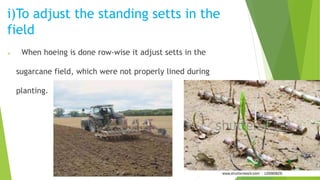
i)To adjust the standing setts in the
field
 When hoeing is done row-wise it adjust setts in the
sugarcane field, which were not properly lined during
planting.
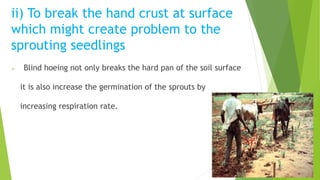
ii) To break the hand crust at surface
which might create problem to the
sprouting seedlings
 Blind hoeing not only breaks the hard pan of the soil surface
it is also increase the germination of the sprouts by
increasing respiration rate.
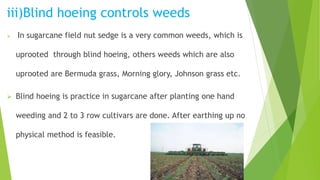
iii)Blind hoeing controls weeds
 In sugarcane field nut sedge is a very common weeds, which is
uprooted through blind hoeing, others weeds which are also
uprooted are Bermuda grass, Morning glory, Johnson grass etc.
 Blind hoeing is practice in sugarcane after planting one hand
weeding and 2 to 3 row cultivars are done. After earthing up no
physical method is feasible.
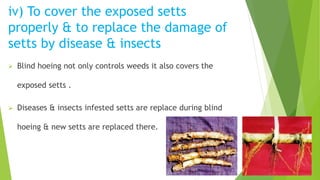
iv) To cover the exposed setts
properly & to replace the damage of
setts by disease & insects
 Blind hoeing not only controls weeds it also covers the
exposed setts .
 Diseases & insects infested setts are replace during blind
hoeing & new setts are replaced there.
Blind hoeing

Blind hoeing

  • 1.
    BLIND HOEING PRESENTED BY- VAIBHAOBONDRE CAU/CPGS/SOILS/M-14/02
  • 2.
    Blind Hoeing The hoeingis done after sowing of the sugarcane called blind hoeing. When, the crop is not germinated due to some reasons like rainfall just after sowing of the crop and formed hard surface crust. To break this layer, the blind hoeing is done.  The objectives of blind hoeing are - (i) To adjust standing setts in the field (ii) To break the hard crust at surface which might create problems to the sprouting seedlings. (iii) To cover the exposed setts properly (iv) To uproot the weeds, if any (v) To replace the damaged setts by disease or insects.
  • 3.
    i)To adjust thestanding setts in the field  When hoeing is done row-wise it adjust setts in the sugarcane field, which were not properly lined during planting.
  • 4.
    ii) To breakthe hand crust at surface which might create problem to the sprouting seedlings  Blind hoeing not only breaks the hard pan of the soil surface it is also increase the germination of the sprouts by increasing respiration rate.
  • 5.
    iii)Blind hoeing controlsweeds  In sugarcane field nut sedge is a very common weeds, which is uprooted through blind hoeing, others weeds which are also uprooted are Bermuda grass, Morning glory, Johnson grass etc.  Blind hoeing is practice in sugarcane after planting one hand weeding and 2 to 3 row cultivars are done. After earthing up no physical method is feasible.
  • 6.
    iv) To coverthe exposed setts properly & to replace the damage of setts by disease & insects  Blind hoeing not only controls weeds it also covers the exposed setts .  Diseases & insects infested setts are replace during blind hoeing & new setts are replaced there.