
STANDARD DEVIATION
AND
โ€˜tโ€™- TEST
Keerthi Samuel
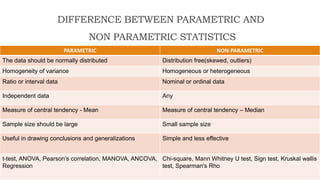
DIFFERENCE BETWEEN PARAMETRIC AND
NON PARAMETRIC STATISTICS
PARAMETRIC NON-PARAMETRIC
The data should be normally distributed Distribution free(skewed, outliers)
Homogeneity of variance Homogeneous or heterogeneous
Ratio or interval data Nominal or ordinal data
Independent data Any
Measure of central tendency - Mean Measure of central tendency โ€“ Median
Sample size should be large Small sample size
Useful in drawing conclusions and generalizations Simple and less effective
t-test, ANOVA, Pearsonโ€™s correlation, MANOVA, ANCOVA,
Regression
Chi-square, Mann Whitney U test, Sign test, Kruskal wallis
test, Spearman's Rho
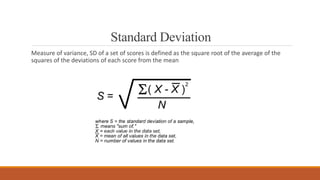
Standard Deviation
Measure of variance, SD of a set of scores is defined as the square root of the average of the
squares of the deviations of each score from the mean
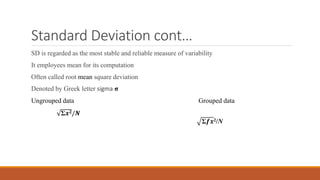
Standard Deviation contโ€ฆ
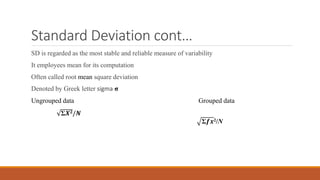
SD is regarded as the most stable and reliable measure of variability
It employees mean for its computation
Often called root mean square deviation
Denoted by Greek letter sigma ฯƒ
Ungrouped data Grouped data
ฮฃ๐’™๐Ÿ/๐‘ต
ฮฃ๐’‡๐’™2/N
Standard Deviation contโ€ฆ
SD is regarded as the most stable and reliable measure of variability
It employees mean for its computation
Often called root mean square deviation
Denoted by Greek letter sigma ฯƒ
Ungrouped data Grouped data
ฮฃ๐‘ฟ๐Ÿ/๐‘ต
ฮฃ๐’‡๐’™2/N
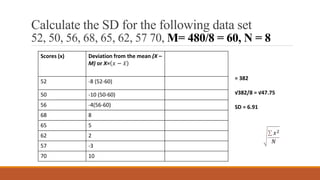
Calculate the SD for the following data set
52, 50, 56, 68, 65, 62, 57 70, M= 480/8 = 60, N = 8
Scores (x) Deviation from the mean (X โ€“
M) or X= ๐‘ฅ โˆ’ ๐‘ฅ
x2
52 -8 (52-60) 64
50 -10 (50-60) 100
56 -4(56-60) 16
68 8 64
65 5 25
62 2 4
57 -3 9
70 10 100
= 382
โˆš382/8 = โˆš47.75
SD = 6.91
๐‘ฅ2
๐‘
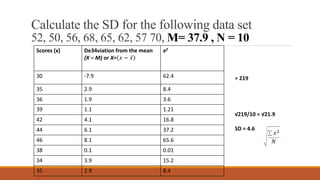
Calculate the SD for the following data set
52, 50, 56, 68, 65, 62, 57 70, M= 37.9 , N = 10
Scores (x) De34viation from the mean
(X โ€“ M) or X= ๐‘ฅ โˆ’ ๐‘ฅ
x2
30 -7.9 62.4
35 2.9 8.4
36 1.9 3.6
39 1.1 1.21
42 4.1 16.8
44 6.1 37.2
46 8.1 65.6
38 0.1 0.01
34 3.9 15.2
35 2.9 8.4
= 219
โˆš219/10 = โˆš21.9
SD = 4.6
๐‘ฅ2
๐‘
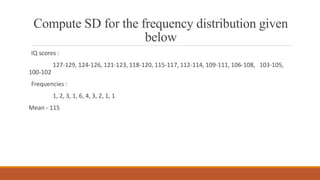
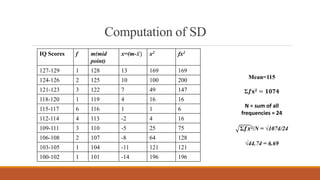
Compute SD for the frequency distribution given
below
IQ scores :
127-129, 124-126, 121-123, 118-120, 115-117, 112-114, 109-111, 106-108, 103-105,
100-102
Frequencies :
1, 2, 3, 1, 6, 4, 3, 2, 1, 1
Mean - 115
Computation of SD
IQ Scores f m(mid
point)
x=(m-๐‘ฅ) x2 fx2
127-129 1 128 13 169 169
124-126 2 125 10 100 200
121-123 3 122 7 49 147
118-120 1 119 4 16 16
115-117 6 116 1 1 6
112-114 4 113 -2 4 16
109-111 3 110 -5 25 75
106-108 2 107 -8 64 128
103-105 1 104 -11 121 121
100-102 1 101 -14 196 196
Mean=115
ฮฃ๐’‡๐ฑ๐Ÿ = ๐Ÿ๐ŸŽ๐Ÿ•๐Ÿ’
N = sum of all
frequencies = 24
ฮฃ๐’‡๐’™2/N = โˆš1074/24
โˆš44.74 = 6.69
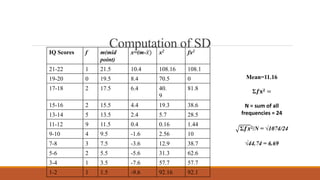
Computation of SD
IQ Scores f m(mid
point)
x=(m-๐‘ฅ) x2 fx2
21-22 1 21.5 10.4 108.16 108.1
19-20 0 19.5 8.4 70.5 0
17-18 2 17.5 6.4 40.
9
81.8
15-16 2 15.5 4.4 19.3 38.6
13-14 5 13.5 2.4 5.7 28.5
11-12 9 11.5 0.4 0.16 1.44
9-10 4 9.5 -1.6 2.56 10
7-8 3 7.5 -3.6 12.9 38.7
5-6 2 5.5 -5.6 31.3 62.6
3-4 1 3.5 -7.6 57.7 57.7
1-2 1 1.5 -9.6 92.16 92.1
Mean=11.16
ฮฃ๐’‡๐ฑ๐Ÿ =
N = sum of all
frequencies = 24
ฮฃ๐’‡๐’™2/N = โˆš1074/24
โˆš44.74 = 6.69
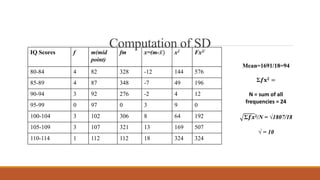
Computation of SD
IQ Scores f m(mid
point)
fm x=(m-๐‘ฅ) x2 Fx2/
80-84 4 82 328 -12 144 576
85-89 4 87 348 -7 49 196
90-94 3 92 276 -2 4 12
95-99 0 97 0 3 9 0
100-104 3 102 306 8 64 192
105-109 3 107 321 13 169 507
110-114 1 112 112 18 324 324
Mean=1691/18=94
ฮฃ๐’‡๐ฑ๐Ÿ =
N = sum of all
frequencies = 24
ฮฃ๐’‡๐’™2/N = โˆš1807/18
โˆš = 10
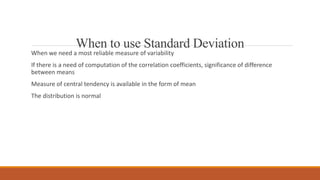
When to use Standard Deviation
When we need a most reliable measure of variability
If there is a need of computation of the correlation coefficients, significance of difference
between means
Measure of central tendency is available in the form of mean
The distribution is normal
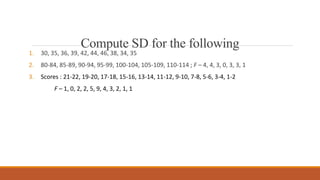
Compute SD for the following
1. 30, 35, 36, 39, 42, 44, 46, 38, 34, 35
2. 80-84, 85-89, 90-94, 95-99, 100-104, 105-109, 110-114 ; F โ€“ 4, 4, 3, 0, 3, 3, 1
3. Scores : 21-22, 19-20, 17-18, 15-16, 13-14, 11-12, 9-10, 7-8, 5-6, 3-4, 1-2
F โ€“ 1, 0, 2, 2, 5, 9, 4, 3, 2, 1, 1
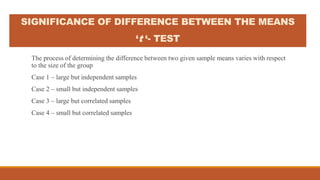
SIGNIFICANCE OF DIFFERENCE BETWEEN THE MEANS
โ€˜t โ€˜- TEST
The process of determining the difference between two given sample means varies with respect
to the size of the group
Case 1 โ€“ large but independent samples
Case 2 โ€“ small but independent samples
Case 3 โ€“ large but correlated samples
Case 4 โ€“ small but correlated samples
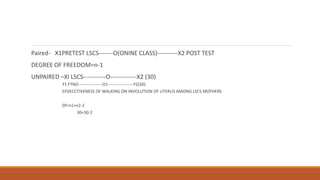
Paired- X1PRETEST LSCS-------O(ONINE CLASS)----------X2 POST TEST
DEGREE OF FREEDOM=n-1
UNPAIRED โ€“XI LSCS-----------O-------------X2 (30)
Y1 FTND-----------------O1------------------Y2(30)
EFDECCTIVENESS OF WALKING ON INVOLUTION OF UTERUS AMONG LSCS MOTHERS
Df=n1+n2-2
30+30-2
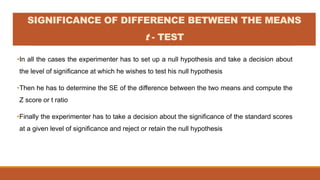
โ€ขIn all the cases the experimenter has to set up a null hypothesis and take a decision about
the level of significance at which he wishes to test his null hypothesis
โ€ขThen he has to determine the SE of the difference between the two means and compute the
Z score or t ratio
โ€ขFinally the experimenter has to take a decision about the significance of the standard scores
at a given level of significance and reject or retain the null hypothesis
SIGNIFICANCE OF DIFFERENCE BETWEEN THE MEANS
t - TEST
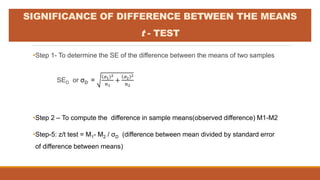
โ€ขStep 1- To determine the SE of the difference between the means of two samples
SED or ฯƒD =
๐œŽ1
2
๐‘›1
+
๐œŽ2
2
๐‘›2
โ€ขStep 2 โ€“ To compute the difference in sample means(observed difference) M1-M2
โ€ขStep-5: z/t test = M1- M2 / ฯƒD (difference between mean divided by standard error
of difference between means)
SIGNIFICANCE OF DIFFERENCE BETWEEN THE MEANS
t - TEST
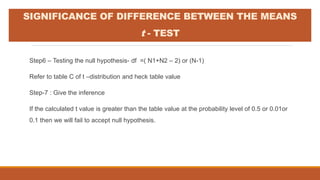
Step6 โ€“ Testing the null hypothesis- df =( N1+N2 โ€“ 2) or (N-1)
Refer to table C of t โ€“distribution and heck table value
Step-7 : Give the inference
If the calculated t value is greater than the table value at the probability level of 0.5 or 0.01or
0.1 then we will fail to accept null hypothesis.
SIGNIFICANCE OF DIFFERENCE BETWEEN THE MEANS
t - TEST
PROCEDURE- FOR CASE1&2
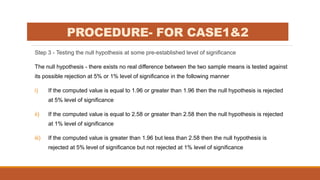
Step 3 - Testing the null hypothesis at some pre-established level of significance
The null hypothesis - there exists no real difference between the two sample means is tested against
its possible rejection at 5% or 1% level of significance in the following manner
i) If the computed value is equal to 1.96 or greater than 1.96 then the null hypothesis is rejected
at 5% level of significance
ii) If the computed value is equal to 2.58 or greater than 2.58 then the null hypothesis is rejected
at 1% level of significance
iii) If the computed value is greater than 1.96 but less than 2.58 then the null hypothesis is
rejected at 5% level of significance but not rejected at 1% level of significance
ILLUSTRATION
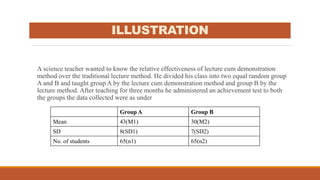
A science teacher wanted to know the relative effectiveness of lecture cum demonstration
method over the traditional lecture method. He divided his class into two equal random group
A and B and taught group A by the lecture cum demonstration method and group B by the
lecture method. After teaching for three months he administered an achievement test to both
the groups the data collected were as under
Group A Group B
Mean 43(M1) 30(M2)
SD 8(SD1) 7(SD2)
No. of students 65(n1) 65(n2)
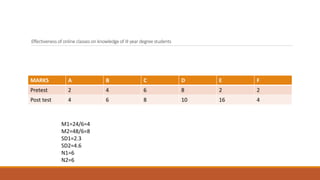
Effectiveness of online classes on knowledge of III year degree students
MARKS A B C D E F
Pretest 2 4 6 8 2 2
Post test 4 6 8 10 16 4
M1=24/6=4
M2=48/6=8
SD1=2.3
SD2=4.6
N1=6
N2=6
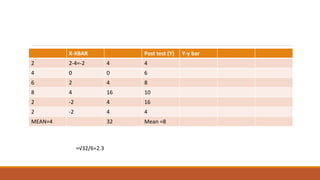
X-XBAR Post test (Y) Y-y bar
2 2-4=-2 4 4
4 0 0 6
6 2 4 8
8 4 16 10
2 -2 4 16
2 -2 4 4
MEAN=4 32 Mean =8
=โˆš32/6=2.3
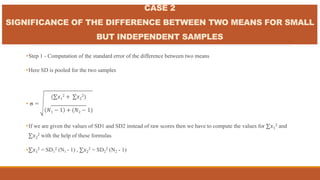
CASE 2
SIGNIFICANCE OF THE DIFFERENCE BETWEEN TWO MEANS FOR SMALL
BUT INDEPENDENT SAMPLES
โ€ขStep 1 - Computation of the standard error of the difference between two means
โ€ขHere SD is pooled for the two samples
โ€ข ฯƒ =
( ๐‘ฅ1
2 + ๐‘ฅ2
2)
_________________
๐‘1 โˆ’ 1 + (๐‘2 โˆ’ 1)
โ€ขIf we are given the values of SD1 and SD2 instead of raw scores then we have to compute the values for ๐‘ฅ1
2 and
๐‘ฅ2
2 with the help of these formulas
โ€ข ๐‘ฅ1
2 = SD1
2 (N1 - 1) , ๐‘ฅ2
2 = SD2
2 (N2 - 1)
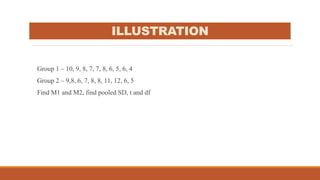
ILLUSTRATION
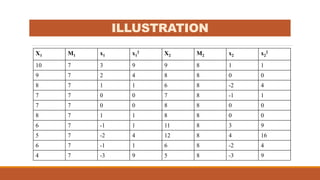
Group 1 โ€“ 10, 9, 8, 7, 7, 8, 6, 5, 6, 4
Group 2 โ€“ 9,8, 6, 7, 8, 8, 11, 12, 6, 5
Find M1 and M2, find pooled SD, t and df
ILLUSTRATION
X1 M1 x1 x1
2 X2 M2 x2 x2
2
10 7 3 9 9 8 1 1
9 7 2 4 8 8 0 0
8 7 1 1 6 8 -2 4
7 7 0 0 7 8 -1 1
7 7 0 0 8 8 0 0
8 7 1 1 8 8 0 0
6 7 -1 1 11 8 3 9
5 7 -2 4 12 8 4 16
6 7 -1 1 6 8 -2 4
4 7 -3 9 5 8 -3 9
PRACTICE
A language teacher divides the class into two groups experimental group and control group.
Under the assumption that newspaper reading will increase the vocabulary the experimental
group was given two hours daily to read English newspapers and magazines while no such
facility was provided to the control group. After 6 months both the groups were given a
vocabulary test and the scores obtained are detailed below
Experimental group โ€“ 115, 112, 109, 112, 137
Control group โ€“ 110, 112, 95, 105, 111, 97, 112,102
CASE 3 AND 4
SIGNIFICANCE OF THE DIFFERENCE BETWEEN TWO MEANS FOR
CORRELATED SAMPLES โ€“ LARGE AND SMALL
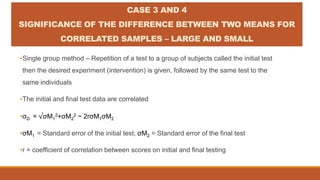
โ€ขSingle group method โ€“ Repetition of a test to a group of subjects called the initial test
then the desired experiment (intervention) is given, followed by the same test to the
same individuals
โ€ขThe initial and final test data are correlated
โ€ขฯƒD = โˆšฯƒM1
2+ฯƒM2
2 โˆ’ 2rฯƒM1ฯƒM2
โ€ขฯƒM1 = Standard error of the initial test, ฯƒM2 = Standard error of the final test
โ€ขr = coefficient of correlation between scores on initial and final testing
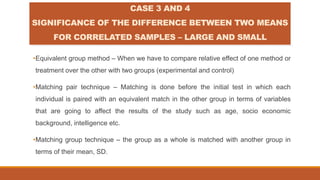
โ€ขEquivalent group method โ€“ When we have to compare relative effect of one method or
treatment over the other with two groups (experimental and control)
โ€ขMatching pair technique โ€“ Matching is done before the initial test in which each
individual is paired with an equivalent match in the other group in terms of variables
that are going to affect the results of the study such as age, socio economic
background, intelligence etc.
โ€ขMatching group technique โ€“ the group as a whole is matched with another group in
terms of their mean, SD.
CASE 3 AND 4
SIGNIFICANCE OF THE DIFFERENCE BETWEEN TWO MEANS
FOR CORRELATED SAMPLES โ€“ LARGE AND SMALL
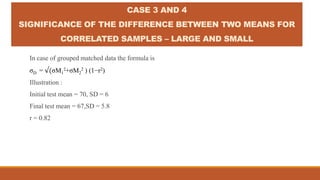
In case of grouped matched data the formula is
ฯƒD = โˆš(ฯƒM1
2+ฯƒM2
2 ) (1โˆ’r2)
Illustration :
Initial test mean = 70, SD = 6
Final test mean = 67,SD = 5.8
r = 0.82
CASE 3 AND 4
SIGNIFICANCE OF THE DIFFERENCE BETWEEN TWO MEANS FOR
CORRELATED SAMPLES โ€“ LARGE AND SMALL

Sd,t test

  • 1.
  • 2.
    DIFFERENCE BETWEEN PARAMETRICAND NON PARAMETRIC STATISTICS PARAMETRIC NON-PARAMETRIC The data should be normally distributed Distribution free(skewed, outliers) Homogeneity of variance Homogeneous or heterogeneous Ratio or interval data Nominal or ordinal data Independent data Any Measure of central tendency - Mean Measure of central tendency โ€“ Median Sample size should be large Small sample size Useful in drawing conclusions and generalizations Simple and less effective t-test, ANOVA, Pearsonโ€™s correlation, MANOVA, ANCOVA, Regression Chi-square, Mann Whitney U test, Sign test, Kruskal wallis test, Spearman's Rho
  • 3.
    Standard Deviation Measure ofvariance, SD of a set of scores is defined as the square root of the average of the squares of the deviations of each score from the mean
  • 4.
    Standard Deviation contโ€ฆ SDis regarded as the most stable and reliable measure of variability It employees mean for its computation Often called root mean square deviation Denoted by Greek letter sigma ฯƒ Ungrouped data Grouped data ฮฃ๐’™๐Ÿ/๐‘ต ฮฃ๐’‡๐’™2/N
  • 5.
    Standard Deviation contโ€ฆ SDis regarded as the most stable and reliable measure of variability It employees mean for its computation Often called root mean square deviation Denoted by Greek letter sigma ฯƒ Ungrouped data Grouped data ฮฃ๐‘ฟ๐Ÿ/๐‘ต ฮฃ๐’‡๐’™2/N
  • 6.
    Calculate the SDfor the following data set 52, 50, 56, 68, 65, 62, 57 70, M= 480/8 = 60, N = 8 Scores (x) Deviation from the mean (X โ€“ M) or X= ๐‘ฅ โˆ’ ๐‘ฅ x2 52 -8 (52-60) 64 50 -10 (50-60) 100 56 -4(56-60) 16 68 8 64 65 5 25 62 2 4 57 -3 9 70 10 100 = 382 โˆš382/8 = โˆš47.75 SD = 6.91 ๐‘ฅ2 ๐‘
  • 7.
    Calculate the SDfor the following data set 52, 50, 56, 68, 65, 62, 57 70, M= 37.9 , N = 10 Scores (x) De34viation from the mean (X โ€“ M) or X= ๐‘ฅ โˆ’ ๐‘ฅ x2 30 -7.9 62.4 35 2.9 8.4 36 1.9 3.6 39 1.1 1.21 42 4.1 16.8 44 6.1 37.2 46 8.1 65.6 38 0.1 0.01 34 3.9 15.2 35 2.9 8.4 = 219 โˆš219/10 = โˆš21.9 SD = 4.6 ๐‘ฅ2 ๐‘
  • 8.
    Compute SD forthe frequency distribution given below IQ scores : 127-129, 124-126, 121-123, 118-120, 115-117, 112-114, 109-111, 106-108, 103-105, 100-102 Frequencies : 1, 2, 3, 1, 6, 4, 3, 2, 1, 1 Mean - 115
  • 9.
    Computation of SD IQScores f m(mid point) x=(m-๐‘ฅ) x2 fx2 127-129 1 128 13 169 169 124-126 2 125 10 100 200 121-123 3 122 7 49 147 118-120 1 119 4 16 16 115-117 6 116 1 1 6 112-114 4 113 -2 4 16 109-111 3 110 -5 25 75 106-108 2 107 -8 64 128 103-105 1 104 -11 121 121 100-102 1 101 -14 196 196 Mean=115 ฮฃ๐’‡๐ฑ๐Ÿ = ๐Ÿ๐ŸŽ๐Ÿ•๐Ÿ’ N = sum of all frequencies = 24 ฮฃ๐’‡๐’™2/N = โˆš1074/24 โˆš44.74 = 6.69
  • 10.
    Computation of SD IQScores f m(mid point) x=(m-๐‘ฅ) x2 fx2 21-22 1 21.5 10.4 108.16 108.1 19-20 0 19.5 8.4 70.5 0 17-18 2 17.5 6.4 40. 9 81.8 15-16 2 15.5 4.4 19.3 38.6 13-14 5 13.5 2.4 5.7 28.5 11-12 9 11.5 0.4 0.16 1.44 9-10 4 9.5 -1.6 2.56 10 7-8 3 7.5 -3.6 12.9 38.7 5-6 2 5.5 -5.6 31.3 62.6 3-4 1 3.5 -7.6 57.7 57.7 1-2 1 1.5 -9.6 92.16 92.1 Mean=11.16 ฮฃ๐’‡๐ฑ๐Ÿ = N = sum of all frequencies = 24 ฮฃ๐’‡๐’™2/N = โˆš1074/24 โˆš44.74 = 6.69
  • 11.
    Computation of SD IQScores f m(mid point) fm x=(m-๐‘ฅ) x2 Fx2/ 80-84 4 82 328 -12 144 576 85-89 4 87 348 -7 49 196 90-94 3 92 276 -2 4 12 95-99 0 97 0 3 9 0 100-104 3 102 306 8 64 192 105-109 3 107 321 13 169 507 110-114 1 112 112 18 324 324 Mean=1691/18=94 ฮฃ๐’‡๐ฑ๐Ÿ = N = sum of all frequencies = 24 ฮฃ๐’‡๐’™2/N = โˆš1807/18 โˆš = 10
  • 12.
    When to useStandard Deviation When we need a most reliable measure of variability If there is a need of computation of the correlation coefficients, significance of difference between means Measure of central tendency is available in the form of mean The distribution is normal
  • 13.
    Compute SD forthe following 1. 30, 35, 36, 39, 42, 44, 46, 38, 34, 35 2. 80-84, 85-89, 90-94, 95-99, 100-104, 105-109, 110-114 ; F โ€“ 4, 4, 3, 0, 3, 3, 1 3. Scores : 21-22, 19-20, 17-18, 15-16, 13-14, 11-12, 9-10, 7-8, 5-6, 3-4, 1-2 F โ€“ 1, 0, 2, 2, 5, 9, 4, 3, 2, 1, 1
  • 14.
    SIGNIFICANCE OF DIFFERENCEBETWEEN THE MEANS โ€˜t โ€˜- TEST The process of determining the difference between two given sample means varies with respect to the size of the group Case 1 โ€“ large but independent samples Case 2 โ€“ small but independent samples Case 3 โ€“ large but correlated samples Case 4 โ€“ small but correlated samples
  • 15.
    Paired- X1PRETEST LSCS-------O(ONINECLASS)----------X2 POST TEST DEGREE OF FREEDOM=n-1 UNPAIRED โ€“XI LSCS-----------O-------------X2 (30) Y1 FTND-----------------O1------------------Y2(30) EFDECCTIVENESS OF WALKING ON INVOLUTION OF UTERUS AMONG LSCS MOTHERS Df=n1+n2-2 30+30-2
  • 16.
    โ€ขIn all thecases the experimenter has to set up a null hypothesis and take a decision about the level of significance at which he wishes to test his null hypothesis โ€ขThen he has to determine the SE of the difference between the two means and compute the Z score or t ratio โ€ขFinally the experimenter has to take a decision about the significance of the standard scores at a given level of significance and reject or retain the null hypothesis SIGNIFICANCE OF DIFFERENCE BETWEEN THE MEANS t - TEST
  • 17.
    โ€ขStep 1- Todetermine the SE of the difference between the means of two samples SED or ฯƒD = ๐œŽ1 2 ๐‘›1 + ๐œŽ2 2 ๐‘›2 โ€ขStep 2 โ€“ To compute the difference in sample means(observed difference) M1-M2 โ€ขStep-5: z/t test = M1- M2 / ฯƒD (difference between mean divided by standard error of difference between means) SIGNIFICANCE OF DIFFERENCE BETWEEN THE MEANS t - TEST
  • 18.
    Step6 โ€“ Testingthe null hypothesis- df =( N1+N2 โ€“ 2) or (N-1) Refer to table C of t โ€“distribution and heck table value Step-7 : Give the inference If the calculated t value is greater than the table value at the probability level of 0.5 or 0.01or 0.1 then we will fail to accept null hypothesis. SIGNIFICANCE OF DIFFERENCE BETWEEN THE MEANS t - TEST
  • 19.
    PROCEDURE- FOR CASE1&2 Step3 - Testing the null hypothesis at some pre-established level of significance The null hypothesis - there exists no real difference between the two sample means is tested against its possible rejection at 5% or 1% level of significance in the following manner i) If the computed value is equal to 1.96 or greater than 1.96 then the null hypothesis is rejected at 5% level of significance ii) If the computed value is equal to 2.58 or greater than 2.58 then the null hypothesis is rejected at 1% level of significance iii) If the computed value is greater than 1.96 but less than 2.58 then the null hypothesis is rejected at 5% level of significance but not rejected at 1% level of significance
  • 20.
    ILLUSTRATION A science teacherwanted to know the relative effectiveness of lecture cum demonstration method over the traditional lecture method. He divided his class into two equal random group A and B and taught group A by the lecture cum demonstration method and group B by the lecture method. After teaching for three months he administered an achievement test to both the groups the data collected were as under Group A Group B Mean 43(M1) 30(M2) SD 8(SD1) 7(SD2) No. of students 65(n1) 65(n2)
  • 21.
    Effectiveness of onlineclasses on knowledge of III year degree students MARKS A B C D E F Pretest 2 4 6 8 2 2 Post test 4 6 8 10 16 4 M1=24/6=4 M2=48/6=8 SD1=2.3 SD2=4.6 N1=6 N2=6
  • 22.
    X-XBAR Post test(Y) Y-y bar 2 2-4=-2 4 4 4 0 0 6 6 2 4 8 8 4 16 10 2 -2 4 16 2 -2 4 4 MEAN=4 32 Mean =8 =โˆš32/6=2.3
  • 23.
    CASE 2 SIGNIFICANCE OFTHE DIFFERENCE BETWEEN TWO MEANS FOR SMALL BUT INDEPENDENT SAMPLES โ€ขStep 1 - Computation of the standard error of the difference between two means โ€ขHere SD is pooled for the two samples โ€ข ฯƒ = ( ๐‘ฅ1 2 + ๐‘ฅ2 2) _________________ ๐‘1 โˆ’ 1 + (๐‘2 โˆ’ 1) โ€ขIf we are given the values of SD1 and SD2 instead of raw scores then we have to compute the values for ๐‘ฅ1 2 and ๐‘ฅ2 2 with the help of these formulas โ€ข ๐‘ฅ1 2 = SD1 2 (N1 - 1) , ๐‘ฅ2 2 = SD2 2 (N2 - 1)
  • 24.
    ILLUSTRATION Group 1 โ€“10, 9, 8, 7, 7, 8, 6, 5, 6, 4 Group 2 โ€“ 9,8, 6, 7, 8, 8, 11, 12, 6, 5 Find M1 and M2, find pooled SD, t and df
  • 25.
    ILLUSTRATION X1 M1 x1x1 2 X2 M2 x2 x2 2 10 7 3 9 9 8 1 1 9 7 2 4 8 8 0 0 8 7 1 1 6 8 -2 4 7 7 0 0 7 8 -1 1 7 7 0 0 8 8 0 0 8 7 1 1 8 8 0 0 6 7 -1 1 11 8 3 9 5 7 -2 4 12 8 4 16 6 7 -1 1 6 8 -2 4 4 7 -3 9 5 8 -3 9
  • 26.
    PRACTICE A language teacherdivides the class into two groups experimental group and control group. Under the assumption that newspaper reading will increase the vocabulary the experimental group was given two hours daily to read English newspapers and magazines while no such facility was provided to the control group. After 6 months both the groups were given a vocabulary test and the scores obtained are detailed below Experimental group โ€“ 115, 112, 109, 112, 137 Control group โ€“ 110, 112, 95, 105, 111, 97, 112,102
  • 27.
    CASE 3 AND4 SIGNIFICANCE OF THE DIFFERENCE BETWEEN TWO MEANS FOR CORRELATED SAMPLES โ€“ LARGE AND SMALL โ€ขSingle group method โ€“ Repetition of a test to a group of subjects called the initial test then the desired experiment (intervention) is given, followed by the same test to the same individuals โ€ขThe initial and final test data are correlated โ€ขฯƒD = โˆšฯƒM1 2+ฯƒM2 2 โˆ’ 2rฯƒM1ฯƒM2 โ€ขฯƒM1 = Standard error of the initial test, ฯƒM2 = Standard error of the final test โ€ขr = coefficient of correlation between scores on initial and final testing
  • 28.
    โ€ขEquivalent group methodโ€“ When we have to compare relative effect of one method or treatment over the other with two groups (experimental and control) โ€ขMatching pair technique โ€“ Matching is done before the initial test in which each individual is paired with an equivalent match in the other group in terms of variables that are going to affect the results of the study such as age, socio economic background, intelligence etc. โ€ขMatching group technique โ€“ the group as a whole is matched with another group in terms of their mean, SD. CASE 3 AND 4 SIGNIFICANCE OF THE DIFFERENCE BETWEEN TWO MEANS FOR CORRELATED SAMPLES โ€“ LARGE AND SMALL
  • 29.
    In case ofgrouped matched data the formula is ฯƒD = โˆš(ฯƒM1 2+ฯƒM2 2 ) (1โˆ’r2) Illustration : Initial test mean = 70, SD = 6 Final test mean = 67,SD = 5.8 r = 0.82 CASE 3 AND 4 SIGNIFICANCE OF THE DIFFERENCE BETWEEN TWO MEANS FOR CORRELATED SAMPLES โ€“ LARGE AND SMALL