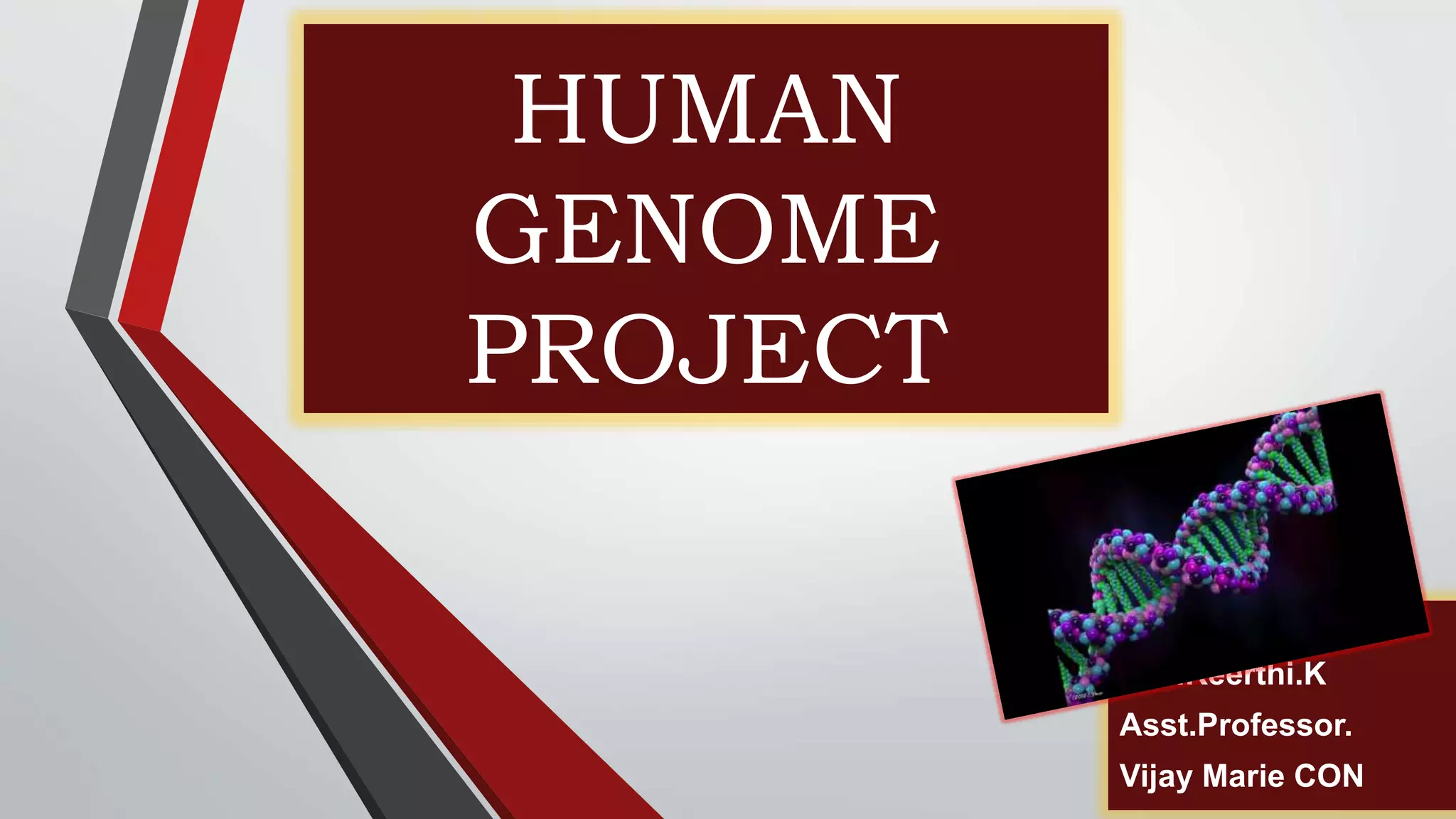
HUMAN
GENOME
PROJECT
BY:
Mrs.Keerthi.K
Asst.Professor.
Vijay Marie CON
INTRODUCTION
• The term genome denotes to the total gene pool of an organism.
• Human genome is made up of myriad combination of four bases
A,C,T,G. These four bases joined in specific combinations to
produce all the necessary proteins to sustain the life.
• These four bases along with other factors determines how we
look and our characters.
INTRODUCTION
• The Human Genome Project (HGP) was an international
project that aimed to determine the complete sequence of
nucleotide base pairs that makeup human DNA and all the
genes it contains.
• It remains worlds largest collaborative biological project.
• The idea was picked up by in1984by the US government when
the planning started, was formally launched in 1990 and was
declared completed in 2003
GOALS
• To identify and map all the 20,000-25,000 genes in the human DNA from a
physical and functional stand point.
• To determine the sequences of the 3 billion chemical base pairs that make
human DNA.
• To store the information in databases.
• To determine more efficient technologies for data analysis.
• Allow the private sector access to the information's and technologies that
arise from this project
• To sequence the genomes of other organisms that are important in medical
research such as mouse drosophila etc.
• To address ethical, legal and social issues that may arise from the project,
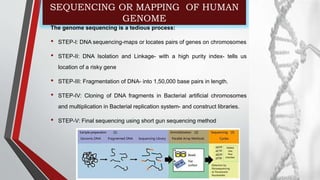
SEQUENCING OR MAPPING OF HUMAN
GENOME
The genome sequencing is a tedious process:
• STEP-I: DNA sequencing-maps or locates pairs of genes on chromosomes
• STEP-II: DNA Isolation and Linkage- with a high purity index- tells us
location of a risky gene
• STEP-III: Fragmentation of DNA- into 1,50,000 base pairs in length.
• STEP-IV: Cloning of DNA fragments in Bacterial artificial chromosomes
and multiplication in Bacterial replication system- and construct libraries.
• STEP-V: Final sequencing using short gun sequencing method
APPLICATION OF HGP- IN MEDICINE
• Used to diagnose various genetic diseases.
• Witnessed a revolution in molecular understanding of the diseases
including Fragile X syndrome, type I and II DM, inherited colon cancer,
Alzheimer's disease, familial breast cancer, myotonic dystrophy etc.
• Invention of customized drug medicine.
• Early detection of genetic diseases
• Improved pharmacogenomics
• Gene therapy
• Novel and rational drug design
APPLICATION OF HGP- IN AGRICULTURE
AND LIVESTOCK
• Draught and insect resistant plants.
• This would ultimately lead to reduction in cost of agricultural production.
• Breed healthier, more productive and disease resistant farm animals
• Develop biopesticides
• Incorporate edible vaccines into food products
• Develop new environmental cleanup uses for plants like tobacco.
APPLICATION OF HGP- IN RISK ASSESSMENT
• Assess health damage and risks caused by radiation exposure including
low dose exposure
• Assess health damage and risk caused by exposure to mutagenic
chemicals and cancer causing toxins
• Reduce likelihood of heritable mutations
• Improve diagnose of disease
• Defect genetic predisposition of diseases
• Create drugs based on molecular information
• Use gene therapy and control systems as drugs
• Design ‘custom drugs’ based on individual
genetic profiles.
• Rapid detection and treatment of
pathogens in clinical practice.
• Develop energy resources (biofuels)
• Monitor environment to detect pollutants
• Protect citizens from biological and
chemical warfare
• Clean up toxic waste safely and efficiently
APPLICATION OF HUMAN GENOME PROJECT
MOLECULAR MEDICINE MICROBIAL GENOMICS
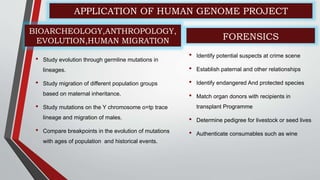
• Study evolution through germline mutations in
lineages.
• Study migration of different population groups
based on maternal inheritance.
• Study mutations on the Y chromosome o=tp trace
lineage and migration of males.
• Compare breakpoints in the evolution of mutations
with ages of population and historical events.
• Identify potential suspects at crime scene
• Establish paternal and other relationships
• Identify endangered And protected species
• Match organ donors with recipients in
transplant Programme
• Determine pedigree for livestock or seed lives
• Authenticate consumables such as wine
APPLICATION OF HUMAN GENOME PROJECT
BIOARCHEOLOGY,ANTHROPOLOGY,
EVOLUTION,HUMAN MIGRATION FORENSICS
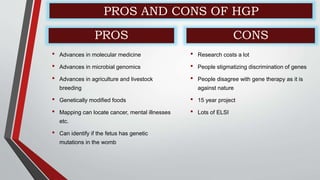
• Advances in molecular medicine
• Advances in microbial genomics
• Advances in agriculture and livestock
breeding
• Genetically modified foods
• Mapping can locate cancer, mental illnesses
etc.
• Can identify if the fetus has genetic
mutations in the womb
• Research costs a lot
• People stigmatizing discrimination of genes
• People disagree with gene therapy as it is
against nature
• 15 year project
• Lots of ELSI
PROS AND CONS OF HGP
PROS CONS
ELSI IN HUMAN GENOME PROJECT
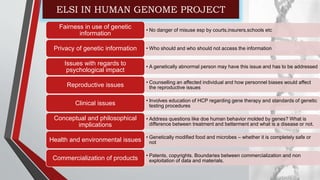
• No danger of misuse esp by courts,insurers,schools etc
Fairness in use of genetic
information
• Who should and who should not access the information
Privacy of genetic information
• A genetically abnormal person may have this issue and has to be addressed
Issues with regards to
psychological impact
• Counselling an affected individual and how personnel biases would affect
the reproductive issues
Reproductive issues
• Involves education of HCP regarding gene therapy and standards of genetic
testing procedures
Clinical issues
• Address questions like doe human behavior molded by genes? What is
difference between treatment and betterment and what is a disease or not.
Conceptual and philosophical
implications
• Genetically modified food and microbes – whether it is completely safe or
not
Health and environmental issues
• Patents, copyrights. Boundaries between commercialization and non
exploitation of data and materials.
Commercialization of products

Human genome project [autosaved]

  • 1.
  • 2.
    INTRODUCTION • The termgenome denotes to the total gene pool of an organism. • Human genome is made up of myriad combination of four bases A,C,T,G. These four bases joined in specific combinations to produce all the necessary proteins to sustain the life. • These four bases along with other factors determines how we look and our characters.
  • 3.
    INTRODUCTION • The HumanGenome Project (HGP) was an international project that aimed to determine the complete sequence of nucleotide base pairs that makeup human DNA and all the genes it contains. • It remains worlds largest collaborative biological project. • The idea was picked up by in1984by the US government when the planning started, was formally launched in 1990 and was declared completed in 2003
  • 4.
    GOALS • To identifyand map all the 20,000-25,000 genes in the human DNA from a physical and functional stand point. • To determine the sequences of the 3 billion chemical base pairs that make human DNA. • To store the information in databases. • To determine more efficient technologies for data analysis. • Allow the private sector access to the information's and technologies that arise from this project • To sequence the genomes of other organisms that are important in medical research such as mouse drosophila etc. • To address ethical, legal and social issues that may arise from the project,
  • 5.
    SEQUENCING OR MAPPINGOF HUMAN GENOME The genome sequencing is a tedious process: • STEP-I: DNA sequencing-maps or locates pairs of genes on chromosomes • STEP-II: DNA Isolation and Linkage- with a high purity index- tells us location of a risky gene • STEP-III: Fragmentation of DNA- into 1,50,000 base pairs in length. • STEP-IV: Cloning of DNA fragments in Bacterial artificial chromosomes and multiplication in Bacterial replication system- and construct libraries. • STEP-V: Final sequencing using short gun sequencing method
  • 6.
    APPLICATION OF HGP-IN MEDICINE • Used to diagnose various genetic diseases. • Witnessed a revolution in molecular understanding of the diseases including Fragile X syndrome, type I and II DM, inherited colon cancer, Alzheimer's disease, familial breast cancer, myotonic dystrophy etc. • Invention of customized drug medicine. • Early detection of genetic diseases • Improved pharmacogenomics • Gene therapy • Novel and rational drug design
  • 7.
    APPLICATION OF HGP-IN AGRICULTURE AND LIVESTOCK • Draught and insect resistant plants. • This would ultimately lead to reduction in cost of agricultural production. • Breed healthier, more productive and disease resistant farm animals • Develop biopesticides • Incorporate edible vaccines into food products • Develop new environmental cleanup uses for plants like tobacco. APPLICATION OF HGP- IN RISK ASSESSMENT • Assess health damage and risks caused by radiation exposure including low dose exposure • Assess health damage and risk caused by exposure to mutagenic chemicals and cancer causing toxins • Reduce likelihood of heritable mutations
  • 8.
    • Improve diagnoseof disease • Defect genetic predisposition of diseases • Create drugs based on molecular information • Use gene therapy and control systems as drugs • Design ‘custom drugs’ based on individual genetic profiles. • Rapid detection and treatment of pathogens in clinical practice. • Develop energy resources (biofuels) • Monitor environment to detect pollutants • Protect citizens from biological and chemical warfare • Clean up toxic waste safely and efficiently APPLICATION OF HUMAN GENOME PROJECT MOLECULAR MEDICINE MICROBIAL GENOMICS
  • 9.
    • Study evolutionthrough germline mutations in lineages. • Study migration of different population groups based on maternal inheritance. • Study mutations on the Y chromosome o=tp trace lineage and migration of males. • Compare breakpoints in the evolution of mutations with ages of population and historical events. • Identify potential suspects at crime scene • Establish paternal and other relationships • Identify endangered And protected species • Match organ donors with recipients in transplant Programme • Determine pedigree for livestock or seed lives • Authenticate consumables such as wine APPLICATION OF HUMAN GENOME PROJECT BIOARCHEOLOGY,ANTHROPOLOGY, EVOLUTION,HUMAN MIGRATION FORENSICS
  • 10.
    • Advances inmolecular medicine • Advances in microbial genomics • Advances in agriculture and livestock breeding • Genetically modified foods • Mapping can locate cancer, mental illnesses etc. • Can identify if the fetus has genetic mutations in the womb • Research costs a lot • People stigmatizing discrimination of genes • People disagree with gene therapy as it is against nature • 15 year project • Lots of ELSI PROS AND CONS OF HGP PROS CONS
  • 11.
    ELSI IN HUMANGENOME PROJECT • No danger of misuse esp by courts,insurers,schools etc Fairness in use of genetic information • Who should and who should not access the information Privacy of genetic information • A genetically abnormal person may have this issue and has to be addressed Issues with regards to psychological impact • Counselling an affected individual and how personnel biases would affect the reproductive issues Reproductive issues • Involves education of HCP regarding gene therapy and standards of genetic testing procedures Clinical issues • Address questions like doe human behavior molded by genes? What is difference between treatment and betterment and what is a disease or not. Conceptual and philosophical implications • Genetically modified food and microbes – whether it is completely safe or not Health and environmental issues • Patents, copyrights. Boundaries between commercialization and non exploitation of data and materials. Commercialization of products