MEANING
•Determinants of learningrefer to the factors that influence how
effectively a person learns.
•Understanding these determinants allows educators to create
more personalized and effective teaching strategies that
accommodate learners' specific needs circumstances.
I.LEARNING NEEDS
•DEFINITION:
“Learning needsrefer to the gaps between a
learner's current knowledge or skills and what they need to
know or be able to do. Identifying these needs helps guide
what, how, and when learning should occur”.
5.
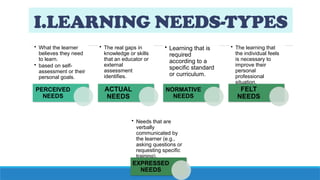
I.LEARNING NEEDS-TYPES
• Whatthe learner
believes they need
to learn.
• based on self-
assessment or their
personal goals.
PERCEIVED
NEEDS
• The real gaps in
knowledge or skills
that an educator or
external
assessment
identifies.
ACTUAL
NEEDS
• Learning that is
required
according to a
specific standard
or curriculum.
NORMATIVE
NEEDS
• The learning that
the individual feels
is necessary to
improve their
personal
professional
situation.
FELT
NEEDS
• Needs that are
verbally
communicated by
the learner (e.g.,
asking questions or
requesting specific
training).
EXPRESSED
NEEDS
6.
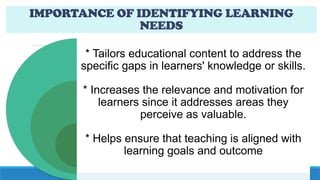
IMPORTANCE OF IDENTIFYINGLEARNING
NEEDS
* Tailors educational content to address the
specific gaps in learners' knowledge or skills.
* Increases the relevance and motivation for
learners since it addresses areas they
perceive as valuable.
* Helps ensure that teaching is aligned with
learning goals and outcome
7.
WAYS TO IDENTIFYLEARNING NEEDS
•Self-assessment: Learners reflect on what they already
know and what they need to learn.
•Assessment Tools: Pre-tests, diagnostic assessments, or
interviews to identify gaps in knowledge.
•Feedback from Peers and Instructors: Insights from
teachers or classmates about areas needing improvement.
8.
II.READINESS TO LEARN
DEFINITION:
“Readinessto learn refers to the physical,
emotional, and cognitive state of the learner that makes
them prepared and motivated to engage in learning. It
encompasses the learner's willingness and ability to learn at
a given time”.
9.
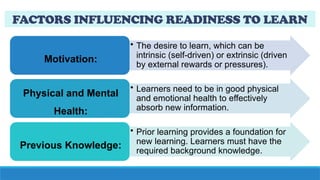
FACTORS INFLUENCING READINESSTO LEARN
• The desire to learn, which can be
intrinsic (self-driven) or extrinsic (driven
by external rewards or pressures).
Motivation:
• Learners need to be in good physical
and emotional health to effectively
absorb new information.
Physical and Mental
Health:
• Prior learning provides a foundation for
new learning. Learners must have the
required background knowledge.
Previous Knowledge:
10.
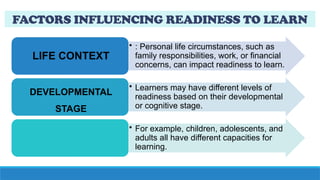
FACTORS INFLUENCING READINESSTO LEARN
• : Personal life circumstances, such as
family responsibilities, work, or financial
concerns, can impact readiness to learn.
LIFE CONTEXT
• Learners may have different levels of
readiness based on their developmental
or cognitive stage.
DEVELOPMENTAL
STAGE
• For example, children, adolescents, and
adults all have different capacities for
learning.
11.
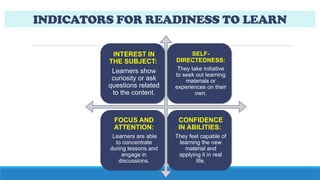
INDICATORS FOR READINESSTO LEARN
INTEREST IN
THE SUBJECT:
Learners show
curiosity or ask
questions related
to the content.
SELF-
DIRECTEDNESS:
They take initiative
to seek out learning
materials or
experiences on their
own.
FOCUS AND
ATTENTION:
Learners are able
to concentrate
during lessons and
engage in
discussions.
CONFIDENCE
IN ABILITIES:
They feel capable of
learning the new
material and
applying it in real
life.
12.
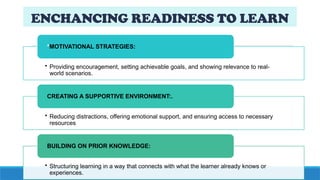
ENCHANCING READINESS TOLEARN
• Providing encouragement, setting achievable goals, and showing relevance to real-
world scenarios.
*MOTIVATIONAL STRATEGIES:
• Reducing distractions, offering emotional support, and ensuring access to necessary
resources
CREATING A SUPPORTIVE ENVIRONMENT:.
• Structuring learning in a way that connects with what the learner already knows or
experiences.
BUILDING ON PRIOR KNOWLEDGE:
13.
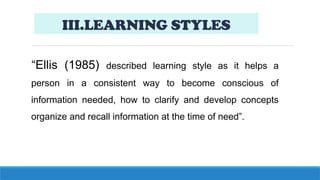
III.LEARNING STYLES
“Ellis (1985)described learning style as it helps a
person in a consistent way to become conscious of
information needed, how to clarify and develop concepts
organize and recall information at the time of need”.
14.
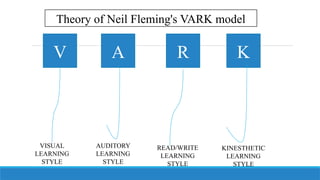
V A RK
VISUAL
LEARNING
STYLE
AUDITORY
LEARNING
STYLE
READ/WRITE
LEARNING
STYLE
KINESTHETIC
LEARNING
STYLE
Theory of Neil Fleming's VARK model
15.
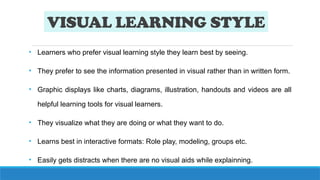
VISUAL LEARNING STYLE
•Learners who prefer visual learning style they learn best by seeing.
• They prefer to see the information presented in visual rather than in written form.
• Graphic displays like charts, diagrams, illustration, handouts and videos are all
helpful learning tools for visual learners.
• They visualize what they are doing or what they want to do.
• Learns best in interactive formats: Role play, modeling, groups etc.
• Easily gets distracts when there are no visual aids while explainning.
16.
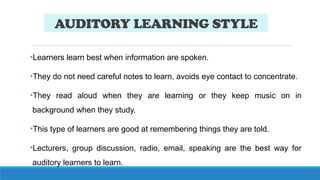
AUDITORY LEARNING STYLE
•Learnerslearn best when information are spoken.
•They do not need careful notes to learn, avoids eye contact to concentrate.
•They read aloud when they are learning or they keep music on in
background when they study.
•This type of learners are good at remembering things they are told.
•Lecturers, group discussion, radio, email, speaking are the best way for
auditory learners to learn.
17.
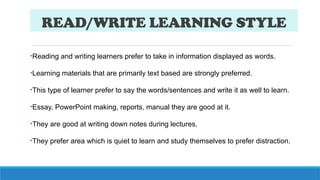
READ/WRITE LEARNING STYLE
•Readingand writing learners prefer to take in information displayed as words.
•Learning materials that are primarily text based are strongly preferred.
•This type of learner prefer to say the words/sentences and write it as well to learn.
•Essay, PowerPoint making, reports, manual they are good at it.
•They are good at writing down notes during lectures.
•They prefer area which is quiet to learn and study themselves to prefer distraction.
18.
KINESTHETIC LEARNING STYLE
•Thistype of learner prefers touch as their primarily mode for taking in information, they are
connected to reality.
•This learners need more and more practical work.
•They need opportunities for creativity, hands on learning, interaction with concrete materials.
•Learning is best accommodated through movements.
•This type of learners doesn’t like to seat at one place and learn they want to try things to get its
knowledge.
•They learn from lot of projects, new concrete personal experiences.
•They believe in doing things and learning, it also includes case study and application-based
learning.
19.
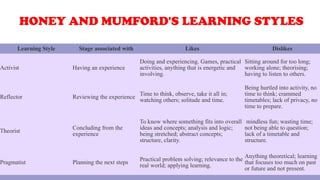
Learning Style Stageassociated with Likes Dislikes
Activist Having an experience
Doing and experiencing. Games, practical
activities, anything that is energetic and
involving.
Sitting around for too long;
working alone; theorising;
having to listen to others.
Reflector Reviewing the experience
Time to think, observe, take it all in;
watching others; solitude and time.
Being hurtled into activity, no
time to think; crammed
timetables; lack of privacy, no
time to prepare.
Theorist
Concluding from the
experience
To know where something fits into overall
ideas and concepts; analysis and logic;
being stretched; abstract concepts;
structure, clarity.
mindless fun; wasting time;
not being able to question;
lack of a timetable and
structure.
Pragmatist Planning the next steps
Practical problem solving; relevance to the
real world; applying learning.
Anything theoretical; learning
that focuses too much on past
or future and not present.
HONEY AND MUMFORD'S LEARNING STYLES
20.
STRENGTH
•Flexible and open-minded.
•Happyto "have a go“.
•Enjoys new situations.
•Optimistic about anything new -
•therefore unlikely to resist change
•Tendency to take the immediately obvious course
of action without weighing up other possibilities.
•Tendency to do too much themselves.
•Tendency to have public attention.
•Often take unnecessary risks.
•Goes into action without sufficient preparation.
•Gets bored with implementation and
consolidation.
ACTIVISTS
WEAKNESS
21.
STRENGTH
•Careful.
•Thorough and methodical.
•Thoughtful.
•Goodat listening and assimilating
information.
•Rarely jump to conclusions.
•Tendency to hold back from direct
participation.
•Slow to make up their minds and reach a
decision.
•Tendency to be too cautious and not take
enough risks.
•Not usually assertive.
REFLECTORS
WEAKNESS
22.
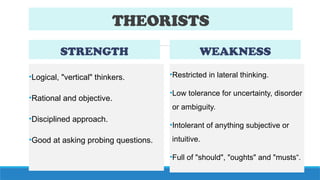
STRENGTH
•Logical, "vertical" thinkers.
•Rationaland objective.
•Disciplined approach.
•Good at asking probing questions.
•Restricted in lateral thinking.
•Low tolerance for uncertainty, disorder
or ambiguity.
•Intolerant of anything subjective or
intuitive.
•Full of "should", "oughts" and "musts“.
THEORISTS
WEAKNESS
23.
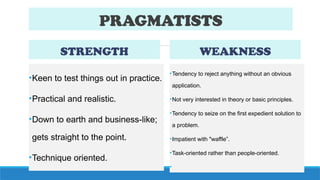
STRENGTH
•Keen to testthings out in practice.
•Practical and realistic.
•Down to earth and business-like;
gets straight to the point.
•Technique oriented.
•Tendency to reject anything without an obvious
application.
•Not very interested in theory or basic principles.
•Tendency to seize on the first expedient solution to
a problem.
•Impatient with "waffle”.
•Task-oriented rather than people-oriented.
•
PRAGMATISTS
WEAKNESS
24.
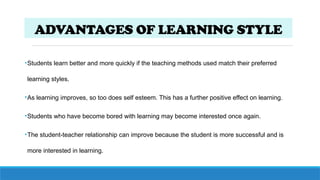
ADVANTAGES OF LEARNINGSTYLE
•Students learn better and more quickly if the teaching methods used match their preferred
learning styles.
•As learning improves, so too does self esteem. This has a further positive effect on learning.
•Students who have become bored with learning may become interested once again.
•The student-teacher relationship can improve because the student is more successful and is
more interested in learning.