SPM Seminar
  A presentation by Dr. Ritesh Malik
  Theni Govt. Medical College
  Tamil Nadu
  India
  For Community Medicine
Health Informational & Basic Medical
             Statistics
    TESTS OF SIGNIFICANCE
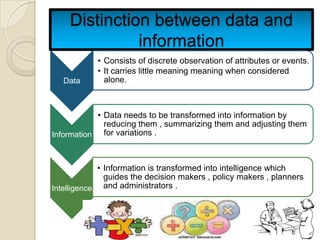
Distinction between data and
              information
            • Consists of discrete observation of attributes or events.
            • It carries little meaning meaning when considered
   Data       alone.


           • Data needs to be transformed into information by
             reducing them , summarizing them and adjusting them
Information for variations .


            • Information is transformed into intelligence which
              guides the decision makers , policy makers , planners
Intelligence and administrators .
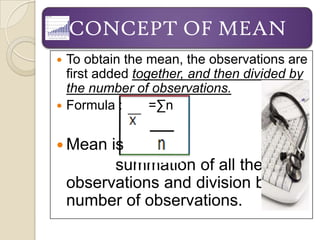
CONCEPT OF MEAN
 To obtain the mean, the observations are
  first added together, and then divided by
  the number of observations.
 Formula :      =∑n


 Mean    is
           summation of all the
    observations and division by
    number of observations.
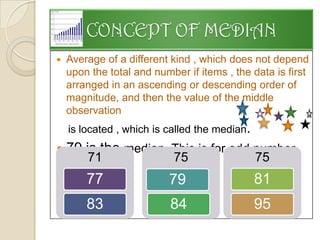
CONCEPT OF MEDIAN
   Average of a different kind , which does not depend
    upon the total and number if items , the data is first
    arranged in an ascending or descending order of
    magnitude, and then the value of the middle
    observation
    is located , which is called the median.
   79 is the median. This is for odd number
       71
    cases.
                           75                  75
        77                79                   81
        83                 84                  95
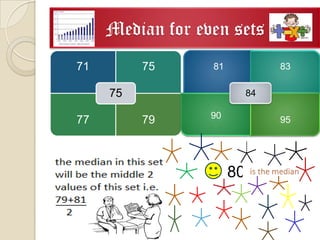
Median for even sets
71        75      81             83

     75                     84

                  90
77        79                     95


                       80
The Mode
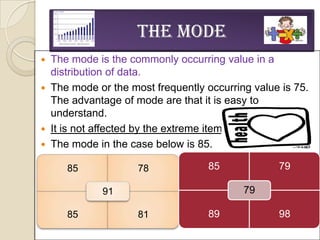
 The mode is the commonly occurring value in a
  distribution of data.
 The mode or the most frequently occurring value is 75.
  The advantage of mode are that it is easy to
  understand.
 It is not affected by the extreme items.
 The mode in the case below is 85.

     85             78             85            79

            91                            79

     85             81             89            98
HEALTH
                                          INFORMATION AND
                                          BASIC MEDICAL
                                          STATISTICS


AS A GENERAL RULE THE MOST SUCCESSFUL
MAN IN LIFE IS THE ONE WHO HAS THE BEST
INFORMATION
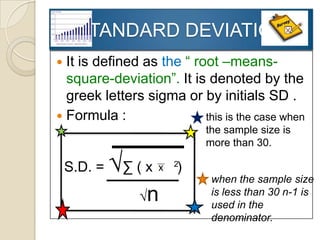
STANDARD DEVIATION
 It is defined as the “ root –means-
  square-deviation”. It is denoted by the
  greek letters sigma or by initials SD .
 Formula :                this is the case when
                            the sample size is
                            more than 30.

    S.D. =   √∑ ( x -   2
                        )
                             when the sample size
                 √n          is less than 30 n-1 is
                             used in the
                             denominator.
STANDARD ERROR
   The standard error of measurement or
    estimation is the standard deviation of
    the sampling distribution associated
    with estimation method.

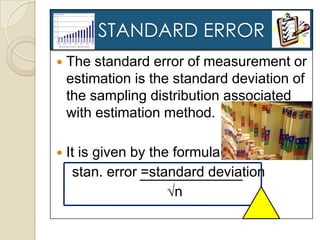
   It is given by the formula :
     stan. error =standard deviation
                      √n
Significance of standard error
 Since the distribution of the means
  follows the pattern of a normal
  distribution , thus it is taken that 95% of
  the sample means within the limits of 2
  standard errors of
      mean +or- 2 ( standard deviation )
                             √n
 On either side of the true population or
  mean. Therefore, standard error is a
  measure which enables us to judge
  whether the mean of a given sample is
  within the set confidence limits or not .
Normal
distribution
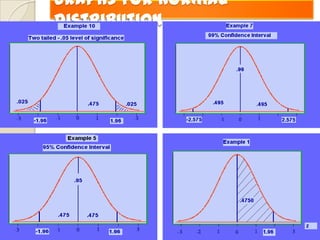
The area between one standard
  deviation on either side of the mean ( x +
  - 1×S.D ) will cover 68% of the
  distribution approximately.
 The area between 2 standard deviations
  on either side with a mean ( x + - 2×S.D )
  will cover 95% of the distribution.
 The area between ( x + - 3×S.D ) will
  cover 99.7 % of the values.
 Thus the confidence limits increase with
  the multiple of the standard deviation.
Graphs for normal
distribution
TESTS OF SIGNIFICANCE

   STANDARD      STANDARD
   ERROR OF      ERROR OF
   THE MEAN     PROPORTION


                  STANDARD
    STANDARD       EROR OF
    ERROR OF     DIFFERENCE
   DIFFERENCE    BETWEEN 2
                PROPORTIONS
STANDARD ERROR OF THE
           MEAN
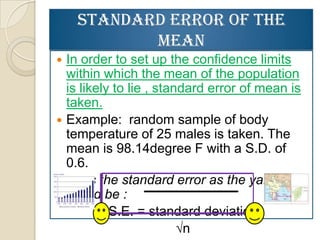
 In order to set up the confidence limits
  within which the mean of the population
  is likely to lie , standard error of mean is
  taken.
 Example: random sample of body
  temperature of 25 males is taken. The
  mean is 98.14degree F with a S.D. of
  0.6.
 Thus the standard error as the yardstick
  would be :
           S.E. = standard deviation
                         √n
Continuation of the example
 Thus    S.E. = 0.6 √25 = 0.12
   if the limits are set out at twice the standard
  error from the mean ( 95 % confidence limits )
  the range of the population would be
               98.14+ - (2×0.12)
  thus range in which most of the population
  will lie is 97.90-98.38 degree F . The chances
  will be that only 1 in 20 people will be outside
  this range ( 95%).
 Thus when we come across the word
  significant , it means that the difference is
  significant or it is unlikely to be merely due to
  chance.
STANDARD ERROR OF
          PROPORTION
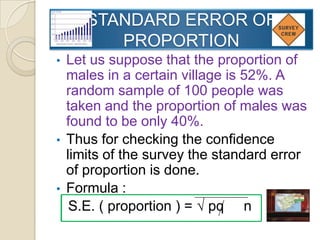
•   Let us suppose that the proportion of
    males in a certain village is 52%. A
    random sample of 100 people was
    taken and the proportion of males was
    found to be only 40%.
•   Thus for checking the confidence
    limits of the survey the standard error
    of proportion is done.
•   Formula :
     S.E. ( proportion ) = √ pq n
Standard error of proportion
               continued
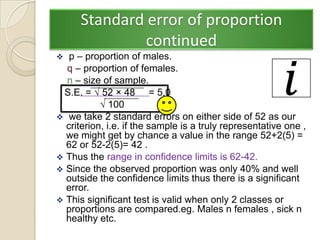
  p – proportion of males.
  q – proportion of females.
  n – size of sample.
 S.E. = √ 52 × 48 = 5.0
           √ 100
 we take 2 standard errors on either side of 52 as our
  criterion, i.e. if the sample is a truly representative one ,
  we might get by chance a value in the range 52+2(5) =
  62 or 52-2(5)= 42 .
 Thus the range in confidence limits is 62-42.
 Since the observed proportion was only 40% and well
  outside the confidence limits thus there is a significant
  error.
 This significant test is valid when only 2 classes or
  proportions are compared.eg. Males n females , sick n
  healthy etc.
STANDARD ERROR OF DIFFERENCE
      BETWEEN TWO MEANS
    Very often in biological work the investigator is faced with the
    problem of comparing results between 2 groups specially when the
    control experiment is performed along with the other experiment.
   it is performed to analyze whether the difference between the 2
    mentioned groups is significant or not.
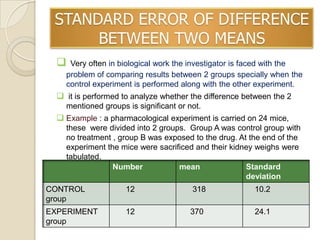
   Example : a pharmacological experiment is carried on 24 mice,
    these were divided into 2 groups. Group A was control group with
    no treatment , group B was exposed to the drug. At the end of the
    experiment the mice were sacrificed and their kidney weighs were
    tabulated.
                 Number            mean               Standard
                                                      deviation
CONTROL              12                 318             10.2
group
EXPERIMENT           12                370              24.1
group
SE BETWEEN THE MEANS
             FORMULA
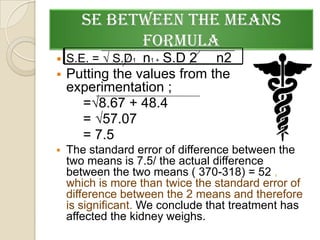
   S.E. = √ S.D1 n1 + S.D 2
                           n2
 Putting the values from the
  experimentation ;
    =√8.67 + 48.4
    = √57.07
    = 7.5
   The standard error of difference between the
    two means is 7.5/ the actual difference
    between the two means ( 370-318) = 52 ,
    which is more than twice the standard error of
    difference between the 2 means and therefore
    is significant. We conclude that treatment has
    affected the kidney weighs.
STANDARD ERROR OF DIFFERENCE
    BETWEEN PROPORTIONS
 In this instead of means we test
  the significance of difference
  between 2 proportions or ratios to
  find out if the difference between
  the 2 proportions or ratios is by
  chance or not.
 Example : trial of 2 whooping cough
  vaccines data are tabulated below ,
  we have to find the standard error of
  difference.
Continued ( mathematical
expression ) :
 From the data below it appears that
  vaccine B is superior to vaccine A .
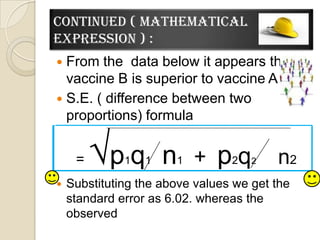
 S.E. ( difference between two
  proportions) formula


     =   √p q 1   1   n + pq
                       1         2   2   n2
   Substituting the above values we get the
    standard error as 6.02. whereas the
    observed
Continuation of
calculation of S.E. of
difference between
proportion :
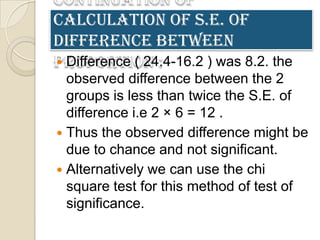
 Difference ( 24.4-16.2 ) was 8.2. the
  observed difference between the 2
  groups is less than twice the S.E. of
  difference i.e 2 × 6 = 12 .
 Thus the observed difference might be
  due to chance and not significant.
 Alternatively we can use the chi
  square test for this method of test of
  significance.
Chi square test
 Chi square test is an alternative method of
  testing the significance of difference of 2
  proportion. It has the advantage that it can be
  used when more than 2 groups are
  compared.
 The previous example of the whooping cough
  vaccine is taken and the following procedure
  is followed :
1. TEST THE NULL HYPOTHESIS :
    this hypothesis assumes that there was no
    difference between the effect of 2 vaccines,
    and then proceed to test the hypothesis in
    quantitative terms.
    O ( observed ) , E ( expected ) is tabulated.
Continued chi square test
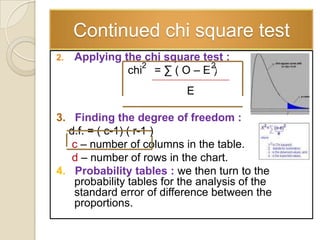
2.   Applying the chi square test :
                  2            2
               chi = ∑ ( O – E )
                           E

3. Finding the degree of freedom :
  d.f. = ( c-1) ( r-1 )
   c – number of columns in the table.
   d – number of rows in the chart.
4. Probability tables : we then turn to the
   probability tables for the analysis of the
   standard error of difference between the
   proportions.
Ritesh
Malik

Community Medicine Presentation

  • 1.
    SPM Seminar A presentation by Dr. Ritesh Malik Theni Govt. Medical College Tamil Nadu India For Community Medicine
  • 2.
    Health Informational &Basic Medical Statistics TESTS OF SIGNIFICANCE
  • 3.
    Distinction between dataand information • Consists of discrete observation of attributes or events. • It carries little meaning meaning when considered Data alone. • Data needs to be transformed into information by reducing them , summarizing them and adjusting them Information for variations . • Information is transformed into intelligence which guides the decision makers , policy makers , planners Intelligence and administrators .
  • 4.
    CONCEPT OF MEAN To obtain the mean, the observations are first added together, and then divided by the number of observations.  Formula : =∑n  Mean is summation of all the observations and division by number of observations.
  • 5.
    CONCEPT OF MEDIAN  Average of a different kind , which does not depend upon the total and number if items , the data is first arranged in an ascending or descending order of magnitude, and then the value of the middle observation is located , which is called the median.  79 is the median. This is for odd number 71 cases. 75 75 77 79 81 83 84 95
  • 6.
    Median for evensets 71 75 81 83 75 84 90 77 79 95 80
  • 7.
    The Mode  Themode is the commonly occurring value in a distribution of data.  The mode or the most frequently occurring value is 75. The advantage of mode are that it is easy to understand.  It is not affected by the extreme items.  The mode in the case below is 85. 85 78 85 79 91 79 85 81 89 98
  • 8.
    HEALTH INFORMATION AND BASIC MEDICAL STATISTICS AS A GENERAL RULE THE MOST SUCCESSFUL MAN IN LIFE IS THE ONE WHO HAS THE BEST INFORMATION
  • 9.
    STANDARD DEVIATION  Itis defined as the “ root –means- square-deviation”. It is denoted by the greek letters sigma or by initials SD .  Formula : this is the case when the sample size is more than 30. S.D. = √∑ ( x - 2 ) when the sample size √n is less than 30 n-1 is used in the denominator.
  • 10.
    STANDARD ERROR  The standard error of measurement or estimation is the standard deviation of the sampling distribution associated with estimation method.  It is given by the formula : stan. error =standard deviation √n
  • 11.
    Significance of standarderror  Since the distribution of the means follows the pattern of a normal distribution , thus it is taken that 95% of the sample means within the limits of 2 standard errors of mean +or- 2 ( standard deviation ) √n  On either side of the true population or mean. Therefore, standard error is a measure which enables us to judge whether the mean of a given sample is within the set confidence limits or not .
  • 12.
    Normal distribution The area betweenone standard deviation on either side of the mean ( x + - 1×S.D ) will cover 68% of the distribution approximately.  The area between 2 standard deviations on either side with a mean ( x + - 2×S.D ) will cover 95% of the distribution.  The area between ( x + - 3×S.D ) will cover 99.7 % of the values.  Thus the confidence limits increase with the multiple of the standard deviation.
  • 13.
  • 15.
    TESTS OF SIGNIFICANCE STANDARD STANDARD ERROR OF ERROR OF THE MEAN PROPORTION STANDARD STANDARD EROR OF ERROR OF DIFFERENCE DIFFERENCE BETWEEN 2 PROPORTIONS
  • 16.
    STANDARD ERROR OFTHE MEAN  In order to set up the confidence limits within which the mean of the population is likely to lie , standard error of mean is taken.  Example: random sample of body temperature of 25 males is taken. The mean is 98.14degree F with a S.D. of 0.6.  Thus the standard error as the yardstick would be : S.E. = standard deviation √n
  • 17.
    Continuation of theexample  Thus S.E. = 0.6 √25 = 0.12 if the limits are set out at twice the standard error from the mean ( 95 % confidence limits ) the range of the population would be 98.14+ - (2×0.12) thus range in which most of the population will lie is 97.90-98.38 degree F . The chances will be that only 1 in 20 people will be outside this range ( 95%).  Thus when we come across the word significant , it means that the difference is significant or it is unlikely to be merely due to chance.
  • 18.
    STANDARD ERROR OF PROPORTION • Let us suppose that the proportion of males in a certain village is 52%. A random sample of 100 people was taken and the proportion of males was found to be only 40%. • Thus for checking the confidence limits of the survey the standard error of proportion is done. • Formula : S.E. ( proportion ) = √ pq n
  • 19.
    Standard error ofproportion continued  p – proportion of males. q – proportion of females. n – size of sample. S.E. = √ 52 × 48 = 5.0 √ 100  we take 2 standard errors on either side of 52 as our criterion, i.e. if the sample is a truly representative one , we might get by chance a value in the range 52+2(5) = 62 or 52-2(5)= 42 .  Thus the range in confidence limits is 62-42.  Since the observed proportion was only 40% and well outside the confidence limits thus there is a significant error.  This significant test is valid when only 2 classes or proportions are compared.eg. Males n females , sick n healthy etc.
  • 20.
    STANDARD ERROR OFDIFFERENCE BETWEEN TWO MEANS  Very often in biological work the investigator is faced with the problem of comparing results between 2 groups specially when the control experiment is performed along with the other experiment.  it is performed to analyze whether the difference between the 2 mentioned groups is significant or not.  Example : a pharmacological experiment is carried on 24 mice, these were divided into 2 groups. Group A was control group with no treatment , group B was exposed to the drug. At the end of the experiment the mice were sacrificed and their kidney weighs were tabulated. Number mean Standard deviation CONTROL 12 318 10.2 group EXPERIMENT 12 370 24.1 group
  • 21.
    SE BETWEEN THEMEANS FORMULA  S.E. = √ S.D1 n1 + S.D 2 n2  Putting the values from the experimentation ; =√8.67 + 48.4 = √57.07 = 7.5  The standard error of difference between the two means is 7.5/ the actual difference between the two means ( 370-318) = 52 , which is more than twice the standard error of difference between the 2 means and therefore is significant. We conclude that treatment has affected the kidney weighs.
  • 22.
    STANDARD ERROR OFDIFFERENCE BETWEEN PROPORTIONS  In this instead of means we test the significance of difference between 2 proportions or ratios to find out if the difference between the 2 proportions or ratios is by chance or not.  Example : trial of 2 whooping cough vaccines data are tabulated below , we have to find the standard error of difference.
  • 23.
    Continued ( mathematical expression) :  From the data below it appears that vaccine B is superior to vaccine A .  S.E. ( difference between two proportions) formula = √p q 1 1 n + pq 1 2 2 n2  Substituting the above values we get the standard error as 6.02. whereas the observed
  • 24.
    Continuation of calculation ofS.E. of difference between proportion :  Difference ( 24.4-16.2 ) was 8.2. the observed difference between the 2 groups is less than twice the S.E. of difference i.e 2 × 6 = 12 .  Thus the observed difference might be due to chance and not significant.  Alternatively we can use the chi square test for this method of test of significance.
  • 25.
    Chi square test Chi square test is an alternative method of testing the significance of difference of 2 proportion. It has the advantage that it can be used when more than 2 groups are compared.  The previous example of the whooping cough vaccine is taken and the following procedure is followed : 1. TEST THE NULL HYPOTHESIS : this hypothesis assumes that there was no difference between the effect of 2 vaccines, and then proceed to test the hypothesis in quantitative terms. O ( observed ) , E ( expected ) is tabulated.
  • 26.
    Continued chi squaretest 2. Applying the chi square test : 2 2 chi = ∑ ( O – E ) E 3. Finding the degree of freedom : d.f. = ( c-1) ( r-1 ) c – number of columns in the table. d – number of rows in the chart. 4. Probability tables : we then turn to the probability tables for the analysis of the standard error of difference between the proportions.
  • 27.