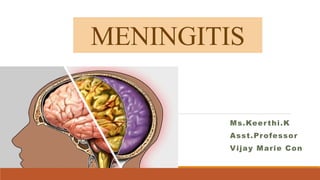
MENINGITIS
Ms.Keerthi.K
Asst.Professor
Vijay Marie Con
ANATOMY OF MENINGES
DEFINITION
•Meningitis (from Greek meninx, "membrane”) is an acute
inflammation of the meninges caused by either bacteria or
virus.
•Meningitis is an acute inflammation of the protective
membranes covering the brain and spinal cord, known
collectively as the meninges. The most common symptoms are
fever, headache, and neck stiffness.
INCIDENCE
Although meningitis is a notifiable disease, the exact incidence rate is unknown.
In 2010 – 420, 000 deaths
In 2013 - 303,000 deaths.
n 2015, meningitis occurred in about 8.7 million people worldwide This resulted in
379,000 deaths—down from 464,000 deaths in 1990.
With appropriate treatment the risk of death in bacterial meningitis is less than 15%.
Outbreaks of bacterial meningitis occur between December and June each year in an
area of sub-Saharan Africa known as the meningitis belt
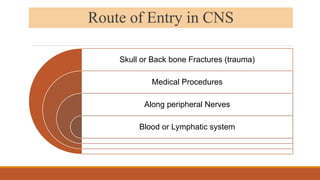
Route of Entry in CNS
Skull or Back bone Fractures (trauma)
Medical Procedures
Along peripheral Nerves
Blood or Lymphatic system
ETIOLOGY
 The causes can be classifiedinto:
• Bacterial Infections
• Viral Infections
• Fungal Infections
• Inflammatory diseases (SLE)
• Cancer
• Trauma to head or spine
PATHOPHYSIOLOGY
Bacteria enters blood stream/ trauma
Enters the mucosal surface/ cavity Breakdown of
normal barriers Crosses the blood brain barrier
Proliferates in the CSF
Inflammation of the meninges
Increase in ICP
BACTERIAL MENINGITIS
• Also known as septic meningitis, extremely serious that requires
immediate care.
• Can lead to permanent damage of brain or disability and death.
• Spreads by:-coughing or sneezing
• Treatment available : antibiotics as per causative organism.
• Causative Agents:
• Streptococcus Pneumonia 30-80%
• Neisseria meningitis 15- 40%
• Hemophilus Influenza 2-7%
TUBERCULAR MENINGITIS
• TB meningitis is caused by Mycobacterium
tuberculi that usually begins in the lungs
• 1 – 2% of cases the bacteria travel via the
bloodstream.
• Unlike other types of meningitis its
progresses very slowly and symptoms are
vague
VIRAL MENINGITIS
• Also known as aseptic meningitis.
• More common than bacterial form and usually less serious.
• Less likely to have permanent brain damage after the infection
resolves.
• Treatment: No specific treatment available.
• Most patients recover completely on their own
• Causative agents: Enterovirus, Adenovirus,Arbovirus,Measles virus, Herpes
simplex virus, Varicella
FUNGAL MENINGITIS
• It is much less common than the other two infections.
• It is rare in healthy people but it is more likely in persons who have impaired immune
system.
• Risk factors are :Systemic infections , Viral RTIs , Tobacco use , Impaired Immune system ,
Over crowding,immunosuppressants (such as after organ transplantation), HIV/AIDS, and the
loss of immunity associated with aging.
• The most common fungal meningitis is cryptococcal meningitis due to Cryptococcus
neoformans. Other less common fungal pathogens which can cause meningitis include:
Coccidioides immitis, Histoplasma capsulatum, Blastomyces dermatitidis, and Candida
species.
PARASITIC MENINGITIS
•This type of meningitis is less common than viral or bacterial meningitis, and it’s caused by
parasites that are found in dirt, feces, and on some animals and food, like snails, raw fish,
poultry, or produce.
•One type of parasitic meningitis is rarer than others. It’s called eosinophilia meningitis (EM).
Three main parasites are responsible for EM. These include:
• Angiostrongylus cantonensis
• Baylisascaris procyonis
• Gnathostoma spinigerum
PARASITIC MENINGITIS
•Parasitic meningitis is not passed from person to person. Instead, these parasites infect an
animal or hide out on food that a human then eats. If the parasite or parasite eggs are
infectious when they’re ingested, an infection may occur.
•One very rare type of parasitic meningitis, amebic meningitis, is a life-threatening type of
infection. This type is caused when one of several types of ameba enters the body through
the nose while you swim in contaminated lakes, rivers, or ponds.
•The parasite can destroy brain tissue and may eventually cause hallucinations, seizures,
and other serious symptoms. The most commonly recognized species is Naegleria fowleri.
CLINICAL MANIFESTATION
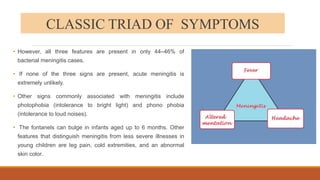
CLASSIC TRIAD OF SYMPTOMS
• However, all three features are present in only 44–46% of
bacterial meningitis cases.
• If none of the three signs are present, acute meningitis is
extremely unlikely.
• Other signs commonly associated with meningitis include
photophobia (intolerance to bright light) and phono phobia
(intolerance to loud noises).
• The fontanels can bulge in infants aged up to 6 months. Other
features that distinguish meningitis from less severe illnesses in
young children are leg pain, cold extremities, and an abnormal
skin color.
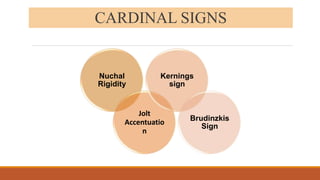
CARDINAL SIGNS
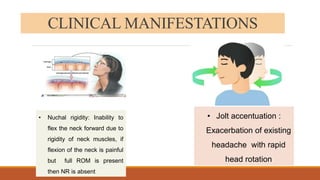
Nuchal
Rigidity
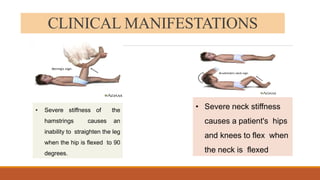
Jolt
Accentuatio
n
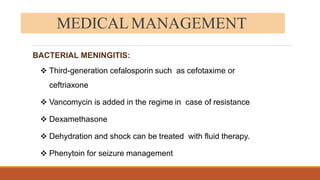
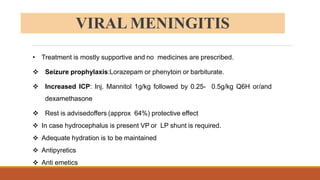
Kernings
sign
Brudinzkis
Sign
CLINICAL MANIFESTATIONS
• Nuchal rigidity: Inability to
flex the neck forward due to
rigidity of neck muscles, if
flexion of the neck is painful
but full ROM is present
then NR is absent
• Jolt accentuation :
Exacerbation of existing
headache with rapid
head rotation
CLINICAL MANIFESTATIONS
• Severe stiffness of the
hamstrings causes an
inability to straighten the leg
when the hip is flexed to 90
degrees.
• Severe neck stiffness
causes a patient's hips
and knees to flex when
the neck is flexed
ASSESSMENT AND DIAGNOSIS
CSF FINDING
COMPLICATIONS
• Sensory-neural hearing loss
• Epilepsy/ seizures
• Memory loss
• Paralysis
• Learning difficulty
• Behavioral difficulty
• Decreased intelligence
• Septicemia
• Death
MEDICAL MANAGEMENT
BACTERIAL MENINGITIS:
 Third-generation cefalosporin such as cefotaxime or
ceftriaxone
 Vancomycin is added in the regime in case of resistance
 Dexamethasone
 Dehydration and shock can be treated with fluid therapy.
 Phenytoin for seizure management
TUBERCULAR MENINGITIS:
 ATT medications are started: Isoniazid; rifampacin; pyrazinamide
and streptomycin.
Second line drugs: Aminoglycosides; Fluroquinolones
 Conventional therapy is given for 6-9 months
 In children BCG vaccine offers (approx 64%) protective effect
VIRAL MENINGITIS
• Treatment is mostly supportive and no medicines are prescribed.
 Seizure prophylaxis:Lorazepam or phenytoin or barbiturate.
 Increased ICP: Inj. Mannitol 1g/kg followed by 0.25- 0.5g/kg Q6H or/and
dexamethasone
 Rest is advisedoffers (approx 64%) protective effect
 In case hydrocephalus is present VP or LP shunt is required.
 Adequate hydration is to be maintained
 Antipyretics
 Anti emetics
QUESTIONS
A patient being treated for viral meningitis arrives at the hospital reporting a persistent severe headache.
Which nursing intervention is most appropriate for the patient?
a.Telling the patient to use analgesics
b.Informing the patient that headaches can occur after recovery
c.Informing the patient that a headache is not a major complication
d.Informing the patient that a full recovery from viral meningitis is not possible
RATIONALE: he patient should be informed that headaches will occur post recovery, even though they are a
rare manifestation. The patient should be treated symptomatically, based on the reason for developing the
headache. A complete recovery is expected. A severe headache might be a major complication.)
 a
QUESTIONS
2.The nurse is assessing the client diagnosed with bacterial meningitis. Which clinical
manifestations would support the diagnosis of bacterial meningitis
a.Positive Babinski's sign and peripheral paresthesia.
b.Negative Chvostek's sign and facial tingling.
c.Positive Kernig's sign and nuchal rigidity.
d.Negative Trousseau's sign and nystagmus.
Rationale: (. A positive Kernig's sign (client unableto extend leg when lying flat) and
nuchal rigidity (stiff neck) are signs ofbacterial meningitis, occurring becausethe meninges
surrounding the brainand spinal column are irritated.)
QUESTIONS
The nurse is caring for a client diagnosed with meningitis. Which collaborative
intervention should be included in the plan of care?
A.Administer antibiotics.
B.Obtain a sputum culture.
C.Monitor the pulse-oximeter.
D.Assess intake and output.
Rationale: A nurse administering antibiotics is a collaborative intervention because the
HCP must write an order for the intervention; nurses cannot prescribe medications unless
they have additional education and licensure and are nurse practitioners with prescriptive
authority.)
QUESTIONS
Which statement best describes the scientific rationale for alternating a nonnarcotic
antipyretic and a nonsteroidal anti-inflammatory drug (NSAID) every two (2) hours
to a female client diagnosed with bacterial meningitis?
1. This regimen helps to decrease the purulent exudate surrounding the meninges.
2. These medications will decrease intracranial pressure and brain metabolism.
3. These medications will increase the client's memory and orientation.
4. This will help prevent a yeast infection secondary to antibiotic therapy.
Rationale:Fever increases cerebral metabolism and intracranial pressure. Therefore, measures are
taken to reduce body temperature as soon as possible, and alternating Tylenol and Motrin would be
appropriate.)
QUESTIONS
A 29-year-old client is admitted to the medical floor diagnosed with meningitis.
Which assessment by the nurse has priority?
1. Assess lung sounds.
2. Assess the six cardinal fields of gaze.
3. Assess apical pulse.
4. Assess level of consciousness..)
Rationale: Meningitis directly affects the client's brain. Therefore, assessing the
neurological status would have priority for this client.)
CDC recommends meningococcal vaccine between ages___ to ____ and booster at ___
Ans:11 12 16

Meningitis

  • 1.
  • 2.
  • 3.
    DEFINITION •Meningitis (from Greekmeninx, "membrane”) is an acute inflammation of the meninges caused by either bacteria or virus. •Meningitis is an acute inflammation of the protective membranes covering the brain and spinal cord, known collectively as the meninges. The most common symptoms are fever, headache, and neck stiffness.
  • 4.
    INCIDENCE Although meningitis isa notifiable disease, the exact incidence rate is unknown. In 2010 – 420, 000 deaths In 2013 - 303,000 deaths. n 2015, meningitis occurred in about 8.7 million people worldwide This resulted in 379,000 deaths—down from 464,000 deaths in 1990. With appropriate treatment the risk of death in bacterial meningitis is less than 15%. Outbreaks of bacterial meningitis occur between December and June each year in an area of sub-Saharan Africa known as the meningitis belt
  • 5.
    Route of Entryin CNS Skull or Back bone Fractures (trauma) Medical Procedures Along peripheral Nerves Blood or Lymphatic system
  • 6.
    ETIOLOGY  The causescan be classifiedinto: • Bacterial Infections • Viral Infections • Fungal Infections • Inflammatory diseases (SLE) • Cancer • Trauma to head or spine
  • 7.
    PATHOPHYSIOLOGY Bacteria enters bloodstream/ trauma Enters the mucosal surface/ cavity Breakdown of normal barriers Crosses the blood brain barrier Proliferates in the CSF Inflammation of the meninges Increase in ICP
  • 8.
    BACTERIAL MENINGITIS • Alsoknown as septic meningitis, extremely serious that requires immediate care. • Can lead to permanent damage of brain or disability and death. • Spreads by:-coughing or sneezing • Treatment available : antibiotics as per causative organism. • Causative Agents: • Streptococcus Pneumonia 30-80% • Neisseria meningitis 15- 40% • Hemophilus Influenza 2-7%
  • 9.
    TUBERCULAR MENINGITIS • TBmeningitis is caused by Mycobacterium tuberculi that usually begins in the lungs • 1 – 2% of cases the bacteria travel via the bloodstream. • Unlike other types of meningitis its progresses very slowly and symptoms are vague
  • 10.
    VIRAL MENINGITIS • Alsoknown as aseptic meningitis. • More common than bacterial form and usually less serious. • Less likely to have permanent brain damage after the infection resolves. • Treatment: No specific treatment available. • Most patients recover completely on their own • Causative agents: Enterovirus, Adenovirus,Arbovirus,Measles virus, Herpes simplex virus, Varicella
  • 11.
    FUNGAL MENINGITIS • Itis much less common than the other two infections. • It is rare in healthy people but it is more likely in persons who have impaired immune system. • Risk factors are :Systemic infections , Viral RTIs , Tobacco use , Impaired Immune system , Over crowding,immunosuppressants (such as after organ transplantation), HIV/AIDS, and the loss of immunity associated with aging. • The most common fungal meningitis is cryptococcal meningitis due to Cryptococcus neoformans. Other less common fungal pathogens which can cause meningitis include: Coccidioides immitis, Histoplasma capsulatum, Blastomyces dermatitidis, and Candida species.
  • 12.
    PARASITIC MENINGITIS •This typeof meningitis is less common than viral or bacterial meningitis, and it’s caused by parasites that are found in dirt, feces, and on some animals and food, like snails, raw fish, poultry, or produce. •One type of parasitic meningitis is rarer than others. It’s called eosinophilia meningitis (EM). Three main parasites are responsible for EM. These include: • Angiostrongylus cantonensis • Baylisascaris procyonis • Gnathostoma spinigerum
  • 13.
    PARASITIC MENINGITIS •Parasitic meningitisis not passed from person to person. Instead, these parasites infect an animal or hide out on food that a human then eats. If the parasite or parasite eggs are infectious when they’re ingested, an infection may occur. •One very rare type of parasitic meningitis, amebic meningitis, is a life-threatening type of infection. This type is caused when one of several types of ameba enters the body through the nose while you swim in contaminated lakes, rivers, or ponds. •The parasite can destroy brain tissue and may eventually cause hallucinations, seizures, and other serious symptoms. The most commonly recognized species is Naegleria fowleri.
  • 14.
  • 15.
    CLASSIC TRIAD OFSYMPTOMS • However, all three features are present in only 44–46% of bacterial meningitis cases. • If none of the three signs are present, acute meningitis is extremely unlikely. • Other signs commonly associated with meningitis include photophobia (intolerance to bright light) and phono phobia (intolerance to loud noises). • The fontanels can bulge in infants aged up to 6 months. Other features that distinguish meningitis from less severe illnesses in young children are leg pain, cold extremities, and an abnormal skin color.
  • 16.
  • 17.
    CLINICAL MANIFESTATIONS • Nuchalrigidity: Inability to flex the neck forward due to rigidity of neck muscles, if flexion of the neck is painful but full ROM is present then NR is absent • Jolt accentuation : Exacerbation of existing headache with rapid head rotation
  • 18.
    CLINICAL MANIFESTATIONS • Severestiffness of the hamstrings causes an inability to straighten the leg when the hip is flexed to 90 degrees. • Severe neck stiffness causes a patient's hips and knees to flex when the neck is flexed
  • 19.
  • 20.
  • 21.
    COMPLICATIONS • Sensory-neural hearingloss • Epilepsy/ seizures • Memory loss • Paralysis • Learning difficulty • Behavioral difficulty • Decreased intelligence • Septicemia • Death
  • 22.
    MEDICAL MANAGEMENT BACTERIAL MENINGITIS: Third-generation cefalosporin such as cefotaxime or ceftriaxone  Vancomycin is added in the regime in case of resistance  Dexamethasone  Dehydration and shock can be treated with fluid therapy.  Phenytoin for seizure management
  • 23.
    TUBERCULAR MENINGITIS:  ATTmedications are started: Isoniazid; rifampacin; pyrazinamide and streptomycin. Second line drugs: Aminoglycosides; Fluroquinolones  Conventional therapy is given for 6-9 months  In children BCG vaccine offers (approx 64%) protective effect
  • 24.
    VIRAL MENINGITIS • Treatmentis mostly supportive and no medicines are prescribed.  Seizure prophylaxis:Lorazepam or phenytoin or barbiturate.  Increased ICP: Inj. Mannitol 1g/kg followed by 0.25- 0.5g/kg Q6H or/and dexamethasone  Rest is advisedoffers (approx 64%) protective effect  In case hydrocephalus is present VP or LP shunt is required.  Adequate hydration is to be maintained  Antipyretics  Anti emetics
  • 25.
    QUESTIONS A patient beingtreated for viral meningitis arrives at the hospital reporting a persistent severe headache. Which nursing intervention is most appropriate for the patient? a.Telling the patient to use analgesics b.Informing the patient that headaches can occur after recovery c.Informing the patient that a headache is not a major complication d.Informing the patient that a full recovery from viral meningitis is not possible RATIONALE: he patient should be informed that headaches will occur post recovery, even though they are a rare manifestation. The patient should be treated symptomatically, based on the reason for developing the headache. A complete recovery is expected. A severe headache might be a major complication.)  a
  • 26.
    QUESTIONS 2.The nurse isassessing the client diagnosed with bacterial meningitis. Which clinical manifestations would support the diagnosis of bacterial meningitis a.Positive Babinski's sign and peripheral paresthesia. b.Negative Chvostek's sign and facial tingling. c.Positive Kernig's sign and nuchal rigidity. d.Negative Trousseau's sign and nystagmus. Rationale: (. A positive Kernig's sign (client unableto extend leg when lying flat) and nuchal rigidity (stiff neck) are signs ofbacterial meningitis, occurring becausethe meninges surrounding the brainand spinal column are irritated.)
  • 27.
    QUESTIONS The nurse iscaring for a client diagnosed with meningitis. Which collaborative intervention should be included in the plan of care? A.Administer antibiotics. B.Obtain a sputum culture. C.Monitor the pulse-oximeter. D.Assess intake and output. Rationale: A nurse administering antibiotics is a collaborative intervention because the HCP must write an order for the intervention; nurses cannot prescribe medications unless they have additional education and licensure and are nurse practitioners with prescriptive authority.)
  • 28.
    QUESTIONS Which statement bestdescribes the scientific rationale for alternating a nonnarcotic antipyretic and a nonsteroidal anti-inflammatory drug (NSAID) every two (2) hours to a female client diagnosed with bacterial meningitis? 1. This regimen helps to decrease the purulent exudate surrounding the meninges. 2. These medications will decrease intracranial pressure and brain metabolism. 3. These medications will increase the client's memory and orientation. 4. This will help prevent a yeast infection secondary to antibiotic therapy. Rationale:Fever increases cerebral metabolism and intracranial pressure. Therefore, measures are taken to reduce body temperature as soon as possible, and alternating Tylenol and Motrin would be appropriate.)
  • 29.
    QUESTIONS A 29-year-old clientis admitted to the medical floor diagnosed with meningitis. Which assessment by the nurse has priority? 1. Assess lung sounds. 2. Assess the six cardinal fields of gaze. 3. Assess apical pulse. 4. Assess level of consciousness..) Rationale: Meningitis directly affects the client's brain. Therefore, assessing the neurological status would have priority for this client.) CDC recommends meningococcal vaccine between ages___ to ____ and booster at ___ Ans:11 12 16