1
SCREENING FOR DISEASE
2
3
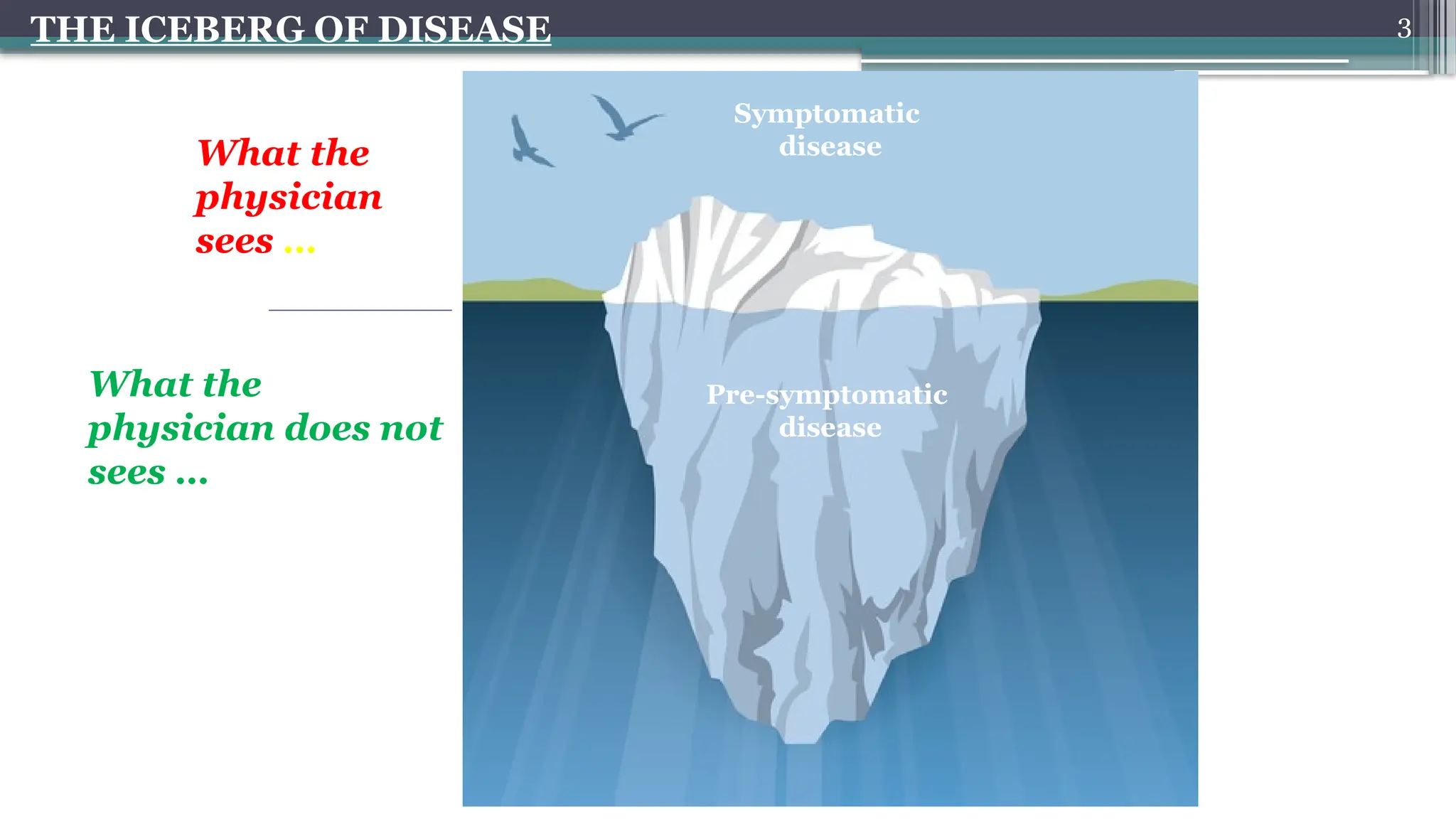
Symptomatic
disease
What the
physician
sees …
Pre-symptomatic
disease
What the
physician does not
sees …
THE ICEBERG OF DISEASE
4
SCREENING
• Definition:
• The search for unrecognized disease or defect by means of rapidly
applied tests, examinations or other procedures in apparently
healthy individuals.
• Concept:
• Early detection of “hidden disease”.
• Conserving physician time for diagnosis and treatment.
• Techniques to administer simple, inexpensive laboratory tests
and operate other measuring devices.
5
Screening differs from Periodic health examination
a. Capable of wide application
b. Relatively inexpensive
c. Requires little physician time.
d. Physician is not required to administer the test but only
interpret it.
6
Screening Test VS Diagnostic Tests
Screening Test Diagnostic Test
• Done on apparently healthy
• Applied to groups
• Test results are arbitrary and
final
• Done on those with
indications and sick
• Applied to single patients, all
diseases are considered
• Diagnosis is not final but
modified in light of new
evidence, diagnosis is the sum
of all evidence
7
Screening Test VS Diagnostic Tests
Screening Test Diagnostic Test
• Based on one criterion or cut-
off point
• Less expensive
• Not a basis for treatment
• The initiative comes from the
investigator or agency
providing care
• Based on evaluation of a
number of symptoms, signs
and laboratory findings.
• More expensive
• Used as a basis for treatment
• The initiative comes from a
patient with a complaint
8
Lead Time
• Detection programs should concentrate on those conditions where
the time lag between the disease onset and its final critical point is
sufficiently long to be suitable for population screening.
• “Lead time” is the advantage gained by screening
• i.e the period between diagnosis by early detection and diagnosis
by other means.
9
Disease
onset
detection
First
possible
point
Final
critical
diagnosis
Usual
time of
diagnosis
A
B
OUTCOME
Screening time
Lead time
MODEL FOR EARLY DISEASE DETECTION PROGRAMMES
10
Apparently Normal
(Periodic re-scanning)
POSSIBLE OUTCOMES OF SCREENING
Apparently Abnormal
(a)Normal – periodic re-scanning
(b)Intermediate- surveillance
(c)Abnormal - treatment
Apparently Healthy
(Screening Tests)
11
USES OF SCREENING
1. Case detection ( Prescriptive screening)
2. Control of disease (Prospective Screening)
3. Research purposes
4. Educational opportunities
12
TYPES OF SCREENING
1. Mass Screening
2. High Risk or Selective screening
3. Multiphasic Screening
13
CRITERIA FOR SCREENING
• It is based on two considerations:
A. DISEASE to be screened
B. TEST to be applied
14
The test must satisfy the following criteria:
1. Acceptability
2. Repeatability
Observer Variation
Biological ( Subject ) variation
Errors related to technical methods
3. Validity ( Accuracy)
Sensitivity
Specificity
15
Validity (accuracy)
• The term validity refers to what extent the test accurately
measures which it purports to measure.
• Validity has two components sensitivity and specificity
• Sensitivity and specificity, together with "predictive accuracy" are
inherent properties of a screening test.
16
Sensitivity
• It has been defined as the ability of a test to identify correctly all
those who have the disease
• that is "true-positive".
• A 90 per cent sensitivity means that 90 per cent of the diseased
people screened by the test will give a "true-positive" result and
the remaining 10 per cent a "false-negative" result.
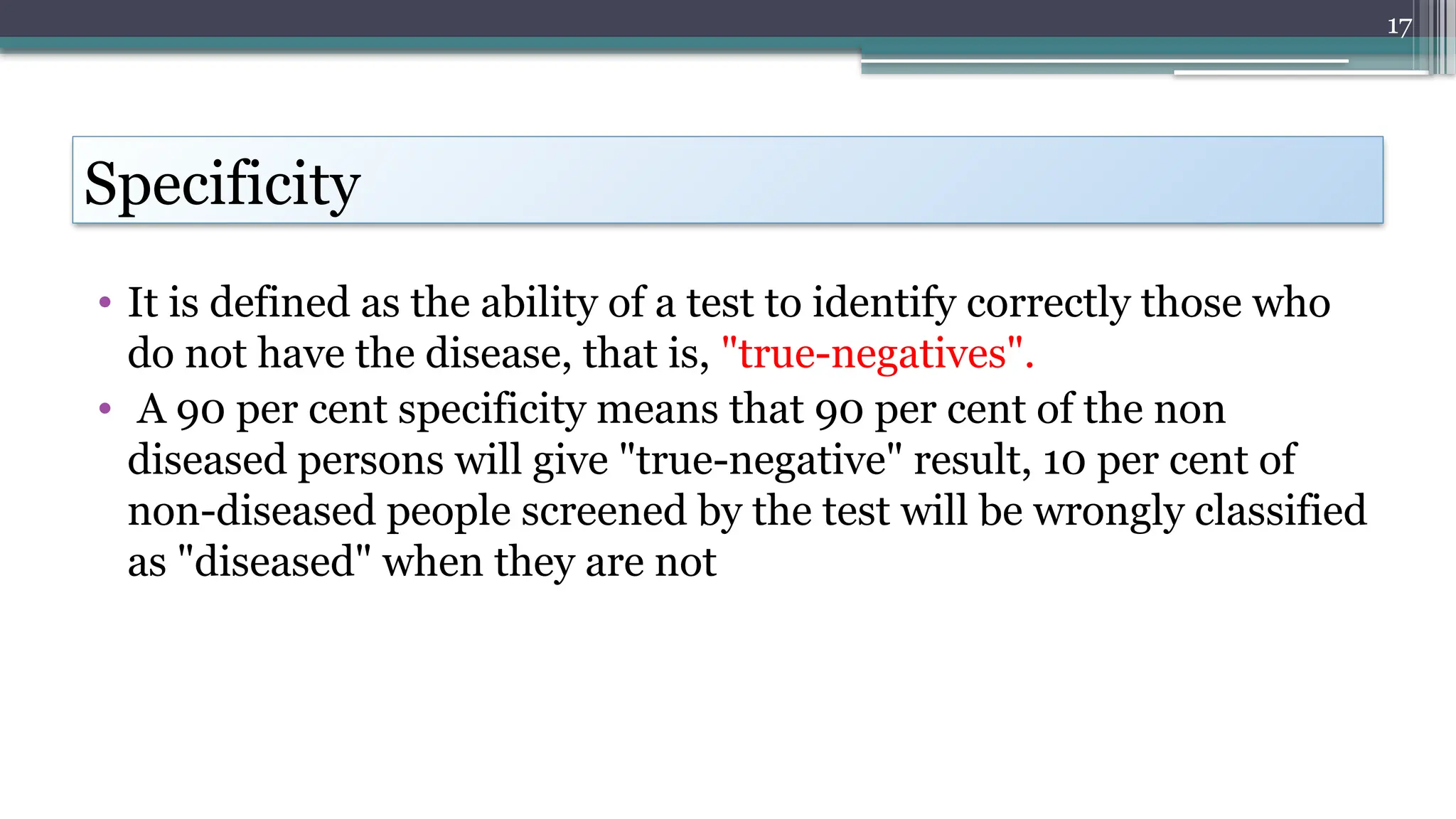
17
Specificity
• It is defined as the ability of a test to identify correctly those who
do not have the disease, that is, "true-negatives".
• A 90 per cent specificity means that 90 per cent of the non
diseased persons will give "true-negative" result, 10 per cent of
non-diseased people screened by the test will be wrongly classified
as "diseased" when they are not
18
Predictive accuracy
• Reflects the diagnostic power of the test.
• The predictive accuracy depends upon sensitivity, specificity and
disease prevalence.
• The "predictive value of a positive test" indicates the
probability that a patient with a positive test result has, in fact, the
disease in question.
• Negative predictive value is the probability that subjects with
a negative screening test truly don't have the disease
19
Screening test
results
Diagnosis Total
Disease + Disease -
Positive a+b
Negative c+d
Total a+c b +d a+b+c+d
a(true positive) b (false positive)
c(false negative) d ( true negatives)
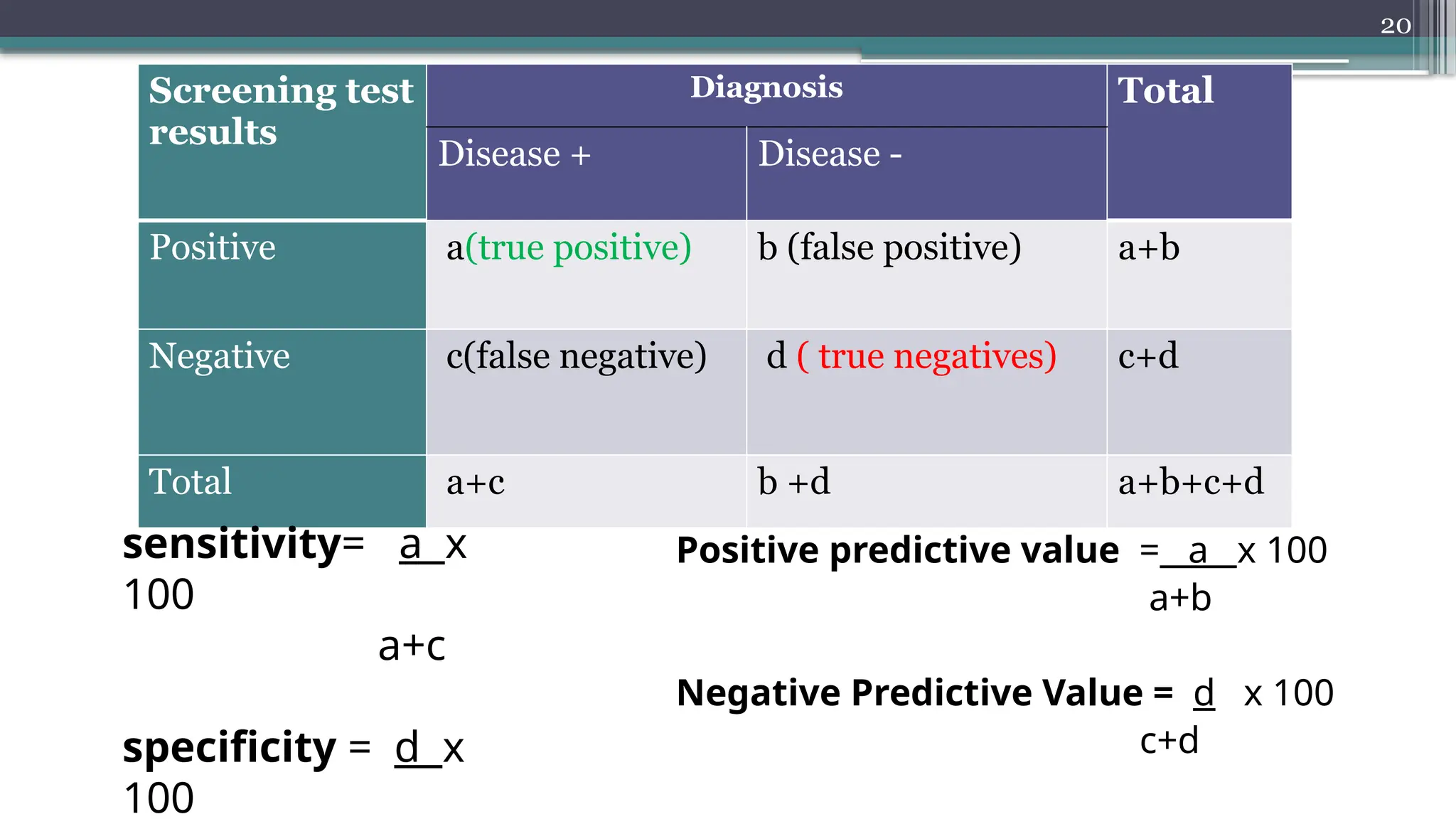
20
Positive predictive value = a x 100
a+b
Negative Predictive Value = d x 100
c+d
Screening test
results
Diagnosis Total
Disease + Disease -
Positive a(true positive) b (false positive) a+b
Negative c(false negative) d ( true negatives) c+d
Total a+c b +d a+b+c+d
sensitivity= a x
100
a+c
specificity = d x
100
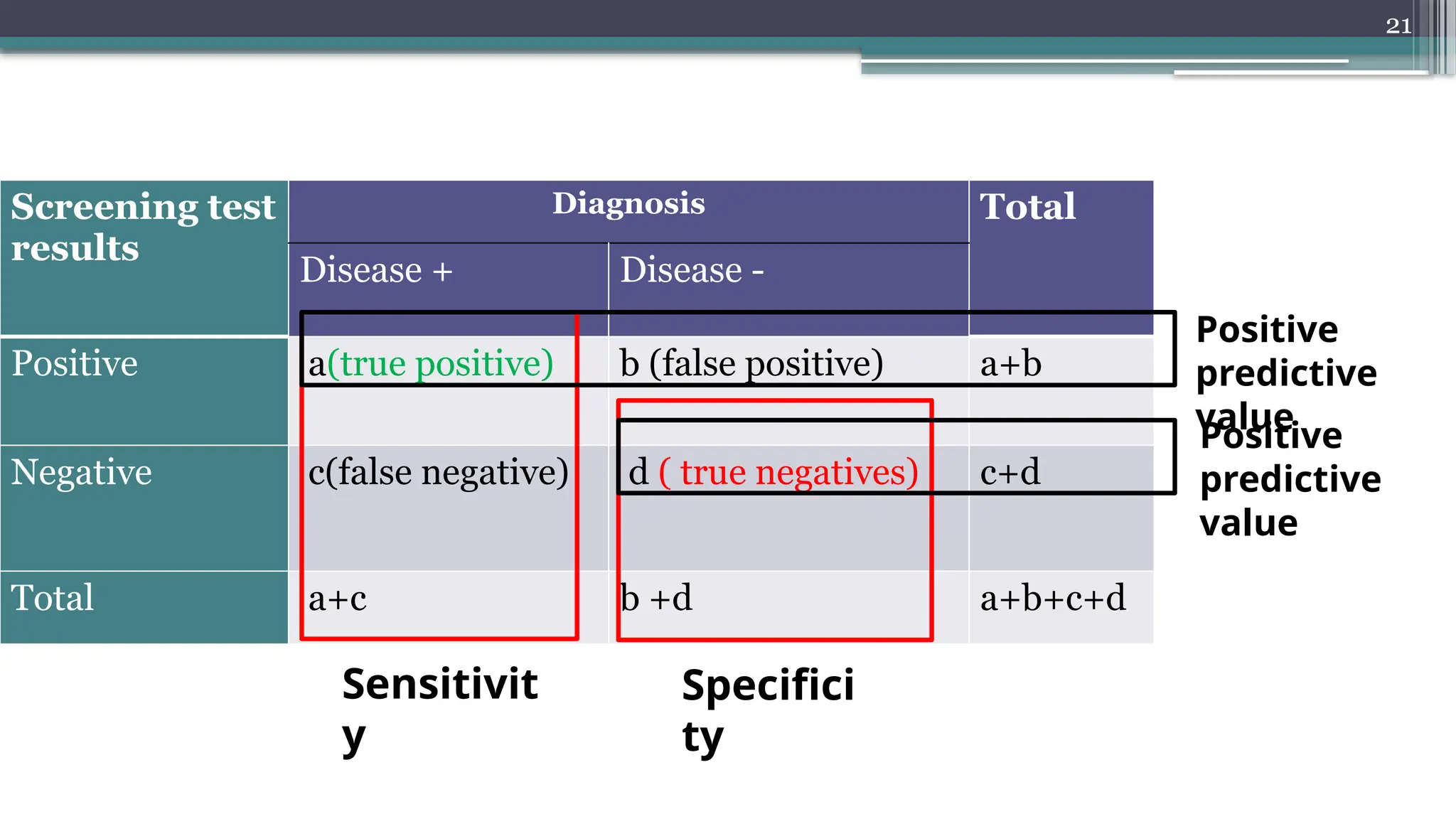
21
Screening test
results
Diagnosis Total
Disease + Disease -
Positive a(true positive) b (false positive) a+b
Negative c(false negative) d ( true negatives) c+d
Total a+c b +d a+b+c+d
Sensitivit
y
Specifici
ty
Positive
predictive
value
Positive
predictive
value
22
Problems
23
A new screening test for breast cancer was found to be
positive in 20% of 600 elderly females. Biopsy done among
the 600 women was found positive in 96 of them. There
were 12 false negatives.
Calculate the specificity, sensitivity, positive and negative
predictive value of the new screening test.
11/15/2024
24
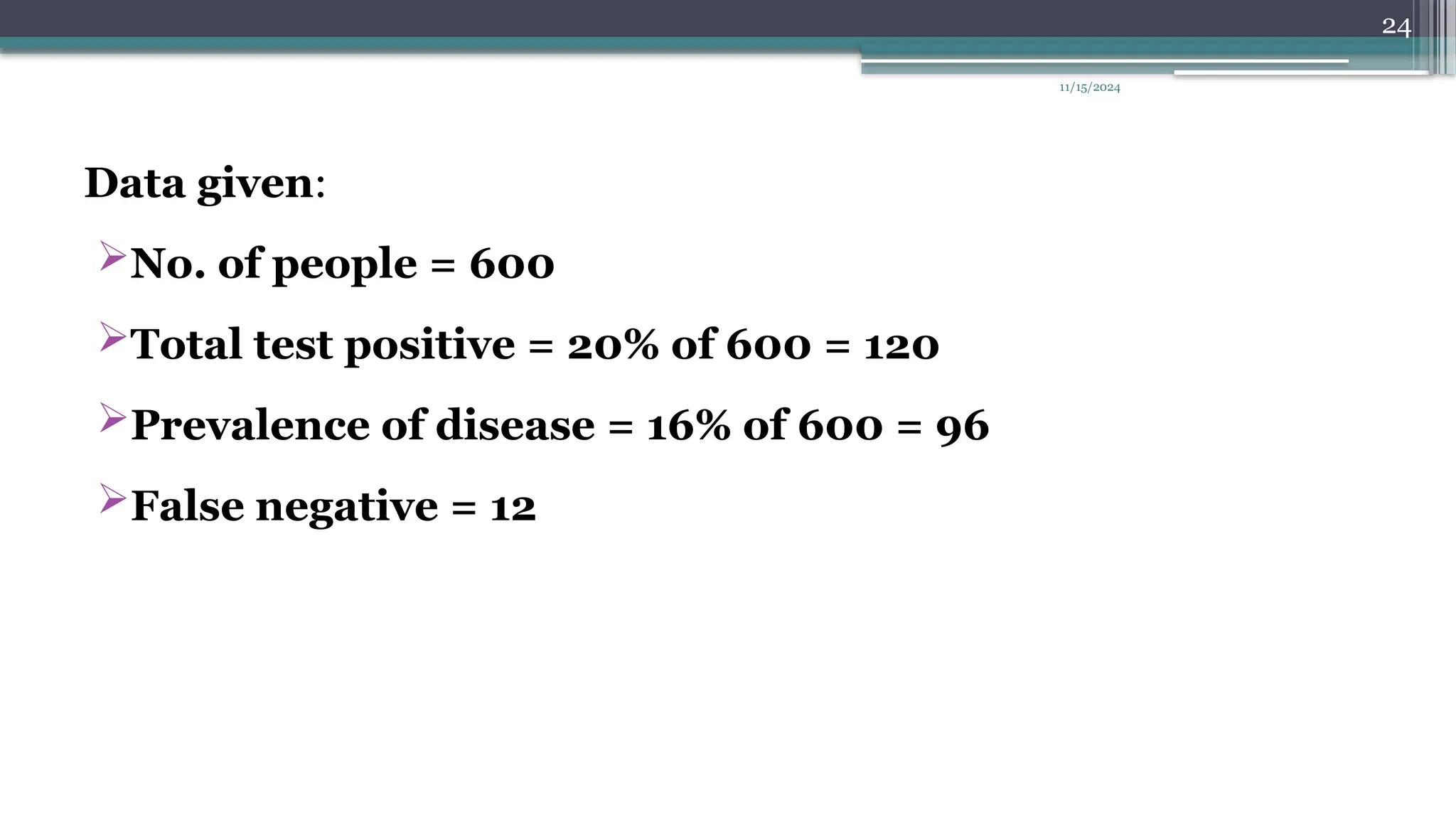
Data given:
No. of people = 600
Total test positive = 20% of 600 = 120
Prevalence of disease = 16% of 600 = 96
False negative = 12
11/15/2024
25
Screening test results Biopsy positive Biopsy negative Total
Screening test + 84 (a) 36 (b) 120
Screening Test - 12 (c) 468 (d) 480
Total 96 504 600
11/15/2024
26
sensitivity= a x 100 = 84/96 X 100 = 87.5%
a+c
specificity = d x 100= 468/504 X 100 = 92.86%
b+d
Positive predictive value = a x 100= 84/120 X100 = 70%
a+b
Negative Predictive Value = d/ c+d x 100
= 468/ 480 x 100 = 97.5%
11/15/2024
27
Problem 2:
The results obtained after screening 10,000 people
for diabetes with random blood sugar is given in the
table. Cut off value of 200 mg/dl for random blood
sugar was used as test positive. The prevalence of
diabetes in that population was known to be 1.5%.
11/15/2024
28
Diabetic Non-diabetic Total
RBS + 70 (a) 100 (b) 170
RBS - 80 (c) 9750 (d) 9830
Total 150 9850 10,000
11/15/2024
29
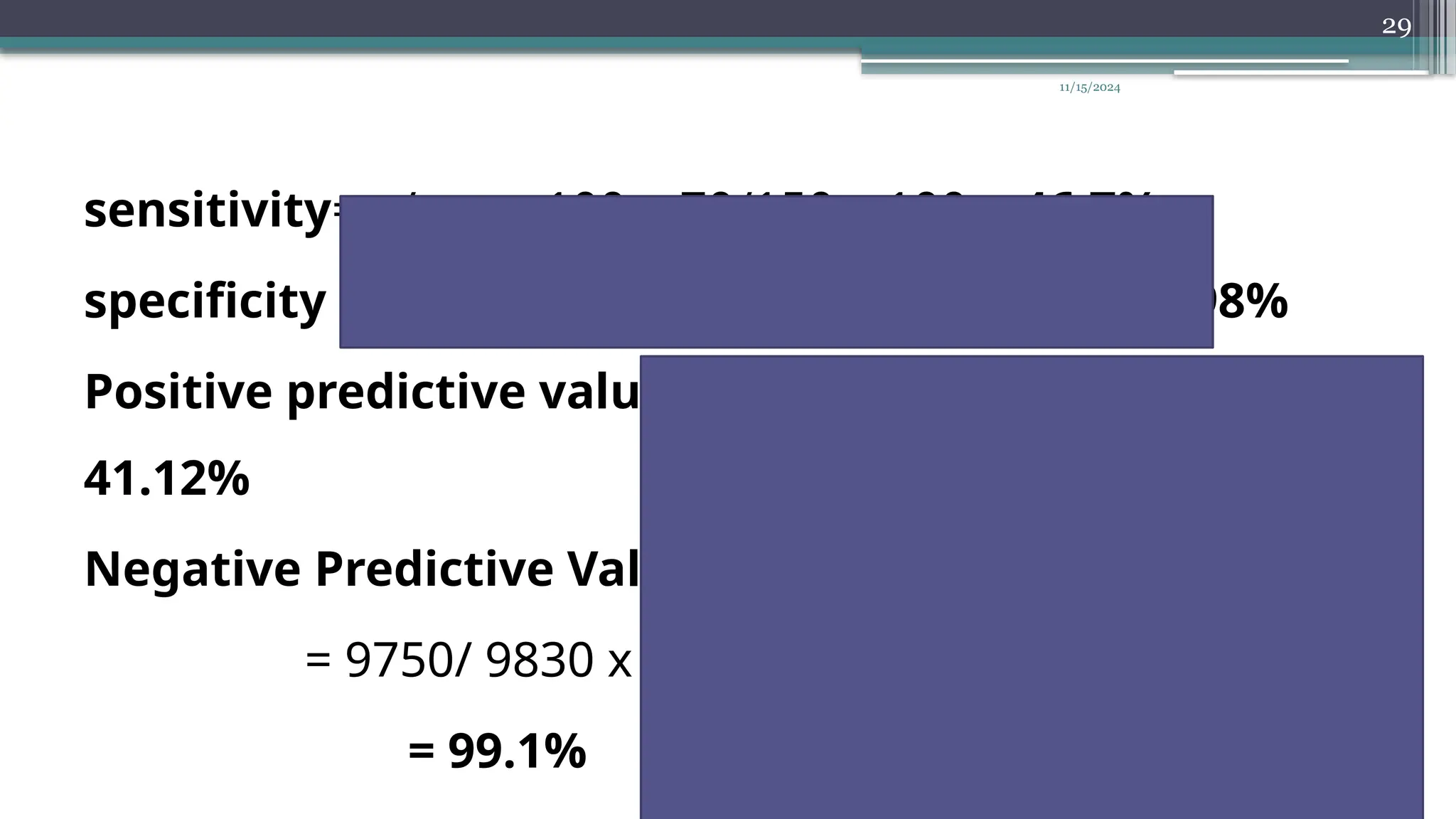
sensitivity= a/a+c x 100 = 70/150 x 100 = 46.7%
specificity = d/b+d x 100 = 9750/9850 x 100 = 98.98%
Positive predictive value = a/a+b x 100= 70/170 x100 =
41.12%
Negative Predictive Value = d/ c+d x 100
= 9750/ 9830 x 100
= 99.1%
11/15/2024
30
THANK YOU

SCREENING-1.pptx including sensitivity .

  • 1.
  • 2.
  • 3.
    3 Symptomatic disease What the physician sees … Pre-symptomatic disease Whatthe physician does not sees … THE ICEBERG OF DISEASE
  • 4.
    4 SCREENING • Definition: • Thesearch for unrecognized disease or defect by means of rapidly applied tests, examinations or other procedures in apparently healthy individuals. • Concept: • Early detection of “hidden disease”. • Conserving physician time for diagnosis and treatment. • Techniques to administer simple, inexpensive laboratory tests and operate other measuring devices.
  • 5.
    5 Screening differs fromPeriodic health examination a. Capable of wide application b. Relatively inexpensive c. Requires little physician time. d. Physician is not required to administer the test but only interpret it.
  • 6.
    6 Screening Test VSDiagnostic Tests Screening Test Diagnostic Test • Done on apparently healthy • Applied to groups • Test results are arbitrary and final • Done on those with indications and sick • Applied to single patients, all diseases are considered • Diagnosis is not final but modified in light of new evidence, diagnosis is the sum of all evidence
  • 7.
    7 Screening Test VSDiagnostic Tests Screening Test Diagnostic Test • Based on one criterion or cut- off point • Less expensive • Not a basis for treatment • The initiative comes from the investigator or agency providing care • Based on evaluation of a number of symptoms, signs and laboratory findings. • More expensive • Used as a basis for treatment • The initiative comes from a patient with a complaint
  • 8.
    8 Lead Time • Detectionprograms should concentrate on those conditions where the time lag between the disease onset and its final critical point is sufficiently long to be suitable for population screening. • “Lead time” is the advantage gained by screening • i.e the period between diagnosis by early detection and diagnosis by other means.
  • 9.
  • 10.
    10 Apparently Normal (Periodic re-scanning) POSSIBLEOUTCOMES OF SCREENING Apparently Abnormal (a)Normal – periodic re-scanning (b)Intermediate- surveillance (c)Abnormal - treatment Apparently Healthy (Screening Tests)
  • 11.
    11 USES OF SCREENING 1.Case detection ( Prescriptive screening) 2. Control of disease (Prospective Screening) 3. Research purposes 4. Educational opportunities
  • 12.
    12 TYPES OF SCREENING 1.Mass Screening 2. High Risk or Selective screening 3. Multiphasic Screening
  • 13.
    13 CRITERIA FOR SCREENING •It is based on two considerations: A. DISEASE to be screened B. TEST to be applied
  • 14.
    14 The test mustsatisfy the following criteria: 1. Acceptability 2. Repeatability Observer Variation Biological ( Subject ) variation Errors related to technical methods 3. Validity ( Accuracy) Sensitivity Specificity
  • 15.
    15 Validity (accuracy) • Theterm validity refers to what extent the test accurately measures which it purports to measure. • Validity has two components sensitivity and specificity • Sensitivity and specificity, together with "predictive accuracy" are inherent properties of a screening test.
  • 16.
    16 Sensitivity • It hasbeen defined as the ability of a test to identify correctly all those who have the disease • that is "true-positive". • A 90 per cent sensitivity means that 90 per cent of the diseased people screened by the test will give a "true-positive" result and the remaining 10 per cent a "false-negative" result.
  • 17.
    17 Specificity • It isdefined as the ability of a test to identify correctly those who do not have the disease, that is, "true-negatives". • A 90 per cent specificity means that 90 per cent of the non diseased persons will give "true-negative" result, 10 per cent of non-diseased people screened by the test will be wrongly classified as "diseased" when they are not
  • 18.
    18 Predictive accuracy • Reflectsthe diagnostic power of the test. • The predictive accuracy depends upon sensitivity, specificity and disease prevalence. • The "predictive value of a positive test" indicates the probability that a patient with a positive test result has, in fact, the disease in question. • Negative predictive value is the probability that subjects with a negative screening test truly don't have the disease
  • 19.
    19 Screening test results Diagnosis Total Disease+ Disease - Positive a+b Negative c+d Total a+c b +d a+b+c+d a(true positive) b (false positive) c(false negative) d ( true negatives)
  • 20.
    20 Positive predictive value= a x 100 a+b Negative Predictive Value = d x 100 c+d Screening test results Diagnosis Total Disease + Disease - Positive a(true positive) b (false positive) a+b Negative c(false negative) d ( true negatives) c+d Total a+c b +d a+b+c+d sensitivity= a x 100 a+c specificity = d x 100
  • 21.
    21 Screening test results Diagnosis Total Disease+ Disease - Positive a(true positive) b (false positive) a+b Negative c(false negative) d ( true negatives) c+d Total a+c b +d a+b+c+d Sensitivit y Specifici ty Positive predictive value Positive predictive value
  • 22.
  • 23.
    23 A new screeningtest for breast cancer was found to be positive in 20% of 600 elderly females. Biopsy done among the 600 women was found positive in 96 of them. There were 12 false negatives. Calculate the specificity, sensitivity, positive and negative predictive value of the new screening test.
  • 24.
    11/15/2024 24 Data given: No. ofpeople = 600 Total test positive = 20% of 600 = 120 Prevalence of disease = 16% of 600 = 96 False negative = 12
  • 25.
    11/15/2024 25 Screening test resultsBiopsy positive Biopsy negative Total Screening test + 84 (a) 36 (b) 120 Screening Test - 12 (c) 468 (d) 480 Total 96 504 600
  • 26.
    11/15/2024 26 sensitivity= a x100 = 84/96 X 100 = 87.5% a+c specificity = d x 100= 468/504 X 100 = 92.86% b+d Positive predictive value = a x 100= 84/120 X100 = 70% a+b Negative Predictive Value = d/ c+d x 100 = 468/ 480 x 100 = 97.5%
  • 27.
    11/15/2024 27 Problem 2: The resultsobtained after screening 10,000 people for diabetes with random blood sugar is given in the table. Cut off value of 200 mg/dl for random blood sugar was used as test positive. The prevalence of diabetes in that population was known to be 1.5%.
  • 28.
    11/15/2024 28 Diabetic Non-diabetic Total RBS+ 70 (a) 100 (b) 170 RBS - 80 (c) 9750 (d) 9830 Total 150 9850 10,000
  • 29.
    11/15/2024 29 sensitivity= a/a+c x100 = 70/150 x 100 = 46.7% specificity = d/b+d x 100 = 9750/9850 x 100 = 98.98% Positive predictive value = a/a+b x 100= 70/170 x100 = 41.12% Negative Predictive Value = d/ c+d x 100 = 9750/ 9830 x 100 = 99.1%
  • 30.