Screening
A Tool of Surveillance
To identify undiagnosed cases of
disease using rapid test
Bhoj R Singh
Section of Epidemiology, CADRAD, IVRI, Izatnagar-243122, India
Objectives/ Purpose
• Objective:
• To reduce mortality and/or morbidity by early detection and treatment.
• To Maintain or enhance production through better management.
• Purpose
– To identify undiagnosed cases of disease
– Detect outbreaks/ disease/ production losses and causes
– Detect animal health threats
– Detect infectious cases (case finding)
– Monitor trends in a target population
– Monitor exposed individuals for symptoms
– Monitor treated individuals for complications
– Direct animal health interventions
– Evaluate animal health interventions
– Generate hypotheses for further evaluation
• Aim
– To separate apparently healthy individuals that probably have a disease from those that probably
do not.
• Does not Intend for
– Diagnosis of disease at individual level, testing positive in screening test needs more
confirmatory tests/ diagnostic tests.
Approaches
• Population-level screening/ Mass screening
– National level policy decision to offer mass screening to a whole sub-group
of a population
• Measurement of pesticide levels / antibiotic levels in animals/ their products/
feeds/ fodder
• Tuberculin testing
• PPR antibodies in Goats
• Strategic screening
– Targeted in specific areas where disease cases may be present eg. For FMD
in a territory of 5 Km area; Bird flue in a district, FMD in vaccinated
animals etc.
• Prescriptive screening/ Individual-level screening/ Case finding
– Occurs at the individual patient-veterinarian level
– Also a component of the disease control.
– Focus is on identifying existing disease in patients who don’t know they
have it, e.g., Brucella testing in a herd or an individual animal before
purchasing
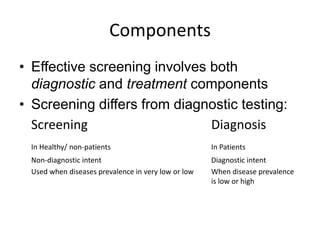
Components
• Effective screening involves both
diagnostic and treatment components
• Screening differs from diagnostic testing:
Screening Diagnosis
In Healthy/ non-patients In Patients
Non-diagnostic intent Diagnostic intent
Used when diseases prevalence in very low or low When disease prevalence
is low or high
Phases in screening
• Preclinical phase (PCP): the period between early
detection by screening and the clinical diagnosis.
Pathology begins/ infection establishes
Diseases detectible
PCP LT
Disease diagnosed and is in typical clinical form
Lead Time (LT):
• Equals the amount of time by which treatment is advanced or made
“early”.
• Not a theory or statistical artifact but what is expected and must
occur with early detection.
• Does not imply improved outcome!!
• Necessary but not sufficient condition for effective screening.
Characteristics of Screening tests
a) Sensitivity (Se) (Prob T+|D+)
a) the proportion of cases with a positive screening test among all
individuals with pre-clinical disease.
b) Want a highly Se test in order to identify as many cases as
possible…… but there’s a trade off with……the specificity should not
be too low
• b) Specificity (Sp) (Prob T-|D-)
the proportion of individuals with a negative screening test result
among all individuals with no pre-clinical disease.
The feasibility and efficiency of screening programs is acutely sensitive to
the positive predictive value which is often very low due to the very
low disease prevalence.
*Imperfect Sp affects many (the healthy), whereas an imperfect Se
affects only a few (the sick).
Evaluation of Screening results
– Compare disease-specific mortality rate (DSMR)
between those randomized to screening and
those not
– Eliminates all forms of bias (theoretically)
– But, problems of:
• Expense, time consuming, logistically difficult,
contamination, non-compliance, ethical concerns,
changing technology.
– Can also evaluate screening programmes using
Cohort and Case-control studies, but they are
difficult to do and very susceptible to bias.
The only valid measure of Screening
Disease-specific Mortality Rate (DSMR)
the number of deaths due to disease
Total person-years experience
– The only gold-standard outcome measure for screening
– Not affected by lead time
– when calculated from a Randomized control trials (RCT) - not
affected by compliance bias or length-time bias.
– However, there can be problems with the correct assignment of
cause of death (hence some researchers advocate using only all-
cause mortality as the outcome).
Biases in Screening
• Observational studies and especially survival data are acutely
sensitive to:
• 1. Compliance bias (Selection bias):
• Volunteers or compliers are better educated and more health conscious – thus
they have inherently better prognosis
• 2. Lead-time bias
• Apparent increased survival duration introduced by the lead time that results
from screening.
• Screen-detected cases survive longer event without benefit of early
treatment.
• 3. Length-time bias
• Screening preferentially identifies slower growing or less progressive cases
that have a better prognosis.
• Length-time bias – cases with better prognosis detected by screening
Pseudo-diseases and over diagnosis
• Over-diagnosis
– Limited malignant potential
– Extreme form of length-biased sampling
– e.g., Pap screening and cervical carcinoma
• Competing risks
– Cases detected that would have been interrupted by an unrelated
death
– e.g. Prostate Cancer and cardiovascular disease (CVD) death
• Serendipity
– Chance detection due to diagnostic testing for another reason
– e.g. PSA (Prostate specific antigen) and prostate CA (Cancer), FOBT
(Faecal occult blood test) and Colo-rectal cancer (CR CA)
Assessing the feasibility of screening
• Burden of disease
– Effectiveness of treatment without screening
• Acceptability
– Convenience, comfort, safety, costs (= compliance)
• Efficacy of screening
– Test characteristics (Se, Sp)
– Potential to reduce mortality
• Efficiency
– Low PVP (Predictive value of Positive) (PVN, predictive value of
negative))
– Risks and costs of follow-up of test positives
– Cost-effectiveness
• Balance of risks (harms) vs. benefits
Three questions before screening
• Should we screen? (scientific): Efficacy
• Can we screen? (practical): Effectiveness
• Is it worth to do it? (scientific, practical, policy,
political): Cost effectiveness

Screening

  • 1.
    Screening A Tool ofSurveillance To identify undiagnosed cases of disease using rapid test Bhoj R Singh Section of Epidemiology, CADRAD, IVRI, Izatnagar-243122, India
  • 2.
    Objectives/ Purpose • Objective: •To reduce mortality and/or morbidity by early detection and treatment. • To Maintain or enhance production through better management. • Purpose – To identify undiagnosed cases of disease – Detect outbreaks/ disease/ production losses and causes – Detect animal health threats – Detect infectious cases (case finding) – Monitor trends in a target population – Monitor exposed individuals for symptoms – Monitor treated individuals for complications – Direct animal health interventions – Evaluate animal health interventions – Generate hypotheses for further evaluation • Aim – To separate apparently healthy individuals that probably have a disease from those that probably do not. • Does not Intend for – Diagnosis of disease at individual level, testing positive in screening test needs more confirmatory tests/ diagnostic tests.
  • 3.
    Approaches • Population-level screening/Mass screening – National level policy decision to offer mass screening to a whole sub-group of a population • Measurement of pesticide levels / antibiotic levels in animals/ their products/ feeds/ fodder • Tuberculin testing • PPR antibodies in Goats • Strategic screening – Targeted in specific areas where disease cases may be present eg. For FMD in a territory of 5 Km area; Bird flue in a district, FMD in vaccinated animals etc. • Prescriptive screening/ Individual-level screening/ Case finding – Occurs at the individual patient-veterinarian level – Also a component of the disease control. – Focus is on identifying existing disease in patients who don’t know they have it, e.g., Brucella testing in a herd or an individual animal before purchasing
  • 4.
    Components • Effective screeninginvolves both diagnostic and treatment components • Screening differs from diagnostic testing: Screening Diagnosis In Healthy/ non-patients In Patients Non-diagnostic intent Diagnostic intent Used when diseases prevalence in very low or low When disease prevalence is low or high
  • 5.
    Phases in screening •Preclinical phase (PCP): the period between early detection by screening and the clinical diagnosis. Pathology begins/ infection establishes Diseases detectible PCP LT Disease diagnosed and is in typical clinical form Lead Time (LT): • Equals the amount of time by which treatment is advanced or made “early”. • Not a theory or statistical artifact but what is expected and must occur with early detection. • Does not imply improved outcome!! • Necessary but not sufficient condition for effective screening.
  • 6.
    Characteristics of Screeningtests a) Sensitivity (Se) (Prob T+|D+) a) the proportion of cases with a positive screening test among all individuals with pre-clinical disease. b) Want a highly Se test in order to identify as many cases as possible…… but there’s a trade off with……the specificity should not be too low • b) Specificity (Sp) (Prob T-|D-) the proportion of individuals with a negative screening test result among all individuals with no pre-clinical disease. The feasibility and efficiency of screening programs is acutely sensitive to the positive predictive value which is often very low due to the very low disease prevalence. *Imperfect Sp affects many (the healthy), whereas an imperfect Se affects only a few (the sick).
  • 7.
    Evaluation of Screeningresults – Compare disease-specific mortality rate (DSMR) between those randomized to screening and those not – Eliminates all forms of bias (theoretically) – But, problems of: • Expense, time consuming, logistically difficult, contamination, non-compliance, ethical concerns, changing technology. – Can also evaluate screening programmes using Cohort and Case-control studies, but they are difficult to do and very susceptible to bias.
  • 8.
    The only validmeasure of Screening Disease-specific Mortality Rate (DSMR) the number of deaths due to disease Total person-years experience – The only gold-standard outcome measure for screening – Not affected by lead time – when calculated from a Randomized control trials (RCT) - not affected by compliance bias or length-time bias. – However, there can be problems with the correct assignment of cause of death (hence some researchers advocate using only all- cause mortality as the outcome).
  • 9.
    Biases in Screening •Observational studies and especially survival data are acutely sensitive to: • 1. Compliance bias (Selection bias): • Volunteers or compliers are better educated and more health conscious – thus they have inherently better prognosis • 2. Lead-time bias • Apparent increased survival duration introduced by the lead time that results from screening. • Screen-detected cases survive longer event without benefit of early treatment. • 3. Length-time bias • Screening preferentially identifies slower growing or less progressive cases that have a better prognosis. • Length-time bias – cases with better prognosis detected by screening
  • 10.
    Pseudo-diseases and overdiagnosis • Over-diagnosis – Limited malignant potential – Extreme form of length-biased sampling – e.g., Pap screening and cervical carcinoma • Competing risks – Cases detected that would have been interrupted by an unrelated death – e.g. Prostate Cancer and cardiovascular disease (CVD) death • Serendipity – Chance detection due to diagnostic testing for another reason – e.g. PSA (Prostate specific antigen) and prostate CA (Cancer), FOBT (Faecal occult blood test) and Colo-rectal cancer (CR CA)
  • 11.
    Assessing the feasibilityof screening • Burden of disease – Effectiveness of treatment without screening • Acceptability – Convenience, comfort, safety, costs (= compliance) • Efficacy of screening – Test characteristics (Se, Sp) – Potential to reduce mortality • Efficiency – Low PVP (Predictive value of Positive) (PVN, predictive value of negative)) – Risks and costs of follow-up of test positives – Cost-effectiveness • Balance of risks (harms) vs. benefits
  • 12.
    Three questions beforescreening • Should we screen? (scientific): Efficacy • Can we screen? (practical): Effectiveness • Is it worth to do it? (scientific, practical, policy, political): Cost effectiveness