MEASURES OF ASSOCIATION Presenter: P. Ganeshkumar Moderator: Dr. Pragati Chhabra
Overview of the presentation Association Types of association Measures of association Ratio measures Difference measures Relationship between OR & RR Causation 24-Dec-08 DEPT. OF COMMUNITY MEDICINE, UCMS&GTBH DELHI.
ASSOCIATION 24-Dec-08 DEPT. OF COMMUNITY MEDICINE, UCMS&GTBH DELHI.
Types of association Positive/Negative Direct/Indirect Causal/Non causal 24-Dec-08 DEPT. OF COMMUNITY MEDICINE, UCMS&GTBH DELHI.
Types of association….contd. Positive: Occurrence of higher value of a predictor variable is associated with occurrence of higher value of another dependent variable. Ex: education and suicide 24-Dec-08 DEPT. OF COMMUNITY MEDICINE, UCMS&GTBH DELHI.
Types of association……contd. Negative–Occurrence of higher value of a predictor variable is associated with lower value of another dependent variable. Ex – Female literacy and IMR 24-Dec-08 DEPT. OF COMMUNITY MEDICINE, UCMS&GTBH DELHI.
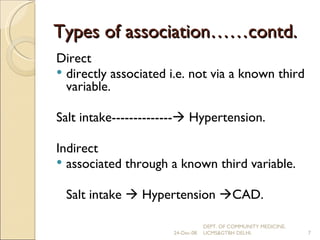
Types of association……contd. Direct  directly associated i.e. not via a known third variable. Salt intake--------------   Hypertension. Indirect associated through a known third variable. Salt intake    Hypertension   CAD. 24-Dec-08 DEPT. OF COMMUNITY MEDICINE, UCMS&GTBH DELHI.
Types of association……contd. Causal  independent variable must cause change in dependent variable.  Definite condition of causal associations are time and direction Ex –salt intake and hypertension Non-causal non-directional association between two variables. Ex –alcohol use and smoking 24-Dec-08 DEPT. OF COMMUNITY MEDICINE, UCMS&GTBH DELHI.
Association-types Spurious association artificial, fortuitous, false  or all non-causal associations due to chance, bias or confounding. Ex: Increased water intake and crime rate in summer. 24-Dec-08 DEPT. OF COMMUNITY MEDICINE, UCMS&GTBH DELHI.
24-Dec-08 DEPT. OF COMMUNITY MEDICINE, UCMS&GTBH DELHI.
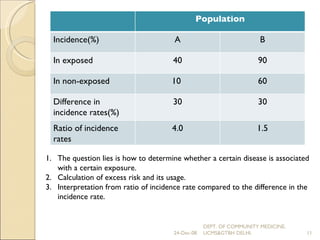
24-Dec-08 DEPT. OF COMMUNITY MEDICINE, UCMS&GTBH DELHI. The question lies is how to determine whether a certain disease is associated with a certain exposure. Calculation of excess risk and its usage. Interpretation from ratio of incidence rate compared to the difference in the incidence rate. Population Incidence(%) A B In exposed 40 90 In non-exposed 10  60 Difference in incidence rates(%) 30 30 Ratio of incidence rates 4.0 1.5
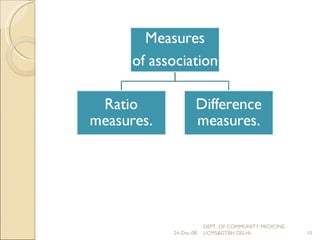
In other words, Difference measures are measures of association in which  absolute differences  between groups being compared . Ratio measures are measures of association in which  relative differences  between groups being compared. 24-Dec-08 DEPT. OF COMMUNITY MEDICINE, UCMS&GTBH DELHI.
Absolute differences ( Syn: Difference measures ) Main goal is often an absolute reduction in the risk of an undesirable outcome. When outcome of interest is continuous, the assessment of mean absolute differences between exposed and unexposed individuals may be an appropriate method for the determination of association. Preferred by public health or preventive activist.  24-Dec-08 DEPT. OF COMMUNITY MEDICINE, UCMS&GTBH DELHI.
Relative differences  (Syn:Ratio measures) Can be assessed for discrete outcomes. To assess causal associations. 24-Dec-08 DEPT. OF COMMUNITY MEDICINE, UCMS&GTBH DELHI.
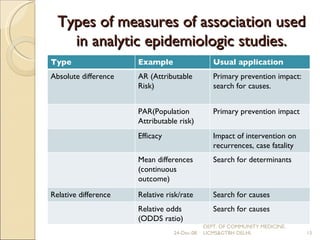
Types of measures of association used in analytic epidemiologic studies. 24-Dec-08 DEPT. OF COMMUNITY MEDICINE, UCMS&GTBH DELHI. Type Example Usual application Absolute difference AR (Attributable Risk) Primary prevention impact: search for causes. PAR(Population Attributable risk) Primary prevention impact Efficacy Impact of intervention on recurrences, case fatality etc.  Mean differences (continuous outcome) Search for determinants Relative difference Relative risk/rate Search for causes Relative odds (ODDS ratio) Search for causes
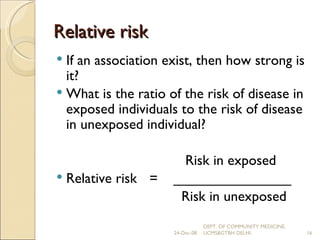
Relative risk If an association exist, then how strong is it? What is the ratio of the risk of disease in exposed individuals to the risk of disease in unexposed individual?   Risk in exposed Relative risk =  _______________   Risk in unexposed 24-Dec-08 DEPT. OF COMMUNITY MEDICINE, UCMS&GTBH DELHI.
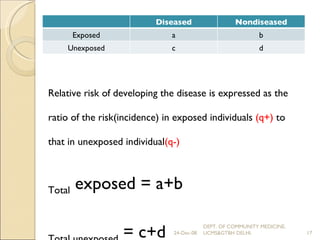
Relative risk of developing the disease is expressed as the ratio of the risk(incidence) in exposed individuals  (q+)  to that in unexposed individual (q-) Total  exposed = a+b Total unexposed  = c+d 24-Dec-08 DEPT. OF COMMUNITY MEDICINE, UCMS&GTBH DELHI. Diseased Nondiseased Exposed a b Unexposed c d
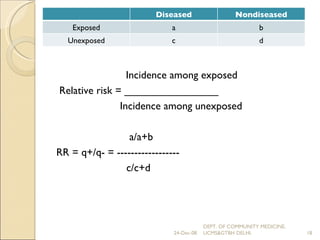
  Incidence among exposed Relative risk = ________________   Incidence among unexposed     a/a+b RR = q+/q- = ------------------   c/c+d 24-Dec-08 DEPT. OF COMMUNITY MEDICINE, UCMS&GTBH DELHI. Diseased Nondiseased Exposed a b Unexposed c d
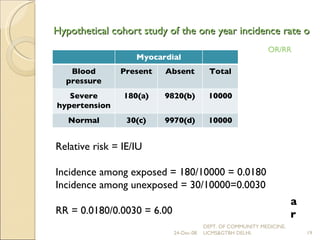
Hypothetical cohort study of the one year incidence rate of acute MI. Relative risk = IE/IU Incidence among exposed = 180/10000  = 0.0180 Incidence among unexposed = 30/10000=0.0030 RR = 0.0180/0.0030 = 6.00 ar 24-Dec-08 DEPT. OF COMMUNITY MEDICINE, UCMS&GTBH DELHI. OR/RR Myocardial infarction Blood pressure Present Absent Total Severe hypertension 180(a) 9820(b) 10000 Normal 30(c) 9970(d) 10000
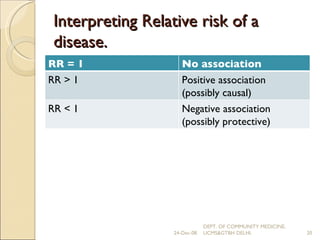
Interpreting Relative risk of a disease. 24-Dec-08 DEPT. OF COMMUNITY MEDICINE, UCMS&GTBH DELHI. RR = 1 No association RR > 1 Positive association  (possibly causal) RR < 1 Negative association (possibly protective)
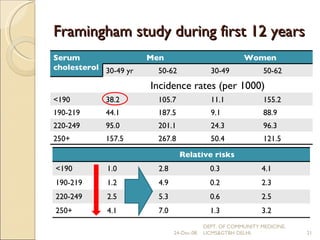
Framingham study during first 12 years 24-Dec-08 DEPT. OF COMMUNITY MEDICINE, UCMS&GTBH DELHI. Serum cholesterol Men Women 30-49 yr 50-62 30-49 50-62 Incidence rates (per 1000) <190 38.2 105.7 11.1 155.2 190-219 44.1 187.5 9.1 88.9 220-249 95.0 201.1 24.3 96.3 250+ 157.5 267.8 50.4 121.5 Relative risks <190 1.0 2.8 0.3 4.1 190-219 1.2 4.9 0.2 2.3 220-249 2.5 5.3 0.6 2.5 250+ 4.1 7.0 1.3 3.2
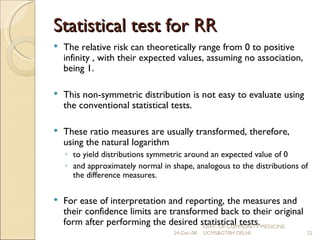
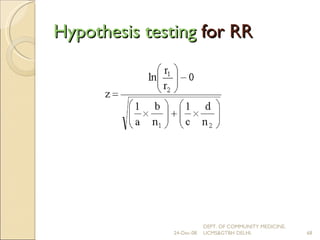
Statistical test for RR The relative risk can theoretically range from 0 to positive infinity , with their expected values, assuming no association, being 1. This non-symmetric distribution is not easy to evaluate using the conventional statistical tests. These ratio measures are usually transformed, therefore, using the natural logarithm  to yield distributions symmetric around an expected value of 0  and approximately normal in shape, analogous to the distributions of the difference measures.  For ease of interpretation and reporting, the measures and their confidence limits are transformed back to their original form after performing the desired statistical tests. 24-Dec-08 DEPT. OF COMMUNITY MEDICINE, UCMS&GTBH DELHI.
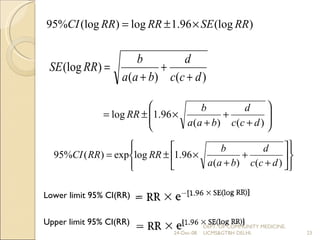
Lower limit 95% CI(RR) Upper limit 95% CI(RR) 24-Dec-08 DEPT. OF COMMUNITY MEDICINE, UCMS&GTBH DELHI.
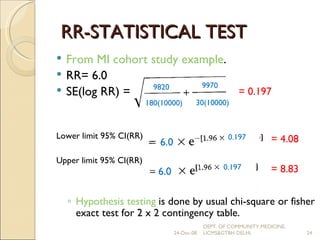
RR-STATISTICAL TEST From MI cohort study example . RR= 6.0 SE(log RR) =  Lower limit 95% CI(RR) Upper limit 95% CI(RR) Hypothesis testing  is done by usual chi-square or fisher exact test for 2 x 2 contingency table.  9820 180(10000)  9970 30(10000) = 0.197 6.0 0.197 6.0 0.197 = 4.08 = 8.83 24-Dec-08 DEPT. OF COMMUNITY MEDICINE, UCMS&GTBH DELHI.
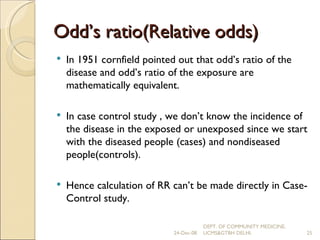
Odd’s ratio(Relative odds) In 1951 cornfield pointed out that odd’s ratio of the disease and odd’s ratio of the exposure are mathematically equivalent. In case control study , we don’t know the incidence of the disease in the exposed or unexposed since we start with the diseased people (cases) and nondiseased people(controls). Hence calculation of RR can’t be made directly in Case-Control study.  24-Dec-08 DEPT. OF COMMUNITY MEDICINE, UCMS&GTBH DELHI.
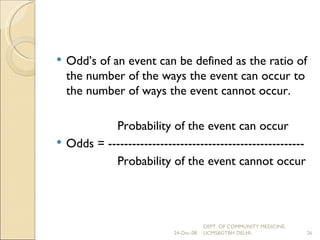
Odd’s of an event can be defined as the ratio of the number of the ways the event can occur to the number of ways the event cannot occur. Probability of the event can occur Odds = ------------------------------------------------- Probability of the event cannot occur 24-Dec-08 DEPT. OF COMMUNITY MEDICINE, UCMS&GTBH DELHI.
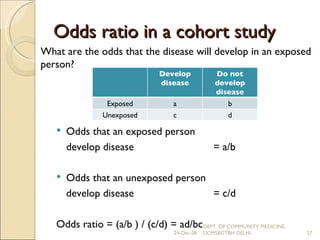
Odds ratio in a cohort study Odds that an exposed person  develop disease = a/b Odds that an  unexposed person develop disease = c/d Odds ratio = (a/b ) / (c/d) = ad/bc What are the odds that the disease will develop in an exposed person? 24-Dec-08 DEPT. OF COMMUNITY MEDICINE, UCMS&GTBH DELHI. Develop disease Do not develop disease Exposed a b Unexposed c d
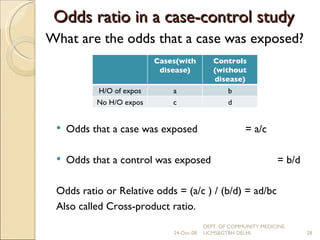
Odds ratio in a case-control study What are the odds that a case was exposed? Odds that a case was exposed  = a/c Odds that a control was  exposed  = b/d Odds ratio or Relative odds = (a/c ) / (b/d) = ad/bc Also called Cross-product ratio. 24-Dec-08 DEPT. OF COMMUNITY MEDICINE, UCMS&GTBH DELHI. Cases(with disease) Controls (without disease) H/O of expos a b No H/O expos c d
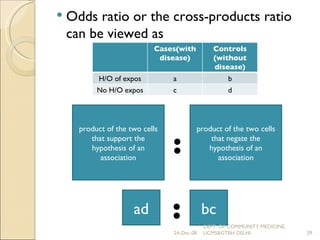
Odds ratio or the cross-products ratio can be viewed as product of the two cells that support the hypothesis of an association product of the two cells that negate the hypothesis of an association : ad bc : 24-Dec-08 DEPT. OF COMMUNITY MEDICINE, UCMS&GTBH DELHI. Cases(with disease) Controls (without disease) H/O of expos a b No H/O expos c d
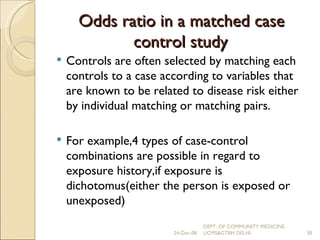
Odds ratio in a matched case control study Controls are often selected by matching each controls to a case according to variables that are known to be related to disease risk either by individual matching or matching pairs. For example,4 types of case-control combinations are possible in regard to exposure history,if exposure is dichotomus(either the person is exposed or unexposed) 24-Dec-08 DEPT. OF COMMUNITY MEDICINE, UCMS&GTBH DELHI.
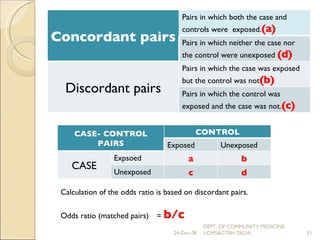
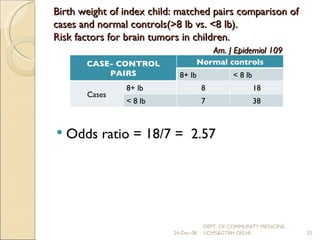
Calculation of the odds ratio is based on discordant pairs. Odds ratio (matched pairs) =  b/c 24-Dec-08 DEPT. OF COMMUNITY MEDICINE, UCMS&GTBH DELHI. Concordant pairs Pairs in which both the case and controls were  exposed. (a) Pairs in which neither the case nor the control were unexposed  (d) Discordant pairs Pairs in which the case was exposed but the control was not (b) Pairs in which the control was exposed and the case was not. (c) CASE- CONTROL PAIRS CONTROL Exposed Unexposed CASE Expsoed a b Unexposed c d
Birth weight of index child: matched pairs comparison of cases and normal controls(>8 lb vs. <8 lb). Risk factors for brain tumors in children. Am. J Epidemiol 109 Odds ratio = 18/7 =  2.57 24-Dec-08 DEPT. OF COMMUNITY MEDICINE, UCMS&GTBH DELHI. CASE- CONTROL PAIRS Normal controls 8+ lb < 8 lb Cases 8+ lb  8 18 < 8 lb 7 38
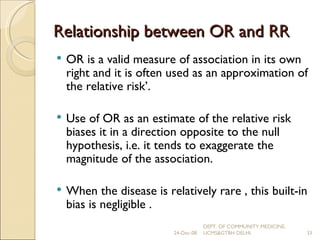
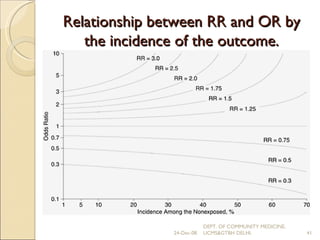
Relationship between OR and RR OR is a valid measure of association in its own right and it is often used as an approximation of the relative risk’. Use of OR as an estimate of the relative risk biases it in a direction opposite to the null hypothesis, i.e. it tends to exaggerate the magnitude of the association. When the disease is relatively rare , this built-in bias is negligible . 24-Dec-08 DEPT. OF COMMUNITY MEDICINE, UCMS&GTBH DELHI.
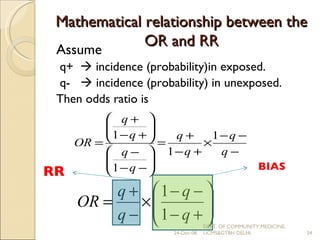
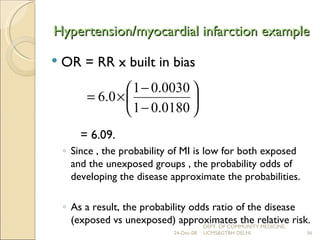
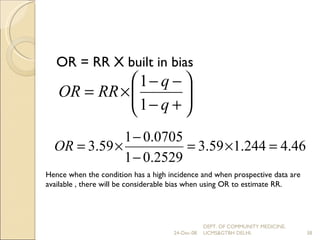
Mathematical relationship between the OR and RR Assume  q+    incidence (probability)in exposed. q-    incidence (probability) in unexposed. Then odds ratio is RR BIAS 24-Dec-08 DEPT. OF COMMUNITY MEDICINE, UCMS&GTBH DELHI.
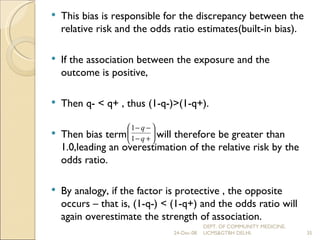
This bias is responsible for the discrepancy between the relative risk and the odds ratio estimates(built-in bias). If the association between the exposure and the outcome is positive,  Then q- < q+ , thus (1-q-)>(1-q+).  Then bias term  will therefore be greater than 1.0,leading an overestimation of the relative risk by the odds ratio. By analogy, if the factor is protective , the opposite occurs – that is, (1-q-) < (1-q+) and the odds ratio will again overestimate the strength of association. 24-Dec-08 DEPT. OF COMMUNITY MEDICINE, UCMS&GTBH DELHI.
Hypertension/myocardial infarction example OR = RR x built in bias = 6.09. Since , the probability of MI is low for both exposed and the unexposed groups , the probability odds of developing the disease approximate the probabilities. As a result, the probability odds ratio of the disease (exposed vs unexposed) approximates the relative risk. 24-Dec-08 DEPT. OF COMMUNITY MEDICINE, UCMS&GTBH DELHI.
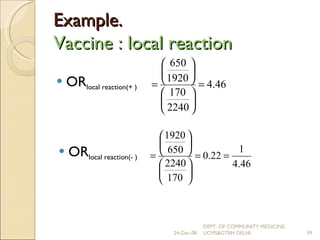
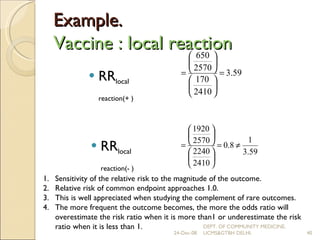
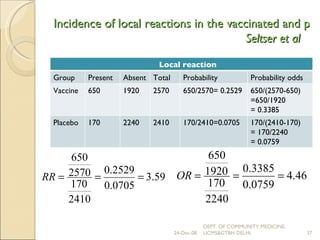
Incidence of local reactions in the vaccinated and placebo groups, influenza vaccination trial. Seltser et al 24-Dec-08 DEPT. OF COMMUNITY MEDICINE, UCMS&GTBH DELHI. Local reaction Group Present Absent Total Probability Probability odds Vaccine 650 1920 2570 650/2570= 0.2529 650/(2570-650) =650/1920  = 0.3385 Placebo 170 2240 2410 170/2410=0.0705 170/(2410-170) = 170/2240 = 0.0759
OR = RR X built in bias Hence when the condition has a high incidence and when prospective data are available , there will be considerable bias when using OR to estimate RR. 24-Dec-08 DEPT. OF COMMUNITY MEDICINE, UCMS&GTBH DELHI.
Example.  Vaccine : local reaction  OR local reaction(+ ) OR local reaction(- ) 24-Dec-08 DEPT. OF COMMUNITY MEDICINE, UCMS&GTBH DELHI.
Example.  Vaccine : local reaction  RR local reaction(+ ) RR local reaction(- ) Sensitivity of the relative risk to the magnitude of the outcome. Relative risk of common endpoint approaches 1.0. This is well appreciated when studying the complement of rare outcomes. The more frequent the outcome becomes, the more the odds ratio will overestimate the risk ratio when it is more than1 or underestimate the risk ratio when it is less than 1. 24-Dec-08 DEPT. OF COMMUNITY MEDICINE, UCMS&GTBH DELHI.
Relationship between RR and OR by the incidence of the outcome. 24-Dec-08 DEPT. OF COMMUNITY MEDICINE, UCMS&GTBH DELHI.
ATTRIBUTABLE RISK (AR) How much of the disease that occurs can be attributed to a certain exposure? AR is defined as the amount of proportion of disease incidence (or disease risk) that can be attributed to a specific exposure. AR in exposed persons(eg.  AR of lung cancer in smokers) AR for the population includes both exposed and unexposed persons(AR of lung cancer in population which consists of both smokers and non-smokers) 24-Dec-08 DEPT. OF COMMUNITY MEDICINE, UCMS&GTBH DELHI.
Terms AR is a measure of association based on the absolute difference between two risk estimates. It is often used to imply a cause-effect relationship and should be interpreted as a  true etiologic fraction  only when there is a reasonable certainty of a causal connection between exposure and outcome.  When causality has not been firmly established then the AR is termed as  excess fraction . 24-Dec-08 DEPT. OF COMMUNITY MEDICINE, UCMS&GTBH DELHI.
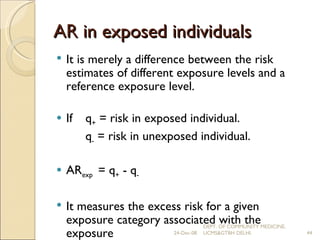
AR in exposed individuals It is merely a difference between the risk estimates of different exposure levels and a reference exposure level. If  q +  = risk in exposed individual.   q -  = risk in unexposed individual. AR exp  = q +  - q - It measures the excess risk for a given exposure category associated with the exposure 24-Dec-08 DEPT. OF COMMUNITY MEDICINE, UCMS&GTBH DELHI.
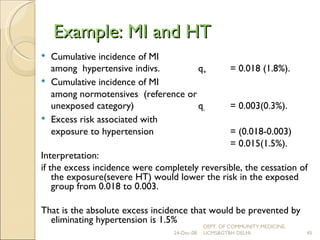
Example: MI and HT   Cumulative incidence of MI  among  hypertensive indivs.  q + = 0.018 (1.8%). Cumulative incidence of MI  among normotensives  (reference or  unexposed category)  q -  = 0.003(0.3%). Excess risk associated with  exposure to hypertension  = (0.018-0.003) = 0.015(1.5%). Interpretation:  if the excess incidence were completely reversible, the cessation of the exposure(severe HT) would lower the risk in the exposed group from 0.018 to 0.003. That is the absolute excess incidence that would be prevented by eliminating hypertension is 1.5% 24-Dec-08 DEPT. OF COMMUNITY MEDICINE, UCMS&GTBH DELHI.
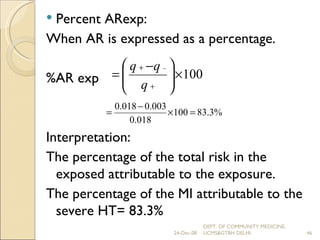
Percent ARexp: When AR is expressed as a percentage. %AR exp  Interpretation: The percentage of the total risk in the exposed attributable to the exposure. The percentage of the MI attributable to the severe HT= 83.3% 24-Dec-08 DEPT. OF COMMUNITY MEDICINE, UCMS&GTBH DELHI.
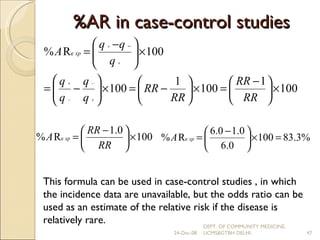
%AR in case-control studies This formula can be used in case-control studies , in which the incidence data are unavailable, but the odds ratio can be used as an estimate of the relative risk if the disease is relatively rare. 24-Dec-08 DEPT. OF COMMUNITY MEDICINE, UCMS&GTBH DELHI.
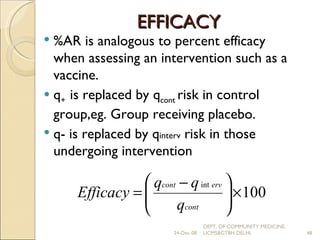
EFFICACY %AR is analogous to percent efficacy when assessing an intervention such as a vaccine. q +  is replaced by q cont  risk in control group,eg. Group receiving placebo. q- is replaced by q interv  risk in those undergoing intervention 24-Dec-08 DEPT. OF COMMUNITY MEDICINE, UCMS&GTBH DELHI.
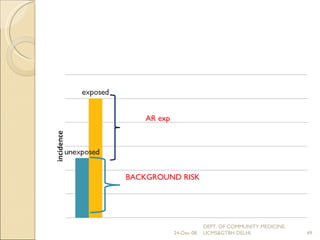
AR exp BACKGROUND RISK 24-Dec-08 DEPT. OF COMMUNITY MEDICINE, UCMS&GTBH DELHI.
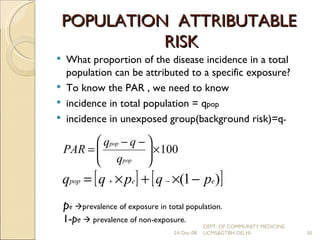
POPULATION  ATTRIBUTABLE  RISK What proportion of the disease incidence in a total population can be attributed to a specific exposure? To know the PAR , we need to know  incidence in total population = q pop incidence in unexposed group(background risk)=q - p e    prevalence of exposure in total population. 1- p e     prevalence of non-exposure. 24-Dec-08 DEPT. OF COMMUNITY MEDICINE, UCMS&GTBH DELHI.
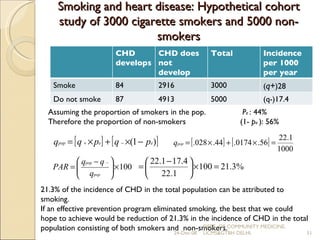
Smoking and heart disease: Hypothetical cohort study of 3000 cigarette smokers and 5000 non-smokers Assuming the proportion of smokers in the pop.   P e  : 44% Therefore the proportion of non-smokers (1-  p e  ): 56% 21.3% of the incidence of CHD in the total population can be attributed to smoking. If an effective prevention program eliminated smoking, the best that we could hope to achieve would be reduction of 21.3% in the incidence of CHD in the total population consisting of both smokers and  non-smokers. 24-Dec-08 DEPT. OF COMMUNITY MEDICINE, UCMS&GTBH DELHI. CHD develops CHD does not develop Total Incidence per 1000 per year Smoke  84 2916 3000 ( q+ )28 Do not smoke 87 4913 5000 (q-)17.4
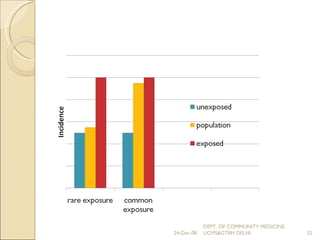
24-Dec-08 DEPT. OF COMMUNITY MEDICINE, UCMS&GTBH DELHI.
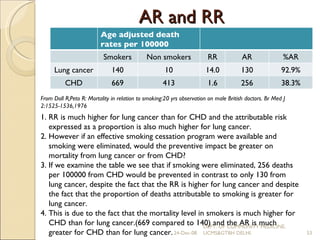
AR and RR From Doll R,Peto R: Mortality in relation to smoking:20 yrs observation on male British doctors. Br Med J 2:1525-1536,1976 24-Dec-08 DEPT. OF COMMUNITY MEDICINE, UCMS&GTBH DELHI. RR is much higher for lung cancer than for CHD and the attributable risk expressed as a proportion is also much higher for lung cancer. However if an effective smoking cessation program were available and smoking were eliminated, would the preventive impact be greater on mortality from lung cancer or from CHD?  If we examine the table we see that if smoking were eliminated, 256 deaths per 100000 from CHD would be prevented in contrast to only 130 from lung cancer, despite the fact that the RR is higher for lung cancer and despite the fact that the proportion of deaths attributable to smoking is greater for lung cancer. This is due to the fact that the mortality level in smokers is much higher for CHD than for lung cancer.(669 compared to 140) and the AR is much greater for CHD than for lung cancer. Age adjusted death rates per 100000 Smokers Non smokers RR AR %AR Lung cancer 140 10 14.0 130 92.9% CHD 669 413 1.6 256 38.3%
CAUSATION Causation is an interpretation, not an entity; it should not be reified. The 18th-century Scottish philosopher David Hume pointed out that causation is induced logically, not observed empirically. Therefore we can never  know absolutely that  exposure X causes disease Y. There is no final  proof of causation. it is merely an inference based on an observed conjunction of two variables (exposure and health status) in time and space. This limitation of inductive logic applies, of course, to both experimental and non-experimental research. 24-Dec-08 DEPT. OF COMMUNITY MEDICINE, UCMS&GTBH DELHI.
Karl Popper stressed that  science progresses by rejecting or modifying causal hypotheses, not by actually proving causation . a practical data-based approach to the notion of causation - Bradford Hill’s criteria of causality. 24-Dec-08 DEPT. OF COMMUNITY MEDICINE, UCMS&GTBH DELHI.
Bradford Hill’s  criteria Bradford Hill recognized the importance of moving from association to causation as a necessary step for taking preventive action against environmental causes of disease. views 24-Dec-08 DEPT. OF COMMUNITY MEDICINE, UCMS&GTBH DELHI.
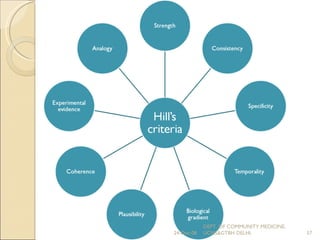
24-Dec-08 DEPT. OF COMMUNITY MEDICINE, UCMS&GTBH DELHI.
STRENGTH Strong assocaitions are more likely to be causal than weak. Weaker associations are more likely to be explained by undetected bias. But weaker association does not rule out causation. Eg. Smoking and CHD Strong but non-causal. Eg: Down syndrome and birth rank. Confounded by maternal age. 24-Dec-08 DEPT. OF COMMUNITY MEDICINE, UCMS&GTBH DELHI.
CONSISTENCY Repeated observation of an association in different populations under different circumstances. Lack of consistency however does not rule out a causal association. Consistency is apparent only after all the relevant details of a causal mechanism are understood, which is to say very seldom. Consistency serves only to rule out hypotheses that the association is attributable to some factor that varies across studies. The results (effect estimates) from the studies could all be identical even if many were significant and many were not, the differences arises solely from difference in standard errors or sizes of the studies. 24-Dec-08 DEPT. OF COMMUNITY MEDICINE, UCMS&GTBH DELHI.
SPECIFICITY Cause leads to a single effect and not multiple effects. Causal hypothesis predicts a relation with one outcome but no relation with another outcome; it can be logically deduced from the causal hypothesis in question. Eg: smoking. 24-Dec-08 DEPT. OF COMMUNITY MEDICINE, UCMS&GTBH DELHI.
TEMPORALITY Necessity for a cause to precede an effect in time. It is the only necessary criterion for a causal relationship between an exposure and an outcome. 24-Dec-08 DEPT. OF COMMUNITY MEDICINE, UCMS&GTBH DELHI.
BIOLOGICAL GRADIENT Presence of a unidirectional dose-response curve. Monotonic relation.  More smoking   more tissue damage   carcinogenisis. Threshold relation. DES   adenocarcinoma of uterus. All monotonic are not causal. Eg:Down syndrome and birth rank;confouded by maternal age. A non monotonic relation only refutes those causal hypotheses specific enough to predict a monotonic dose-response curve. 24-Dec-08 DEPT. OF COMMUNITY MEDICINE, UCMS&GTBH DELHI.
PLAUSIBILITY Biological plausibility of the hypothesis but one that is far from objective or absolute. It is too often not based on logic or data ,but only on prior beliefs. It is difficult to demonstrate where the confounder itself exhibits a biological gradient in relation to the outcome. 24-Dec-08 DEPT. OF COMMUNITY MEDICINE, UCMS&GTBH DELHI.
COHERENCE Cause and effect interpretation for an association does not conflict with what is known of the natural history and biology of the disease. Absence of coherent information as distinguished, apparently , from the presence of conflicting information, should not be taken as evidence against an association being considered causal. 24-Dec-08 DEPT. OF COMMUNITY MEDICINE, UCMS&GTBH DELHI.
EXPERIMENTAL EVIDENCE However , is seldom available for most epidemiologic research questions. It seems from the hill’s view, that experimental evidence was the result of removal of some harmful exposure in an intervention or prevention program, rather than the results of laboratory experiments. However experimental evidence is not a criterion but a test of the causal hypothesis. Although experimental tests can be much stronger than other tests, they are often not as decisive as thought, because of difficulties in interpretation. 24-Dec-08 DEPT. OF COMMUNITY MEDICINE, UCMS&GTBH DELHI.
ANALOGY Analogy provides a source of more elaborate hypotheses about the associations under study; Absence of such analogies only reflects lack of imagination or experience , not falsity of the hypothesis. 24-Dec-08 DEPT. OF COMMUNITY MEDICINE, UCMS&GTBH DELHI.
REFERENCES 24-Dec-08 DEPT. OF COMMUNITY MEDICINE, UCMS&GTBH DELHI. 3.Measures of Association and Hypothesis Testing by Deborah Rosenberg, PhD and Arden Handler, DrPH 4.Causation and Causal Inference in Epidemiology Kenneth J.Rothman, DrPH, Sander  Greenland, MA, MS, DrPH, C Stat
Hypothesis testing  for RR 24-Dec-08 DEPT. OF COMMUNITY MEDICINE, UCMS&GTBH DELHI.

Measures Of Association

  • 1.
    MEASURES OF ASSOCIATIONPresenter: P. Ganeshkumar Moderator: Dr. Pragati Chhabra
  • 2.
    Overview of thepresentation Association Types of association Measures of association Ratio measures Difference measures Relationship between OR & RR Causation 24-Dec-08 DEPT. OF COMMUNITY MEDICINE, UCMS&GTBH DELHI.
  • 3.
    ASSOCIATION 24-Dec-08 DEPT.OF COMMUNITY MEDICINE, UCMS&GTBH DELHI.
  • 4.
    Types of associationPositive/Negative Direct/Indirect Causal/Non causal 24-Dec-08 DEPT. OF COMMUNITY MEDICINE, UCMS&GTBH DELHI.
  • 5.
    Types of association….contd.Positive: Occurrence of higher value of a predictor variable is associated with occurrence of higher value of another dependent variable. Ex: education and suicide 24-Dec-08 DEPT. OF COMMUNITY MEDICINE, UCMS&GTBH DELHI.
  • 6.
    Types of association……contd.Negative–Occurrence of higher value of a predictor variable is associated with lower value of another dependent variable. Ex – Female literacy and IMR 24-Dec-08 DEPT. OF COMMUNITY MEDICINE, UCMS&GTBH DELHI.
  • 7.
    Types of association……contd.Direct directly associated i.e. not via a known third variable. Salt intake--------------  Hypertension. Indirect associated through a known third variable. Salt intake  Hypertension  CAD. 24-Dec-08 DEPT. OF COMMUNITY MEDICINE, UCMS&GTBH DELHI.
  • 8.
    Types of association……contd.Causal independent variable must cause change in dependent variable. Definite condition of causal associations are time and direction Ex –salt intake and hypertension Non-causal non-directional association between two variables. Ex –alcohol use and smoking 24-Dec-08 DEPT. OF COMMUNITY MEDICINE, UCMS&GTBH DELHI.
  • 9.
    Association-types Spurious associationartificial, fortuitous, false or all non-causal associations due to chance, bias or confounding. Ex: Increased water intake and crime rate in summer. 24-Dec-08 DEPT. OF COMMUNITY MEDICINE, UCMS&GTBH DELHI.
  • 10.
    24-Dec-08 DEPT. OFCOMMUNITY MEDICINE, UCMS&GTBH DELHI.
  • 11.
    24-Dec-08 DEPT. OFCOMMUNITY MEDICINE, UCMS&GTBH DELHI. The question lies is how to determine whether a certain disease is associated with a certain exposure. Calculation of excess risk and its usage. Interpretation from ratio of incidence rate compared to the difference in the incidence rate. Population Incidence(%) A B In exposed 40 90 In non-exposed 10 60 Difference in incidence rates(%) 30 30 Ratio of incidence rates 4.0 1.5
  • 12.
    In other words,Difference measures are measures of association in which absolute differences between groups being compared . Ratio measures are measures of association in which relative differences between groups being compared. 24-Dec-08 DEPT. OF COMMUNITY MEDICINE, UCMS&GTBH DELHI.
  • 13.
    Absolute differences (Syn: Difference measures ) Main goal is often an absolute reduction in the risk of an undesirable outcome. When outcome of interest is continuous, the assessment of mean absolute differences between exposed and unexposed individuals may be an appropriate method for the determination of association. Preferred by public health or preventive activist. 24-Dec-08 DEPT. OF COMMUNITY MEDICINE, UCMS&GTBH DELHI.
  • 14.
    Relative differences (Syn:Ratio measures) Can be assessed for discrete outcomes. To assess causal associations. 24-Dec-08 DEPT. OF COMMUNITY MEDICINE, UCMS&GTBH DELHI.
  • 15.
    Types of measuresof association used in analytic epidemiologic studies. 24-Dec-08 DEPT. OF COMMUNITY MEDICINE, UCMS&GTBH DELHI. Type Example Usual application Absolute difference AR (Attributable Risk) Primary prevention impact: search for causes. PAR(Population Attributable risk) Primary prevention impact Efficacy Impact of intervention on recurrences, case fatality etc. Mean differences (continuous outcome) Search for determinants Relative difference Relative risk/rate Search for causes Relative odds (ODDS ratio) Search for causes
  • 16.
    Relative risk Ifan association exist, then how strong is it? What is the ratio of the risk of disease in exposed individuals to the risk of disease in unexposed individual? Risk in exposed Relative risk = _______________ Risk in unexposed 24-Dec-08 DEPT. OF COMMUNITY MEDICINE, UCMS&GTBH DELHI.
  • 17.
    Relative risk ofdeveloping the disease is expressed as the ratio of the risk(incidence) in exposed individuals (q+) to that in unexposed individual (q-) Total exposed = a+b Total unexposed = c+d 24-Dec-08 DEPT. OF COMMUNITY MEDICINE, UCMS&GTBH DELHI. Diseased Nondiseased Exposed a b Unexposed c d
  • 18.
    Incidenceamong exposed Relative risk = ________________ Incidence among unexposed a/a+b RR = q+/q- = ------------------ c/c+d 24-Dec-08 DEPT. OF COMMUNITY MEDICINE, UCMS&GTBH DELHI. Diseased Nondiseased Exposed a b Unexposed c d
  • 19.
    Hypothetical cohort studyof the one year incidence rate of acute MI. Relative risk = IE/IU Incidence among exposed = 180/10000 = 0.0180 Incidence among unexposed = 30/10000=0.0030 RR = 0.0180/0.0030 = 6.00 ar 24-Dec-08 DEPT. OF COMMUNITY MEDICINE, UCMS&GTBH DELHI. OR/RR Myocardial infarction Blood pressure Present Absent Total Severe hypertension 180(a) 9820(b) 10000 Normal 30(c) 9970(d) 10000
  • 20.
    Interpreting Relative riskof a disease. 24-Dec-08 DEPT. OF COMMUNITY MEDICINE, UCMS&GTBH DELHI. RR = 1 No association RR > 1 Positive association (possibly causal) RR < 1 Negative association (possibly protective)
  • 21.
    Framingham study duringfirst 12 years 24-Dec-08 DEPT. OF COMMUNITY MEDICINE, UCMS&GTBH DELHI. Serum cholesterol Men Women 30-49 yr 50-62 30-49 50-62 Incidence rates (per 1000) <190 38.2 105.7 11.1 155.2 190-219 44.1 187.5 9.1 88.9 220-249 95.0 201.1 24.3 96.3 250+ 157.5 267.8 50.4 121.5 Relative risks <190 1.0 2.8 0.3 4.1 190-219 1.2 4.9 0.2 2.3 220-249 2.5 5.3 0.6 2.5 250+ 4.1 7.0 1.3 3.2
  • 22.
    Statistical test forRR The relative risk can theoretically range from 0 to positive infinity , with their expected values, assuming no association, being 1. This non-symmetric distribution is not easy to evaluate using the conventional statistical tests. These ratio measures are usually transformed, therefore, using the natural logarithm to yield distributions symmetric around an expected value of 0 and approximately normal in shape, analogous to the distributions of the difference measures. For ease of interpretation and reporting, the measures and their confidence limits are transformed back to their original form after performing the desired statistical tests. 24-Dec-08 DEPT. OF COMMUNITY MEDICINE, UCMS&GTBH DELHI.
  • 23.
    Lower limit 95%CI(RR) Upper limit 95% CI(RR) 24-Dec-08 DEPT. OF COMMUNITY MEDICINE, UCMS&GTBH DELHI.
  • 24.
    RR-STATISTICAL TEST FromMI cohort study example . RR= 6.0 SE(log RR) = Lower limit 95% CI(RR) Upper limit 95% CI(RR) Hypothesis testing is done by usual chi-square or fisher exact test for 2 x 2 contingency table. 9820 180(10000) 9970 30(10000) = 0.197 6.0 0.197 6.0 0.197 = 4.08 = 8.83 24-Dec-08 DEPT. OF COMMUNITY MEDICINE, UCMS&GTBH DELHI.
  • 25.
    Odd’s ratio(Relative odds)In 1951 cornfield pointed out that odd’s ratio of the disease and odd’s ratio of the exposure are mathematically equivalent. In case control study , we don’t know the incidence of the disease in the exposed or unexposed since we start with the diseased people (cases) and nondiseased people(controls). Hence calculation of RR can’t be made directly in Case-Control study. 24-Dec-08 DEPT. OF COMMUNITY MEDICINE, UCMS&GTBH DELHI.
  • 26.
    Odd’s of anevent can be defined as the ratio of the number of the ways the event can occur to the number of ways the event cannot occur. Probability of the event can occur Odds = ------------------------------------------------- Probability of the event cannot occur 24-Dec-08 DEPT. OF COMMUNITY MEDICINE, UCMS&GTBH DELHI.
  • 27.
    Odds ratio ina cohort study Odds that an exposed person develop disease = a/b Odds that an unexposed person develop disease = c/d Odds ratio = (a/b ) / (c/d) = ad/bc What are the odds that the disease will develop in an exposed person? 24-Dec-08 DEPT. OF COMMUNITY MEDICINE, UCMS&GTBH DELHI. Develop disease Do not develop disease Exposed a b Unexposed c d
  • 28.
    Odds ratio ina case-control study What are the odds that a case was exposed? Odds that a case was exposed = a/c Odds that a control was exposed = b/d Odds ratio or Relative odds = (a/c ) / (b/d) = ad/bc Also called Cross-product ratio. 24-Dec-08 DEPT. OF COMMUNITY MEDICINE, UCMS&GTBH DELHI. Cases(with disease) Controls (without disease) H/O of expos a b No H/O expos c d
  • 29.
    Odds ratio orthe cross-products ratio can be viewed as product of the two cells that support the hypothesis of an association product of the two cells that negate the hypothesis of an association : ad bc : 24-Dec-08 DEPT. OF COMMUNITY MEDICINE, UCMS&GTBH DELHI. Cases(with disease) Controls (without disease) H/O of expos a b No H/O expos c d
  • 30.
    Odds ratio ina matched case control study Controls are often selected by matching each controls to a case according to variables that are known to be related to disease risk either by individual matching or matching pairs. For example,4 types of case-control combinations are possible in regard to exposure history,if exposure is dichotomus(either the person is exposed or unexposed) 24-Dec-08 DEPT. OF COMMUNITY MEDICINE, UCMS&GTBH DELHI.
  • 31.
    Calculation of theodds ratio is based on discordant pairs. Odds ratio (matched pairs) = b/c 24-Dec-08 DEPT. OF COMMUNITY MEDICINE, UCMS&GTBH DELHI. Concordant pairs Pairs in which both the case and controls were exposed. (a) Pairs in which neither the case nor the control were unexposed (d) Discordant pairs Pairs in which the case was exposed but the control was not (b) Pairs in which the control was exposed and the case was not. (c) CASE- CONTROL PAIRS CONTROL Exposed Unexposed CASE Expsoed a b Unexposed c d
  • 32.
    Birth weight ofindex child: matched pairs comparison of cases and normal controls(>8 lb vs. <8 lb). Risk factors for brain tumors in children. Am. J Epidemiol 109 Odds ratio = 18/7 = 2.57 24-Dec-08 DEPT. OF COMMUNITY MEDICINE, UCMS&GTBH DELHI. CASE- CONTROL PAIRS Normal controls 8+ lb < 8 lb Cases 8+ lb 8 18 < 8 lb 7 38
  • 33.
    Relationship between ORand RR OR is a valid measure of association in its own right and it is often used as an approximation of the relative risk’. Use of OR as an estimate of the relative risk biases it in a direction opposite to the null hypothesis, i.e. it tends to exaggerate the magnitude of the association. When the disease is relatively rare , this built-in bias is negligible . 24-Dec-08 DEPT. OF COMMUNITY MEDICINE, UCMS&GTBH DELHI.
  • 34.
    Mathematical relationship betweenthe OR and RR Assume q+  incidence (probability)in exposed. q-  incidence (probability) in unexposed. Then odds ratio is RR BIAS 24-Dec-08 DEPT. OF COMMUNITY MEDICINE, UCMS&GTBH DELHI.
  • 35.
    This bias isresponsible for the discrepancy between the relative risk and the odds ratio estimates(built-in bias). If the association between the exposure and the outcome is positive, Then q- < q+ , thus (1-q-)>(1-q+). Then bias term will therefore be greater than 1.0,leading an overestimation of the relative risk by the odds ratio. By analogy, if the factor is protective , the opposite occurs – that is, (1-q-) < (1-q+) and the odds ratio will again overestimate the strength of association. 24-Dec-08 DEPT. OF COMMUNITY MEDICINE, UCMS&GTBH DELHI.
  • 36.
    Hypertension/myocardial infarction exampleOR = RR x built in bias = 6.09. Since , the probability of MI is low for both exposed and the unexposed groups , the probability odds of developing the disease approximate the probabilities. As a result, the probability odds ratio of the disease (exposed vs unexposed) approximates the relative risk. 24-Dec-08 DEPT. OF COMMUNITY MEDICINE, UCMS&GTBH DELHI.
  • 37.
    Incidence of localreactions in the vaccinated and placebo groups, influenza vaccination trial. Seltser et al 24-Dec-08 DEPT. OF COMMUNITY MEDICINE, UCMS&GTBH DELHI. Local reaction Group Present Absent Total Probability Probability odds Vaccine 650 1920 2570 650/2570= 0.2529 650/(2570-650) =650/1920 = 0.3385 Placebo 170 2240 2410 170/2410=0.0705 170/(2410-170) = 170/2240 = 0.0759
  • 38.
    OR = RRX built in bias Hence when the condition has a high incidence and when prospective data are available , there will be considerable bias when using OR to estimate RR. 24-Dec-08 DEPT. OF COMMUNITY MEDICINE, UCMS&GTBH DELHI.
  • 39.
    Example. Vaccine: local reaction OR local reaction(+ ) OR local reaction(- ) 24-Dec-08 DEPT. OF COMMUNITY MEDICINE, UCMS&GTBH DELHI.
  • 40.
    Example. Vaccine: local reaction RR local reaction(+ ) RR local reaction(- ) Sensitivity of the relative risk to the magnitude of the outcome. Relative risk of common endpoint approaches 1.0. This is well appreciated when studying the complement of rare outcomes. The more frequent the outcome becomes, the more the odds ratio will overestimate the risk ratio when it is more than1 or underestimate the risk ratio when it is less than 1. 24-Dec-08 DEPT. OF COMMUNITY MEDICINE, UCMS&GTBH DELHI.
  • 41.
    Relationship between RRand OR by the incidence of the outcome. 24-Dec-08 DEPT. OF COMMUNITY MEDICINE, UCMS&GTBH DELHI.
  • 42.
    ATTRIBUTABLE RISK (AR)How much of the disease that occurs can be attributed to a certain exposure? AR is defined as the amount of proportion of disease incidence (or disease risk) that can be attributed to a specific exposure. AR in exposed persons(eg. AR of lung cancer in smokers) AR for the population includes both exposed and unexposed persons(AR of lung cancer in population which consists of both smokers and non-smokers) 24-Dec-08 DEPT. OF COMMUNITY MEDICINE, UCMS&GTBH DELHI.
  • 43.
    Terms AR isa measure of association based on the absolute difference between two risk estimates. It is often used to imply a cause-effect relationship and should be interpreted as a true etiologic fraction only when there is a reasonable certainty of a causal connection between exposure and outcome. When causality has not been firmly established then the AR is termed as excess fraction . 24-Dec-08 DEPT. OF COMMUNITY MEDICINE, UCMS&GTBH DELHI.
  • 44.
    AR in exposedindividuals It is merely a difference between the risk estimates of different exposure levels and a reference exposure level. If q + = risk in exposed individual. q - = risk in unexposed individual. AR exp = q + - q - It measures the excess risk for a given exposure category associated with the exposure 24-Dec-08 DEPT. OF COMMUNITY MEDICINE, UCMS&GTBH DELHI.
  • 45.
    Example: MI andHT Cumulative incidence of MI among hypertensive indivs. q + = 0.018 (1.8%). Cumulative incidence of MI among normotensives (reference or unexposed category) q - = 0.003(0.3%). Excess risk associated with exposure to hypertension = (0.018-0.003) = 0.015(1.5%). Interpretation: if the excess incidence were completely reversible, the cessation of the exposure(severe HT) would lower the risk in the exposed group from 0.018 to 0.003. That is the absolute excess incidence that would be prevented by eliminating hypertension is 1.5% 24-Dec-08 DEPT. OF COMMUNITY MEDICINE, UCMS&GTBH DELHI.
  • 46.
    Percent ARexp: WhenAR is expressed as a percentage. %AR exp Interpretation: The percentage of the total risk in the exposed attributable to the exposure. The percentage of the MI attributable to the severe HT= 83.3% 24-Dec-08 DEPT. OF COMMUNITY MEDICINE, UCMS&GTBH DELHI.
  • 47.
    %AR in case-controlstudies This formula can be used in case-control studies , in which the incidence data are unavailable, but the odds ratio can be used as an estimate of the relative risk if the disease is relatively rare. 24-Dec-08 DEPT. OF COMMUNITY MEDICINE, UCMS&GTBH DELHI.
  • 48.
    EFFICACY %AR isanalogous to percent efficacy when assessing an intervention such as a vaccine. q + is replaced by q cont risk in control group,eg. Group receiving placebo. q- is replaced by q interv risk in those undergoing intervention 24-Dec-08 DEPT. OF COMMUNITY MEDICINE, UCMS&GTBH DELHI.
  • 49.
    AR exp BACKGROUNDRISK 24-Dec-08 DEPT. OF COMMUNITY MEDICINE, UCMS&GTBH DELHI.
  • 50.
    POPULATION ATTRIBUTABLE RISK What proportion of the disease incidence in a total population can be attributed to a specific exposure? To know the PAR , we need to know incidence in total population = q pop incidence in unexposed group(background risk)=q - p e  prevalence of exposure in total population. 1- p e  prevalence of non-exposure. 24-Dec-08 DEPT. OF COMMUNITY MEDICINE, UCMS&GTBH DELHI.
  • 51.
    Smoking and heartdisease: Hypothetical cohort study of 3000 cigarette smokers and 5000 non-smokers Assuming the proportion of smokers in the pop. P e : 44% Therefore the proportion of non-smokers (1- p e ): 56% 21.3% of the incidence of CHD in the total population can be attributed to smoking. If an effective prevention program eliminated smoking, the best that we could hope to achieve would be reduction of 21.3% in the incidence of CHD in the total population consisting of both smokers and non-smokers. 24-Dec-08 DEPT. OF COMMUNITY MEDICINE, UCMS&GTBH DELHI. CHD develops CHD does not develop Total Incidence per 1000 per year Smoke 84 2916 3000 ( q+ )28 Do not smoke 87 4913 5000 (q-)17.4
  • 52.
    24-Dec-08 DEPT. OFCOMMUNITY MEDICINE, UCMS&GTBH DELHI.
  • 53.
    AR and RRFrom Doll R,Peto R: Mortality in relation to smoking:20 yrs observation on male British doctors. Br Med J 2:1525-1536,1976 24-Dec-08 DEPT. OF COMMUNITY MEDICINE, UCMS&GTBH DELHI. RR is much higher for lung cancer than for CHD and the attributable risk expressed as a proportion is also much higher for lung cancer. However if an effective smoking cessation program were available and smoking were eliminated, would the preventive impact be greater on mortality from lung cancer or from CHD? If we examine the table we see that if smoking were eliminated, 256 deaths per 100000 from CHD would be prevented in contrast to only 130 from lung cancer, despite the fact that the RR is higher for lung cancer and despite the fact that the proportion of deaths attributable to smoking is greater for lung cancer. This is due to the fact that the mortality level in smokers is much higher for CHD than for lung cancer.(669 compared to 140) and the AR is much greater for CHD than for lung cancer. Age adjusted death rates per 100000 Smokers Non smokers RR AR %AR Lung cancer 140 10 14.0 130 92.9% CHD 669 413 1.6 256 38.3%
  • 54.
    CAUSATION Causation isan interpretation, not an entity; it should not be reified. The 18th-century Scottish philosopher David Hume pointed out that causation is induced logically, not observed empirically. Therefore we can never know absolutely that exposure X causes disease Y. There is no final proof of causation. it is merely an inference based on an observed conjunction of two variables (exposure and health status) in time and space. This limitation of inductive logic applies, of course, to both experimental and non-experimental research. 24-Dec-08 DEPT. OF COMMUNITY MEDICINE, UCMS&GTBH DELHI.
  • 55.
    Karl Popper stressedthat science progresses by rejecting or modifying causal hypotheses, not by actually proving causation . a practical data-based approach to the notion of causation - Bradford Hill’s criteria of causality. 24-Dec-08 DEPT. OF COMMUNITY MEDICINE, UCMS&GTBH DELHI.
  • 56.
    Bradford Hill’s criteria Bradford Hill recognized the importance of moving from association to causation as a necessary step for taking preventive action against environmental causes of disease. views 24-Dec-08 DEPT. OF COMMUNITY MEDICINE, UCMS&GTBH DELHI.
  • 57.
    24-Dec-08 DEPT. OFCOMMUNITY MEDICINE, UCMS&GTBH DELHI.
  • 58.
    STRENGTH Strong assocaitionsare more likely to be causal than weak. Weaker associations are more likely to be explained by undetected bias. But weaker association does not rule out causation. Eg. Smoking and CHD Strong but non-causal. Eg: Down syndrome and birth rank. Confounded by maternal age. 24-Dec-08 DEPT. OF COMMUNITY MEDICINE, UCMS&GTBH DELHI.
  • 59.
    CONSISTENCY Repeated observationof an association in different populations under different circumstances. Lack of consistency however does not rule out a causal association. Consistency is apparent only after all the relevant details of a causal mechanism are understood, which is to say very seldom. Consistency serves only to rule out hypotheses that the association is attributable to some factor that varies across studies. The results (effect estimates) from the studies could all be identical even if many were significant and many were not, the differences arises solely from difference in standard errors or sizes of the studies. 24-Dec-08 DEPT. OF COMMUNITY MEDICINE, UCMS&GTBH DELHI.
  • 60.
    SPECIFICITY Cause leadsto a single effect and not multiple effects. Causal hypothesis predicts a relation with one outcome but no relation with another outcome; it can be logically deduced from the causal hypothesis in question. Eg: smoking. 24-Dec-08 DEPT. OF COMMUNITY MEDICINE, UCMS&GTBH DELHI.
  • 61.
    TEMPORALITY Necessity fora cause to precede an effect in time. It is the only necessary criterion for a causal relationship between an exposure and an outcome. 24-Dec-08 DEPT. OF COMMUNITY MEDICINE, UCMS&GTBH DELHI.
  • 62.
    BIOLOGICAL GRADIENT Presenceof a unidirectional dose-response curve. Monotonic relation. More smoking  more tissue damage  carcinogenisis. Threshold relation. DES  adenocarcinoma of uterus. All monotonic are not causal. Eg:Down syndrome and birth rank;confouded by maternal age. A non monotonic relation only refutes those causal hypotheses specific enough to predict a monotonic dose-response curve. 24-Dec-08 DEPT. OF COMMUNITY MEDICINE, UCMS&GTBH DELHI.
  • 63.
    PLAUSIBILITY Biological plausibilityof the hypothesis but one that is far from objective or absolute. It is too often not based on logic or data ,but only on prior beliefs. It is difficult to demonstrate where the confounder itself exhibits a biological gradient in relation to the outcome. 24-Dec-08 DEPT. OF COMMUNITY MEDICINE, UCMS&GTBH DELHI.
  • 64.
    COHERENCE Cause andeffect interpretation for an association does not conflict with what is known of the natural history and biology of the disease. Absence of coherent information as distinguished, apparently , from the presence of conflicting information, should not be taken as evidence against an association being considered causal. 24-Dec-08 DEPT. OF COMMUNITY MEDICINE, UCMS&GTBH DELHI.
  • 65.
    EXPERIMENTAL EVIDENCE However, is seldom available for most epidemiologic research questions. It seems from the hill’s view, that experimental evidence was the result of removal of some harmful exposure in an intervention or prevention program, rather than the results of laboratory experiments. However experimental evidence is not a criterion but a test of the causal hypothesis. Although experimental tests can be much stronger than other tests, they are often not as decisive as thought, because of difficulties in interpretation. 24-Dec-08 DEPT. OF COMMUNITY MEDICINE, UCMS&GTBH DELHI.
  • 66.
    ANALOGY Analogy providesa source of more elaborate hypotheses about the associations under study; Absence of such analogies only reflects lack of imagination or experience , not falsity of the hypothesis. 24-Dec-08 DEPT. OF COMMUNITY MEDICINE, UCMS&GTBH DELHI.
  • 67.
    REFERENCES 24-Dec-08 DEPT.OF COMMUNITY MEDICINE, UCMS&GTBH DELHI. 3.Measures of Association and Hypothesis Testing by Deborah Rosenberg, PhD and Arden Handler, DrPH 4.Causation and Causal Inference in Epidemiology Kenneth J.Rothman, DrPH, Sander Greenland, MA, MS, DrPH, C Stat
  • 68.
    Hypothesis testing for RR 24-Dec-08 DEPT. OF COMMUNITY MEDICINE, UCMS&GTBH DELHI.