SCREENING OF A DISEASE
Dr Jazeela Mohamed Siddique
Senior Resident
Department of Community Medicine
Definition
• The search for unrecognized disease or defect
• By means of rapidly applied tests, examinations or
other procedures
• In apparently healthy individuals
INTRODUCTION
PROBLEM STATEMENT
Iceberg phenomenon of disease
PREVENTION AND
NATURAL HISTORY OF
DISEASE
Biological
onset of
disease
Symptoms
appear
Pre-clinical phase
Diagnosis Therapy
begins
Clinical phase
outcome
Promoting
health and
primary
prevention
Tertiary
prevention
Rehabilitation,
support
Potential improvement by
screening
Secondary
prevention
Screening and
early detection
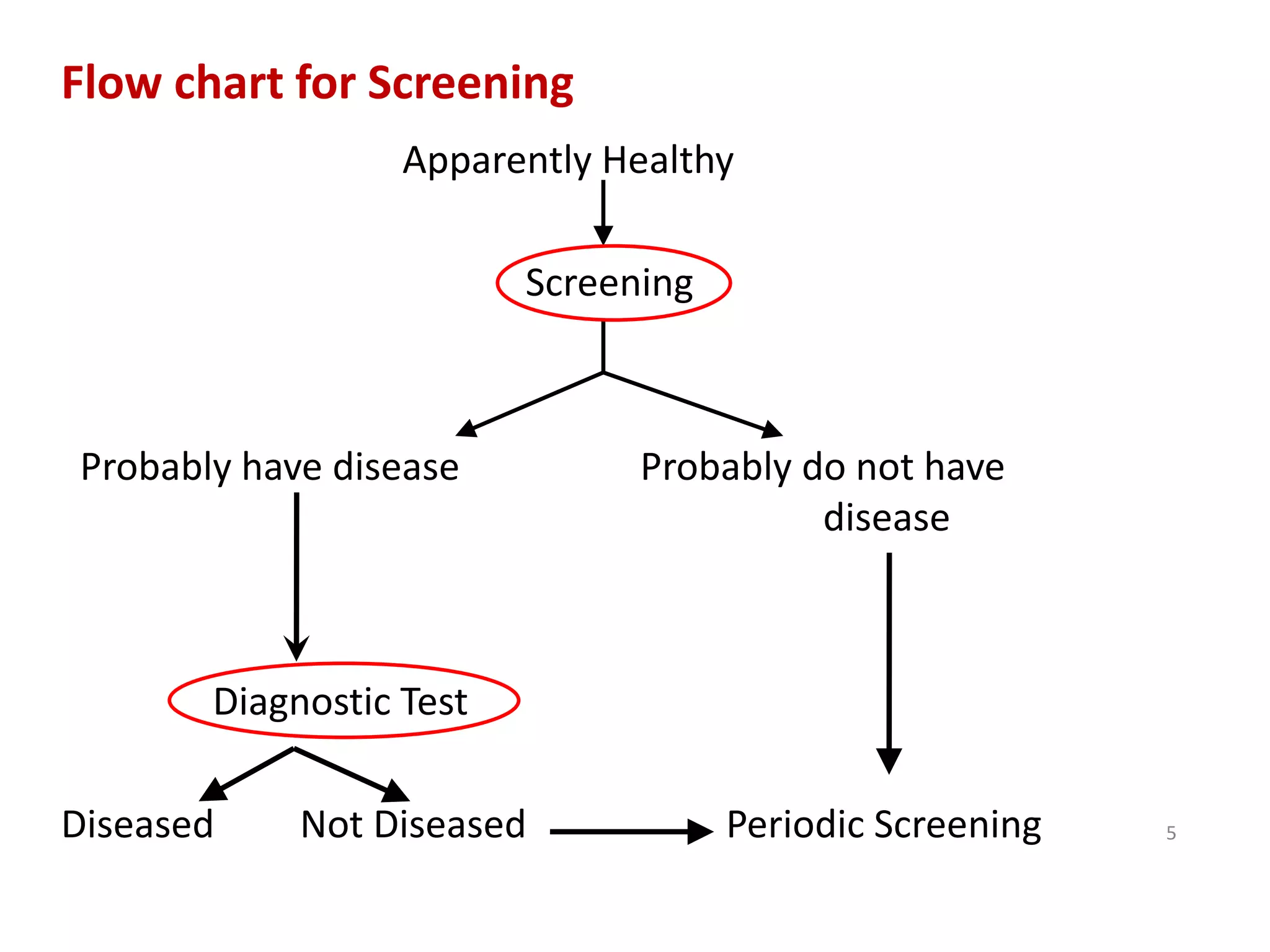
Flow chart for Screening
Apparently Healthy
Screening
Probably have disease Probably do not have
disease
Diagnostic Test
Diseased Not Diseased Periodic Screening 5
SCREENING TEST DIAGNOSTIC TEST
Apparently healthy Indications or sick
Applied to groups Applied to single patients all diseases
are considered
Test results are arbitrary and final Diagnosis not final but modified; sum
of all evidence.
Based on one cut-off point Based on evaluation of number of
symptoms, signs and lab findings
Less accurate More accurate
Less expensive More expensive
Not a basis for treatment Used as a basis for treatment
The initiative comes from the
investigator or agency providing care
The initiative comes from a patient
with a complaint
Concept of lead time
Disease onset
detection
First
possible
point
Final critical
diagnosis OUTCOME
Usual time of
diagnosis
Screening time
Lead time
A
B
7
A - usual outcome of the disease
B - advantage gained by early detection of the disease
B-A - benefit by the screening programme.
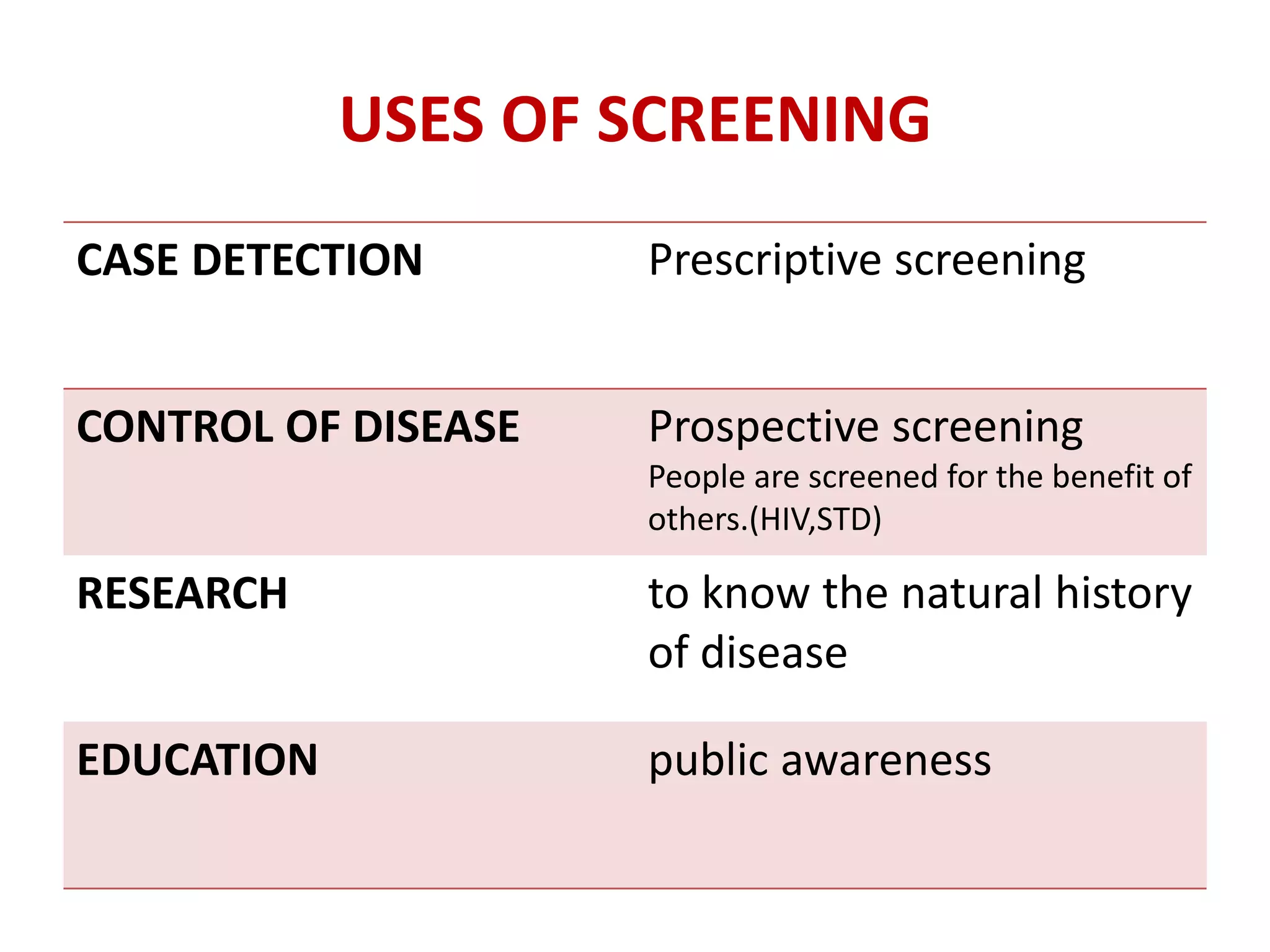
USES OF SCREENING
CASE DETECTION Prescriptive screening
People are screened for their own
benefit.(cancer, DM, HTN)
CONTROL OF DISEASE Prospective screening
People are screened for the benefit of
others.(HIV,STD)
RESEARCH to know the natural history
of disease
EDUCATION public awareness
TYPES OF SCREENING
1. Mass screening
2. High risk or selective screening
3. Multiphasic screening
Mass screening
• Screening of whole population
• Irrespective of risk of
contracting the disease
• Eg: visual defects in school
children
• Indiscriminate mass screening
not useful unless backed up by
a suitable treatment
High risk screening
• screening of selected high-risk
groups in the population
• Eg: screening for HIV in risk
groups
• Effective and economical use
of resources
TYPES OF SCREENING
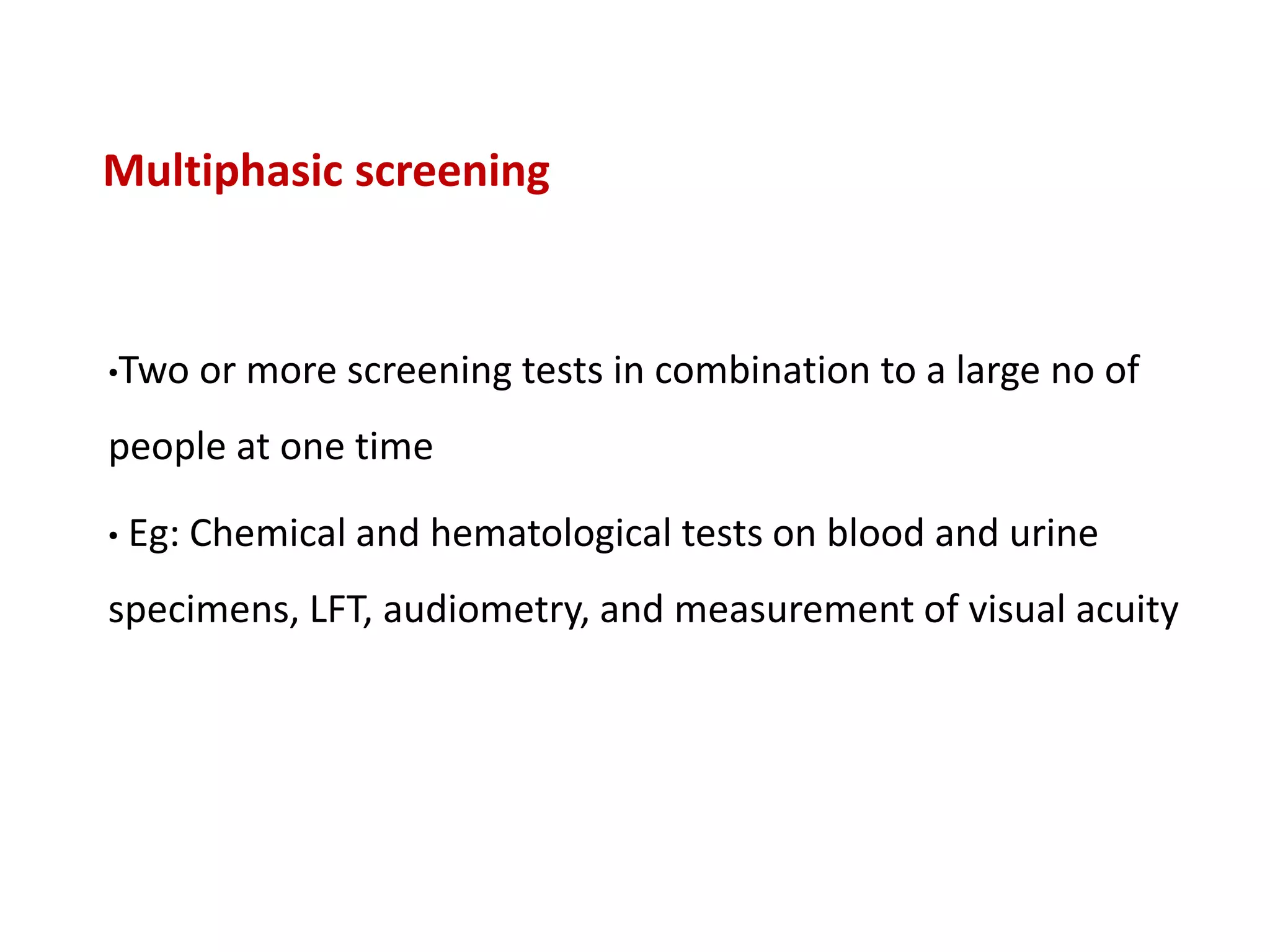
•Two or more screening tests in combination to a large no of
people at one time
• Eg: Chemical and hematological tests on blood and urine
specimens, LFT, audiometry, and measurement of visual acuity
Multiphasic screening
CRITERIA FOR SCREENING
• Disease to be screened
• Screening test
– Acceptability
– Repeatability
– Validity
– Yield
– simplicity, safety, rapidity, ease of administration
and cost
• Important health problem high prevalence
• Recognizable latent or early asymptomatic stage
• Natural history of the condition should be known
• Test that can detect the disease prior to onset of signs &
symptoms
• Facilities to confirm diagnosis
DISEASE TO BE SCREENED - CRITERIA
• Effective treatment should be there
• There should be an agreed-on policy concerning whom to treat
as patients
• Evidence that early detection & treatment reduces morbidity
& mortality
• Expected benefits greater than risk and cost of screening
DISEASE TO BE SCREENED - CRITERIA
1.ACCEPTABILITY
Cooperation and acceptable to population
SCREENING TEST - CRITERIA
2. REPEATABILITY/ RELIABILITY/ PRECISION/
REPRODUCIBILITY
• The test must give consistent results when repeated more
than once on the same individual or material, under the same
conditions.
• Depends on 3 major factors:
➢ Observer variation.
➢ Biological variation
➢ Errors relating to technical methods.
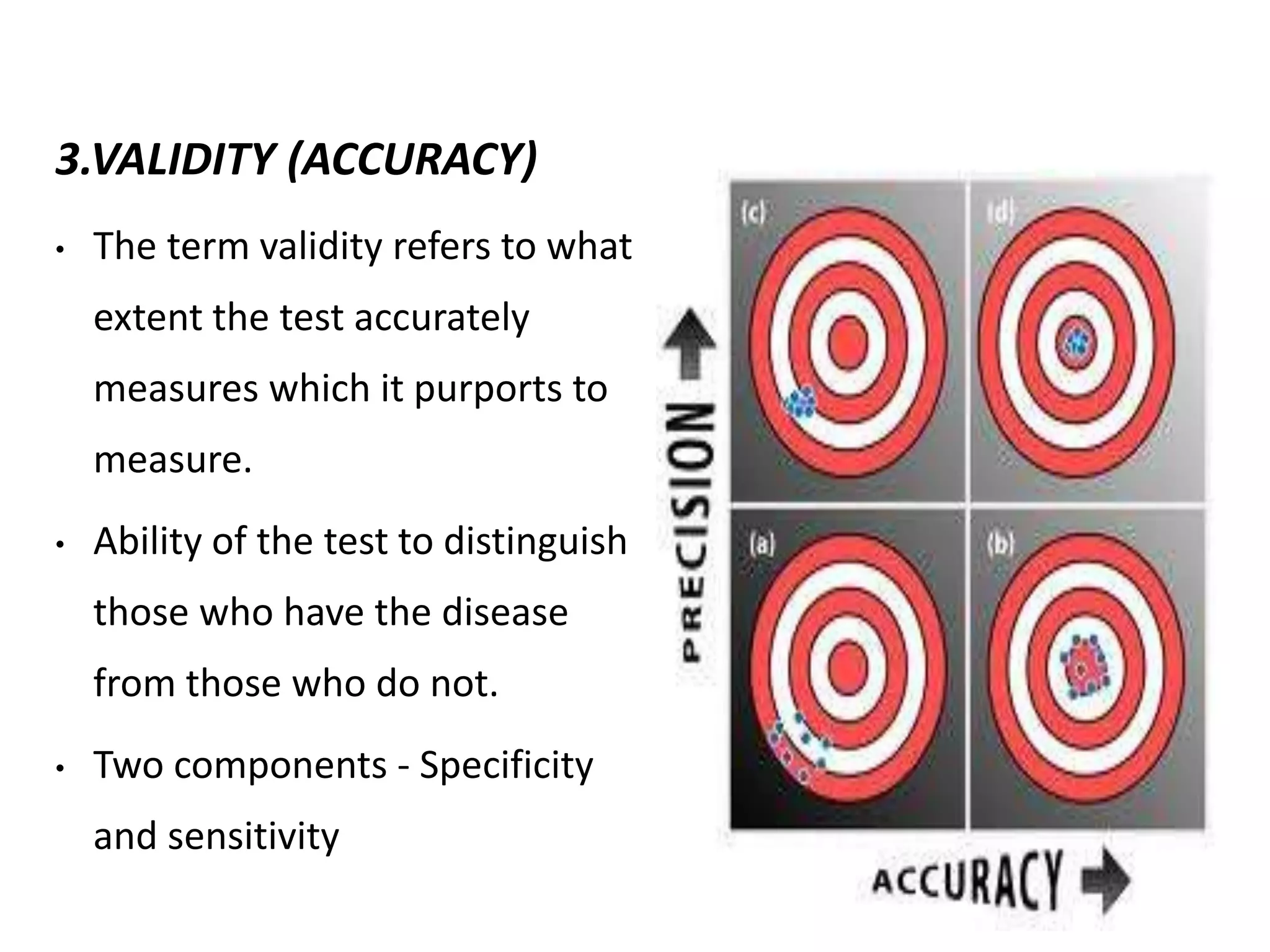
3.VALIDITY (ACCURACY)
• The term validity refers to what
extent the test accurately
measures which it purports to
measure.
• Ability of the test to distinguish
those who have the disease
from those who do not.
• Two components - Specificity
and sensitivity
4. YIELD
It is the amount of previously unrecognized disease that is
diagnosed as a result of screening effort.
Yield depends up on :
▪ sensitivity
▪ specificity
▪ prevalence of the disease
▪ community participation
▪ availability of medical care
EVALUATION OF A SCREENING TEST
Screening test
results
Cancer Diagnosis(Sx biopsy) Total
Diseased Not diseased
Positive(FNAC) a (14)
( true positive)
b(8)
(false positive)
a + b (22)
Negative(FNAC) c (1)
(False negative )
d (91)
( true negative)
c + d (92)
Total a + c(15) b + d (99) a+b+c+d (114)
1. Sensitivity
• It is defined as the proportion of the diseased people who
were correctly identified as positive by the test.
TP/ TP+FN = a/ a+c x100 = 14/ 14+1 x100 = 93%
• For the FNAC test,93% of all the patients with breast cancer
had positive test results
EVALUATION OF A SCREENING TEST
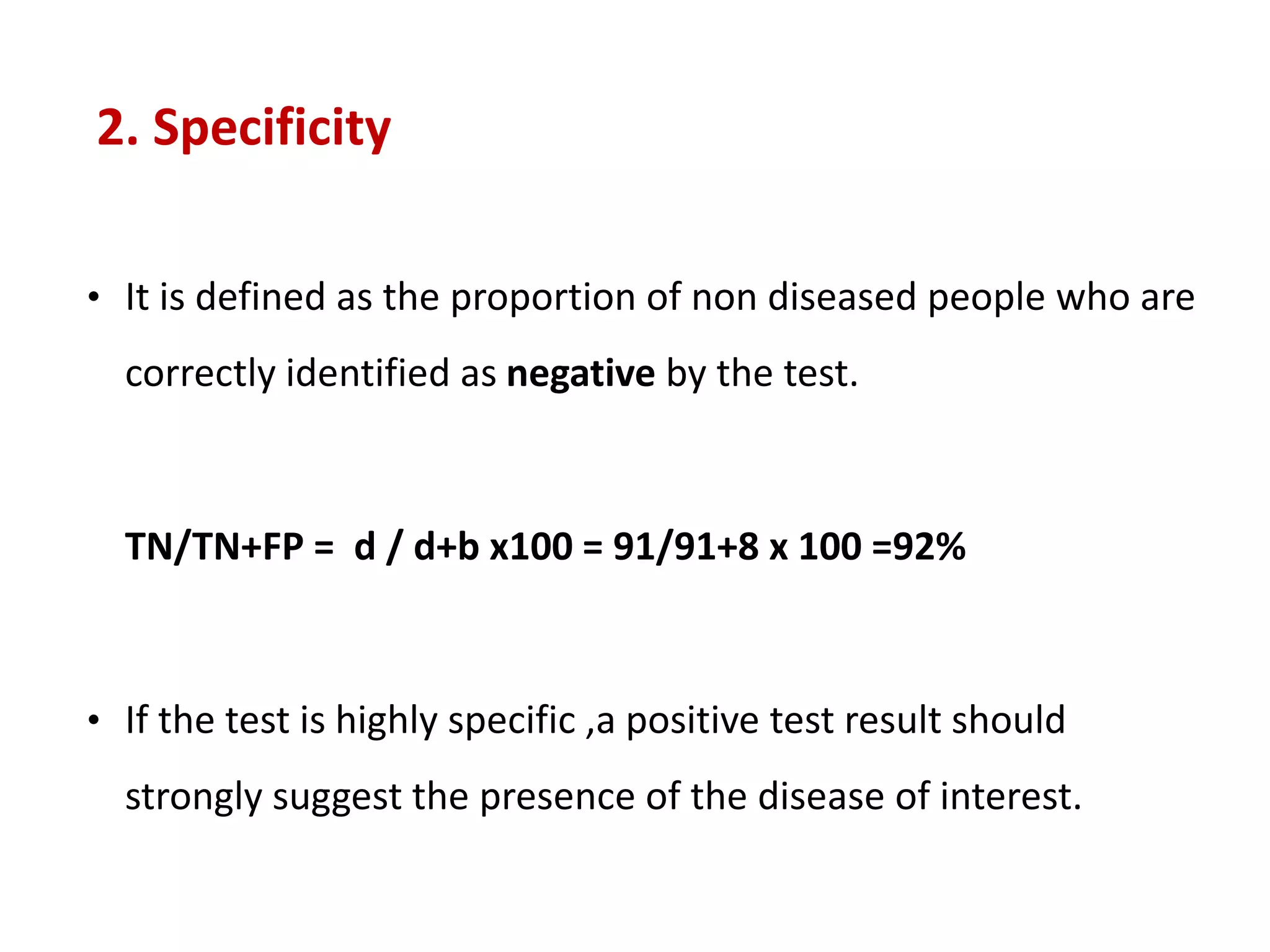
2. Specificity
• It is defined as the proportion of non diseased people who are
correctly identified as negative by the test.
TN/TN+FP = d / d+b x100 = 91/91+8 x 100 =92%
• If the test is highly specific ,a positive test result should
strongly suggest the presence of the disease of interest.
3. Positive Predictive value
• The "predictive value of a positive test" indicates the
probability that a patient with a positive test result has, in
fact, the disease in question.
PPV = TP/TP+FP X 100 =a / a+b x 100 =
14/ 14+8 x100= 64%
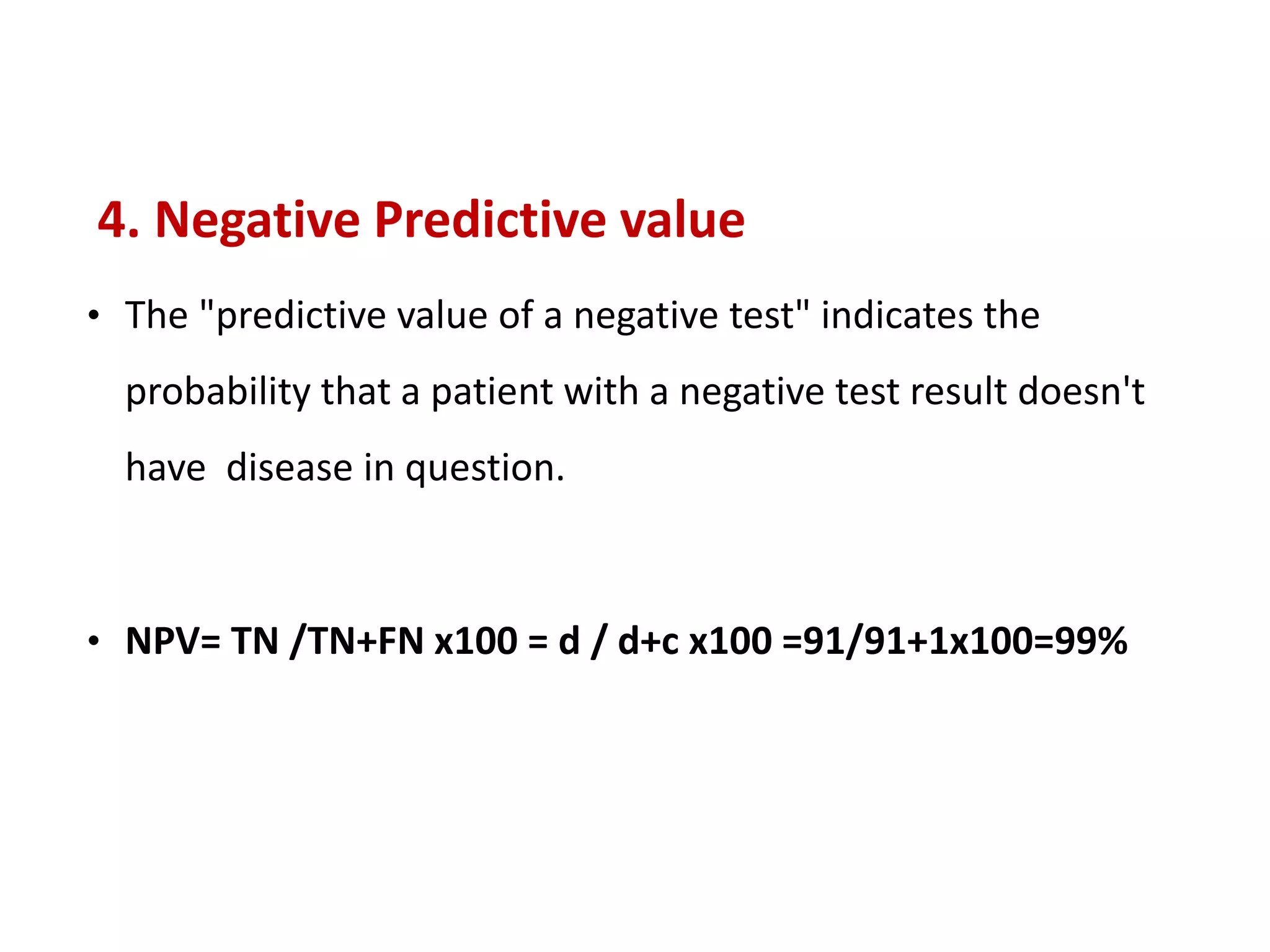
4. Negative Predictive value
• The "predictive value of a negative test" indicates the
probability that a patient with a negative test result doesn't
have disease in question.
• NPV= TN /TN+FN x100 = d / d+c x100 =91/91+1x100=99%
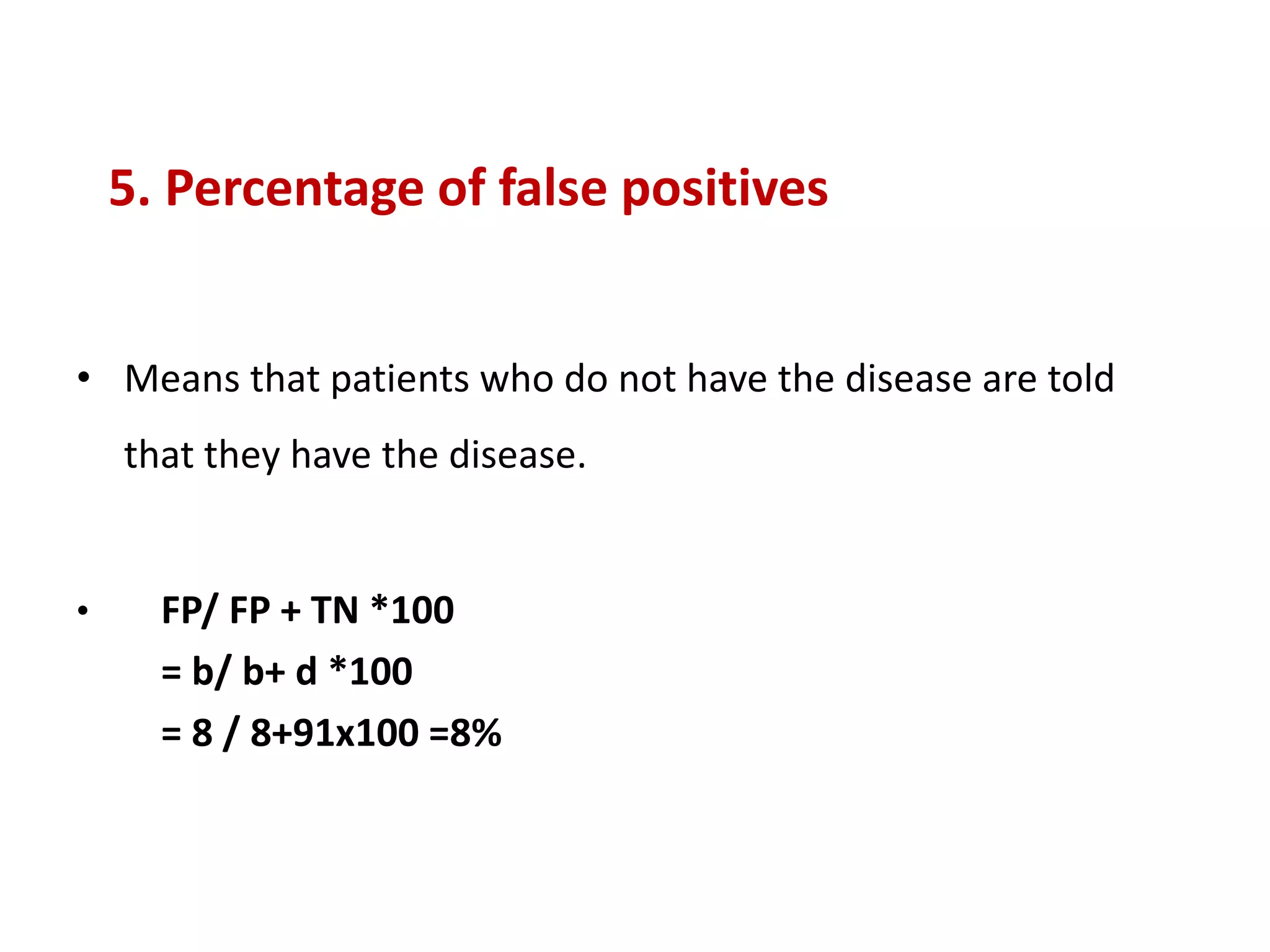
5. Percentage of false positives
• Means that patients who do not have the disease are told
that they have the disease.
• FP/ FP + TN *100
= b/ b+ d *100
= 8 / 8+91x100 =8%
6. Percentage of false negatives
• Means that patients who actually have the disease are told
that they do not have the disease.
• FN/ TP + FN *100
= c/ a+ c *100
= 1/1+14 x100 = 6.6%
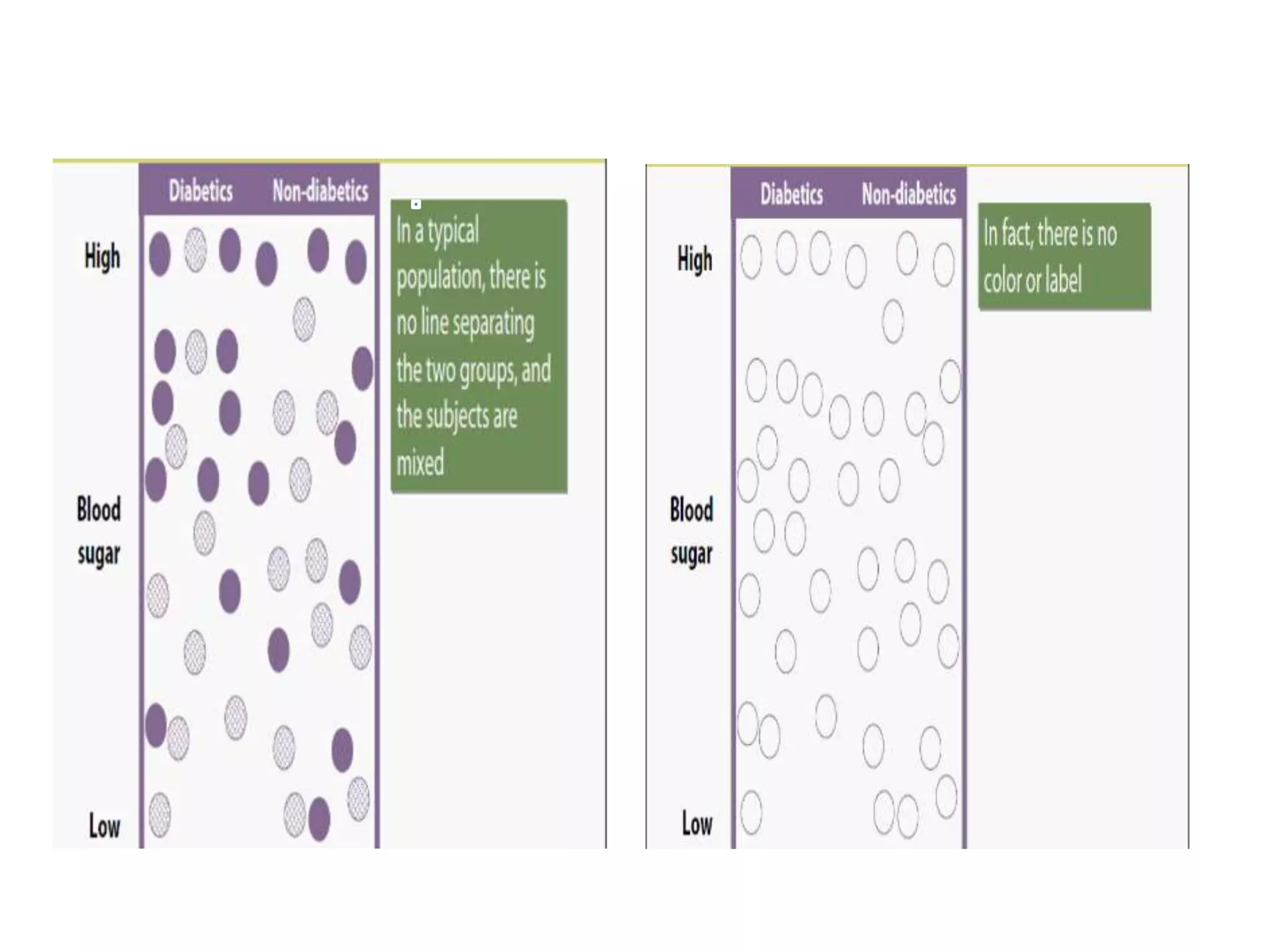
CHANGING CUT-OFF POINTS:
Where to draw cut off points
• High disease prevalence  set low cut off point
• Disease is lethal  set low cut off point
Where to draw cut off points
THANK YOU
https://www.slideshare.net/JazeelaMohamedSiddiq

screening.pptx

  • 1.
    SCREENING OF ADISEASE Dr Jazeela Mohamed Siddique Senior Resident Department of Community Medicine
  • 2.
    Definition • The searchfor unrecognized disease or defect • By means of rapidly applied tests, examinations or other procedures • In apparently healthy individuals INTRODUCTION
  • 3.
  • 4.
    PREVENTION AND NATURAL HISTORYOF DISEASE Biological onset of disease Symptoms appear Pre-clinical phase Diagnosis Therapy begins Clinical phase outcome Promoting health and primary prevention Tertiary prevention Rehabilitation, support Potential improvement by screening Secondary prevention Screening and early detection
  • 5.
    Flow chart forScreening Apparently Healthy Screening Probably have disease Probably do not have disease Diagnostic Test Diseased Not Diseased Periodic Screening 5
  • 6.
    SCREENING TEST DIAGNOSTICTEST Apparently healthy Indications or sick Applied to groups Applied to single patients all diseases are considered Test results are arbitrary and final Diagnosis not final but modified; sum of all evidence. Based on one cut-off point Based on evaluation of number of symptoms, signs and lab findings Less accurate More accurate Less expensive More expensive Not a basis for treatment Used as a basis for treatment The initiative comes from the investigator or agency providing care The initiative comes from a patient with a complaint
  • 7.
    Concept of leadtime Disease onset detection First possible point Final critical diagnosis OUTCOME Usual time of diagnosis Screening time Lead time A B 7 A - usual outcome of the disease B - advantage gained by early detection of the disease B-A - benefit by the screening programme.
  • 8.
    USES OF SCREENING CASEDETECTION Prescriptive screening People are screened for their own benefit.(cancer, DM, HTN) CONTROL OF DISEASE Prospective screening People are screened for the benefit of others.(HIV,STD) RESEARCH to know the natural history of disease EDUCATION public awareness
  • 9.
    TYPES OF SCREENING 1.Mass screening 2. High risk or selective screening 3. Multiphasic screening
  • 10.
    Mass screening • Screeningof whole population • Irrespective of risk of contracting the disease • Eg: visual defects in school children • Indiscriminate mass screening not useful unless backed up by a suitable treatment High risk screening • screening of selected high-risk groups in the population • Eg: screening for HIV in risk groups • Effective and economical use of resources TYPES OF SCREENING
  • 11.
    •Two or morescreening tests in combination to a large no of people at one time • Eg: Chemical and hematological tests on blood and urine specimens, LFT, audiometry, and measurement of visual acuity Multiphasic screening
  • 12.
    CRITERIA FOR SCREENING •Disease to be screened • Screening test – Acceptability – Repeatability – Validity – Yield – simplicity, safety, rapidity, ease of administration and cost
  • 13.
    • Important healthproblem high prevalence • Recognizable latent or early asymptomatic stage • Natural history of the condition should be known • Test that can detect the disease prior to onset of signs & symptoms • Facilities to confirm diagnosis DISEASE TO BE SCREENED - CRITERIA
  • 14.
    • Effective treatmentshould be there • There should be an agreed-on policy concerning whom to treat as patients • Evidence that early detection & treatment reduces morbidity & mortality • Expected benefits greater than risk and cost of screening DISEASE TO BE SCREENED - CRITERIA
  • 15.
    1.ACCEPTABILITY Cooperation and acceptableto population SCREENING TEST - CRITERIA
  • 16.
    2. REPEATABILITY/ RELIABILITY/PRECISION/ REPRODUCIBILITY • The test must give consistent results when repeated more than once on the same individual or material, under the same conditions. • Depends on 3 major factors: ➢ Observer variation. ➢ Biological variation ➢ Errors relating to technical methods.
  • 17.
    3.VALIDITY (ACCURACY) • Theterm validity refers to what extent the test accurately measures which it purports to measure. • Ability of the test to distinguish those who have the disease from those who do not. • Two components - Specificity and sensitivity
  • 18.
    4. YIELD It isthe amount of previously unrecognized disease that is diagnosed as a result of screening effort. Yield depends up on : ▪ sensitivity ▪ specificity ▪ prevalence of the disease ▪ community participation ▪ availability of medical care
  • 19.
    EVALUATION OF ASCREENING TEST Screening test results Cancer Diagnosis(Sx biopsy) Total Diseased Not diseased Positive(FNAC) a (14) ( true positive) b(8) (false positive) a + b (22) Negative(FNAC) c (1) (False negative ) d (91) ( true negative) c + d (92) Total a + c(15) b + d (99) a+b+c+d (114)
  • 20.
    1. Sensitivity • Itis defined as the proportion of the diseased people who were correctly identified as positive by the test. TP/ TP+FN = a/ a+c x100 = 14/ 14+1 x100 = 93% • For the FNAC test,93% of all the patients with breast cancer had positive test results EVALUATION OF A SCREENING TEST
  • 21.
    2. Specificity • Itis defined as the proportion of non diseased people who are correctly identified as negative by the test. TN/TN+FP = d / d+b x100 = 91/91+8 x 100 =92% • If the test is highly specific ,a positive test result should strongly suggest the presence of the disease of interest.
  • 22.
    3. Positive Predictivevalue • The "predictive value of a positive test" indicates the probability that a patient with a positive test result has, in fact, the disease in question. PPV = TP/TP+FP X 100 =a / a+b x 100 = 14/ 14+8 x100= 64%
  • 23.
    4. Negative Predictivevalue • The "predictive value of a negative test" indicates the probability that a patient with a negative test result doesn't have disease in question. • NPV= TN /TN+FN x100 = d / d+c x100 =91/91+1x100=99%
  • 24.
    5. Percentage offalse positives • Means that patients who do not have the disease are told that they have the disease. • FP/ FP + TN *100 = b/ b+ d *100 = 8 / 8+91x100 =8%
  • 25.
    6. Percentage offalse negatives • Means that patients who actually have the disease are told that they do not have the disease. • FN/ TP + FN *100 = c/ a+ c *100 = 1/1+14 x100 = 6.6%
  • 26.
    CHANGING CUT-OFF POINTS: Whereto draw cut off points
  • 32.
    • High diseaseprevalence  set low cut off point • Disease is lethal  set low cut off point Where to draw cut off points
  • 33.