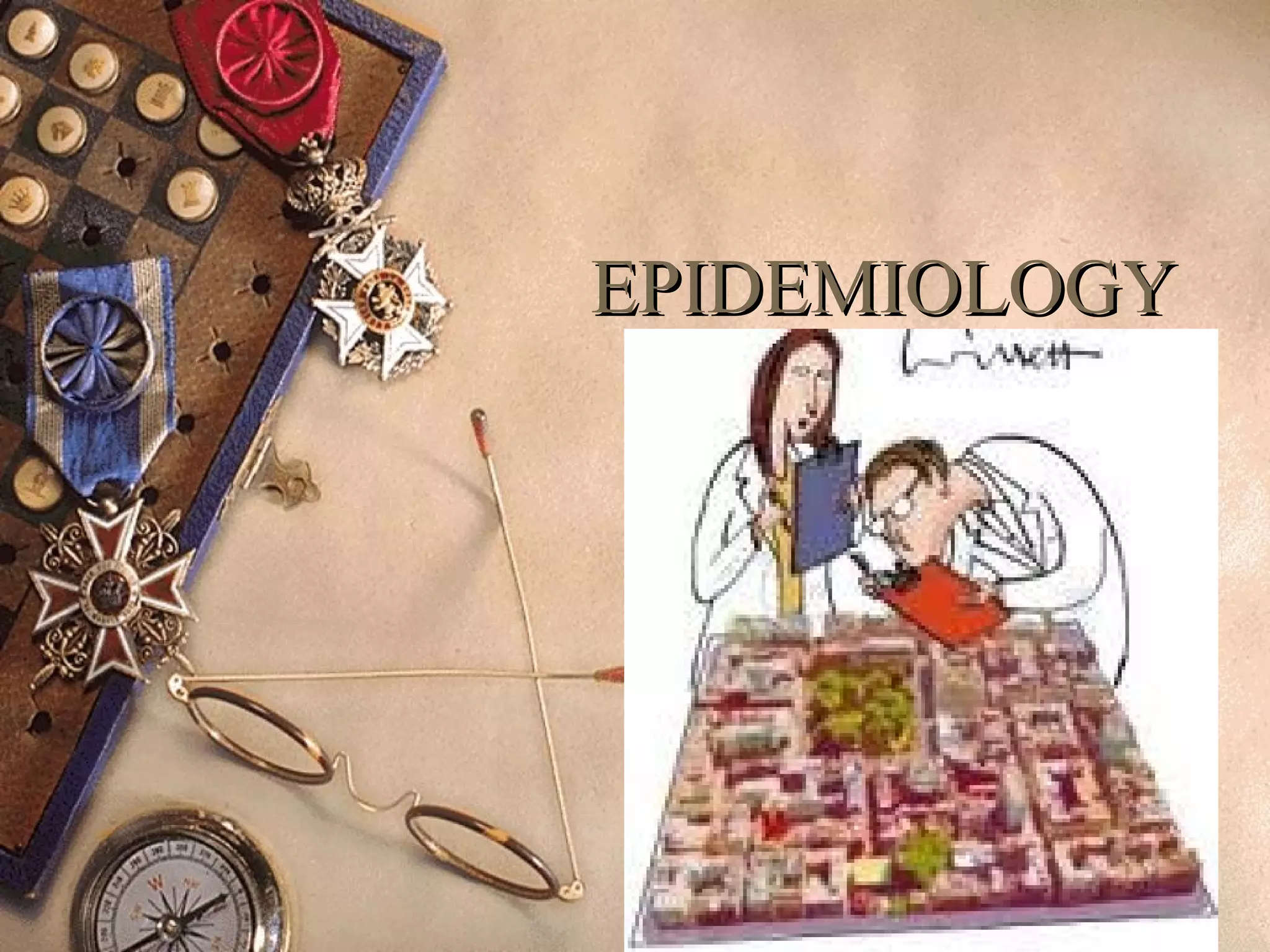
EPIDEMIOLOGYEPIDEMIOLOGY
(CONCEPTS)(CONCEPTS)
INTRODUCTION:
 Epidemiology is the basic science of
preventive and social medicine.
 Epidemiology is derived from the word
epidemic (epi=among; demos=people;
logos=study), which is a very old word dating
back to 3 rd century B.C.
 Epidemiology has grown rapidly during the
past three decades. it has now become
firmly established in medical education.
DEFINITION
 Epidemiology has been defined by
John M. Last in 1988 as
 “The study of the distribution and
determinants of health –related states
or events in specified populations, and
the application of this study to the
control of health problems.”
CONCEPT OF EPIDEMIOLOGY
The concept of epidemiology compasses three
components
 1.Disease frequency:
 measurement of frequency of disease,
disability or death, and summarizing this
information in the form of rates and ratios
(e.g. prevalence rate, incidence rate, death
rate, etc) thus the basic measure of disease
frequency is rates or ratio.
 These rates are essential for comparing
disease frequency in different populations or
subgroups of the same population in relation
to suspected causal factors. Such
comparisons may yield important clues to
disease etiology.
 Epidemiology is also concerned with the
measurement of health-related events and
states in the community (e.g., health needs,
demands, activities, tasks, health care
utilization) and variables such as blood
pressure, serum cholesterol, height, weight,
etc.
2.Distribution of disease
An important function of epidemiology
is to study the distribution patterns in
various subgroups of the population by
time, place, and person. That is, the
epidemiologist examines whether there
has been an increase or decrease of
disease over time span;
 whether there is a higher concentration
of disease in one geographic area than
others
 whether the disease occurs more often
in men or in a particular age-group,
and whether most characteristics or
behaviour of those affected are
different from those not affected.
3.Determinants of disease
 A unique feature of epidemiology is to
test etiological hypotheses and identify
the underlying causes or risk factors of
disease.
AIMS OF EPIDEMIOLOGY
According to the International
Epidemiological Association (IEA),
epidemiology has three main aims:
 a. To describe the distribution and
magnitude of health and disease
problems in human populations
(descriptive studies)
 b. To identify etiological factors (risk
factors)in the pathogenesis of disease;
and(analytical studies)
 c .To provide the data essential to the
planning, implementation and
evaluation of services for the
prevention, control and treatment of
disease and to setting up of priorities
among those services.
The ultimate aim of epidemiology
is to lead to effective action:
–a. To eliminate or reduce the
health problem or its
consequences; and
–b .To promote the health and
well-being of society as a whole.
USES OF EPIDEMIOLOGY
MORRIS has identified seven distinct uses
of epidemiology. These are:
1.TO STUDY HISTORICALLY THE RISE
AND FALL OF DISEASE IN THE
POPULATION
2.COMMUNITY DIAGNOSIS
3.PLANNING AND EVALUATION
4.EVALUATION OF INDIVIDUALS RISKS
AND CHANCES
5.COMPLETING THE NATURAL
HISTORY OF DISEASE
6.SEARCHING FOR CAUSES AND
RISK FACTORS
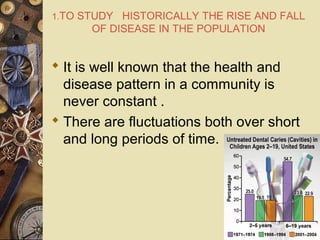
1.TO STUDY HISTORICALLY THE RISE AND FALL
OF DISEASE IN THE POPULATION
 It is well known that the health and
disease pattern in a community is
never constant .
 There are fluctuations both over short
and long periods of time.
 Epidemiology provides a means to
study disease profiles and time trends
in human population.
 By a study of these trends we can
make useful projections into the future
and identify emerging health problems
and their correlates.
2.COMMUNITY DIAGNOSIS:
 One of the uses of epidemiology is
community diagnosis.
 Community diagnosis generally refers to the
identification and quantification of health
problems in a community in terms of
mortality and morbidity rates and ratios.
 It helps to identify individuals or groups at
risk or those who are in need of health care.
3.PLANNING AND EVALUATION
Epidemiological information about the
distribution of health problems over a
period of time and place provides the
fundamental basis for planning and
developing the needed health services
and for assessing the impact of these
services on the people’s problems
 Evaluation is an equally important
concern of epidemiology .
 Any measures taken to control or
prevent a disease must be followed by
an evaluation to find out whether the
measures undertaken are effective in
reducing the frequency of the disease.
4.EVALUATION OF INDIVIDUALS
RISKS AND CHANCES:
One of the important tasks of
epidemiologists is to make a
statement about the degree of risk
in a population.
6.COMPLETING THE NATURAL
HISTORY OF DISEASE:
 Epidemiology is concerned with the
entire spectrum of disease in the
population.
 The epidemiologist by studying
disease patterns in the community in
relation to agent, host and
environmental factors is in a better
position to fill up the gaps in the natural
history of disease than a clinician.
7.SEARCHING FOR CAUSES AND
RISK FACTORS:
Epidemiology helps to identify the
causes and risk factors of
diseases.
TERMINOLOGIES USED IN
EPIDEMIOLOGY
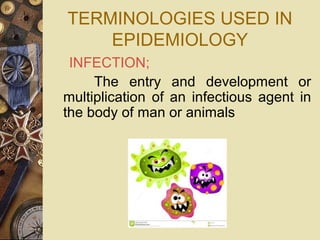
     INFECTION;
The entry and development or
multiplication of an infectious agent in
the body of man or animals
   
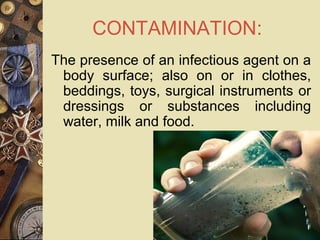
CONTAMINATION:
The presence of an infectious agent on a
body surface; also on or in clothes,
beddings, toys, surgical instruments or
dressings or substances including
water, milk and food.
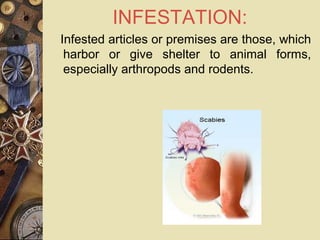
INFESTATION:
   Infested articles or premises are those, which
harbor or give shelter to animal forms,
especially arthropods and rodents.
   
HOST
 A person or other animal, including
birds and arthropods, that affords
subsistence or lodgment to an
infectious agent under natural
conditions.
    INFECTIOUS DISEASE:
 A clinically manifest disease of man
or animals resulting from an infection.
    CONTAGIOUS DISEASE:
 A disease that is transmitted through
contact.
Examples-scabies, trachoma, leprosy STD
     COMMUNICABLE DISEASE:
 An illness due to a specific infectious agent
or its toxic products capable of being directly
or indirectly transmitted from man to man,
animal to animal, or from the environment
(air, dust, soil.water, food) to man or animal
      EPIDEMIC:
A widespread occurrence of an infectious
disease in a community at a particular
time.  
 ENDEMIC:
It refers to the constant presence of a
disease or infectious agent within a given
geographic area or population group,
without importation from outside; may also
refer to the “usual” or expected frequency
of the disease within such area or
population group.
For example common cold is endemic
because somebody always has one.
   SPORADIC:
 The word sporadic means scattered about. The
cases occur irregularly haphazardly from time to
time, and generally in frequently. the cases are few
and separated widely in space and time that they
show little or no connection with each other, nor a
recognizable common source of
infection.e.g.,polio,tetanus,herpes zoster.
       PANDEMIC:
 An epidemic usually affecting a large proportion of
the population occurring over a wide geographic
area such as a section of a nation, the entire
nation, a continent or the world e.g., influenza
pandemics of 1918 and 1957
    EXOTIC:
 Diseases which are imported into the country in
which they do not otherwise occur, as for example,
rabies in UK.
   ZOONOSIS:
 An infection or infectious disease transmissible
under natural conditions from vertebrate animals to
man. May be enzootic or epizootic-e.g.rabies,
plague.bovine tuberculosis, anthrax, brucellosis,
salmonellosis, etc.
    EPIZOOTIC:
 An outbreak (epidemic) of disease in an animal
population e.g.anthrax, influenza, rabies.
   EPORNITHIC:
– An outbreak (epidemic) of disease in a bird
population
    ENZOOTIC:
-An endemic occurring in animals e.g.,
anthrax, rabies
     NOSOCOMIAL INFECTION:
- Nosocomial infection is an infection
originating in a patient while in a hospital
or other health care facility. It denotes new
disorder associated with being in a
hospital.
      OPPORTUNISTIC INFECTION:
 This infection by an organisms that takes the
opportunity provided by a defect in host
defense to infect the host and hence cause
disease. the organisms include herpes
simplex,cytomegalovirus,
    IATROGENIC INFECTION:
 Any untoward or adverse consequence of a
preventive, diagnostic or therapeutic
regimen or procedure, that causes,
handicap, disability or death resulting from a
physician’s professional activity or from the
professional activity of other health
professionals.
     SURVEILLANCE:
 Surveillance has been defined as “the
continuous scrutiny of the factors that
determine the occurrence and distribution of
disease and other conditions of ill health.
      ERADICATION:
 Termination of all transmission of infection
by extermination of the infectious agent
through surveillance and containment.
Eradication is an absolute process, an “all or
none” phenomenon, restricted to termination
of an infection from the whole world. It
implies that disease will no longer occur in a
population.
Epidemiology

Epidemiology

  • 1.
  • 2.
    INTRODUCTION:  Epidemiology isthe basic science of preventive and social medicine.  Epidemiology is derived from the word epidemic (epi=among; demos=people; logos=study), which is a very old word dating back to 3 rd century B.C.  Epidemiology has grown rapidly during the past three decades. it has now become firmly established in medical education.
  • 3.
    DEFINITION  Epidemiology hasbeen defined by John M. Last in 1988 as  “The study of the distribution and determinants of health –related states or events in specified populations, and the application of this study to the control of health problems.”
  • 4.
    CONCEPT OF EPIDEMIOLOGY Theconcept of epidemiology compasses three components  1.Disease frequency:  measurement of frequency of disease, disability or death, and summarizing this information in the form of rates and ratios (e.g. prevalence rate, incidence rate, death rate, etc) thus the basic measure of disease frequency is rates or ratio.
  • 5.
     These ratesare essential for comparing disease frequency in different populations or subgroups of the same population in relation to suspected causal factors. Such comparisons may yield important clues to disease etiology.  Epidemiology is also concerned with the measurement of health-related events and states in the community (e.g., health needs, demands, activities, tasks, health care utilization) and variables such as blood pressure, serum cholesterol, height, weight, etc.
  • 6.
    2.Distribution of disease Animportant function of epidemiology is to study the distribution patterns in various subgroups of the population by time, place, and person. That is, the epidemiologist examines whether there has been an increase or decrease of disease over time span;
  • 7.
     whether thereis a higher concentration of disease in one geographic area than others  whether the disease occurs more often in men or in a particular age-group, and whether most characteristics or behaviour of those affected are different from those not affected.
  • 8.
    3.Determinants of disease A unique feature of epidemiology is to test etiological hypotheses and identify the underlying causes or risk factors of disease.
  • 9.
    AIMS OF EPIDEMIOLOGY Accordingto the International Epidemiological Association (IEA), epidemiology has three main aims:  a. To describe the distribution and magnitude of health and disease problems in human populations (descriptive studies)
  • 10.
     b. Toidentify etiological factors (risk factors)in the pathogenesis of disease; and(analytical studies)  c .To provide the data essential to the planning, implementation and evaluation of services for the prevention, control and treatment of disease and to setting up of priorities among those services.
  • 11.
    The ultimate aimof epidemiology is to lead to effective action: –a. To eliminate or reduce the health problem or its consequences; and –b .To promote the health and well-being of society as a whole.
  • 12.
    USES OF EPIDEMIOLOGY MORRIShas identified seven distinct uses of epidemiology. These are: 1.TO STUDY HISTORICALLY THE RISE AND FALL OF DISEASE IN THE POPULATION 2.COMMUNITY DIAGNOSIS 3.PLANNING AND EVALUATION 4.EVALUATION OF INDIVIDUALS RISKS AND CHANCES
  • 13.
    5.COMPLETING THE NATURAL HISTORYOF DISEASE 6.SEARCHING FOR CAUSES AND RISK FACTORS
  • 14.
    1.TO STUDY HISTORICALLYTHE RISE AND FALL OF DISEASE IN THE POPULATION  It is well known that the health and disease pattern in a community is never constant .  There are fluctuations both over short and long periods of time.
  • 15.
     Epidemiology providesa means to study disease profiles and time trends in human population.  By a study of these trends we can make useful projections into the future and identify emerging health problems and their correlates.
  • 16.
    2.COMMUNITY DIAGNOSIS:  Oneof the uses of epidemiology is community diagnosis.  Community diagnosis generally refers to the identification and quantification of health problems in a community in terms of mortality and morbidity rates and ratios.  It helps to identify individuals or groups at risk or those who are in need of health care.
  • 17.
    3.PLANNING AND EVALUATION Epidemiologicalinformation about the distribution of health problems over a period of time and place provides the fundamental basis for planning and developing the needed health services and for assessing the impact of these services on the people’s problems
  • 18.
     Evaluation isan equally important concern of epidemiology .  Any measures taken to control or prevent a disease must be followed by an evaluation to find out whether the measures undertaken are effective in reducing the frequency of the disease.
  • 19.
    4.EVALUATION OF INDIVIDUALS RISKSAND CHANCES: One of the important tasks of epidemiologists is to make a statement about the degree of risk in a population.
  • 20.
    6.COMPLETING THE NATURAL HISTORYOF DISEASE:  Epidemiology is concerned with the entire spectrum of disease in the population.  The epidemiologist by studying disease patterns in the community in relation to agent, host and environmental factors is in a better position to fill up the gaps in the natural history of disease than a clinician.
  • 21.
    7.SEARCHING FOR CAUSESAND RISK FACTORS: Epidemiology helps to identify the causes and risk factors of diseases.
  • 22.
    TERMINOLOGIES USED IN EPIDEMIOLOGY      INFECTION; Theentry and development or multiplication of an infectious agent in the body of man or animals    
  • 23.
    CONTAMINATION: The presence ofan infectious agent on a body surface; also on or in clothes, beddings, toys, surgical instruments or dressings or substances including water, milk and food.
  • 24.
    INFESTATION:    Infested articles orpremises are those, which harbor or give shelter to animal forms, especially arthropods and rodents.    
  • 25.
    HOST  A personor other animal, including birds and arthropods, that affords subsistence or lodgment to an infectious agent under natural conditions.     INFECTIOUS DISEASE:  A clinically manifest disease of man or animals resulting from an infection.
  • 26.
        CONTAGIOUS DISEASE:  Adisease that is transmitted through contact. Examples-scabies, trachoma, leprosy STD      COMMUNICABLE DISEASE:  An illness due to a specific infectious agent or its toxic products capable of being directly or indirectly transmitted from man to man, animal to animal, or from the environment (air, dust, soil.water, food) to man or animal
  • 27.
          EPIDEMIC: A widespread occurrenceof an infectious disease in a community at a particular time.    ENDEMIC: It refers to the constant presence of a disease or infectious agent within a given geographic area or population group, without importation from outside; may also refer to the “usual” or expected frequency of the disease within such area or population group. For example common cold is endemic because somebody always has one.
  • 28.
       SPORADIC:  Theword sporadic means scattered about. The cases occur irregularly haphazardly from time to time, and generally in frequently. the cases are few and separated widely in space and time that they show little or no connection with each other, nor a recognizable common source of infection.e.g.,polio,tetanus,herpes zoster.        PANDEMIC:  An epidemic usually affecting a large proportion of the population occurring over a wide geographic area such as a section of a nation, the entire nation, a continent or the world e.g., influenza pandemics of 1918 and 1957
  • 29.
        EXOTIC:  Diseases whichare imported into the country in which they do not otherwise occur, as for example, rabies in UK.    ZOONOSIS:  An infection or infectious disease transmissible under natural conditions from vertebrate animals to man. May be enzootic or epizootic-e.g.rabies, plague.bovine tuberculosis, anthrax, brucellosis, salmonellosis, etc.     EPIZOOTIC:  An outbreak (epidemic) of disease in an animal population e.g.anthrax, influenza, rabies.
  • 30.
       EPORNITHIC: – Anoutbreak (epidemic) of disease in a bird population     ENZOOTIC: -An endemic occurring in animals e.g., anthrax, rabies      NOSOCOMIAL INFECTION: - Nosocomial infection is an infection originating in a patient while in a hospital or other health care facility. It denotes new disorder associated with being in a hospital.
  • 31.
          OPPORTUNISTIC INFECTION:  Thisinfection by an organisms that takes the opportunity provided by a defect in host defense to infect the host and hence cause disease. the organisms include herpes simplex,cytomegalovirus,     IATROGENIC INFECTION:  Any untoward or adverse consequence of a preventive, diagnostic or therapeutic regimen or procedure, that causes, handicap, disability or death resulting from a physician’s professional activity or from the professional activity of other health professionals.
  • 32.
         SURVEILLANCE:  Surveillancehas been defined as “the continuous scrutiny of the factors that determine the occurrence and distribution of disease and other conditions of ill health.       ERADICATION:  Termination of all transmission of infection by extermination of the infectious agent through surveillance and containment. Eradication is an absolute process, an “all or none” phenomenon, restricted to termination of an infection from the whole world. It implies that disease will no longer occur in a population.