Compiled by:
Dr. Arpita Sharma
Assistant Professor,
Dept. of Agricultural Communication, College of Agriculture
GBPUA&T, Pantnagar
Email Id: sharmaarpita615@gmail.com
AAC-640
Publication, Production and
Editing
 The design and use of letterforms in printing
is a special subject called typography.
 In printing, letterforms are divided into
typefaces, which are something like species
in the natural sciences.
 A typeface is an alphabet with specific
characteristics by which it can be
distinguished from any other typeface.
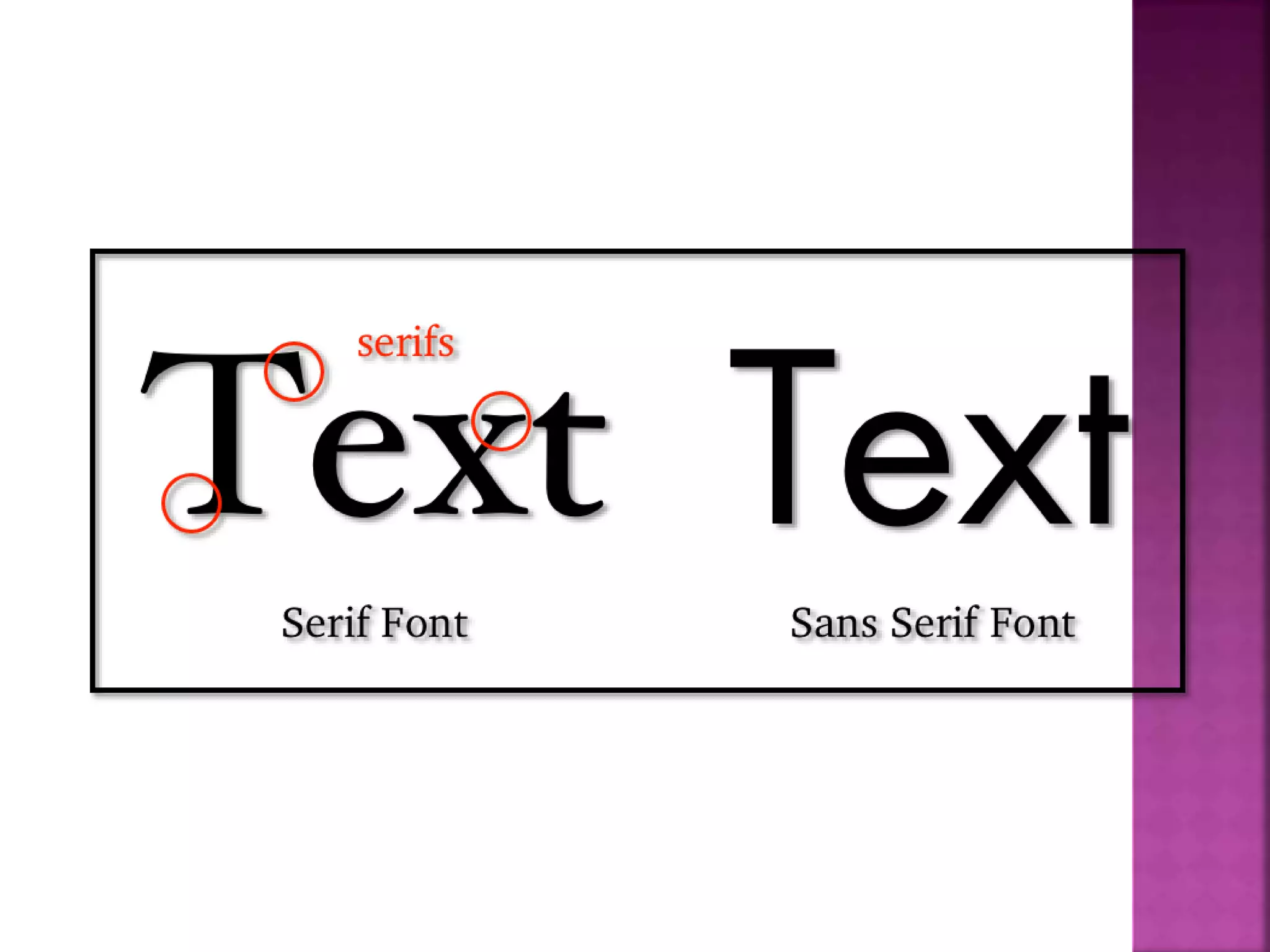
 Sans serif fonts have a reputation of being
more modern, casual, informal and friendly
that serif fonts.
 Although serif fonts dominate the world of
print particularly for long sections of body
copy.
 They are also the frequent choice of the
publishers of children's books because the
letters are easier to recognize.
 In print, small serifs can break up when
they are reversed out of a dark color or
photograph; sans serif type is almost always
the better choice in this instance.
 Sans serif fonts work well for short sections
of text, such as credits and captions. When
a project calls for very small type sizes,
sans serif type is easier to read.
Grotesque, neo-grotesque, geometric,
humanist and informal
 Grotesque sans serif typefaces were the first
ones that were commercially available.
 They were designed in the 19th and early
20th centuries and had some awkward
curves with little variation in stroke width.
 Franklin Gothic
 News Gothic
 Akzidenz-Grotesk
 Neo-Grotesque fonts (also known as
Realists or Transitionals) are more polished
than the grotesque san serif typefaces.
 This classification includes the most
frequently used sans serif fonts.
 Helvetica
 Univers
 Arial
 Bell Centennial
 Geneva
 Impact
 Geometric san serif fonts are built on
geometric shapes rather than on early
letterforms or calligraphy.
 They display little or no stroke weight
contrast.
 Futura
 Avenir
 Bauhaus
 Kabel
 Avant Garde
 Eurostile
 Humanist typefaces are identified by their
calligraphic influence and uneven stroke
weights and most of the fonts bearing this
description are more legible choices than
other san serif faces.
 Gill Sans
 Frutiger
 Myriad
 Optima
 Trebuchet
 Calibri
 Informal sans serif fonts are often used as
novelties, so they are less frequently used
than other sans serif fonts. They include
 Eneas Expanded
 Italo
 Barrio
 ABeeZee
 Bahiana
 High School USA Sans
 In typography, a typeface (also known as
font family) is a set of one or more fonts
each composed of glyphs that share common
design features.
 Each font of a typeface has a specific
weight, style, condensation, width, slant,
italicization, ornamentation, and designer
or foundry (and formerly size, in metal
fonts).
 Type is measured in special units.
 The point (pt) is the smallest unit.
 One point is 0.01384 of an inch or 0.3515
mm.
 For practical purposes, we can say there are
72 points in an inch or 28.5 points in a
centimeter.
 Points are used to measure the size of type.
 The size of a typeface is basically the
distance from the highest point to the lowest
point in the alphabet.
 Points are also used to measure small
distances in space between lines or
characters in type.
 The pica is the second principal measure
of length. One pica equals 12 points.
 Picas are used to measure the width of a line
of type or the dimensions of a type area.
 The text lines on this page are a maximum of
27 picas wide.
 The area of text type is 27 × 54 picas.
 Picas and points are measures of linear
distance.
 An em is a measure of area.
 It is not a fixed size.
 It is an area equal to the square of the size
of type being used.
 A 10 pt em is 10 x 10 pt.
 A 14 pt em is 14 x 14 pt.
 Ems are used to measure space in
typesetting.
 For example, the first line in a paragraph
may be indented 1 or 2 ems. Or a paragraph
quoted from another work may be indented 1
em on either side.
 It is widely available on almost every form of
typesetting equipment.
 • It is available in all sizes, from 6 pt to 72 pt,
and has a wide range of symbols and accents.
 • It is easy to read.
 • It is compact: a large number of words fit on
a page.
 • There are no fussy details. It does not call
attention to itself.
 • It is neutral. It can be used for many different
kinds of messages.
 • People are used to reading it. They feel
comfortable with it.
 Helvetica is perhaps the most popular of several sans serif
faces that look similar. If Helvetica is unavailable,
typesetters may have Univers or Megaron.
 Helvetica is popular for several reasons.
 • It has a clean, modem look.
 • It is easy to read, especially in short texts.
 • It is compact.
 • It or its look-alikes are widely available on all typesetting
systems.
 • It is available in a wide range of sizes and weights
(regular, light, bold,
 • It is especially good for lettering on charts, graphs,
maps, and
 • It is neutral in character, and therefore good for a
variety of work.
 • It works well with a variety of other typefaces.
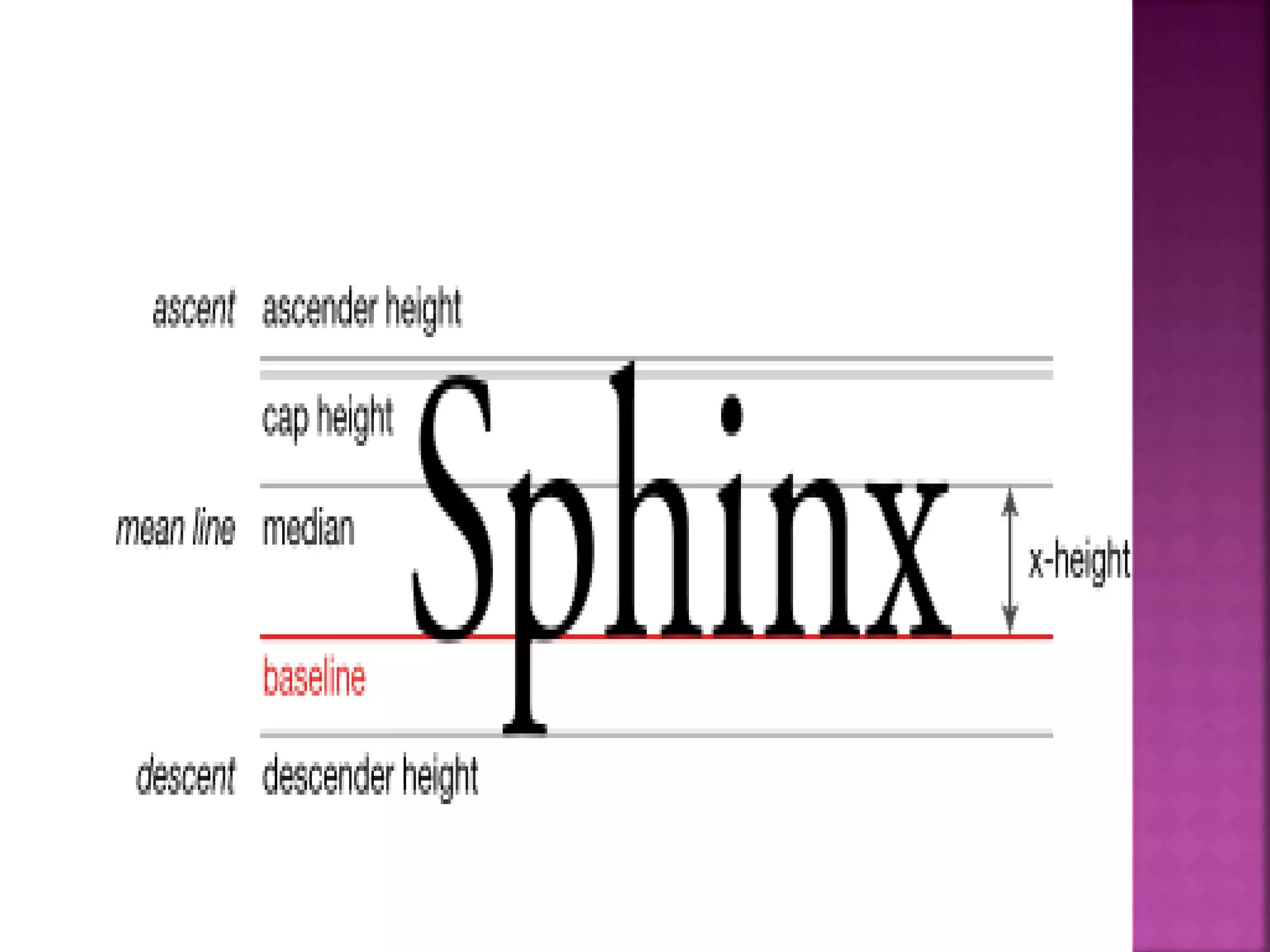
 The easier it is to identify individual letters, the
easier it should be to read a particular typeface.
 In the Latin alphabet, most of the letters use only
the middle part of the available vertical space.
 Only seven letters (b, d, f, k, h, l, t) stretch up to
the top of the available space. Only five (g, j, p, q,
y) stretch down to the bottom of the available space.
 Those 12 letters are said to have ascenders and
descenders, and even in most of them the middle
part is what distinguishes one letter from another.
 If the middle part is large and open. a typeface
should be easy to read.
 This middle portion is often called the x-height
because it is the height of that letter, and x is the
only letter with four serifs squarely in its upper and
low comers.
Thanks

Science of font

  • 1.
    Compiled by: Dr. ArpitaSharma Assistant Professor, Dept. of Agricultural Communication, College of Agriculture GBPUA&T, Pantnagar Email Id: sharmaarpita615@gmail.com AAC-640 Publication, Production and Editing
  • 2.
     The designand use of letterforms in printing is a special subject called typography.  In printing, letterforms are divided into typefaces, which are something like species in the natural sciences.  A typeface is an alphabet with specific characteristics by which it can be distinguished from any other typeface.
  • 6.
     Sans seriffonts have a reputation of being more modern, casual, informal and friendly that serif fonts.  Although serif fonts dominate the world of print particularly for long sections of body copy.  They are also the frequent choice of the publishers of children's books because the letters are easier to recognize.
  • 7.
     In print,small serifs can break up when they are reversed out of a dark color or photograph; sans serif type is almost always the better choice in this instance.  Sans serif fonts work well for short sections of text, such as credits and captions. When a project calls for very small type sizes, sans serif type is easier to read.
  • 8.
  • 9.
     Grotesque sansserif typefaces were the first ones that were commercially available.  They were designed in the 19th and early 20th centuries and had some awkward curves with little variation in stroke width.  Franklin Gothic  News Gothic  Akzidenz-Grotesk
  • 10.
     Neo-Grotesque fonts(also known as Realists or Transitionals) are more polished than the grotesque san serif typefaces.  This classification includes the most frequently used sans serif fonts.  Helvetica  Univers  Arial  Bell Centennial  Geneva  Impact
  • 11.
     Geometric sanserif fonts are built on geometric shapes rather than on early letterforms or calligraphy.  They display little or no stroke weight contrast.  Futura  Avenir  Bauhaus  Kabel  Avant Garde  Eurostile
  • 12.
     Humanist typefacesare identified by their calligraphic influence and uneven stroke weights and most of the fonts bearing this description are more legible choices than other san serif faces.  Gill Sans  Frutiger  Myriad  Optima  Trebuchet  Calibri
  • 13.
     Informal sansserif fonts are often used as novelties, so they are less frequently used than other sans serif fonts. They include  Eneas Expanded  Italo  Barrio  ABeeZee  Bahiana  High School USA Sans
  • 14.
     In typography,a typeface (also known as font family) is a set of one or more fonts each composed of glyphs that share common design features.  Each font of a typeface has a specific weight, style, condensation, width, slant, italicization, ornamentation, and designer or foundry (and formerly size, in metal fonts).
  • 15.
     Type ismeasured in special units.  The point (pt) is the smallest unit.  One point is 0.01384 of an inch or 0.3515 mm.  For practical purposes, we can say there are 72 points in an inch or 28.5 points in a centimeter.  Points are used to measure the size of type.  The size of a typeface is basically the distance from the highest point to the lowest point in the alphabet.
  • 16.
     Points arealso used to measure small distances in space between lines or characters in type.  The pica is the second principal measure of length. One pica equals 12 points.  Picas are used to measure the width of a line of type or the dimensions of a type area.  The text lines on this page are a maximum of 27 picas wide.  The area of text type is 27 × 54 picas.
  • 17.
     Picas andpoints are measures of linear distance.  An em is a measure of area.  It is not a fixed size.  It is an area equal to the square of the size of type being used.  A 10 pt em is 10 x 10 pt.  A 14 pt em is 14 x 14 pt.
  • 18.
     Ems areused to measure space in typesetting.  For example, the first line in a paragraph may be indented 1 or 2 ems. Or a paragraph quoted from another work may be indented 1 em on either side.
  • 19.
     It iswidely available on almost every form of typesetting equipment.  • It is available in all sizes, from 6 pt to 72 pt, and has a wide range of symbols and accents.  • It is easy to read.  • It is compact: a large number of words fit on a page.  • There are no fussy details. It does not call attention to itself.  • It is neutral. It can be used for many different kinds of messages.  • People are used to reading it. They feel comfortable with it.
  • 20.
     Helvetica isperhaps the most popular of several sans serif faces that look similar. If Helvetica is unavailable, typesetters may have Univers or Megaron.  Helvetica is popular for several reasons.  • It has a clean, modem look.  • It is easy to read, especially in short texts.  • It is compact.  • It or its look-alikes are widely available on all typesetting systems.  • It is available in a wide range of sizes and weights (regular, light, bold,  • It is especially good for lettering on charts, graphs, maps, and  • It is neutral in character, and therefore good for a variety of work.  • It works well with a variety of other typefaces.
  • 21.
     The easierit is to identify individual letters, the easier it should be to read a particular typeface.  In the Latin alphabet, most of the letters use only the middle part of the available vertical space.  Only seven letters (b, d, f, k, h, l, t) stretch up to the top of the available space. Only five (g, j, p, q, y) stretch down to the bottom of the available space.  Those 12 letters are said to have ascenders and descenders, and even in most of them the middle part is what distinguishes one letter from another.  If the middle part is large and open. a typeface should be easy to read.  This middle portion is often called the x-height because it is the height of that letter, and x is the only letter with four serifs squarely in its upper and low comers.
  • 23.