GROUP DISCUSSIONGROUP DISCUSSION
AAC-307
Communication Skills for Agricultural
Development
Dr. Arpita Sharma
Assistant professor,
Dept. of Agricultural Communication, College of
Agriculture
GBPUA&T, Pantnagar
Group
A collection of individuals who have regular
contact and frequent interaction, mutual
influence, common feeling of camaraderie,
and who work together to achieve a common
set of goals.
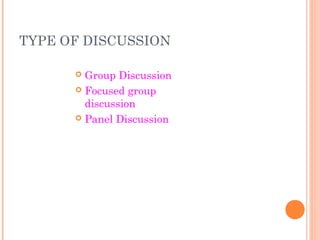
TYPE OF DISCUSSION
 Group Discussion
 Focused group
discussion
 Panel Discussion
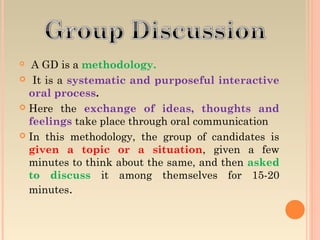
 A GD is a methodology.
 It is a systematic and purposeful interactive
oral process.
 Here the exchange of ideas, thoughts and
feelings take place through oral communication
 In this methodology, the group of candidates is
given a topic or a situation, given a few
minutes to think about the same, and then asked
to discuss it among themselves for 15-20
minutes.
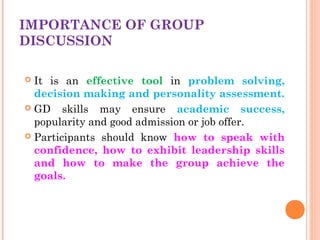
IMPORTANCE OF GROUP
DISCUSSION
 It is an effective tool in problem solving,
decision making and personality assessment.
 GD skills may ensure academic success,
popularity and good admission or job offer.
 Participants should know how to speak with
confidence, how to exhibit leadership skills
and how to make the group achieve the
goals.
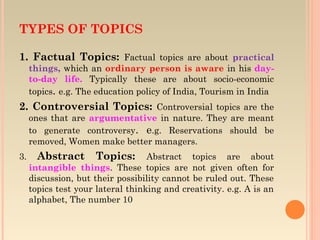
TYPES OF TOPICS
1. Factual Topics: Factual topics are about practical
things, which an ordinary person is aware in his day-
to-day life. Typically these are about socio-economic
topics. e.g. The education policy of India, Tourism in India
2. Controversial Topics: Controversial topics are the
ones that are argumentative in nature. They are meant
to generate controversy. e.g. Reservations should be
removed, Women make better managers.
3. Abstract Topics: Abstract topics are about
intangible things. These topics are not given often for
discussion, but their possibility cannot be ruled out. These
topics test your lateral thinking and creativity. e.g. A is an
alphabet, The number 10
FOUR MAJOR AREAS OF
EVALUATION IN
SELECTION GDS
[1] Subject knowledge: Participants must possess a
thorough understanding of the topic on which they are
supposed to speak.
[2] Oral communication skills: communication skills is
more important as without expression, the knowledge
is of no use.
[i] Listening skills: unless you listen, you cannot
contribute to the stated purpose of communication.
[ii] Clarity of thought and expression: Clarity is the art
of making yourself clear to the audience.
[iii] Apt Language: The flow of language must be smooth.
[iv] Proper non verbal clues: Non verbal clues include eye
contact, body movements, gestures and facial
expressions.
[3] Team management success in a GD depends
on how well you play the role of initiator,
information seeker, information giver,
procedure facilitator, opinion seeker,
opinion giver, clarifier, summarizer, social-
supporter, tension reliever, compromiser,
attacker, humorist and dominator.
[4] Leadership Skills: The success of any team
depends to a larger extent on its leader. The
panel evaluates a candidate’s personal skills
which allow him to prove himself as a natural
leader in the GD.
ROLE DURING GD
 Initiator
 Information seeker and giver
 Procedure facilitator
 Opinion seeker/giver
 Clarifier
 Summarizer
 Social supporter
 Harmonizer
 Tension reliever
 Energizer
 Attacker
 Dominator
PHASES IN A GD:
Initiation/introduction
The central group discussion
Summarization/conclusion
 It helps you to understand a subject more
deeply.
 It improves your ability to think critically.
 It helps in solving a particular problem.
 It helps the group to make a particular decision.
 It improves your listening skills.
 It increases your confidence in speaking.
 It can change your attitudes.
 Speak pleasantly and politely to the group.
 Respect the contribution of every speaker.
 Think about your contribution before you
speak.
 Try to stick to the discussion topic.
 Don't introduce irrelevant information.
 Be aware of your body language when you are
speaking.
DONT’S
 Don’t lose your temper.
 Don’t Shout. Use a moderate tone and
medium pitch.
 Don’t use too many gestures when you speak.
Gestures like finger pointing and table
thumping can appear aggressive.
 Don’t dominate the discussion.
 Don’t interrupt. Wait for a speaker to finish
what they are saying before you speak. 
 Communication Skills.
 Knowledge and ideas regarding a given
subject .
 Capability to co-ordinate and lead.
 Exchange of thoughts.
 Addressing the group as a whole.
 Thorough preparations.
Thanks

Group discussion

  • 1.
    GROUP DISCUSSIONGROUP DISCUSSION AAC-307 CommunicationSkills for Agricultural Development Dr. Arpita Sharma Assistant professor, Dept. of Agricultural Communication, College of Agriculture GBPUA&T, Pantnagar
  • 2.
    Group A collection ofindividuals who have regular contact and frequent interaction, mutual influence, common feeling of camaraderie, and who work together to achieve a common set of goals.
  • 3.
    TYPE OF DISCUSSION Group Discussion  Focused group discussion  Panel Discussion
  • 4.
     A GDis a methodology.  It is a systematic and purposeful interactive oral process.  Here the exchange of ideas, thoughts and feelings take place through oral communication  In this methodology, the group of candidates is given a topic or a situation, given a few minutes to think about the same, and then asked to discuss it among themselves for 15-20 minutes.
  • 5.
    IMPORTANCE OF GROUP DISCUSSION It is an effective tool in problem solving, decision making and personality assessment.  GD skills may ensure academic success, popularity and good admission or job offer.  Participants should know how to speak with confidence, how to exhibit leadership skills and how to make the group achieve the goals.
  • 6.
    TYPES OF TOPICS 1.Factual Topics: Factual topics are about practical things, which an ordinary person is aware in his day- to-day life. Typically these are about socio-economic topics. e.g. The education policy of India, Tourism in India 2. Controversial Topics: Controversial topics are the ones that are argumentative in nature. They are meant to generate controversy. e.g. Reservations should be removed, Women make better managers. 3. Abstract Topics: Abstract topics are about intangible things. These topics are not given often for discussion, but their possibility cannot be ruled out. These topics test your lateral thinking and creativity. e.g. A is an alphabet, The number 10
  • 7.
    FOUR MAJOR AREASOF EVALUATION IN SELECTION GDS [1] Subject knowledge: Participants must possess a thorough understanding of the topic on which they are supposed to speak. [2] Oral communication skills: communication skills is more important as without expression, the knowledge is of no use. [i] Listening skills: unless you listen, you cannot contribute to the stated purpose of communication. [ii] Clarity of thought and expression: Clarity is the art of making yourself clear to the audience. [iii] Apt Language: The flow of language must be smooth. [iv] Proper non verbal clues: Non verbal clues include eye contact, body movements, gestures and facial expressions.
  • 8.
    [3] Team managementsuccess in a GD depends on how well you play the role of initiator, information seeker, information giver, procedure facilitator, opinion seeker, opinion giver, clarifier, summarizer, social- supporter, tension reliever, compromiser, attacker, humorist and dominator. [4] Leadership Skills: The success of any team depends to a larger extent on its leader. The panel evaluates a candidate’s personal skills which allow him to prove himself as a natural leader in the GD.
  • 9.
    ROLE DURING GD Initiator  Information seeker and giver  Procedure facilitator  Opinion seeker/giver  Clarifier  Summarizer  Social supporter  Harmonizer  Tension reliever  Energizer  Attacker  Dominator
  • 10.
    PHASES IN AGD: Initiation/introduction The central group discussion Summarization/conclusion
  • 11.
     It helpsyou to understand a subject more deeply.  It improves your ability to think critically.  It helps in solving a particular problem.  It helps the group to make a particular decision.  It improves your listening skills.  It increases your confidence in speaking.  It can change your attitudes.
  • 12.
     Speak pleasantlyand politely to the group.  Respect the contribution of every speaker.  Think about your contribution before you speak.  Try to stick to the discussion topic.  Don't introduce irrelevant information.  Be aware of your body language when you are speaking.
  • 13.
    DONT’S  Don’t loseyour temper.  Don’t Shout. Use a moderate tone and medium pitch.  Don’t use too many gestures when you speak. Gestures like finger pointing and table thumping can appear aggressive.  Don’t dominate the discussion.  Don’t interrupt. Wait for a speaker to finish what they are saying before you speak. 
  • 14.
     Communication Skills. Knowledge and ideas regarding a given subject .  Capability to co-ordinate and lead.  Exchange of thoughts.  Addressing the group as a whole.  Thorough preparations.
  • 15.